
• Latest
  • Trending
  • All
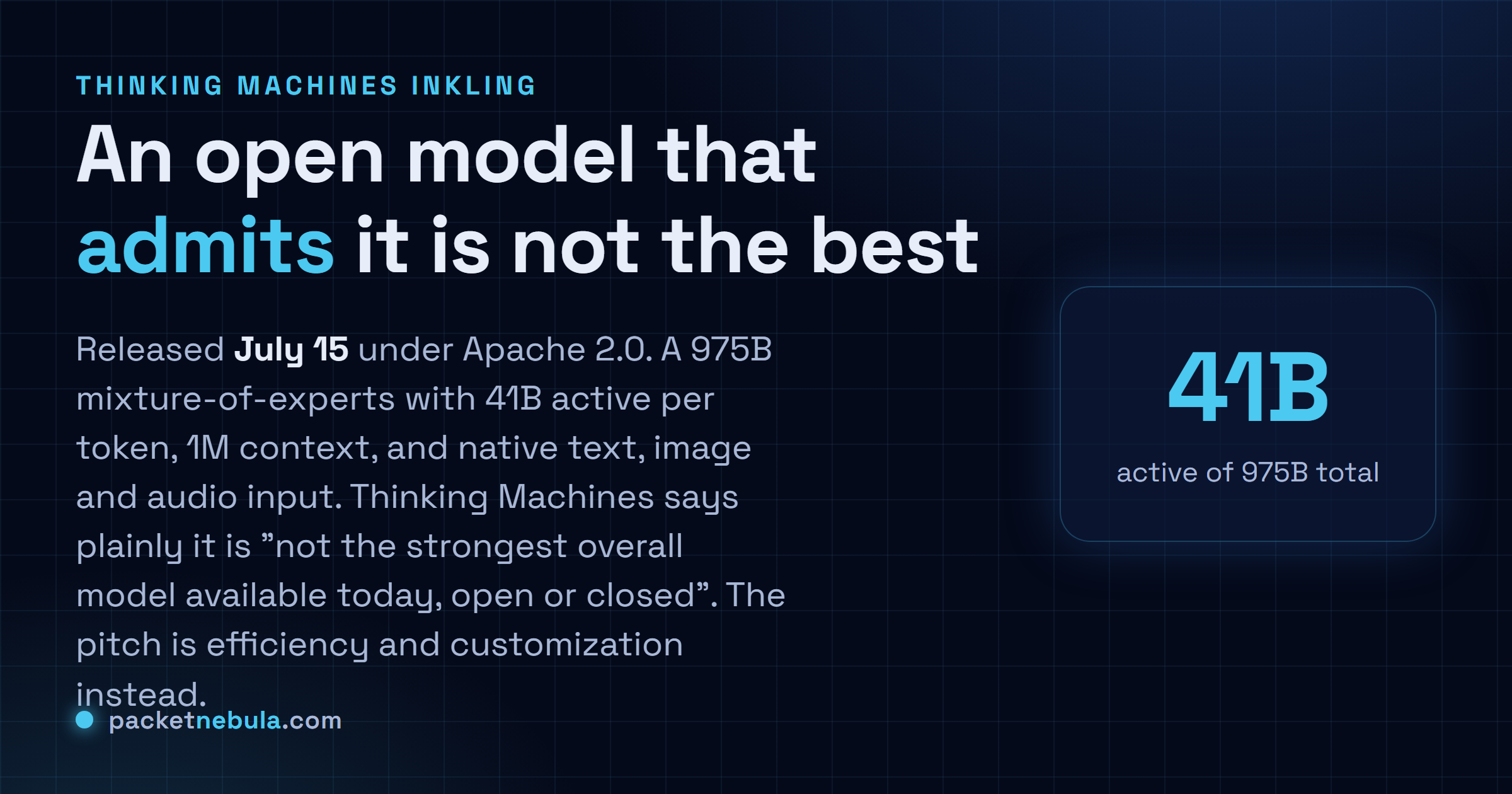
Answer card: Thinking Machines released Inkling on July 15 under Apache 2.0, a 975B mixture-of-experts model with 41B active parameters per token and a 1M token context window, which the lab says is not the strongest model available today.

Inkling is a 975B open model that loses benchmarks on purpose

3 September 2026
The official xAI announcement card for Grok 4.7, white type on a dark grey and navy gradient.

Grok 4.7 keeps $2 and $6, and its gains over 4.6 are xhigh versus high

22 September 2026
Answer card stating that Qwen-Image-2.1, released on 20 September 2026, ships open weights with a 7 billion parameter diffusion transformer, a Qwen3-VL 8B text encoder and an RGBA VAE totalling about 33 gigabytes in BF16, under the Qwen Research License that limits use to research or evaluation and requires a separate commercial licence, unlike the Apache 2.0 licence of Qwen-Image 1.0.

Qwen-Image-2.1 brings the weights back, but not the Apache licence

21 September 2026
Answer card stating that Ternary Bonsai 2 27B, released by PrismML on 17 September 2026 under Apache 2.0, packs Qwen3.8 27B into 5.95 gigabytes at 1.72 bits per weight, keeps 98.2 percent of the 14-benchmark average, about 75 percent on SWE-bench Verified and Terminal-Bench 2.1, and needs PrismML's llama.cpp fork to run.

Does Bonsai 2 27B really keep 98% of Qwen3.8 in 5.95 GB?

20 September 2026
Answer card stating that Jev 1.13 from TypeSafe AI is a decision model in early access since 15 September 2026 that returns typed probabilities instead of text, priced at 42 dollars per billion input tokens with output tokens free, answering in 70 to 500 milliseconds, with a 64K token request budget, text input only, and a documented list of things it does badly, including counting and dates.

Jev 1.13 bills $42 a billion tokens, and it can’t count

19 September 2026
Answer card stating that Qwen3.8-Omni-Flash launched on 17 September 2026 as an API only model on Alibaba Cloud Model Studio, taking text, images, audio and video in a 1M token context and returning text only, priced at 0.15 dollars per million input tokens for every modality and 0.47 dollars per million output tokens in the international regions, with no open weights published and the Qwen-Live Harness GitHub repository returning 404.

Qwen3.8-Omni-Flash bills audio at $0.15 and ships no weights

18 September 2026
Answer card stating that on 15 September 2026 AWS said it is unable to restore access to resources and data hosted exclusively in the Middle East Bahrain region me-south-1 and in the mec1-az2 zone of the UAE region, because the damage spanned multiple Availability Zones and exceeded what multi-AZ services are designed to withstand.

AWS can’t restore me-south-1, six months after the drone strikes

17 September 2026
Answer card stating that Google released Gemini 3.8 Live and Gemini 3.8 Live Extended Thinking on 15 September 2026 at 3 dollars per million audio input tokens and 12 dollars out, that the thinking model requires asynchronous tools, and that Artificial Analysis scores it 82.6 on its Speech to Speech Quality Index.

Gemini 3.8 Live Extended Thinking rejects any tool that blocks

16 September 2026
Answer card summarising the Atria Dawn Preview release: 744B GLM-5.2 base, MIT licence, 1.5 TB BF16 and 756 GB FP8 checkpoints, 256K context, top on five of sixteen benchmark rows and trailing on SWE-bench Pro.

Atria Dawn Preview is 744B under MIT, and the BF16 weighs 1.5 TB

15 September 2026
Answer card stating that OpenAI released the Agents API in public beta on 10 September 2026 with no separate fee, billed through model tokens, tool calls and hosted sandbox time, with a choice of OpenAI hosted, self hosted or partner sandboxes, US only data residency and no Zero Data Retention support.

OpenAI’s Agents API has no fee, no ZDR and a one hour sandbox clock

14 September 2026
Answer card: Sakana Fugu Max at $2 and $6 per million tokens, Fugu Ultra v2 unchanged at $5 and $30, and Sakana saying Ultra v2 scores without Fable 5 or GPT-6 Astra in its pool.

Fugu Max costs $2 and $6 while Fugu Ultra v2 runs without Fable 5

13 September 2026
Answer card stating that DeepSeek released DeepSeek-V4.1-Flash on 10 September 2026 as a 552 billion parameter mixture of experts model with a new causal encoder decoder architecture that activates 8 billion parameters on input and 16 billion on output, with native vision, a one million token context and MIT licensed weights, that the API model name is now deepseek-flash at 0.15 dollars per million input tokens and 0.60 dollars per million output tokens off peak, and that DeepSeek announced V4 Pro would be routed to V4.1-Flash from 14 September and reversed that on 11 September.

DeepSeek V4.1-Flash arrived, and the V4 Pro retirement lasted a day

12 September 2026
Answer card stating that Cognition released SWE-2 on 10 September 2026, a coding model post-trained from Kimi K3, scoring 50.0 percent on FrontierCode 1.1 Main against 50.9 percent for Claude Fable 5.1 and 27.3 percent on Terminal-Bench 4 against 55.8 percent, available only inside Devin.

SWE-2 trails Fable 5.1 by one point, and by 28 on Terminal-Bench 4

11 September 2026
  • About
  • Contact
  • Privacy
  • Legal
Wednesday, September 23, 2026
  • Login
Packet Nebula
  • Home
  • Articles
    • Security
    • Network
    • Dev
    • Sysadmin
    • SEO
    • Email & DNS
  • Tools
    • Network tools: free, fast, no signup
    • Security tools: free, fast, no signup
    • Developer tools: free, fast, no signup
    • Sysadmin tools: free, fast, no signup
    • SEO tools: free, fast, no signup
    • Email & DNS tools: free, fast, no signup
  • Download
  • About
No Result
View All Result
Packet Nebula
No Result
View All Result
Home Dev

Inkling is a 975B open model that loses benchmarks on purpose

by stephane
3 September 2026
in Dev
0
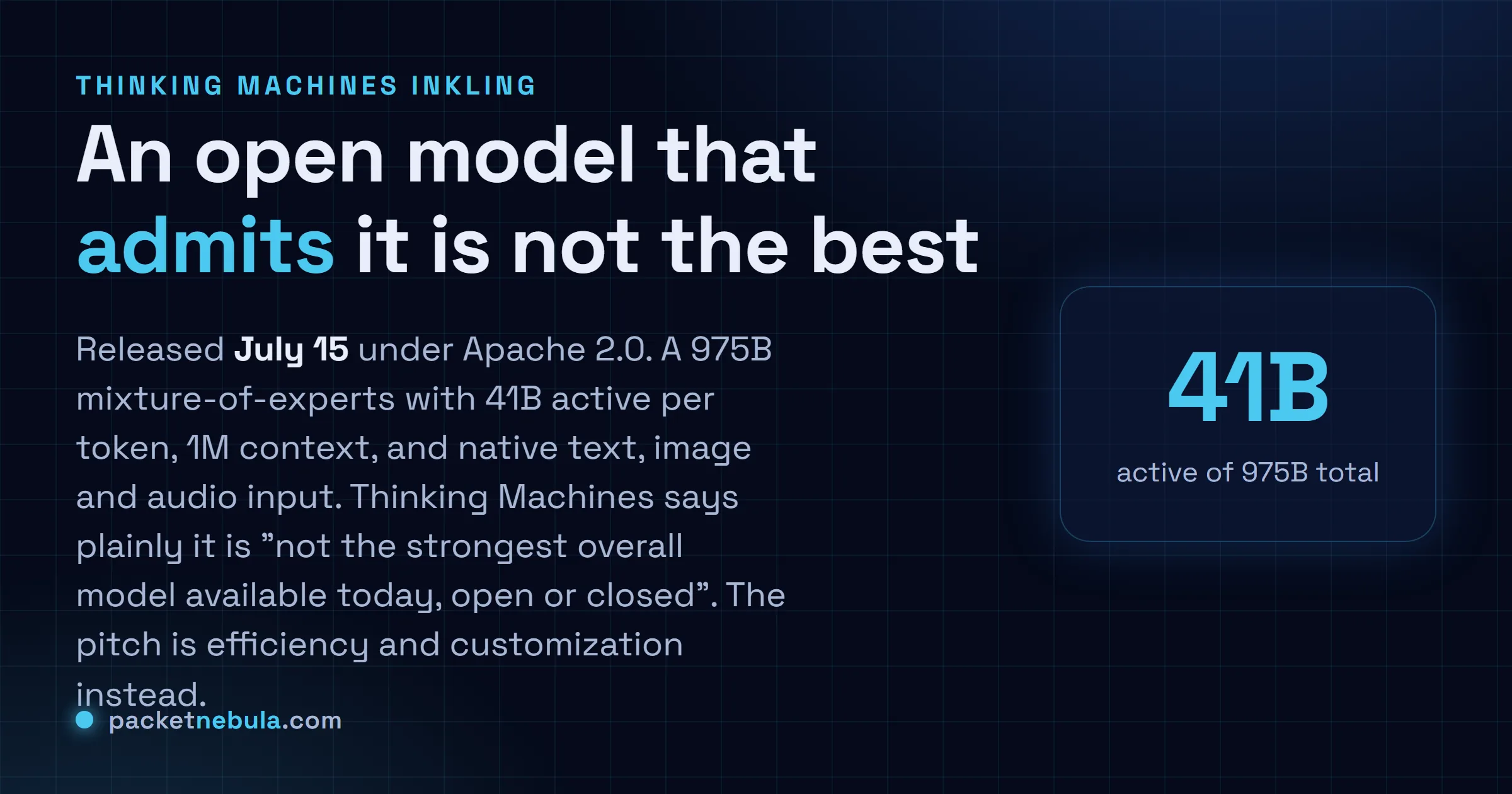
Answer card: Thinking Machines released Inkling on July 15 under Apache 2.0, a 975B mixture-of-experts model with 41B active parameters per token and a 1M token context window, which the lab says is not the strongest model available today.
492
SHARES
1.4k
VIEWS
Share on FacebookShare on Twitter

Mira Murati's lab spent about nine months in near silence, and on July 15 it shipped weights instead of a waitlist. Inkling is a 975B mixture-of-experts model under Apache 2.0, 41B active per token, and Thinking Machines says out loud what most labs bury in a footnote: it isn't the strongest model available today, open or closed. We went hunting for the catch. Found an honest pitch instead. The bet is that a model you can bend beats a model that tops a leaderboard, and the numbers back the modesty. On Terminal Bench 2.1 it posts 63.8 while GLM 5.2 sits at 82.7. So why would you look twice? Because it gets there on roughly a third of the tokens Nemotron 3 Ultra burns, and because you get a thinking-effort dial nobody else hands you.

The short answer

Thinking Machines Lab shipped Inkling, a 975B mixture-of-experts model with 41B active parameters, 1M context, and native text, image and audio input. The lab openly says it isn’t the best model out there. It’s built to be a customization base: Apache 2.0 weights, a thinking-effort dial, and roughly a third of the token spend of Nemotron 3 Ultra for the same terminal score.
975B41B active per token
Apache 2.0weights, commercial ok
2 TBVRAM for BF16
Answer card: Thinking Machines released Inkling on July 15 under Apache 2.0, a 975B mixture-of-experts model with 41B active parameters per token and 1M context, which the lab says is not the strongest model available today.
The one-card version. Enormous on disk, modest in its claims, and genuinely open.

What the lab actually shipped

Weights, a license, and an unusual amount of candour. On July 15 Thinking Machines put Inkling on Hugging Face under Apache 2.0, which means you can download it, fine-tune it and ship it commercially without asking anyone. No research-only clause. No gate.

The shape: a 66-layer decoder-only transformer with a sparse mixture-of-experts backbone. Each MoE layer holds 256 routed experts plus 2 shared ones, and a sigmoid router sends every token to 6 of them. That’s how you get 975B total parameters but only 41B lighting up per token. It’s pretrained on 45 trillion tokens spanning text, images, audio and video, with a context window up to 1M. Some of the design choices are quietly contrarian, like relative positional embeddings instead of RoPE, and short convolutions after the key and value projections.

Input is multimodal. Output isn’t. It reads images at 40px and up, and audio as dMel spectrograms at 16kHz for up to 20 minutes, then it writes text. That’s it. Worth knowing before you plan a product around it.

The sentence that made us pay attention

From the lab’s own announcement: Inkling “is not the strongest overall model available today, open or closed.”

Labs don’t write that. We’ve read a lot of launch posts where a model wins six cherry-picked benchmarks and the losses never surface, so seeing the weakness stated in the second paragraph is disarming. Honestly, it’s the most credible thing about the release.

And it’s true. Here’s where it actually lands on agentic terminal work.
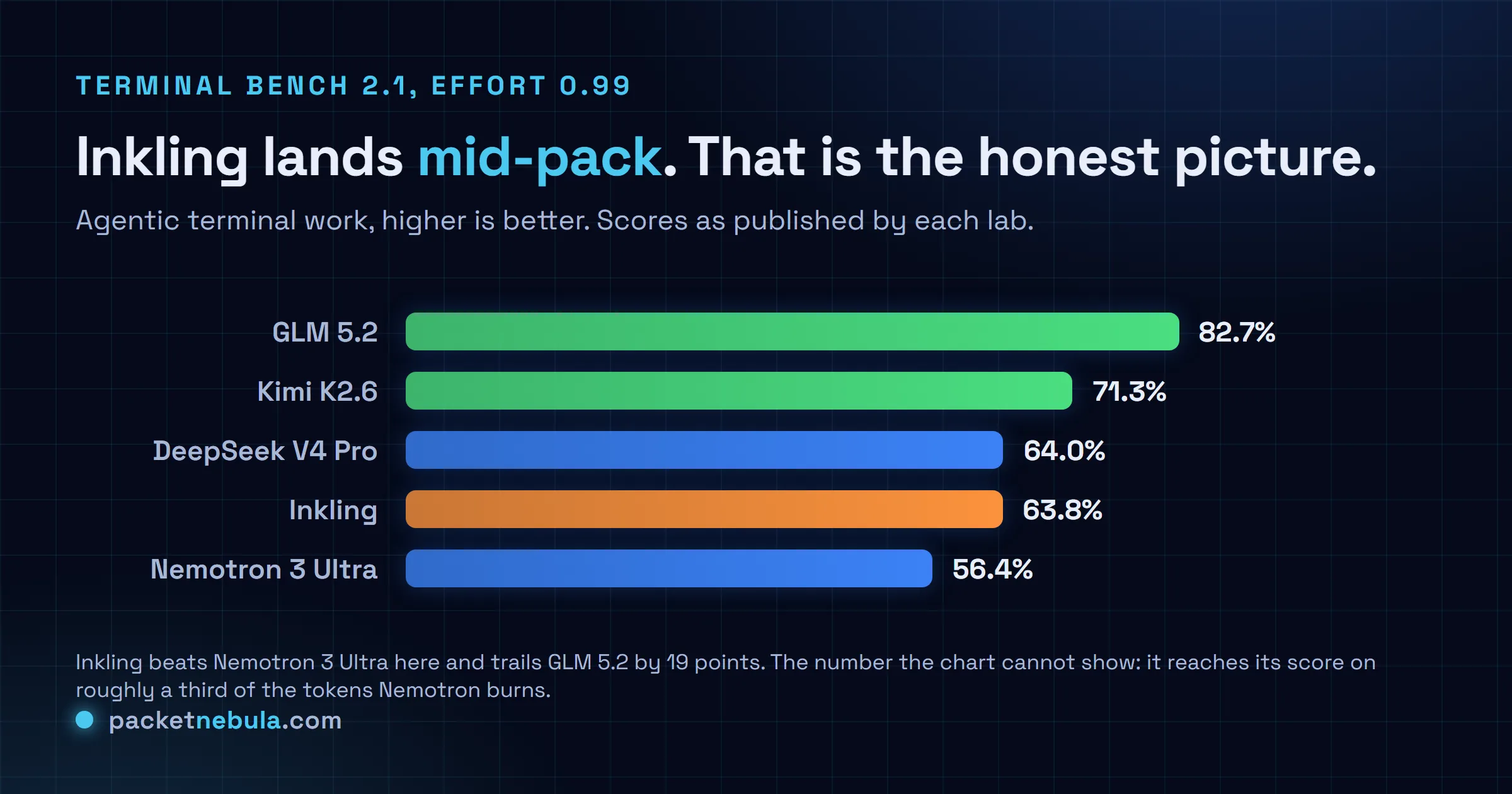
Bar chart of Terminal Bench 2.1 scores at effort 0.99: GLM 5.2 at 82.7 percent, Kimi K2.6 at 71.3 percent, DeepSeek V4 Pro at 64.0 percent, Inkling at 63.8 percent, and Nemotron 3 Ultra at 56.4 percent.
Fourth of five. The lab published this comparison itself rather than hiding it.

The rest of the table rhymes. On Humanity’s Last Exam it takes 29.7% while GLM 5.2 posts 40.1%. SWEBench Verified gives it 77.6% against roughly 80% for Kimi K2.6, GLM 5.2 and DeepSeek V4 Pro. SimpleQA Verified is the ugly one: 43.9% versus DeepSeek’s 57.0%, which is a real gap on factual recall.

Two places it does win. It beats Nvidia’s Nemotron 3 Ultra almost everywhere, and it tops that group on FORTRESS Adversarial at 78.0% with StrongREJECT at 98.6%. If you’re shipping something public-facing, that second one isn’t nothing.

The dial

Here’s the part we’d actually use. Thinking effort is exposed as a number from 0.2 to 0.99, trained in by varying system messages and charging a per-token cost during reinforcement learning. In transformers it shows up as a reasoning_effort argument with named levels.

So instead of keeping a cheap model and an expensive model behind a router you maintain, you keep one model and turn a knob per call. Simple classification at 0.2. Hard debugging at 0.99. Same weights, same endpoint.

That feeds the one benchmark Inkling genuinely wins: token spend. It matches Nemotron 3 Ultra’s Terminal Bench score on about a third of the tokens. For something you invoke a few million times a month, that’s the number on the invoice, and it beats a leaderboard rank you’ll never notice in production. A Bridgewater collaboration reportedly hit 84.7% on financial reasoning at roughly a fourteenth of the running cost of the proprietary models it was measured against. That last figure comes via reporting, not a paper, so we’d hold it loosely.

The hardware bill

Open doesn’t mean local. It never does at this size.
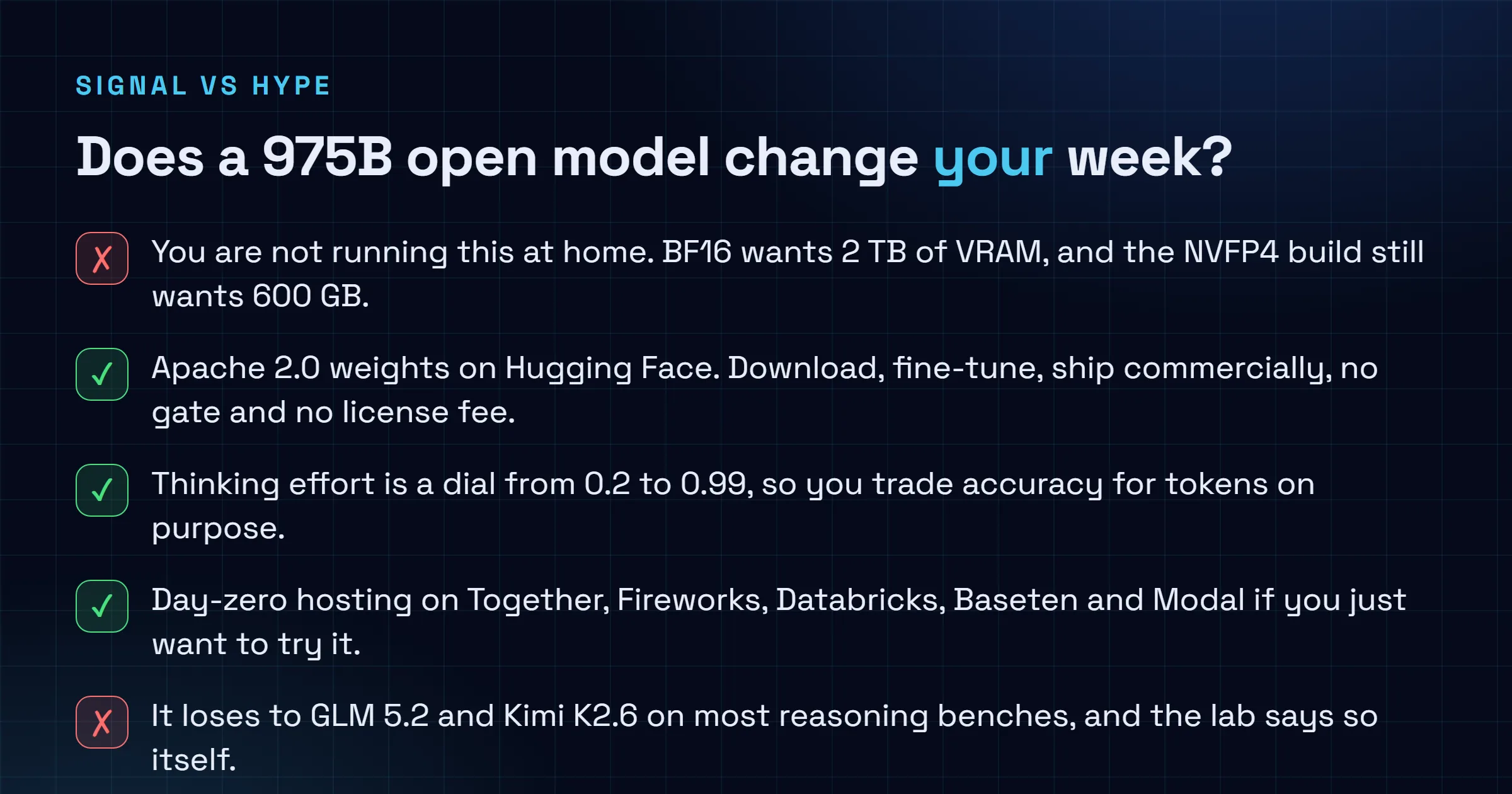
Checklist: you cannot run Inkling at home since BF16 needs 2 TB of VRAM and NVFP4 needs 600 GB, but the Apache 2.0 weights are free to fine-tune and ship, thinking effort is adjustable from 0.2 to 0.99, day-zero hosting exists on Together, Fireworks, Databricks, Baseten and Modal, while it loses most reasoning benchmarks to GLM 5.2 and Kimi K2.6 and outputs text only.
Signal against hype. The license is real, the hardware is the wall.

BF16 wants 2 TB of aggregated VRAM, which is 8 B300s or 16 H200s. The NVFP4 checkpoint cuts it to about 600 GB, so 4 B300s or 8 H200s. That’s the same wall we hit with Tencent’s Hy3, and if you want weights that run on metal you already own, Qwen 3.7 offline remains the sane answer. Runtimes are covered though: SGLang, vLLM with an OpenAI-compatible server, llama.cpp via Unsloth, plus hosted day-zero endpoints on Together AI, Fireworks, Modal, Databricks and Baseten. There’s a free playground if you just want to poke it.

Who this is for

Not you, if you want the best answer to a hard question. Get an API key for something else.

It’s for teams who plan to fine-tune. The whole strategy points at Tinker, the lab’s customization platform and its actual revenue model, and the thesis is that a model an organization adapts for itself will beat a generalist that serves everyone. Murati got here in about nine months with roughly 200 people, which is genuinely fast.

One wrinkle worth flagging: some of Inkling’s early post-training data was generated with help from other open-weight models, Moonshot’s Kimi K2.5 among them. The lab says future models will be fully self-contained. It’s not a scandal, but it’s a funny look for a lab selling independence from other people’s models.

The honest read

I like this release more than its benchmark table deserves, and I’m aware that’s a soft reason. A permissive license on a 975B multimodal model is a real gift, the effort dial is the kind of control that saves money quietly every day, and a lab that publishes the charts it loses has earned a little trust.

What we wouldn’t do is treat “open” as “cheap”. You’re still renting eight big GPUs or paying someone who did. And if nobody who downloads Apache 2.0 weights owes them a cent, the Tinker bet has to work. Pull it up in the playground this week, throw the prompts that actually matter to you at it, then check what it cost in tokens. That comparison is the only one that pays your bills.

Sources: Thinking Machines Lab’s Inkling announcement and official model card, with reporting and independent specs via TechCrunch and MarkTechPost, July 2026. Benchmark figures are as published by each lab and are not independently reproduced. The Bridgewater cost comparison comes from reporting rather than a published paper.

Frequently asked questions

What is Thinking Machines Inkling?

Inkling is the first in-house model from Thinking Machines Lab, the startup founded by former OpenAI CTO Mira Murati, released July 15, 2026. It is a 975B-parameter sparse mixture-of-experts transformer with 41B active parameters per token, 66 layers, a context window up to 1M tokens, and Apache 2.0 open weights. It takes text, images and audio as input, and returns text only.

Can I run Inkling on my own machine?

Not on a desktop. Thinking Machines lists a 2 TB aggregated VRAM minimum for the BF16 weights, roughly 8 Nvidia B300s or 16 H200s. The NVFP4 quantized checkpoint drops that to about 600 GB, so 4 B300s or 8 H200s. For a single-GPU box, a smaller open model is the realistic choice.

Is Inkling better than GLM 5.2 or Kimi K2.6?

Mostly no, and the lab does not claim otherwise. On Thinking Machines' own published table, Inkling scores 63.8% on Terminal Bench 2.1 against 82.7% for GLM 5.2 and 71.3% for Kimi K2.6, and it trails both on Humanity's Last Exam and GPQA Diamond. It does beat Nvidia's Nemotron 3 Ultra across most of that table, and it leads on FORTRESS Adversarial at 78.0%.

What is controllable thinking effort?

It is a dial, from 0.2 to 0.99, that sets how many tokens the model spends reasoning before it answers. Thinking Machines trained it by varying system messages and applying a per-token cost during reinforcement learning. The transformers library exposes it as a reasoning_effort argument with named levels, so you trade accuracy against latency and cost per call rather than swapping models.

How much does Inkling cost?

The weights are free under Apache 2.0, with no commercial gate. If you would rather not own the metal, day-zero hosted inference is available through Together AI, Fireworks, Modal, Databricks and Baseten at their own rates. Fine-tuning runs on the lab's Tinker platform, which offers 64K and 256K context options at a 50% discount, and Tinker is where the company actually expects to make money.

Tags: aillmnewsopen-sourceself-hostingthinking-machines
Share197Tweet123
stephane

stephane

  • Trending
  • Comments
  • Latest
Answer card: Proton Lumo 2.0 is private by policy, not by locality. Saved history is locked so even Proton cannot read it, but the prompt is decrypted on a Proton EU server to answer it, then forgotten.

Proton Lumo 2.0 review: how private is it, really?

3 September 2026
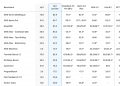
The Agentic Coding section of the official Hy4 preview benchmark appendix published by Tencent, a table comparing Hy3 and Hy4 preview against DeepSeek V4 Pro 0813, Qwen 3.8 Max, GLM 5.3, Kimi K3, GPT 5.6 Sol and Claude Opus 5 across SWE-bench Multilingual, SWE-bench Pro, DeepSWE, three SWE Atlas tasks, SWE-Marathon, Terminal-Bench 2.1, NL2Repo-Bench, CyberGym, ProgramBench, PostTrainBench and Harbor-Index.

Tencent’s 770B Hy4 tops one benchmark row in 46

3 September 2026
Answer card: Qwen 3.7 Max is API-only and cannot run locally yet; the open Qwen models (Qwen 3.6 27B, qwen3:8b to 32b) run offline via Ollama.

Qwen 3.7 local: what you can actually run offline

22 June 2026
Answer card: JWTs are not encrypted, anyone can read them; the signature proves who issued the token, not who may read it.

Are JWTs encrypted? No, and the difference will bite you

0
Answer card: a random 8 character password falls in under 2 hours offline, while 16 random characters hold for 1.4 trillion years at the same speed.

How long does it take to crack a password in 2026?

0
Answer card: three DNS records decide if your mail lands or bounces; SPF lists allowed senders, DKIM signs messages, DMARC sets the failure policy.

SPF, DKIM and DMARC explained: the records your email needs

0
The official xAI announcement card for Grok 4.7, white type on a dark grey and navy gradient.

Grok 4.7 keeps $2 and $6, and its gains over 4.6 are xhigh versus high

22 September 2026
Answer card stating that Qwen-Image-2.1, released on 20 September 2026, ships open weights with a 7 billion parameter diffusion transformer, a Qwen3-VL 8B text encoder and an RGBA VAE totalling about 33 gigabytes in BF16, under the Qwen Research License that limits use to research or evaluation and requires a separate commercial licence, unlike the Apache 2.0 licence of Qwen-Image 1.0.

Qwen-Image-2.1 brings the weights back, but not the Apache licence

21 September 2026
Answer card stating that Ternary Bonsai 2 27B, released by PrismML on 17 September 2026 under Apache 2.0, packs Qwen3.8 27B into 5.95 gigabytes at 1.72 bits per weight, keeps 98.2 percent of the 14-benchmark average, about 75 percent on SWE-bench Verified and Terminal-Bench 2.1, and needs PrismML's llama.cpp fork to run.

Does Bonsai 2 27B really keep 98% of Qwen3.8 in 5.95 GB?

20 September 2026
  • About
  • Contact
  • Privacy
  • Legal

Copyright © 2026 Stephane Cardon.

Welcome Back!

Login to your account below

Forgotten Password?

Retrieve your password

Please enter your username or email address to reset your password.

Log In
No Result
View All Result
  • Home
  • Articles
    • Security
    • Network
    • Dev
    • Sysadmin
    • SEO
    • Email & DNS
  • Tools
    • Network tools: free, fast, no signup
    • Security tools: free, fast, no signup
    • Developer tools: free, fast, no signup
    • Sysadmin tools: free, fast, no signup
    • SEO tools: free, fast, no signup
    • Email & DNS tools: free, fast, no signup
  • Download
  • About

Copyright © 2026 Stephane Cardon.