
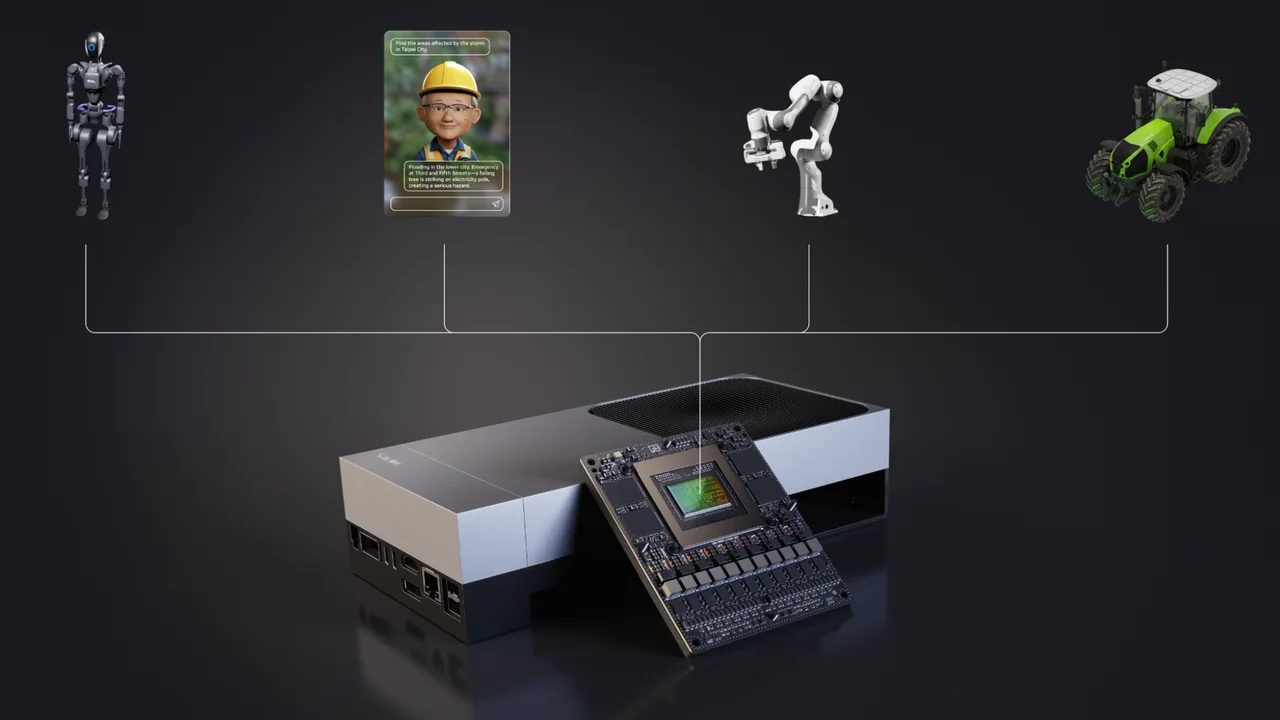
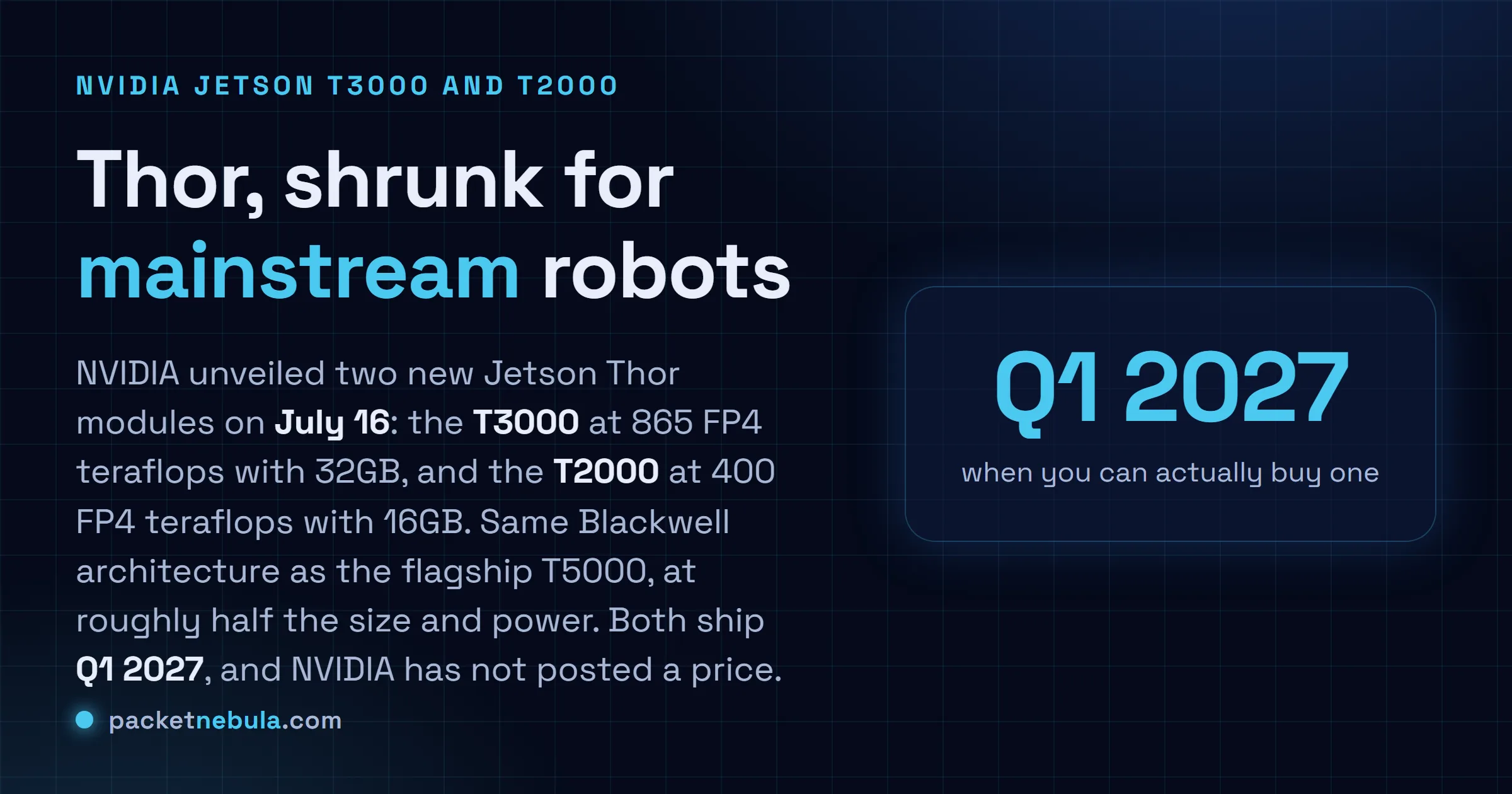
So Jensen Huang stands on a stage in Japan holding a module smaller than a paperback, and that's the actual news. On July 16 NVIDIA added two chips to its Jetson Thor line, the T3000 and the T2000, and they're the cheap seats. Same Blackwell architecture as last year's flagship T5000, scaled down hard. The T2000 does 400 FP4 teraflops in 16GB of memory. The T3000 doubles that to 865 in 32GB, and both drop to about half the size and power of the top module. The pitch is putting Thor-class robot brains into machines that could never justify a 3,499 dollar dev kit. Here's the catch we'd lead with, though. Neither one ships until the first quarter of 2027, and NVIDIA hasn't posted a price. So this is a roadmap you can plan against, not a module you can order tonight.
The short answer
NVIDIA added two cheaper, smaller modules to its Jetson Thor robotics line, the T3000 and the T2000. Same Blackwell architecture as the flagship, roughly half the size and power. They target robots that could never fit the top module. The near-term effect on your work is zero: nothing ships before Q1 2027, and there’s no price yet. The real signal is Thor-class compute heading downmarket.
What NVIDIA actually shipped (on paper)
Let’s be precise about what got announced, because “new Jetson” covers a lot of ground. This isn’t a new architecture. It’s the same Thor generation and the same Blackwell GPU that landed in the T5000 and T4000 modules back in August 2025, cut down into two smaller parts. NVIDIA is calling them the mainstream tier.
Image: NVIDIA
Here are the numbers that matter. The T3000 runs a 1536-core Blackwell GPU paired with an 8-core Arm Neoverse-V3AE CPU, 32GB of LPDDR5X at 273 GB/s, and 25GbE networking, for 865 FP4 teraflops. The T2000 steps down to a 1024-core GPU, a 6-core CPU, 16GB of LPDDR5X at 137 GB/s, and dual 10GbE, landing at 400 FP4 teraflops. Both come in a module roughly half the physical size of the T4000 and T5000, and NVIDIA says the T3000 draws about half the power of the flagship.
The headline claim is the interesting one. NVIDIA says the T3000 reaches similar inference performance to the T5000 on multimodal workloads, despite having a fraction of the raw teraflops and a quarter of the memory. That’s plausible for the right models. It’s also NVIDIA’s own claim with no benchmark table attached yet, so file it under “promising, unverified.”
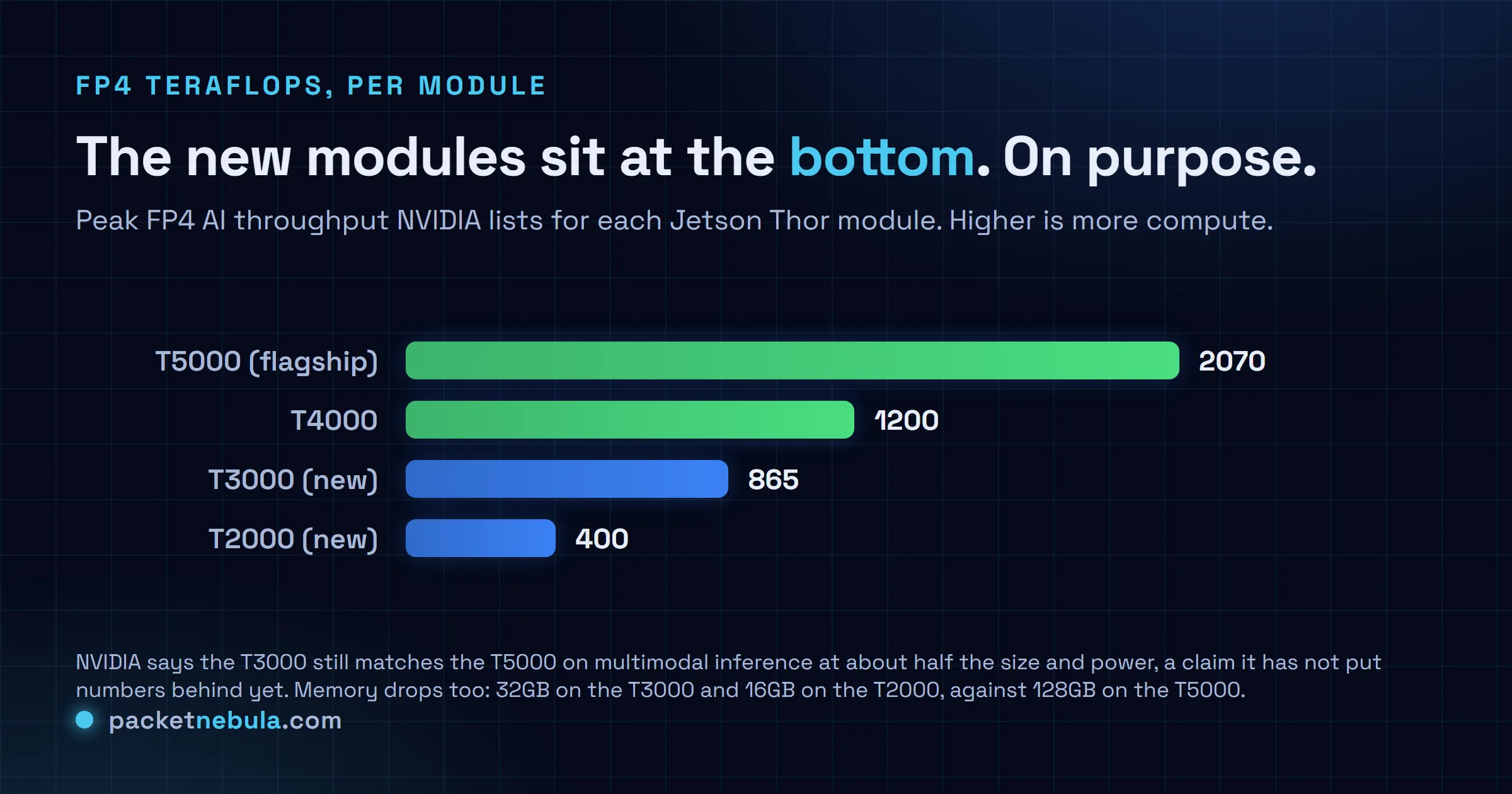
Look at where the new parts fall and the strategy reads itself. On raw FP4 throughput they’re the bottom of the range. That’s the whole design goal. NVIDIA says the Jetson portfolio now spans from about 70 TOPS on the old Orin Nano up to 2,000 teraflops on the T5000, and the T2000 and T3000 fill the fat middle where most actual robots live. Not every autonomous mobile robot or inspection drone needs a 128GB, 2070-teraflop brain. Most of them, can’t fit one or power it.
The catch: Q1 2027, and no price
Now the part the excitement tends to skip. Neither module ships until the first quarter of 2027. This is a preview, not a product on a shelf. And NVIDIA didn’t publish a price for either the T3000 or the T2000, which is a strange gap for a launch whose entire story is “cheaper.”
That price silence matters more than it looks. The word “mainstream” is doing heavy lifting in every writeup, this one included, and it’s a promise about cost that NVIDIA hasn’t put a number on. The T5000-class dev kit runs 3,499 dollars today. A mainstream module needs to land well under that to mean anything to the robotics shops NVIDIA is courting. Until we see the sticker, “affordable Thor” is a direction, not a fact.
There’s a bridge for builders, at least. NVIDIA says you can use the existing Jetson AGX Thor developer kit, on sale since last summer, to emulate the T2000 and T3000 and start writing software now. The whole Jetson line shares one CUDA and software stack, so the work isn’t wasted while you wait out the calendar. If you’re prototyping a robot that ships in 2027 anyway, that lines up.
What it changes for you
Depends who you are, and the honest answer for most readers is “not much this year.”
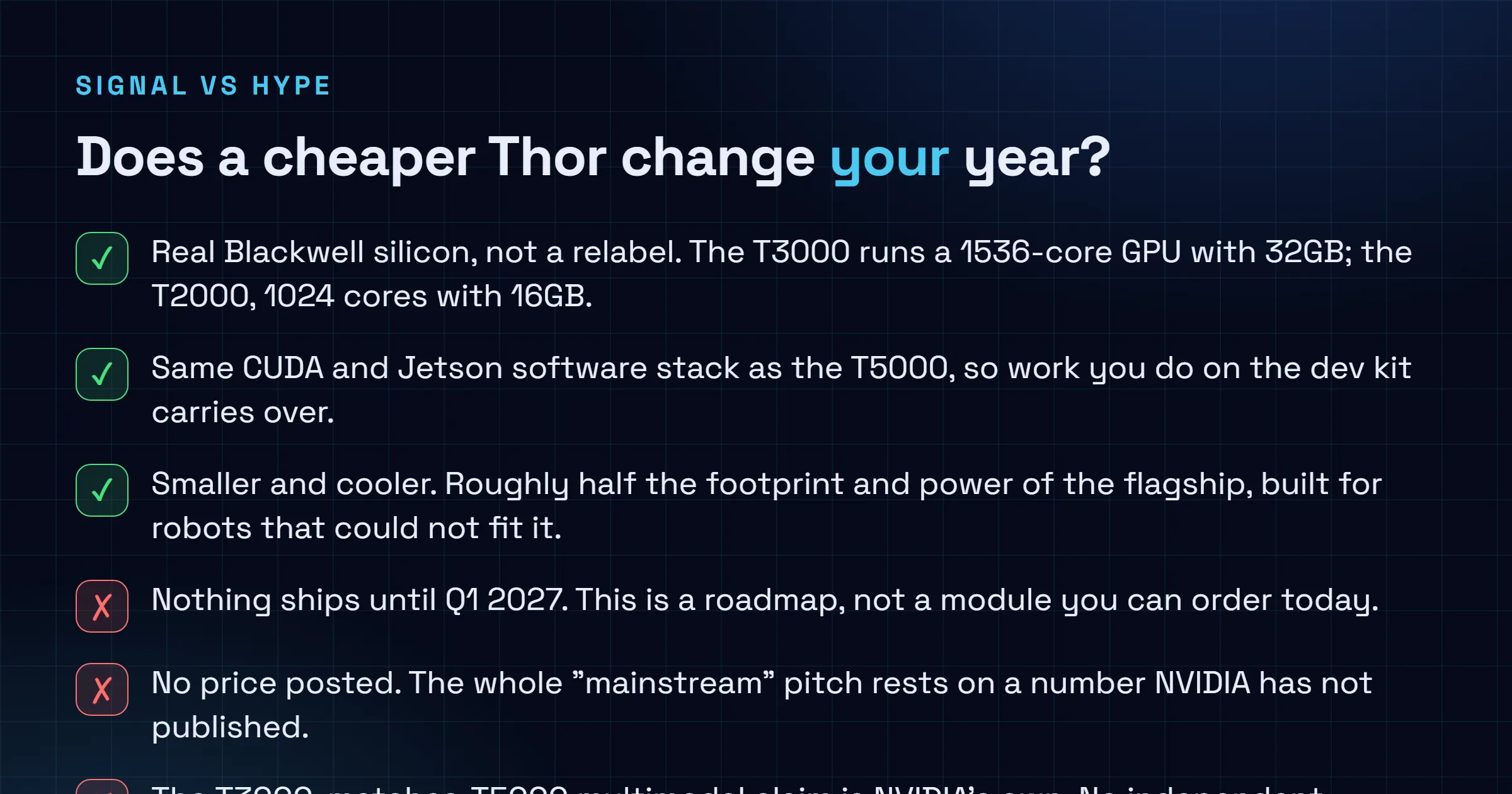
If you build robots or edge vision systems, this is a genuine plan-ahead signal. Thor-class multimodal inference is coming to a smaller, cooler, presumably cheaper package, and you can start on the dev kit today. That’s real, and it’s the kind of thing that changes a 2027 bill of materials. If you don’t build hardware, this is upstream weather. It’s the same trend we’ve tracked with hyperscalers moving inference onto custom silicon like Meta’s Iris chip: compute getting cheaper and more specialized at every tier, which eventually softens the GPU supply crunch that inflates everyone’s cloud costs. Diffuse, slow, but real.
One caveat worth sitting with. The memory numbers are the quiet ceiling. 16GB on the T2000 and 32GB on the T3000 are healthy for an edge device, but on-robot vision-language-action models are hungry, and 16GB fills up fast once you’re running perception and a language model together. The T3000’s 32GB is the more comfortable target for anything ambitious. Spec for the model you actually want to run, not the teraflops headline.
The honest read
The T3000 and T2000 are NVIDIA doing the obvious, sensible thing: taking a flagship robot chip and shrinking it until it fits the market that’s actually buying robots. No new magic, no new architecture, just Thor scaled down to where the volume is. That’s a good move, and the demand is clearly there.
Just don’t confuse a slide with a shipment. There’s no price, nothing ships for two quarters, and the one bold performance claim doesn’t have numbers behind it yet. If you’re building physical AI, grab the dev kit and start now. Everyone else can note the direction and check back when NVIDIA finally tells us what “mainstream” costs. That’s the number that turns this from a keynote into a product.
Sources: NVIDIA’s own announcement, reported on the NVIDIA blog, with the full spec breakdown from CNX Software and ServeTheHome, July 2026. Availability and specs come from NVIDIA; pricing was not disclosed, and the T3000-versus-T5000 multimodal claim has not been independently benchmarked.
Frequently asked questions
What are the NVIDIA Jetson T3000 and T2000?
They are two new modules in NVIDIA's Jetson Thor family for robotics and edge AI, announced on July 16, 2026. Both use the same Blackwell GPU architecture as the existing T4000 and T5000 but in a smaller, lower-power package. The T3000 delivers 865 FP4 teraflops with a 1536-core GPU and 32GB of LPDDR5X memory. The T2000 delivers 400 FP4 teraflops with a 1024-core GPU and 16GB. NVIDIA positions them as the mainstream tier, meant to put Thor-class compute into robots that could not fit or afford the flagship.
When are the Jetson T3000 and T2000 available, and how much do they cost?
NVIDIA says both modules are scheduled for the first quarter of 2027. As of the July 16 announcement, no price has been published for either one. Since the entire mainstream pitch rests on cost, that missing number is the single biggest open question. Until it lands, treat the launch as a roadmap, not a buying decision.
How do the T3000 and T2000 compare to the T4000 and T5000?
On raw throughput they sit lower: 2070 FP4 teraflops on the T5000, 1200 on the T4000, 865 on the T3000, 400 on the T2000. Memory drops too, from 128GB on the T5000 to 32GB on the T3000 and 16GB on the T2000. The trade is size and power. NVIDIA says the T3000 is roughly half the footprint and power of the T5000 while claiming similar multimodal inference performance, though it has not published numbers behind that claim yet.
Can I build for the Jetson T3000 and T2000 before they ship?
Yes. NVIDIA says developers can use the existing Jetson AGX Thor developer kit, which has been on sale since August 2025 at 3,499 dollars, to emulate the performance of the new modules. Because the whole Jetson line shares one CUDA and software stack, code and models you build on the dev kit are meant to carry over to the T3000 and T2000 when they arrive.
What are these modules actually for?
Physical AI at the edge. NVIDIA names humanoid robots, autonomous mobile robots, industrial arms and visual AI agents as the targets. The idea is to run vision-language-action models and multimodal inference on the robot itself, without a tether to a data center. The mainstream modules exist so that use case does not require the biggest, most expensive Jetson.


