
Wednesday night, one line in The Information, and by Thursday morning every model your CI pulls at build time might be coming from a company that sells GPUs. Nvidia has reportedly agreed to buy Hugging Face for $12.9 billion, which would put the hub holding close to three million public model repositories inside the hardware vendor those models get trained and served on. Business Insider tells it differently: talks valuing the company above $13 billion, no signed agreement, and the whole thing could still fall apart. Neither company has confirmed a word of it. So treat the number as soft. The dependency underneath it is not soft at all.
The short answer
Reported, not announced. If it closes, the default place developers fetch open weights from belongs to the company selling the accelerators those weights run on. Your build pipeline should not care who owns a domain. Go and check whether yours does.
What is reported, and what is not
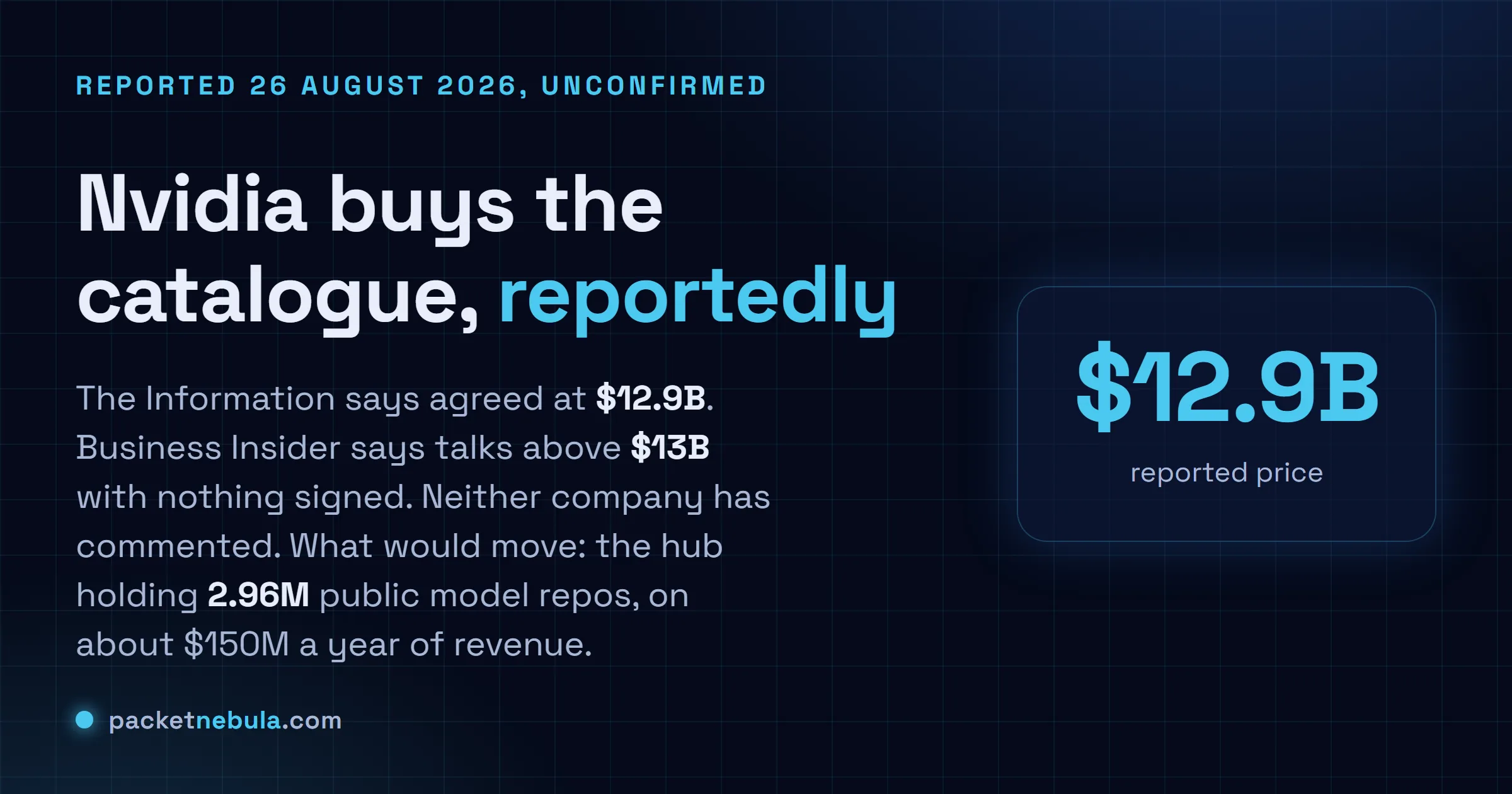
The Information ran it first, Wednesday night: agreement reached, $12.9 billion, sourced to one person familiar with the deal. Business Insider had been on the story since the weekend with a different shape, talks above $13 billion with no signature, plus an explicit warning that they could still come apart.
Both can be true at once. Deals get agreed in principle and then spend weeks in paper before anyone signs.
What we can say flatly is that neither company has said anything. CNBC asked. TechCrunch asked. Reuters asked. Silence from both, which is normal for a live transaction and tells you nothing either way.
The financial picture underneath is unusually clear for a private company, though. Revenue recently around $150 million a year, up from roughly $100 million only two months before, with Delangue on record saying the company had gotten close to profitability. That’s a real business, not an acquihire dressed up.
The $500 million it turned down
Here’s the detail I keep coming back to.
In late 2025, per the Financial Times, Hugging Face declined a $500 million investment from Nvidia that would have valued it at $7 billion. The reported objection was concentration: one shareholder holding that much sway over a platform meant to be neutral ground between labs.
Nine months later, the reported answer is to sell the whole thing to the same company.
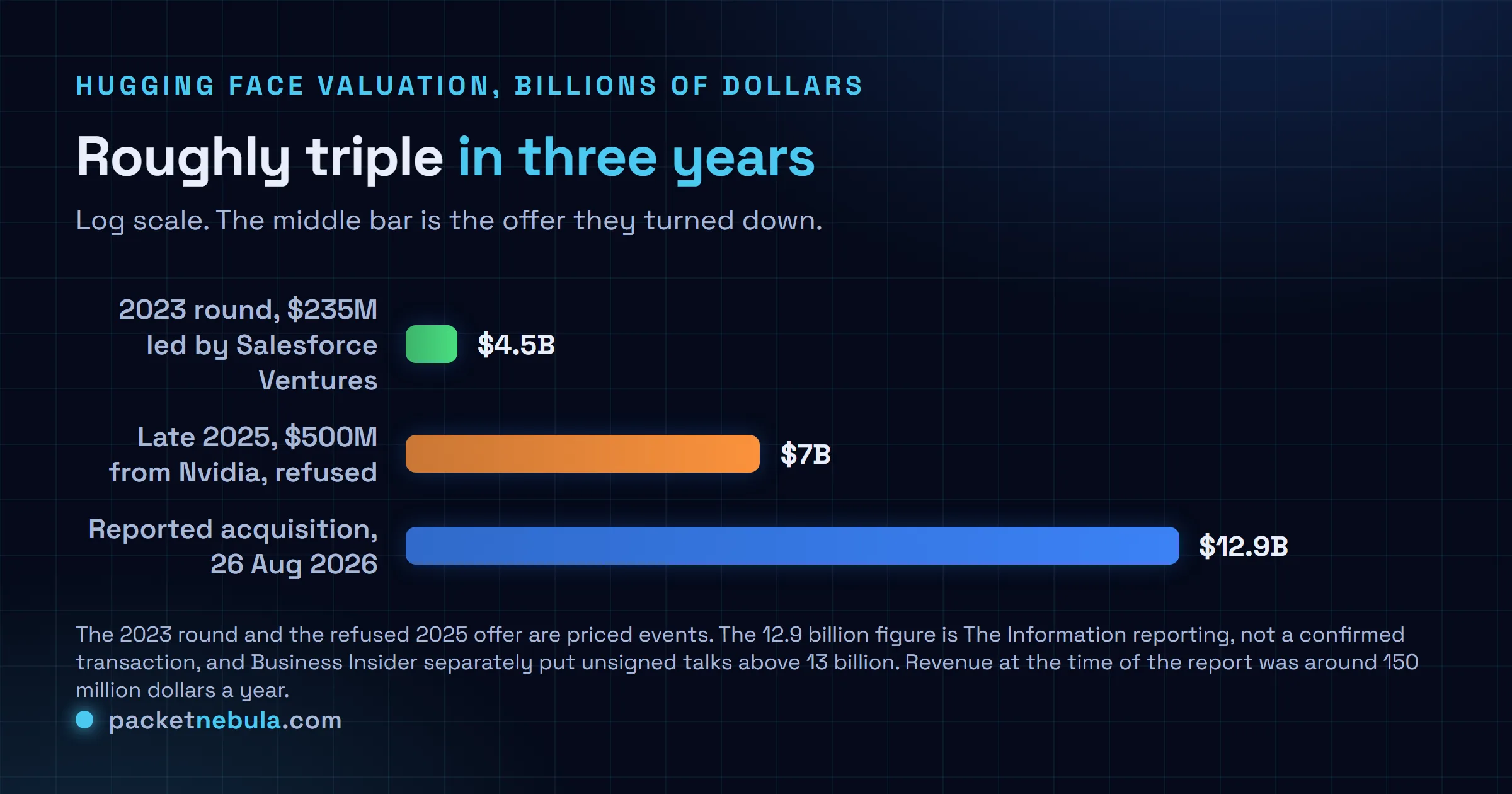
I’m not calling that hypocrisy. Selling outright and taking a minority cheque are genuinely different problems, and a founder handed an offer near triple the last mark has a duty to look at it seriously. But the stated reason for refusing in 2025 doesn’t evaporate at a higher price. It gets larger.
Why a chip company wants a catalogue
Nvidia isn’t buying revenue here. At $150 million a year, $12.9 billion is a multiple nobody would defend on a spreadsheet.
It’s buying position, and the logic is defensive. Every major lab is now building or commissioning its own silicon, which chips away at Nvidia’s core business one customer at a time. Open weights push the other way. When a few hundred thousand teams run models on hardware they purchase themselves, that hardware is overwhelmingly Nvidia’s, so the healthier the open ecosystem gets, the more accelerators move.
Jensen Huang has not been quiet about this. Nvidia signed the open weights letter alongside 24 other companies earlier this year, and so did Hugging Face. They have been arguing the same side in public for months, which is part of why this reads as friendly rather than hostile.
There’s also the pattern. Nvidia has committed around $18 billion to equity investments for the rest of this year, and it keeps converting competitors into partners. We wrote up the Groq reversal in August, where an LPU challenger ended up an Nvidia Cloud Partner. This would be the same move applied to the distribution layer instead of the silicon.
What actually sits on the Hub
Worth knowing the scale, because most people underestimate it.
Per Hugging Face’s own August report, the Hub holds 2.96 million public model repositories, one million datasets and 1.44 million Spaces. Concentration is extreme: 1.5 percent of repositories account for 99.2 percent of all downloads, while 85.6 percent of models have fewer than 200 lifetime downloads. One embedding model, all-MiniLM-L6-v2, took 1.55 billion downloads in seven months.
That concentration cuts both ways. A handful of repos matter enormously, which sounds alarming. It also means mirroring the ones you actually depend on is a small afternoon’s work rather than a project.
What to do about it this week
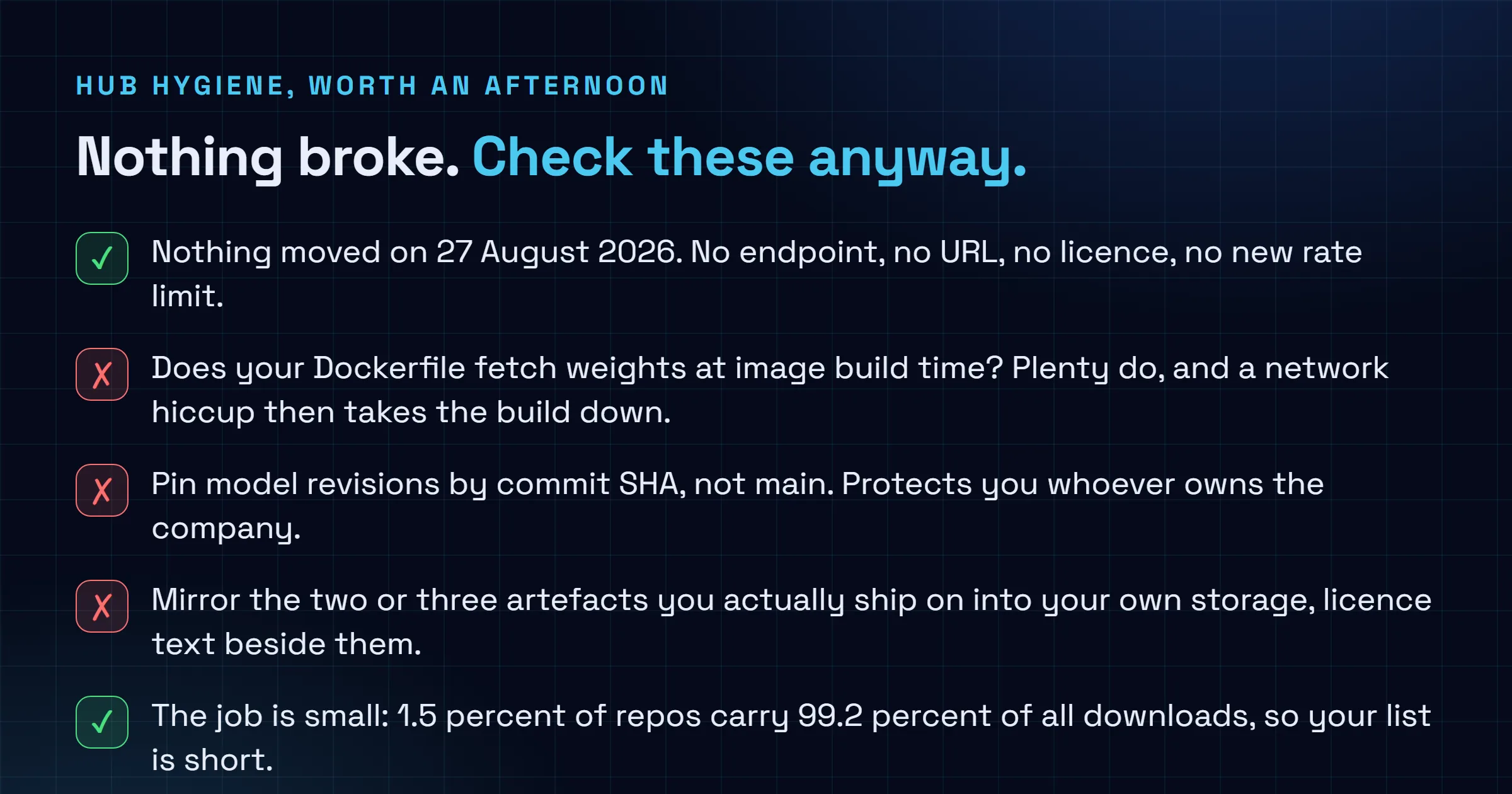
Nothing broke. No endpoint moved, no licence changed, no rate limit appeared. If your stack worked this morning it works tomorrow morning.
So the honest advice is much smaller than the headline. Go and check whether your build pulls weights from huggingface.co at image build time or at container start, because a surprising number of Dockerfiles do the first and nobody notices until a network hiccup takes production down with it. Pin by commit SHA rather than main, which protects you from a repo shifting under you no matter who owns the company. Mirror the two or three model artefacts you genuinely ship on into storage you control, with the licence text sitting right next to them.
That’s the whole list. It’s the same hygiene you’d want if the buyer were anyone at all.
Longer term, the question I can’t answer is whether a vendor-owned catalogue stays neutral about models built for rival hardware. Not through anything as crude as delisting. Through defaults. Through which quantisations get first-class tooling, and what the deploy button points at. I might be wrong and it might change nothing at all. But the moment the Hub stops being neutral ground, its main asset is gone, and Nvidia would understand that better than anyone.
We’ll update this when either company says something on the record.
Sources
The $12.9 billion agreement was first reported by The Information on 26 August 2026, relayed by CNBC and by TechCrunch, which also carries the Business Insider framing of unsigned talks above $13 billion, the $150 million revenue figure and the Financial Times detail on the refused $500 million investment at a $7 billion valuation. The 2023 round of $235 million at $4.5 billion led by Salesforce Ventures sits in that same TechCrunch report. Nvidia declined to comment to Investing.com, which also logged NVDA closing down 1.59 percent at $209.66. Hub repository counts, the download concentration figures and the all-MiniLM-L6-v2 number come from Hugging Face own State of Open Models: Summer 2026, published 14 August 2026. Everything read on 27 August 2026, and this remains reporting rather than a confirmed transaction.
Update, 7 October 2026. This article was written when the deal was only reported. Nvidia's 8-K of 2 September records a definitive agreement: about $11.9 billion payable to Hugging Face stockholders plus an employee retention programme of up to about $1.0 billion, with closing expected in the first half of 2027. Current status: infrastructure deals ledger.
Frequently asked questions
Has Nvidia actually bought Hugging Face?
Not confirmed. The Information reported on 26 August 2026 that Nvidia had agreed to buy Hugging Face for $12.9 billion, citing a person familiar with the deal. Business Insider reported the same week that talks valuing the company at more than $13 billion had not produced a signed agreement and could still collapse. Neither Nvidia nor Hugging Face responded to requests for comment from CNBC, TechCrunch or Reuters. Until one of them says something on the record, this is reporting rather than a done deal.
How much is Hugging Face worth?
The last priced round was 2023: $235 million at a $4.5 billion valuation, led by Salesforce Ventures with GV, IBM Ventures and Nvidia taking part. In late 2025, according to the Financial Times, Hugging Face turned down a $500 million investment from Nvidia that would have valued it at $7 billion. The reported acquisition price is roughly triple the 2023 mark. Revenue was recently around $150 million a year, up from roughly $100 million two months earlier, and CEO Clem Delangue has said the company got close to profitability.
Would this change how I download models?
Nothing changed this week. No API endpoint moved, no URL, no licence. What changes is the risk profile of treating huggingface.co as neutral infrastructure. If a chip vendor owns the default distribution point for open weights, your build pipeline carries a commercial dependency on one supplier that competes with several of the labs publishing to it. Pin revisions by commit SHA, mirror the weights you actually ship on, and know where your fallback is.
Why would Nvidia pay that much for a model hub?
Hugging Face sells neither chips nor models, so the value is not the revenue. It is the position. The big AI labs are all building or buying their own silicon, which erodes Nvidia core business over time. A healthy open weights ecosystem pushes the other way: thousands of teams running models on hardware they buy themselves, and that hardware is overwhelmingly Nvidia. Owning the place where those weights get found is cheap insurance on the installed base.
Is there an antitrust problem here?
Possibly, and nobody has tested it. Hugging Face is not a chip company, so the horizontal overlap argument is weak. The harder question is whether the supplier of most AI accelerators should own the neutral catalogue developers use to compare and fetch models from every lab, including labs building rival chips. That is a conditional access argument rather than a market share one, and no regulator had signalled anything either way as of 27 August 2026.


