
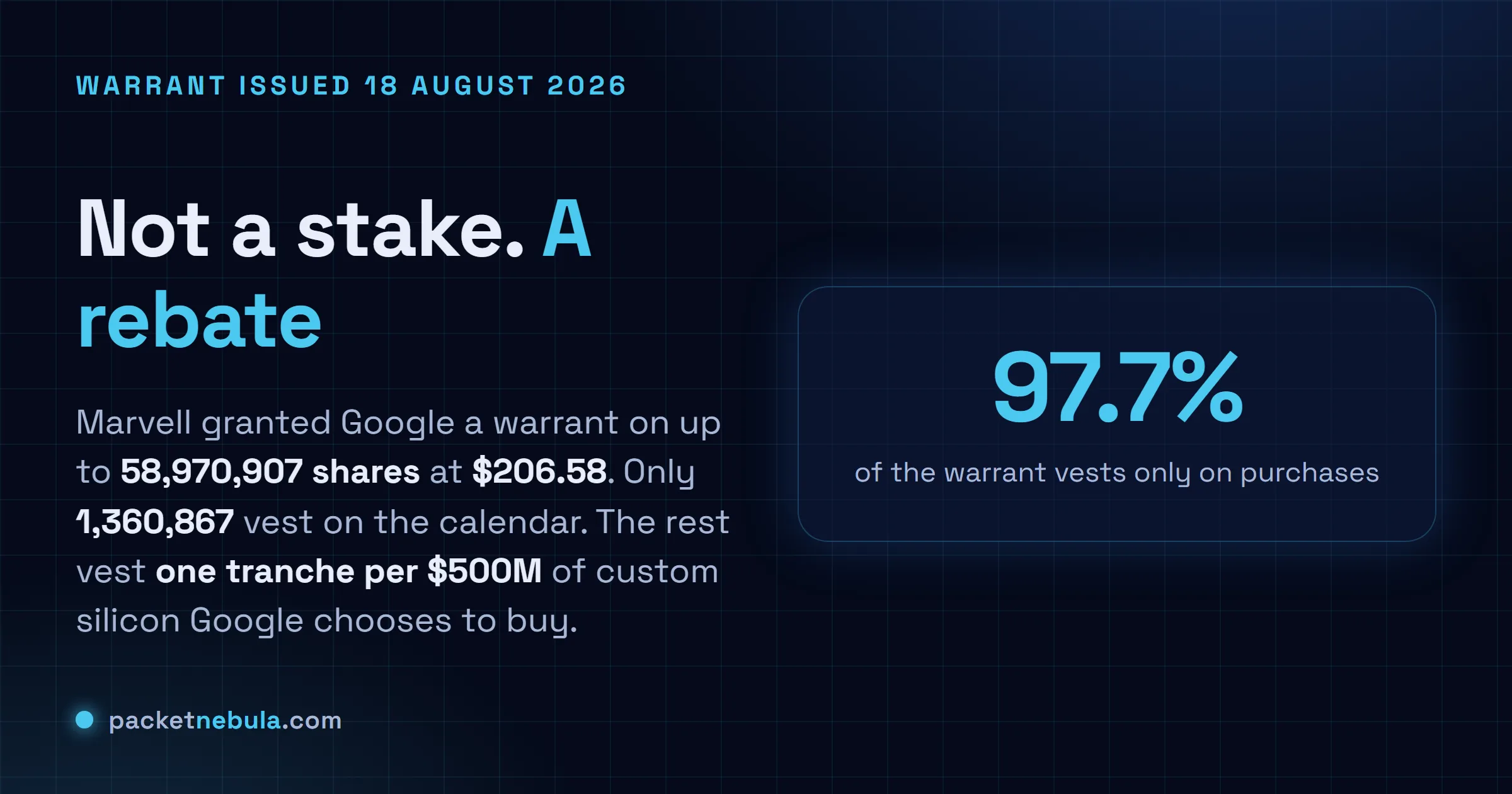
Headlines called it a $12.2 billion stake, and if you stop at the first paragraph of the Reuters wire that is roughly what you get. Open the filing and it's a coupon book. Marvell issued Google a warrant on 18 August covering up to 58,970,907 shares at $206.58, but 97.7% of those shares only vest if Google buys $120 billion of custom silicon between now and fiscal 2033, in 240 tranches of $500 million each. Google has committed to none of it. The filing calls the purchases discretionary and leaves it there.
The short answer
Marvell issued Google a warrant on 18 August 2026 covering up to 58,970,907 shares at $206.58. Only 1,360,867 of those vest on the calendar, quarterly across the first year. The other 57,610,040 vest one tranche at a time, one tranche per $500 million of custom product revenue, through Marvell’s fiscal 2033. Google has promised to buy none of it. Read the $12.2 billion figure as a rebate ceiling on an enormous order book, not as a stake anyone has taken.
The two dates that matter
Marvell filed the 8-K on 19 August, and it runs to about a page and a half of substance.
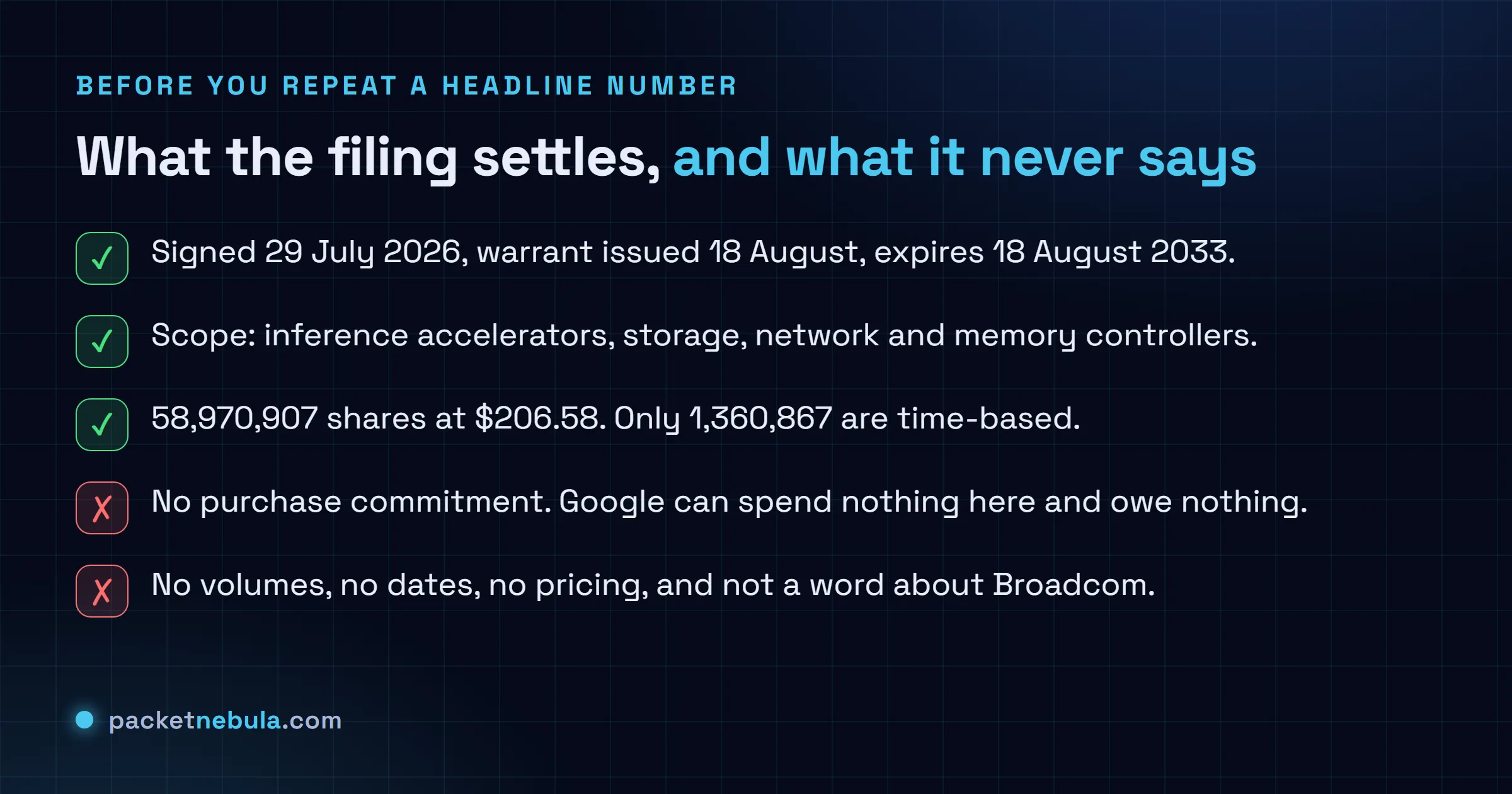
On 29 July 2026 Marvell and Google LLC signed a commercial agreement for Marvell to develop custom semiconductor products. The filing calls them Custom Products, and describes the partnership as spanning custom silicon programs that attach to the TPU ecosystem. Then it lists them: AI inference accelerators, storage controllers, network interface controllers, memory interface controllers, near-memory compute.
Three weeks later, on 18 August, Marvell issued the warrant. Up to 58,970,907 shares at $206.58, exercisable until 18 August 2033, not transferable outside Google’s controlled affiliates without Marvell’s consent.
That gap between the two dates is worth a second. The silicon deal was already signed before the equity sweetener existed. Whatever the warrant is doing, it isn’t what got Google to sign.
Where 97.7% of it goes
Here’s the split the wire copy mostly skipped.
| Slice | Shares | Vests on |
|---|---|---|
| Time-based | 1,360,867 | Four equal quarterly instalments, first year |
| Performance | 57,610,040 | 240 tranches, one per $500M of Custom Products revenue |
| Total | 58,970,907 | $206.58 strike, expires 18 August 2033 |
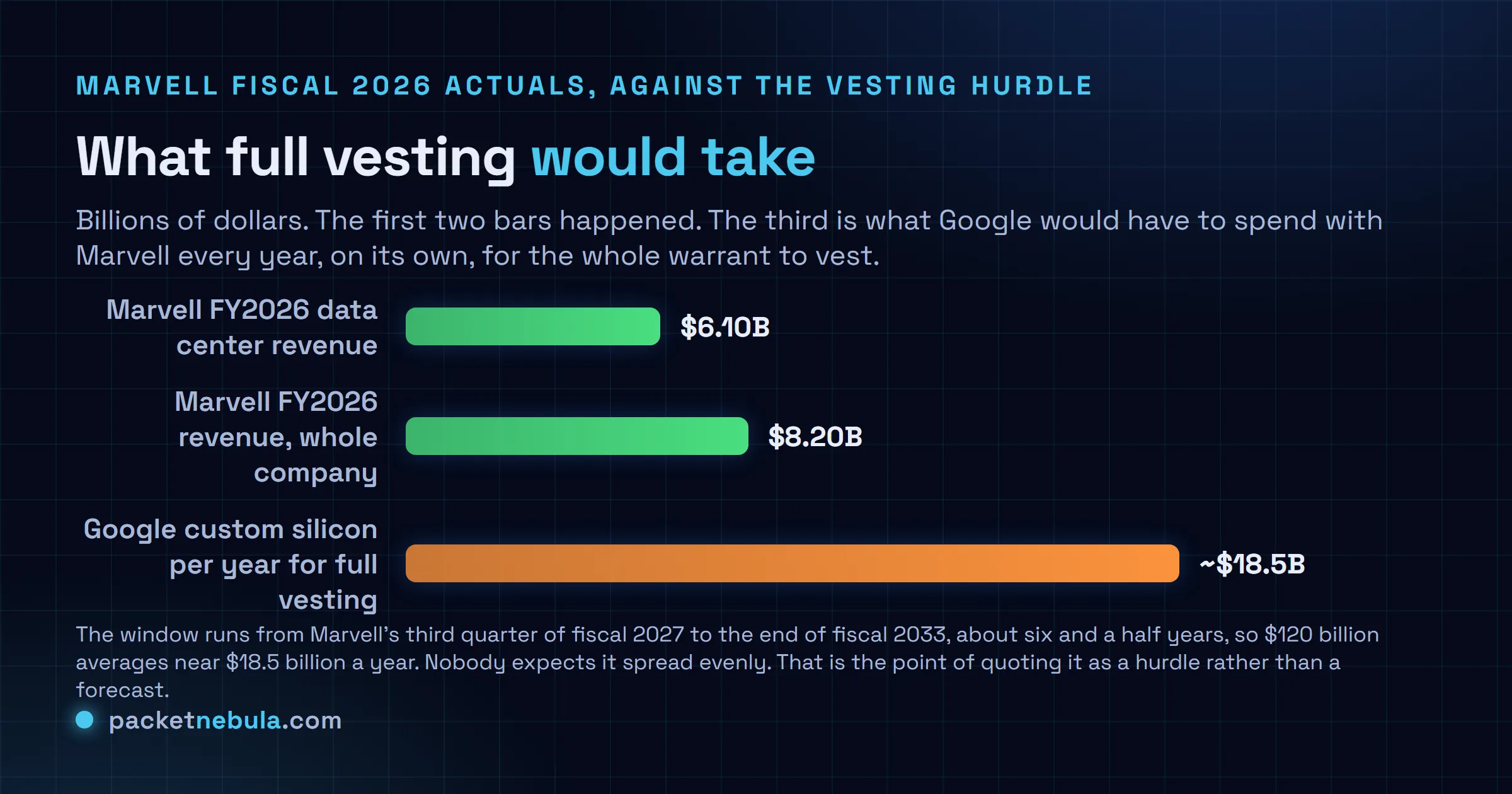
Do the arithmetic on the second row. 240 tranches at $500 million each is $120 billion, and the window runs from Marvell’s third quarter of fiscal 2027 to the end of fiscal 2033, about six and a half years. Call it $18.5 billion a year from Google on its own.
Marvell’s whole company did $8.195 billion in fiscal 2026. Data centre, its biggest segment and the one growing 46% a year, did $6.10 billion of that. So full vesting asks Google alone to buy custom silicon at more than twice what Marvell currently sells to everybody, every year, for six years.
Nobody serious expects that. It isn’t a forecast, it’s a ceiling with a slope attached, and the filing is careful to call the purchases discretionary.
What a tranche is actually worth
Per $500 million Google spends, it earns the right to buy about 240,042 Marvell shares at $206.58.
Marvell closed at $251.01 on 20 August, so that right carries roughly $44.43 a share of intrinsic value right now. Multiply out and each tranche is worth about $10.7 million on paper, or a shade over 2% of the money spent. That is a volume rebate, priced in equity, and a fairly ordinary one by the standards of this market.
The number moves, obviously. If Marvell doubles, the rebate roughly triples. If Marvell trades under $206.58 in 2031 the tranches Google earned that year are worth nothing at all, and the warrant still expires in August 2033 either way. I think that asymmetry is why the structure keeps showing up: it costs the vendor nothing today, and it pays out most when the vendor is doing well anyway.
The dilution is the other side. About 6.3% of Marvell’s common stock at full exercise, against 876.93 million shares outstanding.
The part that’s genuinely useful
Skip the money for a second and read the product list again.
AI inference accelerators. Storage controllers. Network interface controllers, memory interface controllers, near-memory compute. That is not a chip order. That is most of the rack around the accelerator, and Google is contracting a second vendor across all of it at once.
The interface controllers are the interesting names on that list. In a large training or inference cluster the accelerator is rarely the thing that runs out first, and anyone who has watched a job stall on interconnect or on memory bandwidth already knows where the pain lives. Marvell has been pushing exactly there, with an AI memory infrastructure portfolio announced on 4 August aimed at agentic inference. The Google agreement lines up with that push almost too neatly.
For the rest of us, this changes nothing you can order this quarter. No volumes, no nodes, no dates, no prices. What it tells you is that Google is planning TPU-adjacent supply out to 2033 and does not intend to source it from one place, which is a mildly reassuring thing to know if you are budgeting Google Cloud AI capacity across several years rather than one.
Does Broadcom lose something
Everyone asked. The filing does not answer.
It names categories, never programs, and it retires nobody. Morningstar’s William Kerwin read the deal as Google widening its supplier base rather than displacing an incumbent, which is the reading the document supports. Markets disagreed a little: Broadcom fell more than 5% on the news by Reuters’ account while Marvell jumped, and Alphabet barely moved. Those are opinions with money behind them, not disclosures.
We would treat the whole thing as additive until somebody says otherwise on the record.
The pattern, one more time
This is the fourth or fifth version of the same deal shape we’ve written up this year. A hyperscaler or a lab commits to spend, the supplier hands back equity tied to that spend, and the press converts the headline notional into a stake. Nvidia’s balance sheet now rides on companies that also buy its silicon. Meta went the other way and built its own chip with Broadcom.
The Google warrant is the cleanest example yet, because the conditionality is right there in the text and the ratio is absurd enough to notice. 1.36 million shares are real. 57.6 million are a sales target wearing a share certificate.
What we’ll watch is Marvell’s quarterly reporting from Q3 fiscal 2027 onward. If custom product revenue starts getting broken out, the tranche count becomes a public scoreboard, and you’ll be able to read Google’s TPU build-out in $500 million increments without anyone announcing anything.
Sources
- Marvell Technology Form 8-K, filed 19 August 2026, the primary source for the 29 July commercial agreement, the product categories, the 58,970,907 warrant shares, the $206.58 exercise price, the 1,360,867 time-based shares, the 240 tranches at $500 million each and the 18 August 2033 expiry.
- Reuters, via Yahoo Finance, 19 August 2026, for the $12.18 billion aggregate exercise figure, the fifth-largest-investor framing, the Morningstar comment from William Kerwin, and the market reaction including Broadcom falling more than 5%.
- Marvell fiscal 2026 fourth quarter and full year results, for the $8.195 billion of fiscal 2026 revenue and the data centre segment above $6 billion, which is what the $120 billion hurdle is measured against.
- TS2, 19 August 2026, for an independent read of the same filing, the roughly 6.3% dilution at full exercise and the $234.33 close on 17 August.
- Stock Analysis, MRVL quote, for the $251.01 close on 20 August 2026 and the 876.93 million shares outstanding used in the tranche and dilution arithmetic.
- Marvell newsroom, 4 August 2026, for the AI memory infrastructure portfolio aimed at agentic inference, which is the product line the Google scope overlaps.
Frequently asked questions
What did Marvell and Google actually agree?
Two separate things, on two dates. On 29 July 2026 the companies signed a commercial agreement for Marvell to develop custom semiconductor products for Google, described in the filing as custom silicon programs that attach to the TPU ecosystem: AI inference accelerators, storage controllers, network interface controllers, memory interface controllers and near-memory compute. Then on 18 August 2026 Marvell issued Google a warrant on up to 58,970,907 shares at $206.58 each. The warrant is the incentive attached to the first agreement, not a payment and not an investment.
Is Google buying a $12.2 billion stake in Marvell?
No, and the number is doubly misleading. $12.18 billion is what Google would pay to exercise the whole warrant, so it is a purchase price rather than a gift. And it can only exercise the whole thing after Marvell books $120 billion of custom product revenue from Google, which is 14.6 times Marvell's entire fiscal 2026 revenue of $8.195 billion. Today the only shares Google can count on are the 1,360,867 time-based ones, vesting quarterly over the first year.
How does the tranche vesting work?
57,610,040 of the warrant shares vest in 240 equal tranches, one tranche for every $500 million of custom product revenue from discretionary purchases by Google or its affiliates, running from Marvell's third quarter of fiscal 2027 through the end of fiscal 2033. That works out at roughly 240,042 shares per $500 million spent. At the 20 August close of $251.01 against a $206.58 strike, each tranche is worth about $10.7 million on paper, near 2% of the money spent. That percentage moves with the share price, in both directions.
Does this mean Broadcom loses Google TPU work?
The filing does not say so, and neither has Marvell. It names product categories, not programs, and nothing in it retires an existing supplier. Morningstar's William Kerwin read it as Google expanding its supplier list rather than replacing anyone, which matches what the document actually contains. Broadcom stock did fall on the news, more than 5% by Reuters' account, so the market took at least part of it as a share shift. That is a market opinion, not a disclosure.
Does any of this change what I can buy or deploy?
Not this year. There is no volume, no process node, no delivery date and no price anywhere in the filing, so nothing here tells you when TPU-adjacent capacity lands or what it costs. The useful signal is the product list. Google is contracting a second vendor across the parts that surround the accelerator, notably the network and memory interface controllers, which is where large training and inference clusters tend to bottleneck. If you plan multi-year AI infrastructure on Google Cloud, that breadth is the thing to note, not the dollar headline.


