

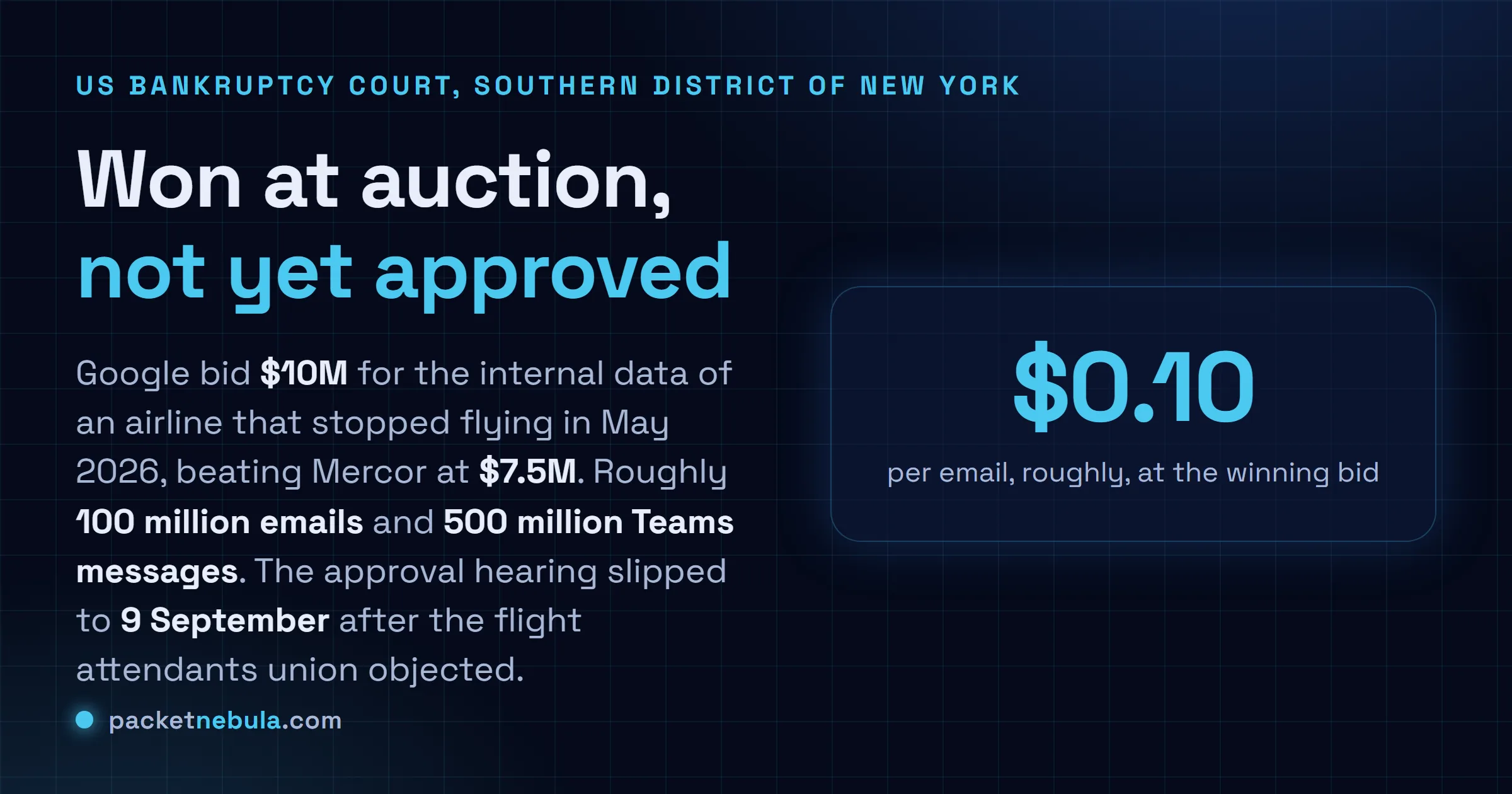
An airline that stopped flying in May just sold its Slack-equivalent. Google won a bankruptcy auction for Spirit Airlines' internal enterprise data with a $10 million bid, roughly 100 million employee emails and 500 million Microsoft Teams messages, and it says the material will help train its AI models. Then the sale hit a wall. The flight attendants union objected, and the approval hearing in the Southern District of New York moved to 9 September. So nothing has changed hands yet. What has changed is that we all now have a public number for what a dead company's mailbox is worth.
The short answer
Google won the bankruptcy auction for Spirit Airlines’ internal enterprise data at $10 million, ahead of Mercor.io Corp. at $7.5 million. The package runs to roughly 100 million employee emails, 500 million Microsoft Teams messages, source code, operations and audit records, and about 176,000 employee records going back to 1986. Passenger profiles, the loyalty database and cardholder records are carved out, and a third party is meant to strip identifiers before handover. The sale is not final: the flight attendants union objected and the hearing moved to 9 September 2026.
What actually got sold
Spirit stopped flying in May 2026. The estate has creditors, the creditors want money, and it turns out the most liquid thing left in the building was the archive.
Google bid $10 million and won. Mercor.io Corp., an AI data and recruiting outfit, came in at $7.5 million and got named backup buyer, which is the court’s way of keeping a spare bidder on the hook in case the first deal falls apart. Reporting on the earlier rounds has Google opening around $5 million, so the price doubled in the room.
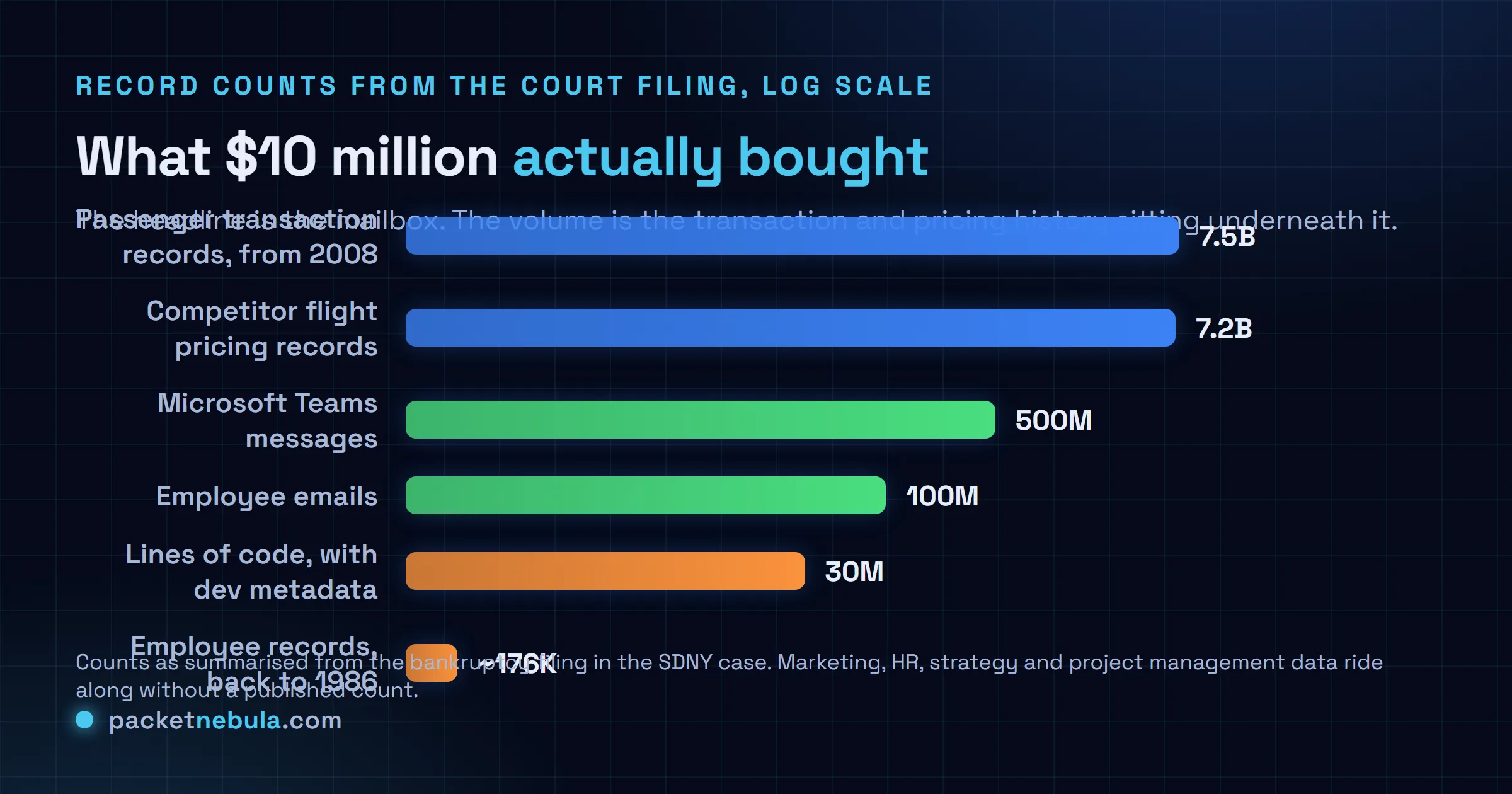
The inventory is the interesting part, and it is bigger than the headlines suggest. About 100 million employee emails. 500 million Microsoft Teams messages and collaboration records. Roughly 7.5 billion passenger transaction records going back to 2008, and 7.2 billion competitor flight pricing records, which for a discount airline is basically the entire strategy department written down. 30 million lines of code with the development metadata attached. Around 176,000 employee records reaching back to 1986, which predates most of the people in them having a work email at all.
Calendars, spreadsheets, marketing, HR, strategy, project management. The boring stuff.
The boring stuff is the point
Here is why a hyperscaler pays real money for a defunct airline’s Teams export instead of scraping another few terabytes of the open web.
Public data tells a model what an organisation does. It almost never shows how one works. The half-finished spreadsheet, the thread where somebody escalates the wrong thing to the wrong VP, the code review that goes nowhere, the calendar invite with eleven people and no agenda: none of that is on the public internet, and all of it is what an agent needs to model if it is ever going to do a job inside a company rather than answer questions about one.
One line in the coverage put it about as well as it can be put, that this kind of material shows how a large organisation actually operates rather than simply supplying information about what it does.
That is the whole thesis of the current agent push, compressed into a bankruptcy filing. And it prices at ten cents an email.
I think the price is the story more than the buyer is. Ten million dollars is a rounding error at Alphabet. It is not a rounding error to a bankruptcy estate, which means this trade clears easily and will clear again the next time a mid-size company with twenty years of Microsoft 365 history goes under. There is no shortage of those.
The carve-outs, and the gap in them
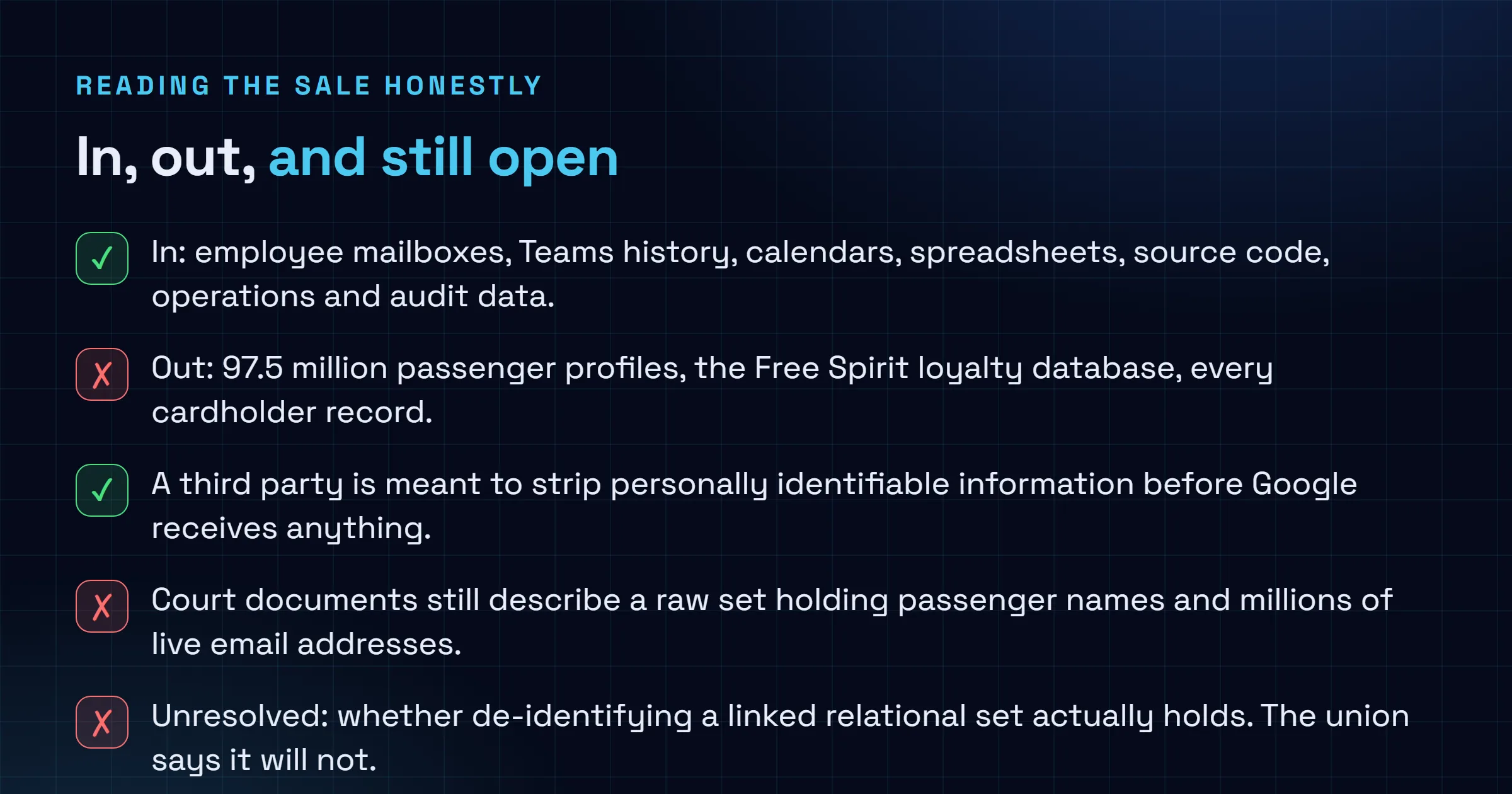
Google is not buying the passengers. The exclusions are written down: 97.5 million passenger profiles, the Free Spirit loyalty database, every cardholder record. Google’s statement is that the data will be rigorously scrubbed of any personally identifiable information by a third party before receipt, and Spirit’s filing describes the records as de-identified, containing no customer information or PII.
Read that carefully, because there are two different sets being described.
The raw archive and the delivered archive are not the same thing. Court documents summarising what Spirit holds still describe passenger names in the tens of millions and roughly 13 million active email addresses. Those live in the estate. The claim is that they get stripped on the way out, by somebody who is not Google, before the files land. Fine, and that is a meaningfully better structure than a straight handover.
But the scrub is now the entire safeguard, and nobody outside the deal gets to audit it.
Why the hearing slipped
The Association of Flight Attendants-CWA filed an objection, and the hearing that was set for this week is now 9 September 2026.
The union wants restrictions on the sale of flight attendant employee data, plus further protections for employees if it is approved anyway. Their technical argument is the one worth repeating: because the links inside the dataset are preserved, information about individuals or small groups could potentially be reconstructed even after de-identification.
They are right that this is hard. Take names off a mail archive and you still have the graph. Who mailed whom, at what hour, in which department, in what volume, and how that changed the week before a furlough. A crew of six on a specific route in a specific month is a very small group, and small groups are where de-identification quietly stops working. This is the same re-identification problem that has embarrassed every organisation that ever released an anonymised dataset and watched a researcher unpick it.
Whether the judge finds that persuasive is a separate question. Bankruptcy courts weigh creditor recovery heavily, and $2.5 million of extra recovery is a concrete number in a way that a re-identification risk is not. I would not bet on the sale being blocked. I would expect conditions.
What to take from this if you run infrastructure
Your retention policy is a valuation input now. That is the practical shift.
Most IT shops keep mail and chat forever because storage is cheap and legal hold is annoying, and the implicit assumption is that the archive stays inside the company. That assumption just got tested in public. In a US Chapter 11, corporate data is an asset of the estate, and assets get sold. The thing protecting your 2014 Teams history is not a policy. It is that nobody had bid on it before.
Two things worth doing this quarter. Find out what your actual retention is on mail and chat, as configured, not as documented, because those differ more often than anyone admits. Then check whether your own vendor and partner contracts say anything about what happens to shared data in an insolvency, since most standard DPAs handle breach and subprocessors carefully and go quiet on bankruptcy.
We have watched the consent question land the same way in a very different venue, when Twitch switched genAI training on by default and one broadcaster’s toggle answered for everyone in the chat. Different company, same structure: the people in the data were not the people making the decision. The $1.5B Anthropic copyright settlement put a price on training material that was taken. This puts one on training material that was bought, legally, at auction, from a seller who no longer has employees to object.
The union does, though. That is why there is a hearing.
Sources
Auction result, bid amounts, the record inventory and the case details (US Bankruptcy Court for the Southern District of New York, Judge Sean Lane, No. 25-11897) from Bloomberg Law, including Google’s statement on the acquisition and the third-party PII scrub. The delayed hearing, the AFA-CWA objection and the raw-set figures from court documents were reported by Reuters, carried here. Bidding sequence and exclusions cross-checked against Simple Flying, with the data categories confirmed independently by Tom’s Hardware and The Register. Google published no blog post about the purchase, so the filing and the company’s statement to press are the record.
Frequently asked questions
Has Google actually got the Spirit Airlines data yet?
No. Google won the auction, but a bankruptcy sale needs the judge to sign it off, and that hearing was pushed to 9 September 2026 after the flight attendants union filed an objection. Until the court approves it, nothing transfers. Mercor.io Corp., the underbidder at $7.5 million, is named as backup buyer if the Google deal collapses.
Is passenger data included in the sale?
Not in what Google is buying. The carve-outs are explicit: 97.5 million passenger profiles, the Free Spirit loyalty database and every cardholder record stay out. The complication is that court documents describing the raw set still reference passenger names and millions of live email addresses, which is why a third party is supposed to strip identifiers before Google receives any files.
What is Google planning to do with it?
Improve products and train models. Google's own line is that it acquired part of an enterprise dataset from Spirit Airlines that can help improve its products and AI models. The value is not aviation trivia. It is a complete record of how a real company of that size actually operated day to day, which is exactly the thing web scraping cannot give you.
Why did the flight attendants union object?
Re-identification. The AFA-CWA is asking for restrictions on the sale of flight attendant employee data and further protections if the sale goes through, arguing that because the links inside the dataset are preserved, information about individuals or small groups could be reconstructed even after de-identification. That is a real technical concern, not a procedural one.
Can my employer sell my work email if it goes bankrupt?
In a US Chapter 11 liquidation, corporate data is an asset of the estate like any other, and assets get sold to pay creditors. Your mailbox is company property in most jurisdictions and most employment contracts. Privacy law can constrain what happens to personal data inside it, and the EU makes that constraint much sharper than the US does, but the default direction of travel is that the data has a price.
Does de-identification actually protect the employees?
Partly, and less than the word suggests. Stripping names and addresses from a set whose internal relationships stay intact is a known-hard problem, because the pattern of who mailed whom, when, from which department is itself identifying. We would not call it worthless. We would not call it a solved problem either, and the union is objecting on exactly that point.


