
• Latest
  • Trending
  • All
Answer card: Anthropic committed $11.6 billion over seven years to Akamai Cloud for CPU workloads only, with revenue from the second half of 2027.

Anthropic’s $11.6B Akamai deal buys CPUs, not GPUs

27 September 2026
Answer card: Xiaomi retrained MiMo-V2.6 to stop repeating tool calls, API swapped on 25 September 2026, MIT weights on 27 September, same model names.

MiMo-V2.6-Pro was quietly retrained to stop looping on tool calls

28 September 2026
Answer card: Google Suncatcher MVP satellite, four Trillium TPUs on about one kilowatt, launching on SpaceX Transporter-18, reported for 1 October 2026.

Google’s first Suncatcher satellite flies four TPUs on 1 kW

25 September 2026
Answer card for Claude Opus 5.5: 4 dollars in and 20 dollars out per million tokens, down from 5 and 25, with cache reads at 20 cents.

Claude Opus 5.5 drops to $4 and $20, and breaks four Opus 5 habits

23 September 2026
The official xAI announcement card for Grok 4.7, white type on a dark grey and navy gradient.

Grok 4.7 keeps $2 and $6, and its gains over 4.6 are xhigh versus high

22 September 2026
Answer card stating that Qwen-Image-2.1, released on 20 September 2026, ships open weights with a 7 billion parameter diffusion transformer, a Qwen3-VL 8B text encoder and an RGBA VAE totalling about 33 gigabytes in BF16, under the Qwen Research License that limits use to research or evaluation and requires a separate commercial licence, unlike the Apache 2.0 licence of Qwen-Image 1.0.

Qwen-Image-2.1 brings the weights back, but not the Apache licence

21 September 2026
Answer card stating that Ternary Bonsai 2 27B, released by PrismML on 17 September 2026 under Apache 2.0, packs Qwen3.8 27B into 5.95 gigabytes at 1.72 bits per weight, keeps 98.2 percent of the 14-benchmark average, about 75 percent on SWE-bench Verified and Terminal-Bench 2.1, and needs PrismML's llama.cpp fork to run.

Does Bonsai 2 27B really keep 98% of Qwen3.8 in 5.95 GB?

20 September 2026
Answer card stating that Jev 1.13 from TypeSafe AI is a decision model in early access since 15 September 2026 that returns typed probabilities instead of text, priced at 42 dollars per billion input tokens with output tokens free, answering in 70 to 500 milliseconds, with a 64K token request budget, text input only, and a documented list of things it does badly, including counting and dates.

Jev 1.13 bills $42 a billion tokens, and it can’t count

19 September 2026
Answer card stating that Qwen3.8-Omni-Flash launched on 17 September 2026 as an API only model on Alibaba Cloud Model Studio, taking text, images, audio and video in a 1M token context and returning text only, priced at 0.15 dollars per million input tokens for every modality and 0.47 dollars per million output tokens in the international regions, with no open weights published and the Qwen-Live Harness GitHub repository returning 404.

Qwen3.8-Omni-Flash bills audio at $0.15 and ships no weights

18 September 2026
Answer card stating that on 15 September 2026 AWS said it is unable to restore access to resources and data hosted exclusively in the Middle East Bahrain region me-south-1 and in the mec1-az2 zone of the UAE region, because the damage spanned multiple Availability Zones and exceeded what multi-AZ services are designed to withstand.

AWS can’t restore me-south-1, six months after the drone strikes

17 September 2026
Answer card stating that Google released Gemini 3.8 Live and Gemini 3.8 Live Extended Thinking on 15 September 2026 at 3 dollars per million audio input tokens and 12 dollars out, that the thinking model requires asynchronous tools, and that Artificial Analysis scores it 82.6 on its Speech to Speech Quality Index.

Gemini 3.8 Live Extended Thinking rejects any tool that blocks

16 September 2026
Answer card summarising the Atria Dawn Preview release: 744B GLM-5.2 base, MIT licence, 1.5 TB BF16 and 756 GB FP8 checkpoints, 256K context, top on five of sixteen benchmark rows and trailing on SWE-bench Pro.

Atria Dawn Preview is 744B under MIT, and the BF16 weighs 1.5 TB

15 September 2026
Answer card stating that OpenAI released the Agents API in public beta on 10 September 2026 with no separate fee, billed through model tokens, tool calls and hosted sandbox time, with a choice of OpenAI hosted, self hosted or partner sandboxes, US only data residency and no Zero Data Retention support.

OpenAI’s Agents API has no fee, no ZDR and a one hour sandbox clock

14 September 2026
  • About
  • Contact
  • Privacy
  • Legal
Monday, September 28, 2026
  • Login
Packet Nebula
  • Home
  • Articles
    • Security
    • Network
    • Dev
    • Sysadmin
    • SEO
    • Email & DNS
  • Tools
    • Network tools: free, fast, no signup
    • Security tools: free, fast, no signup
    • Developer tools: free, fast, no signup
    • Sysadmin tools: free, fast, no signup
    • SEO tools: free, fast, no signup
    • Email & DNS tools: free, fast, no signup
  • Download
  • About
No Result
View All Result
Packet Nebula
No Result
View All Result
Home Dev

Anthropic’s $11.6B Akamai deal buys CPUs, not GPUs

by stephane
27 September 2026
in Dev
0
Answer card: Anthropic committed $11.6 billion over seven years to Akamai Cloud for CPU workloads only, with revenue from the second half of 2027.
492
SHARES
1.4k
VIEWS
Share on FacebookShare on Twitter

Every AI infrastructure deal this year has been a GPU story. This one isn't. Anthropic has committed $11.6 billion over seven years to Akamai Cloud, and the contract covers CPU workloads only, not a single accelerator. Akamai announced it on 24 September after the market closed, filed it with the SEC the same day, and its stock jumped 15% the next morning. We've read the 8-K, the press release and the call coverage. What it buys is the more interesting part, and it's the part nobody's fully explained yet.

The short answer

Anthropic signed a seven-year, $11.6 billion commitment with Akamai for cloud infrastructure that runs CPU workloads, per Akamai's 8-K of 24 September 2026. Options can add about $9 billion more, for roughly $20 billion in total. Akamai gave Anthropic a warrant on up to about 5% of its stock at $111.33 a share, vesting as spending grows. Akamai expects to spend about $5.5 billion in capex first, sees no revenue from it in 2026, $150 million to $300 million in 2027, and a run rate near $1.7 billion a year from the end of 2028. Neither company has said exactly which Anthropic workloads will run there.
$11.6Bfirm commitment over seven years, CPU only
~5%of Akamai via a warrant at $111.33 a share
H2 2027when revenue starts, after about $5.5B of capex
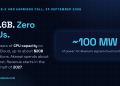
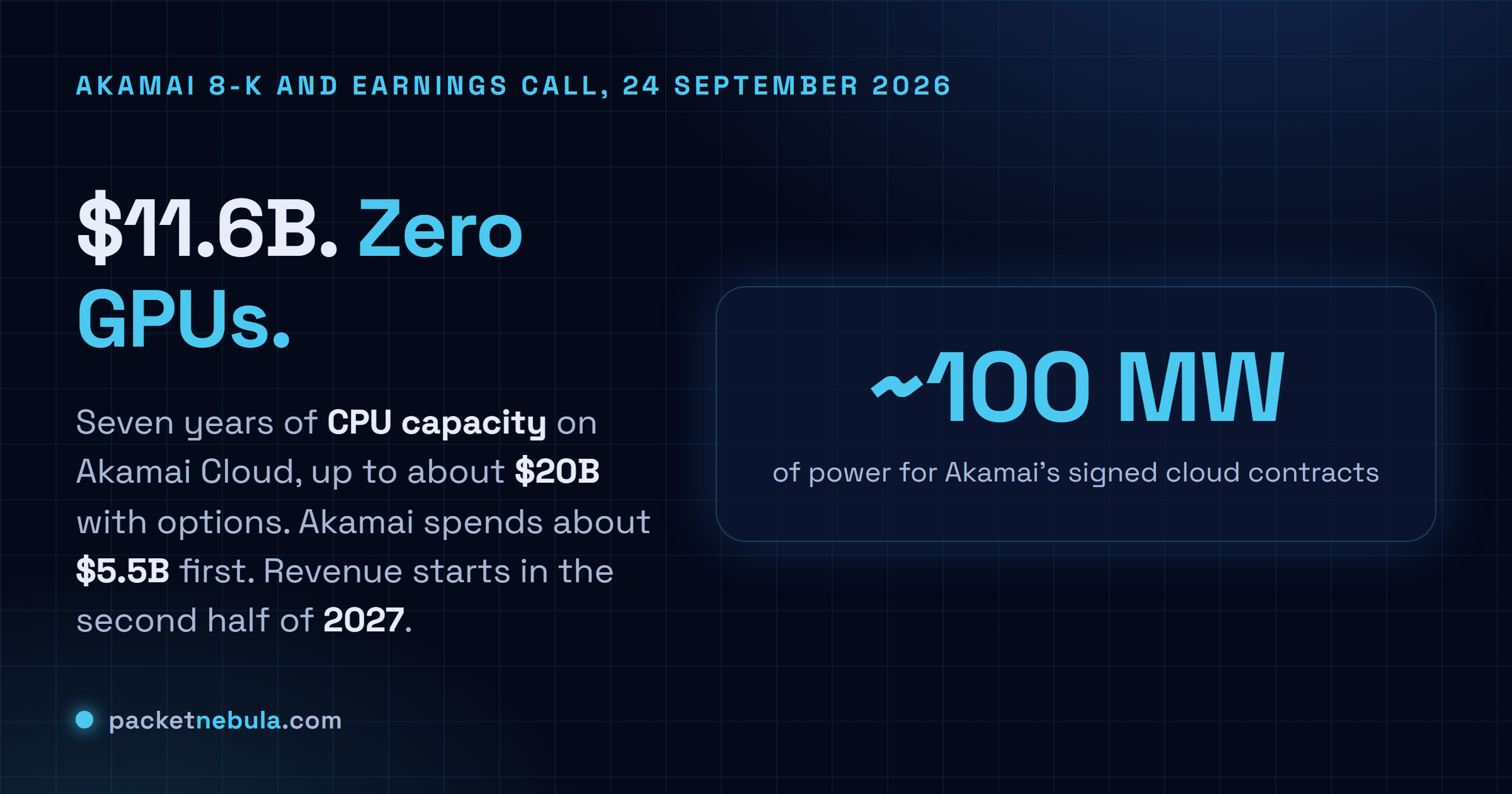
Answer card stating that Anthropic committed 11.6 billion dollars over seven years to Akamai Cloud for CPU workloads only, with an option to add about 9 billion more, about 5.5 billion dollars of capex on Akamai's side, revenue from the second half of 2027, and about 100 megawatts of power for Akamai's signed cloud contracts.
The biggest contract in Akamai's history, and it doesn't include a GPU.

What $11.6 billion of CPUs actually means

The 8-K's wording is careful. The commitment is for cloud infrastructure services to support Anthropic's "accelerating CPU workload demands" on Akamai Cloud, which is the old Linode platform grown up, spread over Akamai's points of presence. Per BankInfoSecurity's account of the call, the deal's "entirely CPU-based", while Akamai's wider book with Anthropic mixes CPU and GPU. Akamai says it signed $2.8 billion of multi-year cloud commitments earlier in 2026, and Bloomberg reported a $1.8 billion Anthropic deal back in May. So this is the third step up, not a first date.

Why CPUs? Nobody's said, officially. Our guess, and it's only a guess: agents. A model that writes code, runs it, opens a browser and calls tools spends a lot of wall-clock time in sandboxes, and a sandbox is a plain VM or container. It needs cores and RAM. It doesn't need an H-class accelerator sitting idle while a test suite runs. Akamai's own roadmap in the release lists agent sandboxing, which fits. We might be wrong, though. Batch data prep and evaluation harnesses are CPU-hungry too, and Anthropic hasn't commented beyond the release.

The power side's small by AI standards. Akamai says its signed cloud contracts, all of them, need about 95 to 105 MW. The Nscale deal we covered in August was 460 MW on its own. CFO Ed McGowan's pitch is that CPU work earns more per megawatt, and Akamai puts its portfolio at roughly $22 million of annual revenue per MW. That's a very different business from renting GPUs by the hour.

The warrant, the capex and the exit door

Here's the part that makes this unusual for Akamai. It's the first time it has attached a warrant to a cloud contract. Anthropic gets the right to buy non-voting preferred stock convertible into 7.7 million common shares, about 5% of the company, at $111.33 each. About 2% vests with the $11.6 billion commitment. The other 3% vests roughly 1% at a time, for each extra $3 billion of services Anthropic signs. Three extra tranches, $9 billion, and you land at about $20 billion in total.

Some quick arithmetic of our own. Akamai traded at $127.49 the morning after, per 24/7 Wall St. The first 2% is around 3.1 million shares, about $16 each in the money, so roughly $50 million on paper. It reads as a sweetener, not a strategy.
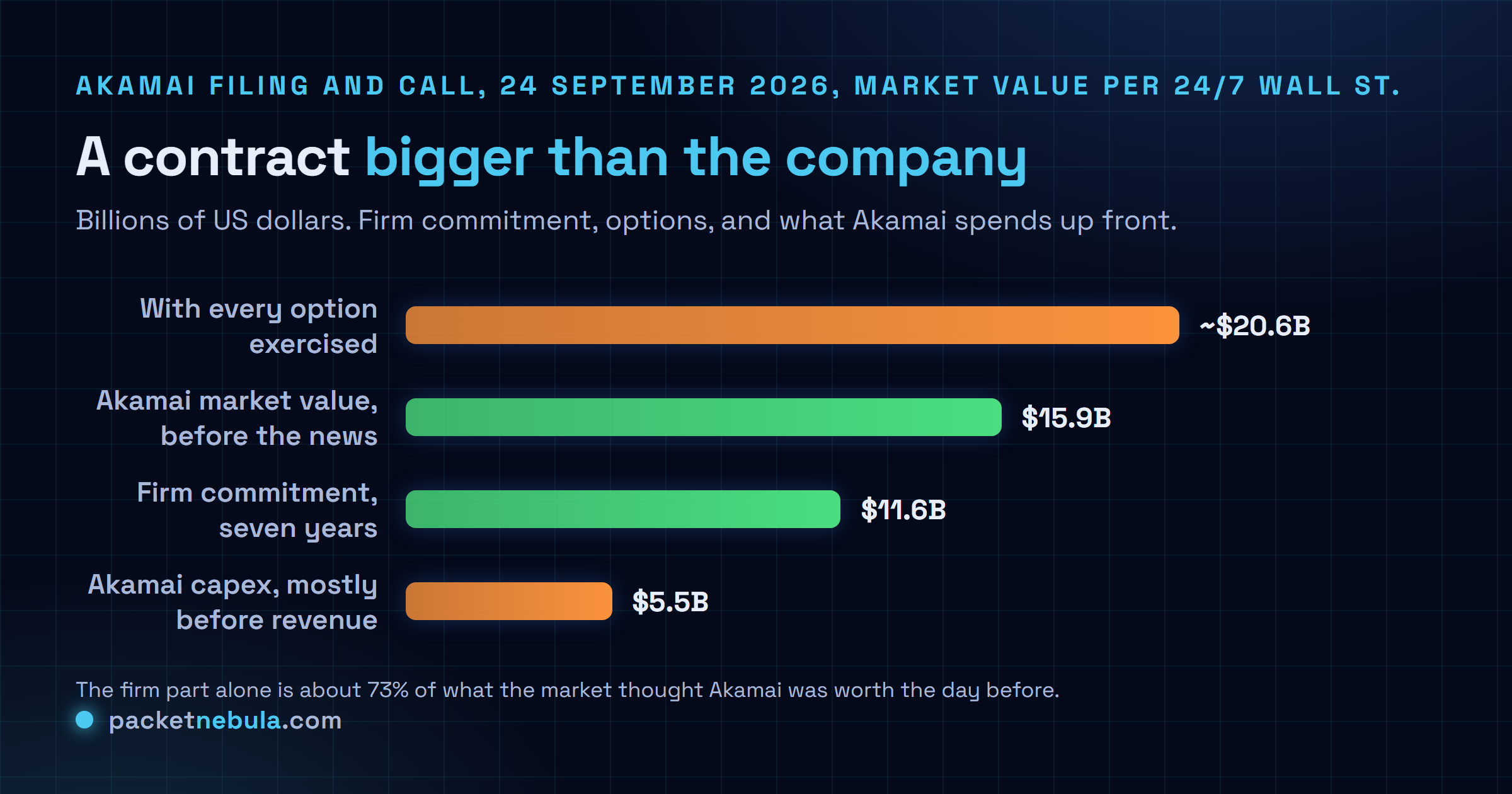
Horizontal bar chart comparing the Anthropic and Akamai deal to Akamai itself: about 20.6 billion dollars with every option exercised, 15.87 billion dollars of Akamai market value before the announcement, 11.6 billion dollars of firm commitment over seven years, and about 5.5 billion dollars of capex Akamai spends before revenue arrives.
Market value from 24/7 Wall St., everything else from Akamai's filing and call.

The capex is where we'd look harder. Akamai expects about $5.5 billion to serve the firm commitment, including roughly $1.7 billion added to 2026 for components and memory bought ahead. It isn't building its own data centres; it's leasing colocation space. Revenue doesn't start until the second half of 2027. And TechCrunch notes the deal depends on Akamai hitting delivery and availability requirements, with either side able to walk away under certain conditions. Those conditions aren't public. For a company whose pre-deal market value was $15.87 billion, that's a lot of money spent against terms we can't read.

Who should care, and what we'd watch

If you run workloads on Akamai Cloud today, the practical question is capacity. A single tenant absorbing tens of megawatts of new CPU build-out could either make the platform better funded or make regions tighter for everyone else during 2027. Akamai hasn't said which regions the build goes into, so we can't tell you yet.

If you're sizing agent infrastructure yourself, the signal's clearer. A frontier lab just priced seven years of general-purpose compute at the scale of a small cloud. It matches how agent loops behave: the model call's often a fraction of the elapsed time, and the rest is shells and builds. Honestly, I'd stop budgeting agent projects as pure token spend. The accelerator race gets the headlines, but CPU hours are the line that grows quietly.

What we don't know is still long. No region list, no instance types, no exit terms, and no word from Anthropic on what runs where. If Akamai's next quarterly filing adds detail, we'll update this page.

Sources

Akamai, Akamai Announces $11.6 Billion Multi-year Agreement with Anthropic, 24 September 2026, and the Form 8-K exhibit 99.1 (commitment, options, warrant terms, $5.5B and $1.7B capex, no 2026 revenue impact). TechCrunch, Anthropic to pay Akamai $11.6 billion over seven years in cloud deal, 25 September 2026 (CPU focus, exit conditions, the May $1.8B report, first warrant on a cloud deal). BankInfoSecurity, 7-Year, $11.6B Anthropic Deal Drives Akamai Cloud Buildout, September 2026 (95 to 105 MW, $22M per MW, colocation, revenue timeline). 24/7 Wall St., Akamai surges 15% on $11.6B Anthropic cloud deal, 25 September 2026 (share price, $15.87B market value).

Frequently asked questions

Does the Akamai deal give Anthropic GPUs?

No. Akamai's filing ties the $11.6 billion commitment to Anthropic's CPU workloads, and coverage of the call describes it as entirely CPU-based. Akamai's other business with Anthropic includes GPU capacity, but this contract doesn't.

How big can the deal get?

About $20 billion. The firm commitment is $11.6 billion over seven years, and Anthropic can add roughly $9 billion more in $3 billion steps, each vesting about another 1% of the warrant.

Is Anthropic becoming an Akamai shareholder?

Potentially, up to about 5%. The warrant covers non-voting preferred stock convertible into 7.7 million common shares at $111.33, and it vests as Anthropic's spending rises, about 2% at the start.

When does the capacity come online?

Akamai expects revenue from the second half of 2027, $150 million to $300 million that year, and a run rate near $1.7 billion from the end of 2028. It hasn't named regions or dates for specific sites.

Tags: ai-infrastructureAkamaianthropiccloudnews
Share197Tweet123
stephane

stephane

  • Trending
  • Comments
  • Latest
Answer card: Proton Lumo 2.0 is private by policy, not by locality. Saved history is locked so even Proton cannot read it, but the prompt is decrypted on a Proton EU server to answer it, then forgotten.

Proton Lumo 2.0 review: how private is it, really?

3 September 2026
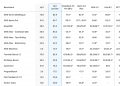
The Agentic Coding section of the official Hy4 preview benchmark appendix published by Tencent, a table comparing Hy3 and Hy4 preview against DeepSeek V4 Pro 0813, Qwen 3.8 Max, GLM 5.3, Kimi K3, GPT 5.6 Sol and Claude Opus 5 across SWE-bench Multilingual, SWE-bench Pro, DeepSWE, three SWE Atlas tasks, SWE-Marathon, Terminal-Bench 2.1, NL2Repo-Bench, CyberGym, ProgramBench, PostTrainBench and Harbor-Index.

Tencent’s 770B Hy4 tops one benchmark row in 46

3 September 2026
Answer card: Qwen 3.7 Max is API-only and cannot run locally yet; the open Qwen models (Qwen 3.6 27B, qwen3:8b to 32b) run offline via Ollama.

Qwen 3.7 local: what you can actually run offline

22 June 2026
Answer card: JWTs are not encrypted, anyone can read them; the signature proves who issued the token, not who may read it.

Are JWTs encrypted? No, and the difference will bite you

0
Answer card: a random 8 character password falls in under 2 hours offline, while 16 random characters hold for 1.4 trillion years at the same speed.

How long does it take to crack a password in 2026?

0
Answer card: three DNS records decide if your mail lands or bounces; SPF lists allowed senders, DKIM signs messages, DMARC sets the failure policy.

SPF, DKIM and DMARC explained: the records your email needs

0
Answer card: Xiaomi retrained MiMo-V2.6 to stop repeating tool calls, API swapped on 25 September 2026, MIT weights on 27 September, same model names.

MiMo-V2.6-Pro was quietly retrained to stop looping on tool calls

28 September 2026
Answer card: Anthropic committed $11.6 billion over seven years to Akamai Cloud for CPU workloads only, with revenue from the second half of 2027.

Anthropic’s $11.6B Akamai deal buys CPUs, not GPUs

27 September 2026
Answer card: Google Suncatcher MVP satellite, four Trillium TPUs on about one kilowatt, launching on SpaceX Transporter-18, reported for 1 October 2026.

Google’s first Suncatcher satellite flies four TPUs on 1 kW

25 September 2026
  • About
  • Contact
  • Privacy
  • Legal

Copyright © 2026 Stephane Cardon.

Welcome Back!

Login to your account below

Forgotten Password?

Retrieve your password

Please enter your username or email address to reset your password.

Log In
No Result
View All Result
  • Home
  • Articles
    • Security
    • Network
    • Dev
    • Sysadmin
    • SEO
    • Email & DNS
  • Tools
    • Network tools: free, fast, no signup
    • Security tools: free, fast, no signup
    • Developer tools: free, fast, no signup
    • Sysadmin tools: free, fast, no signup
    • SEO tools: free, fast, no signup
    • Email & DNS tools: free, fast, no signup
  • Download
  • About

Copyright © 2026 Stephane Cardon.