
• Latest
  • Trending
  • All
Answer card stating that Mullvad announced on 3 September 2026 that it is shutting down its public encrypted domain name system servers on 2 November 2026 and sponsoring the Quad9 Foundation instead, with 194.242.2.2 and its five sibling addresses all going away, and virtual private network customers unaffected.

Mullvad’s DNS servers go dark on 2 November, and Quad9 blocks no ads

5 September 2026
OpenAI announcement image for GPT-6 Astra, a spiral galaxy of white, blue and amber points of light curling around a bright core on a near black star field.

GPT-6 Astra lists at $10 and $50, 2.5x what GPT-5.6 Sol costs

4 September 2026
Google's official announcement image for the release, reading Introducing Gemini 3.8 Flash and 3.8 Flash Cyber in black type over a pale blue background with a blurred white chevron and the four colour Gemini spark below.

Gemini 3.8 Flash keeps the price and the 1 January cliff

3 September 2026
Answer card stating that Anthropic announced Enterprise Frontier Safeguards on 1 September 2026, that activity data used for misuse monitoring moves into cloud storage the customer controls under the customer own encryption keys, that Anthropic charges nothing for the feature while the cloud provider bills storage and egress, and that the phased rollout starts later in autumn 2026 with interim zero data retention on Fable 5 and Fable 5.1 for eligible customers.

Anthropic moves retention into your own cloud, for 30 days

3 September 2026
Official Google diagram of a client connection in three numbered steps: a DNS lookup with a query and an address, a TLS ClientHello and ServerHello, then a content exchange with a website. A callout on the DNS step reads 25% of global web traffic is now protected by encrypted DNS, and a callout beside an Android phone on the ClientHello step reads Android 17 supports ECH GREASE by default.

Android 17 hides the SNI, not your DNS or destination

3 September 2026
Still frame from the Claude Fable 5.1 launch video showing model-designed protein binders in orange docked against twelve grey target proteins, rendered as ESMFold2 structure predictions.

Claude Fable 5.1 breaks forced tool use, cuts cache 75%

1 September 2026
Answer card stating that on 31 August 2026 the European Commission designated ChatGPT a Very Large Online Search Engine under the Digital Services Act, the first conversational AI service classified that way, because it answers user prompts and queries including by searching the web, with OpenAI having declared roughly 159.1 million average monthly users in the European Union for ChatGPT search.

The EU now calls ChatGPT a very large search engine

3 September 2026
Answer card stating that on 31 August 2026 the Department of War added OpenAI ChatGPT Mil and Starshield AI Grok for Government to the GenAI.mil portal alongside Google Gemini, all three accredited at Impact Level 5 for Controlled Unclassified Information, with 1.7 million unique users onboarded out of roughly 3 million eligible personnel, and ChatGPT Mil currently serving GPT-5.4 Terra with GPT-5.6 Terra said to be rolling out.

ChatGPT Mil and Grok reached IL5 on GenAI.mil

3 September 2026
Answer card stating that Anthropic opened a research preview of the Model Hardware Standard on 27 August 2026, standardising the driver layer between an operating system and a laboratory instrument with read and write primitives plus discovery and safety limits, reachable through MCP as well as a command line and code files, with no public specification published.

Anthropic’s Model Hardware Standard is gated, and sits under MCP

3 September 2026
Official Cohere key art for the Parse 5 launch: the Cohere mark and the wordmark Parse with a superscript 5 in white, centred on a soft out of focus gradient of deep blue, violet and amber curves.

Cohere Parse 5 is $1.50 per 1,000 pages, on three of five dimensions

3 September 2026
Title card from the OpenAI announcement video: a man sits on a blue sofa in a loft with tall windows and potted plants, a laptop open on the coffee table in front of him, with the words WebMCP in ChatGPT in large white type across the lower left.

WebMCP in ChatGPT needs GPT-5.6 Sol or Terra

3 September 2026
The Agentic Coding section of the official Hy4 preview benchmark appendix published by Tencent, a table comparing Hy3 and Hy4 preview against DeepSeek V4 Pro 0813, Qwen 3.8 Max, GLM 5.3, Kimi K3, GPT 5.6 Sol and Claude Opus 5 across SWE-bench Multilingual, SWE-bench Pro, DeepSWE, three SWE Atlas tasks, SWE-Marathon, Terminal-Bench 2.1, NL2Repo-Bench, CyberGym, ProgramBench, PostTrainBench and Harbor-Index.

Tencent’s 770B Hy4 tops one benchmark row in 46

3 September 2026
Official Qwen architecture diagram for Qwen3.8-Flash-Next, showing input tokens feeding a vocabulary embedding and a separate n-gram embedding layer at layer 2, a stack of Gated DeltaNet layers punctuated by Qwen Sparse Attention layers in a three to one hybrid block, Gated Residual read and write gates around each MoE block, and MTP modules beside the prediction head.

Qwen3.8-Flash-Next runs 6B active and weighs 173 GiB

3 September 2026
  • About
  • Contact
  • Privacy
  • Legal
Saturday, September 5, 2026
  • Login
Packet Nebula
  • Home
  • Articles
    • Security
    • Network
    • Dev
    • Sysadmin
    • SEO
    • Email & DNS
  • Tools
    • Network tools: free, fast, no signup
    • Security tools: free, fast, no signup
    • Developer tools: free, fast, no signup
    • Sysadmin tools: free, fast, no signup
    • SEO tools: free, fast, no signup
    • Email & DNS tools: free, fast, no signup
  • Download
  • About
No Result
View All Result
Packet Nebula
No Result
View All Result
Home Network

Mullvad’s DNS servers go dark on 2 November, and Quad9 blocks no ads

by stephane
5 September 2026
in Network
0
Answer card stating that Mullvad announced on 3 September 2026 that it is shutting down its public encrypted domain name system servers on 2 November 2026 and sponsoring the Quad9 Foundation instead, with 194.242.2.2 and its five sibling addresses all going away, and virtual private network customers unaffected.
491
SHARES
1.4k
VIEWS
Share on FacebookShare on Twitter

There's a line in a router config somewhere with 194.242.2.2 in it, and whoever typed it has long since forgotten. Mullvad announced on 3 September that it's closing the public encrypted DNS servers it has run since 2022, and putting the money behind the Quad9 Foundation instead. The date that matters is 2 November 2026. After that, six addresses stop answering, and anything still aimed at them falls back to whatever the operating system treats as a spare resolver, which on plenty of machines is the internet provider you were trying to keep out of the loop. We read both providers' documentation, because the swap looks like a one line change and it isn't quite.

The short answer

Mullvad's six public resolvers, 194.242.2.2 through 194.242.2.9, go dark on 2 November 2026. If you configured one by hand, over DoH or DoT, you need a different address before then. Quad9's 9.9.9.9 is where Mullvad points you, and it validates DNSSEC and blocks domains its threat feeds mark as malicious. What it won't do is block advertising, and five of the six Mullvad endpoints did.
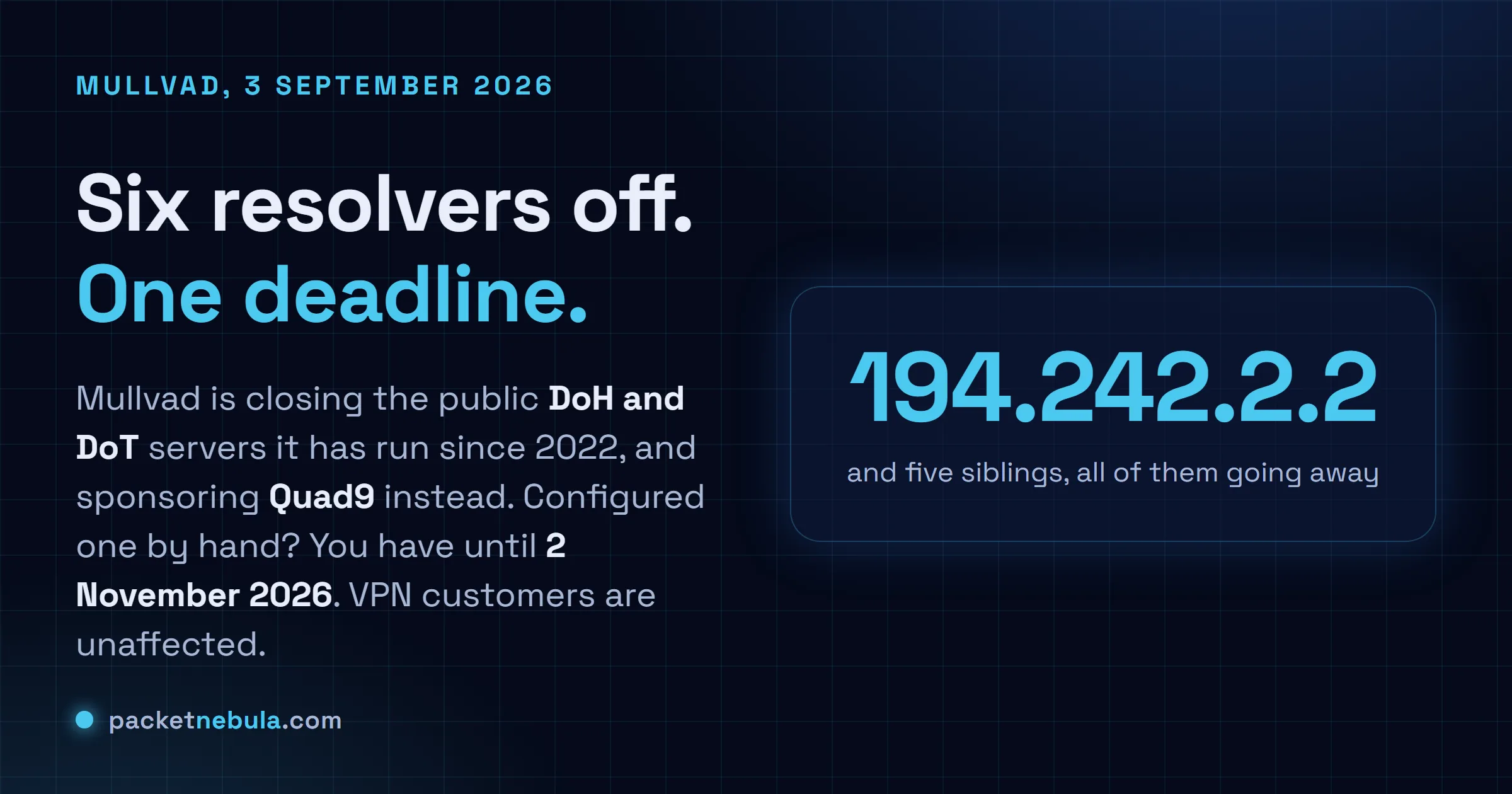
2 Nov 2026when the six Mullvad resolvers stop answering
9.9.9.9the address Mullvad's own post sends you to
0 of 3Quad9 addresses that filter advertising
Answer card stating that on 3 September 2026 Mullvad announced it is shutting down the public encrypted domain name system servers it has run since 2022 and will financially sponsor the Quad9 Foundation instead, that anyone who manually configured a Mullvad DNS over HTTPS or DNS over TLS endpoint must switch before 2 November 2026, and that Mullvad virtual private network customers are unaffected because the application uses its own internal resolver.
One deadline, six addresses, and a filtering question underneath.

What actually goes away on 2 November

Mullvad ran the whole service on one prefix, with the filtering decided by which address you picked. 194.242.2.2, dns.mullvad.net, filtered nothing. 194.242.2.3 was the adblock variant, blocking ads and trackers. .4 added malware to that, .5 added social media, .6 swapped in adult content and gambling, and .9 turned on every list at once. Each variant answered DoH on port 443 and DoT on port 853 under a matching hostname, so a browser profile and a systemd-resolved drop-in could be pointed at the same behaviour.

Two groups have to do something. Anyone who typed one of those addresses or hostnames into a router, a resolver config or a browser, and anyone running Mullvad's iOS or macOS DoH profile, which Mullvad says will simply stop working and needs replacing with Quad9's equivalent. Mullvad's own help page now carries the discontinuation notice at the top of the DoH table, which is a decent sign they expect people to arrive there confused.

Mullvad Browser users on defaults get moved to Quad9 automatically, the bundled ad blocking option included. If you'd switched that browser to base, extended or family by hand, Mullvad asks you to put it back to the default yourself. Slightly odd request, until you realise the automatic migration only knows how to move the settings it shipped.

And the group that doesn't care at all: Mullvad VPN subscribers. The app has always resolved through its own internal DNS inside the tunnel, so none of the public addresses were ever in play. That difference got flattened in a fair bit of the coverage, and it's the gap between a support ticket and a nothing.

Quad9 takes the queries, not the blocklists
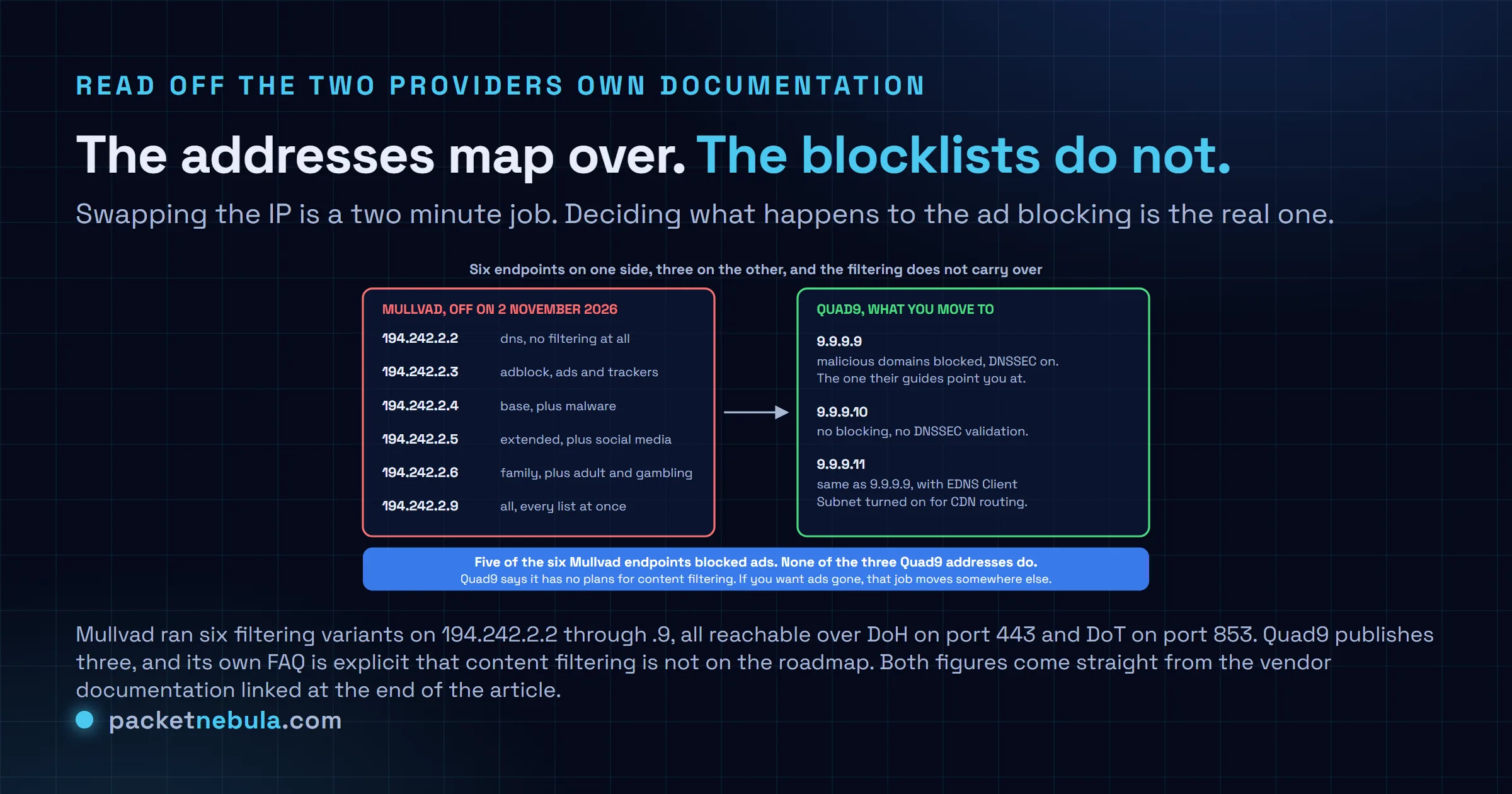
Diagram mapping the six Mullvad public resolver addresses that shut down on 2 November 2026, namely 194.242.2.2 with no filtering, 194.242.2.3 blocking advertisements and trackers, 194.242.2.4 adding malware, 194.242.2.5 adding social media, 194.242.2.6 adding adult content and gambling and 194.242.2.9 applying every list at once, onto the three Quad9 addresses that replace them, namely 9.9.9.9 which blocks malicious domains with DNSSEC validation enabled, 9.9.9.10 which applies no blocking and no validation, and 9.9.9.11 which matches 9.9.9.9 while enabling EDNS Client Subnet.
The address swap is trivial. The filtering is the decision.

Quad9 publishes three services. The recommended one is 9.9.9.9 with 149.112.112.112 as its second address, reachable over DoH at https://dns.quad9.net/dns-query and DoT at dns.quad9.net. It validates DNSSEC and it blocks domains its threat feeds flag as malicious. 9.9.9.10 does neither, for anyone who wants a plain recursive resolver with nothing in the way. 9.9.9.11 behaves like 9.9.9.9 but sends EDNS Client Subnet, which buys better CDN routing at the price of handing the authoritative server a truncated version of your network address.

Now the part worth reading twice. Quad9's FAQ states it has no plans to provide content filtering, and that its scope is malicious domains such as phishing and malware. Advertising isn't in that scope, and neither are trackers. Five of Mullvad's six endpoints blocked both. So if you were on adblock, base, extended, family or all, and most people who go to the trouble of configuring DoH by hand were on one of those, moving to 9.9.9.9 quietly switches your ad blocking off. Nothing breaks. Pages just get busier three weeks later, and nobody connects it back to the DNS change.

There isn't a like for like replacement, and I'd rather say that plainly than pretend otherwise. If the filtering was the point, you're choosing between a resolver that sells content blocking as a product and running your own forwarder with a blocklist, pointed at Quad9 over DoT. We do the second, and it's more work than it sounds on day one and much less than it sounds after that. If the encryption was the point and the ad blocking was a bonus you'd half forgotten about, then 9.9.9.9 is a straight swap and you're finished in two minutes.

Find every place that address is written down

The awkward part of this migration isn't the change, it's the inventory. Encrypted DNS addresses end up in places nobody documents: a router's WAN page, a resolver drop-in file, a browser profile, a phone's private DNS field, a macOS configuration profile installed in 2023 by somebody who has since left. Grep is the fastest first pass on Linux, and it catches the config files that resolvectl will never mention.

Linux
grep -rn 194.242.2 /etc/ 2>/dev/null

Then look at what the resolver stack is actually doing, which is not always what the files say. On a systemd box this prints the servers in use per link, and whether DNS over TLS is switched on:

Linux
resolvectl status

Windows keeps the plain servers and the DoH templates in separate places, so list the servers per interface first and work outwards from there:

Windows
Get-DnsClientServerAddress -AddressFamily IPv4

Once you've switched, confirm the new one answers before you close the ticket. Boring, and it catches the case where a firewall rule allowed 194.242.2.0/24 outbound and nothing else:

Linux
dig @9.9.9.9 example.com +short

Browsers hold their own setting and ignore the system one, so Firefox's Privacy and Security pane and Chrome's secure DNS option both need checking separately. Android's private DNS field wants a hostname rather than an address, so dns.quad9.net goes there. If you'd rather see what a resolver returns for a domain before touching your own config, our DNS Lookup tool does it in the browser and reports the TTL on every record. That TTL decides how long stale answers hang around after any change you make, and we wrote up what DNS TTL actually controls if that part is fuzzy. For the command line versions in more depth, there's how to do a DNS lookup from the command line.

Sources

Mullvad, Shutting down our public encrypted DNS servers and sponsoring Quad9 instead, 3 September 2026 (the announcement, the 2 November date, the browser and profile handling). Mullvad, DNS over HTTPS and DNS over TLS (the six addresses, the filtering each one applies, and the discontinuation notice). Quad9, Service addresses and features (the three services and what each validates or blocks). Quad9, Frequently asked questions (no plans for content filtering). CyberInsider, Mullvad to shut down public encrypted DNS servers, back Quad9 instead, 4 September 2026.

Frequently asked questions

Does this affect me if I pay for Mullvad VPN?

No. The VPN app resolves through Mullvad's own internal DNS inside the tunnel, and it has never used the public addresses. Mullvad says as much in the first line of the announcement, which is why they considered the public service redundant for their own customers to begin with. The change only touches people who put 194.242.2.x, or one of the dns.mullvad.net hostnames, somewhere by hand.

What happens on 2 November 2026 if I do nothing?

The addresses stop answering, and what your device does next depends on how it was configured. A system with a secondary resolver falls back to it, which is often whatever DHCP handed out, so your internet provider sees the queries again. A browser set to a custom DoH provider with no fallback tends to fail resolution outright until the setting changes. Either way it's a change you'd rather make on a Tuesday afternoon than discover on a Sunday.

Which Quad9 address should I use?

9.9.9.9, with 149.112.112.112 as the secondary, unless you have a specific reason not to. That pair validates DNSSEC and blocks malicious domains, and it's what Quad9's own setup guides use. Pick 9.9.9.10 if you need a resolver that does no blocking and no validation, and 9.9.9.11 if you care about CDN routing accuracy enough to send EDNS Client Subnet with your queries. Over DoH the URL is https://dns.quad9.net/dns-query, and over DoT the hostname is dns.quad9.net.

Will Quad9 block ads like the Mullvad adblock endpoint did?

It won't. Quad9's FAQ says it has no plans to provide content filtering and that it's dedicated to blocking malicious domains, meaning phishing, malware and exploit kits. Advertising and trackers sit outside that. Five of the six Mullvad endpoints filtered ads, so for most people this migration removes ad blocking as a side effect. Getting it back means a browser extension, or a filtering resolver you run yourself.

Is Mullvad paying Quad9, and does that change anything for Quad9 users?

Mullvad says it's putting the resources it spent running the service into financially supporting Quad9 instead, and no figure is published. Quad9 is a Swiss foundation already funded by donations and sponsorship, so this adds to an existing model rather than creating a new arrangement. Nothing in either announcement points to a change in how Quad9 operates, what it blocks or what it logs.

Tags: dnsDNSSECDoHMullvadnewsQuad9
Share196Tweet123
stephane

stephane

  • Trending
  • Comments
  • Latest
Answer card: Proton Lumo 2.0 is private by policy, not by locality. Saved history is locked so even Proton cannot read it, but the prompt is decrypted on a Proton EU server to answer it, then forgotten.

Proton Lumo 2.0 review: how private is it, really?

3 September 2026
Answer card stating that Anthropic announced Enterprise Frontier Safeguards on 1 September 2026, that activity data used for misuse monitoring moves into cloud storage the customer controls under the customer own encryption keys, that Anthropic charges nothing for the feature while the cloud provider bills storage and egress, and that the phased rollout starts later in autumn 2026 with interim zero data retention on Fable 5 and Fable 5.1 for eligible customers.

Anthropic moves retention into your own cloud, for 30 days

3 September 2026
Google's official announcement image for the release, reading Introducing Gemini 3.8 Flash and 3.8 Flash Cyber in black type over a pale blue background with a blurred white chevron and the four colour Gemini spark below.

Gemini 3.8 Flash keeps the price and the 1 January cliff

3 September 2026
Answer card: JWTs are not encrypted, anyone can read them; the signature proves who issued the token, not who may read it.

Are JWTs encrypted? No, and the difference will bite you

0
Answer card: a random 8 character password falls in under 2 hours offline, while 16 random characters hold for 1.4 trillion years at the same speed.

How long does it take to crack a password in 2026?

0
Answer card: three DNS records decide if your mail lands or bounces; SPF lists allowed senders, DKIM signs messages, DMARC sets the failure policy.

SPF, DKIM and DMARC explained: the records your email needs

0
Answer card stating that Mullvad announced on 3 September 2026 that it is shutting down its public encrypted domain name system servers on 2 November 2026 and sponsoring the Quad9 Foundation instead, with 194.242.2.2 and its five sibling addresses all going away, and virtual private network customers unaffected.

Mullvad’s DNS servers go dark on 2 November, and Quad9 blocks no ads

5 September 2026
OpenAI announcement image for GPT-6 Astra, a spiral galaxy of white, blue and amber points of light curling around a bright core on a near black star field.

GPT-6 Astra lists at $10 and $50, 2.5x what GPT-5.6 Sol costs

4 September 2026
Google's official announcement image for the release, reading Introducing Gemini 3.8 Flash and 3.8 Flash Cyber in black type over a pale blue background with a blurred white chevron and the four colour Gemini spark below.

Gemini 3.8 Flash keeps the price and the 1 January cliff

3 September 2026
  • About
  • Contact
  • Privacy
  • Legal

Copyright © 2026 Stephane Cardon.

Welcome Back!

Login to your account below

Forgotten Password?

Retrieve your password

Please enter your username or email address to reset your password.

Log In
No Result
View All Result
  • Home
  • Articles
    • Security
    • Network
    • Dev
    • Sysadmin
    • SEO
    • Email & DNS
  • Tools
    • Network tools: free, fast, no signup
    • Security tools: free, fast, no signup
    • Developer tools: free, fast, no signup
    • Sysadmin tools: free, fast, no signup
    • SEO tools: free, fast, no signup
    • Email & DNS tools: free, fast, no signup
  • Download
  • About

Copyright © 2026 Stephane Cardon.