
• Latest
  • Trending
  • All
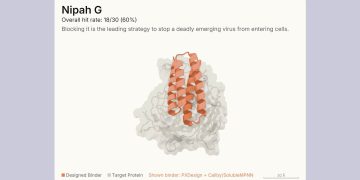
Still frame from the Claude Fable 5.1 launch video showing model-designed protein binders in orange docked against twelve grey target proteins, rendered as ESMFold2 structure predictions.

Claude Fable 5.1 breaks forced tool use, cuts cache 75%

1 September 2026
Answer card stating that Qwen-Image-2.1, released on 20 September 2026, ships open weights with a 7 billion parameter diffusion transformer, a Qwen3-VL 8B text encoder and an RGBA VAE totalling about 33 gigabytes in BF16, under the Qwen Research License that limits use to research or evaluation and requires a separate commercial licence, unlike the Apache 2.0 licence of Qwen-Image 1.0.

Qwen-Image-2.1 brings the weights back, but not the Apache licence

21 September 2026
Answer card stating that Ternary Bonsai 2 27B, released by PrismML on 17 September 2026 under Apache 2.0, packs Qwen3.8 27B into 5.95 gigabytes at 1.72 bits per weight, keeps 98.2 percent of the 14-benchmark average, about 75 percent on SWE-bench Verified and Terminal-Bench 2.1, and needs PrismML's llama.cpp fork to run.

Does Bonsai 2 27B really keep 98% of Qwen3.8 in 5.95 GB?

20 September 2026
Answer card stating that Jev 1.13 from TypeSafe AI is a decision model in early access since 15 September 2026 that returns typed probabilities instead of text, priced at 42 dollars per billion input tokens with output tokens free, answering in 70 to 500 milliseconds, with a 64K token request budget, text input only, and a documented list of things it does badly, including counting and dates.

Jev 1.13 bills $42 a billion tokens, and it can’t count

19 September 2026
Answer card stating that Qwen3.8-Omni-Flash launched on 17 September 2026 as an API only model on Alibaba Cloud Model Studio, taking text, images, audio and video in a 1M token context and returning text only, priced at 0.15 dollars per million input tokens for every modality and 0.47 dollars per million output tokens in the international regions, with no open weights published and the Qwen-Live Harness GitHub repository returning 404.

Qwen3.8-Omni-Flash bills audio at $0.15 and ships no weights

18 September 2026
Answer card stating that on 15 September 2026 AWS said it is unable to restore access to resources and data hosted exclusively in the Middle East Bahrain region me-south-1 and in the mec1-az2 zone of the UAE region, because the damage spanned multiple Availability Zones and exceeded what multi-AZ services are designed to withstand.

AWS can’t restore me-south-1, six months after the drone strikes

17 September 2026
Answer card stating that Google released Gemini 3.8 Live and Gemini 3.8 Live Extended Thinking on 15 September 2026 at 3 dollars per million audio input tokens and 12 dollars out, that the thinking model requires asynchronous tools, and that Artificial Analysis scores it 82.6 on its Speech to Speech Quality Index.

Gemini 3.8 Live Extended Thinking rejects any tool that blocks

16 September 2026
Answer card summarising the Atria Dawn Preview release: 744B GLM-5.2 base, MIT licence, 1.5 TB BF16 and 756 GB FP8 checkpoints, 256K context, top on five of sixteen benchmark rows and trailing on SWE-bench Pro.

Atria Dawn Preview is 744B under MIT, and the BF16 weighs 1.5 TB

15 September 2026
Answer card stating that OpenAI released the Agents API in public beta on 10 September 2026 with no separate fee, billed through model tokens, tool calls and hosted sandbox time, with a choice of OpenAI hosted, self hosted or partner sandboxes, US only data residency and no Zero Data Retention support.

OpenAI’s Agents API has no fee, no ZDR and a one hour sandbox clock

14 September 2026
Answer card: Sakana Fugu Max at $2 and $6 per million tokens, Fugu Ultra v2 unchanged at $5 and $30, and Sakana saying Ultra v2 scores without Fable 5 or GPT-6 Astra in its pool.

Fugu Max costs $2 and $6 while Fugu Ultra v2 runs without Fable 5

13 September 2026
Answer card stating that DeepSeek released DeepSeek-V4.1-Flash on 10 September 2026 as a 552 billion parameter mixture of experts model with a new causal encoder decoder architecture that activates 8 billion parameters on input and 16 billion on output, with native vision, a one million token context and MIT licensed weights, that the API model name is now deepseek-flash at 0.15 dollars per million input tokens and 0.60 dollars per million output tokens off peak, and that DeepSeek announced V4 Pro would be routed to V4.1-Flash from 14 September and reversed that on 11 September.

DeepSeek V4.1-Flash arrived, and the V4 Pro retirement lasted a day

12 September 2026
Answer card stating that Cognition released SWE-2 on 10 September 2026, a coding model post-trained from Kimi K3, scoring 50.0 percent on FrontierCode 1.1 Main against 50.9 percent for Claude Fable 5.1 and 27.3 percent on Terminal-Bench 4 against 55.8 percent, available only inside Devin.

SWE-2 trails Fable 5.1 by one point, and by 28 on Terminal-Bench 4

11 September 2026
Answer card for Meta Muse, free to 100 million tokens a week then $20 a month, launched 8 September 2026 for United States adults only, running in a dedicated per user virtual machine.

Does Meta Muse do enough to earn your inbox and a card on file?

9 September 2026
  • About
  • Contact
  • Privacy
  • Legal
Monday, September 21, 2026
  • Login
Packet Nebula
  • Home
  • Articles
    • Security
    • Network
    • Dev
    • Sysadmin
    • SEO
    • Email & DNS
  • Tools
    • Network tools: free, fast, no signup
    • Security tools: free, fast, no signup
    • Developer tools: free, fast, no signup
    • Sysadmin tools: free, fast, no signup
    • SEO tools: free, fast, no signup
    • Email & DNS tools: free, fast, no signup
  • Download
  • About
No Result
View All Result
Packet Nebula
No Result
View All Result
Home Dev

Claude Fable 5.1 breaks forced tool use, cuts cache 75%

by stephane
1 September 2026
in Dev
0
Still frame from the Claude Fable 5.1 launch video showing model-designed protein binders in orange docked against twelve grey target proteins, rendered as ESMFold2 structure predictions.
495
SHARES
1.4k
VIEWS
Share on FacebookShare on Twitter

Swap claude-fable-5 for claude-fable-5-1 in your config and there is a decent chance your agent starts throwing 400s before it finishes a single turn. Anthropic shipped both models on 1 September 2026, and the interesting part is not the benchmark deck. It is that forced tool use is simply gone: tool_choice set to any or tool now returns invalid_request_error, and anyone who was using that trick to get schema-valid JSON out of the model has code that stops working on a one-line change. The price story is real too, though it is hiding in a row most people skim past.

The short answer

Claude Fable 5.1 and Claude Mythos 5.1 landed on 1 September 2026. Same model underneath, different safeguards. Base price is untouched at $10 in and $50 out, and the whole cost story is one row: cache reads fell to a quarter of what other Claude models charge. Before you change the model ID, check three things, because forced tool use is the one that breaks loudest.
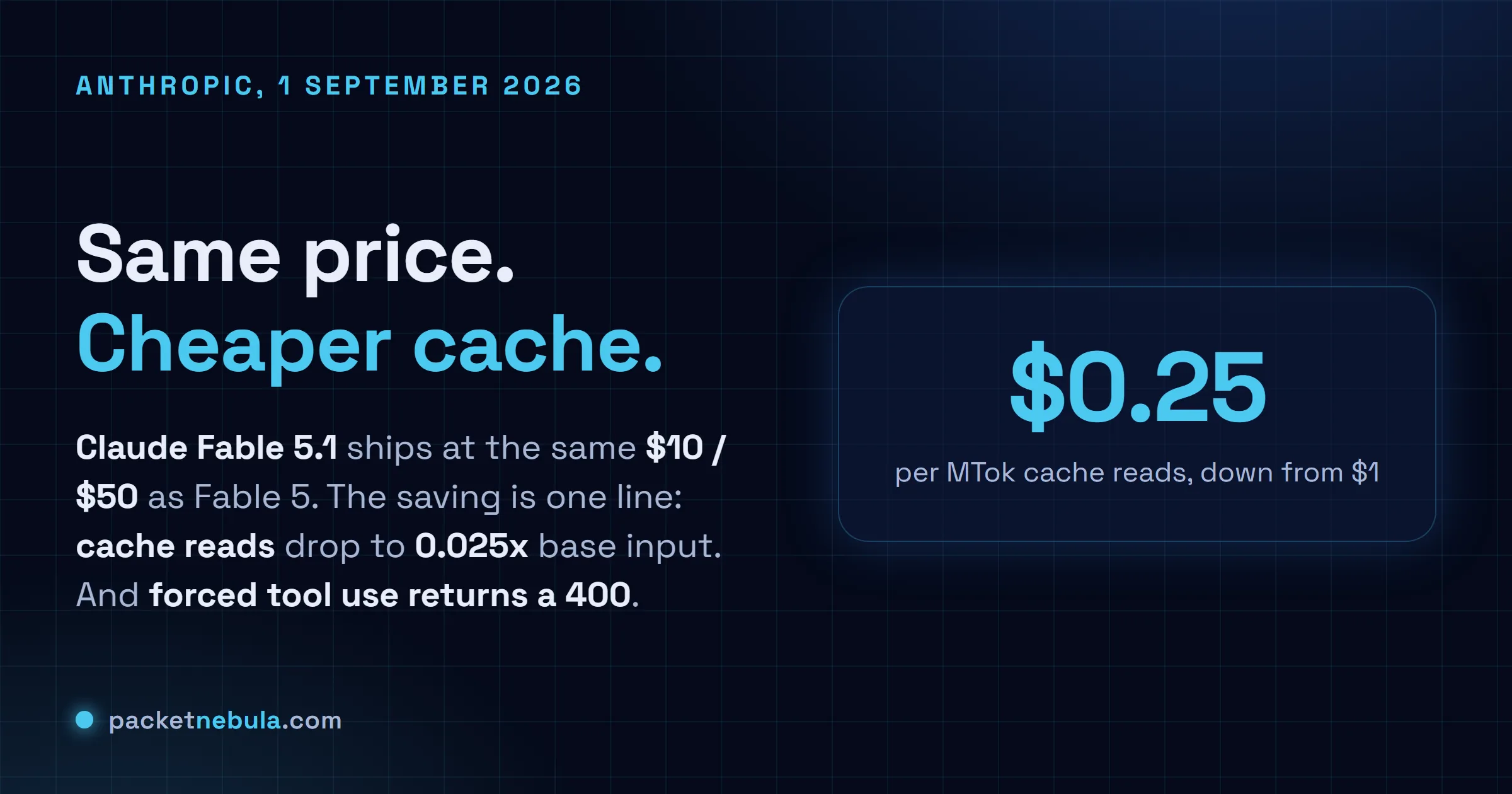
$0.25per MTok cache reads, down from $1
400what tool_choice any returns now
3breaking changes on a model swap
Answer card stating that Anthropic released Claude Fable 5.1 and Claude Mythos 5.1 on 1 September 2026 as the same underlying model with different safeguard levels, at an unchanged base price of ten dollars per million input tokens and fifty dollars per million output tokens, with cache reads cut to twenty five cents per million tokens, a one million token context window and one hundred twenty eight thousand max output tokens.
The one-card version. The price cut is entirely in the cache row.

The three things that break

Anthropic lists three breaking changes and five additive ones. Read the three.

Forced tool use is gone. tool_choice: {"type": "any"} and {"type": "tool", "name": "..."} both return a 400 invalid_request_error. The message reads tool_choice: type "tool" and "any" are not supported for this model. Meanwhile auto and none behave as before. The rationale is that thinking is always on here, and forcing a tool call skips it, so the model would dump its reasoning into the arguments. Fine as reasoning. It still means every pipeline that leaned on forced tool calls for structured output needs rewriting onto strict tool use or structured outputs before the model ID changes.

Thinking blocks only travel forwards. Every thinking block records which model produced it. Fable 5.1 reads earlier models’ blocks; no earlier model reads its. So a conversation that upgrades mid-flight keeps its reasoning, and one that falls back to Opus 5 loses it for the turns that run there. Worth knowing if you run a router. When a target model cannot read a block, the API drops it silently, uncounted and unbilled, unless you send the thinking-binding-controls-2026-08-01 beta header and read input_transformations.

Editing history now errors. Modify anything before a Fable 5.1 thinking block, the system prompt or the tools array or an earlier message, and the next request fails. Claude Code, claude.ai and the Agent SDK keep that prefix intact for you. If your code assembles the messages array itself, this is the one to audit. The pattern that bites hardest is the per-request reminder you inject into an earlier turn and strip on the next call, which is a common enough trick that Anthropic shipped turn-scoped system messages specifically to replace it.

One detail in the small print: the history check is enforced for accounts created on or after 31 August 2026. Older accounts get the mismatch recorded but not acted on until they opt in. So an established team can migrate and see nothing wrong, then watch a new account hit walls on identical code.
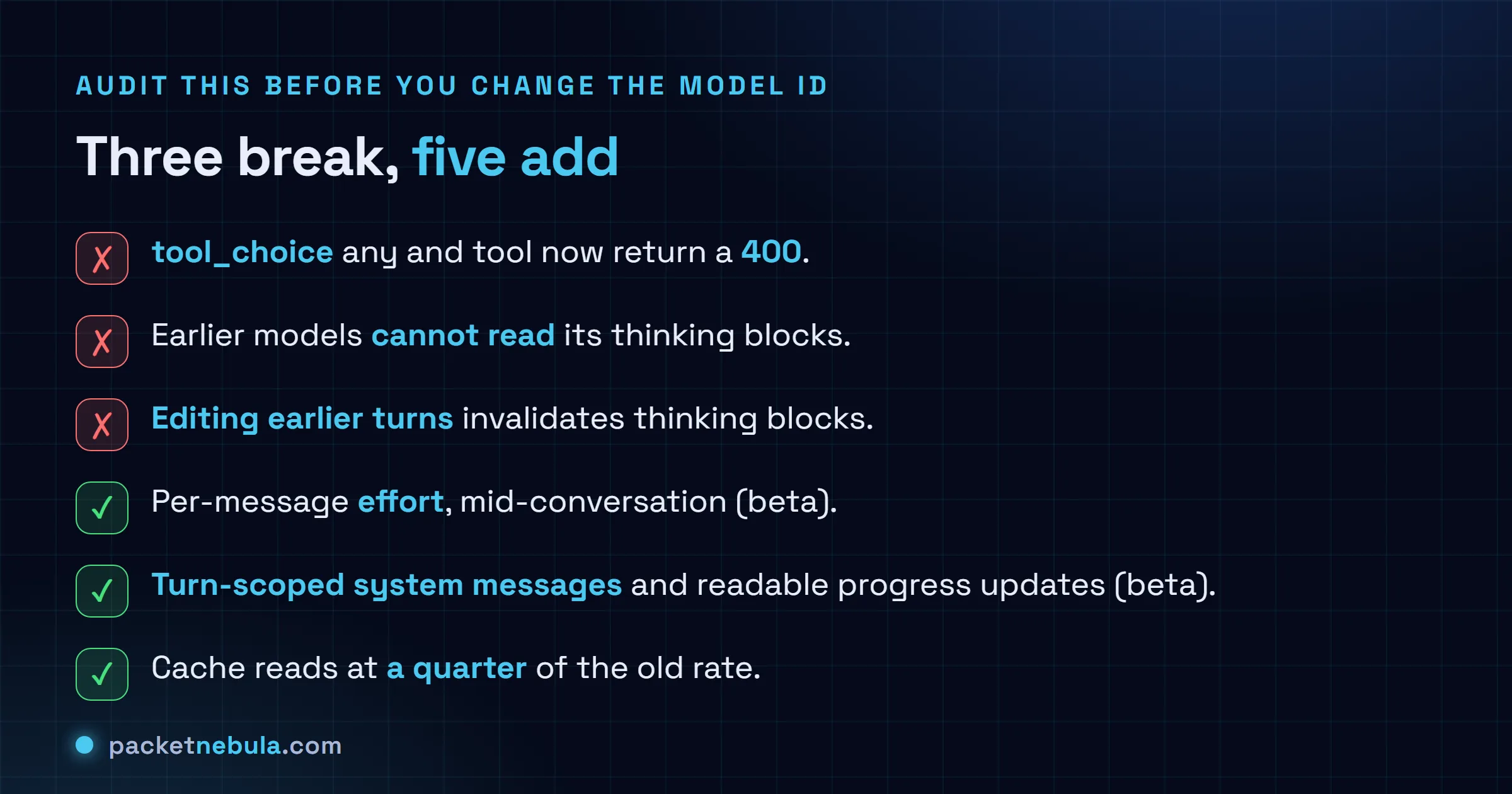
Checklist separating the three breaking changes in Claude Fable 5.1, namely that forced tool use returns a four hundred error, that earlier models cannot read its thinking blocks, and that editing earlier turns invalidates thinking blocks, from the five additive changes, namely per message effort in beta, turn scoped system messages in beta, readable progress updates between tool calls in beta, a lower cache read price, and content provenance through text watermarking and C2PA credentials.
Three break, five add. The audit is the left column.

Where the money actually moved

Base input stays at $10 per million. Output stays at $50. Anthropic’s headline is roughly 25 percent off for typical workloads and up to about 45 percent for highly agentic work, and every cent of that comes from one line.

Cache reads on Fable 5.1 and Mythos 5.1 cost 0.025 times the base input price. On every other Claude model that multiplier is 0.1. In money: $0.25 per million tokens instead of $1. Cache writes are unchanged at $12.50 for the five-minute tier and $20 for the hour, and the 512-token minimum cacheable prompt is unchanged too.

Which tells you exactly who benefits. A long agent session that re-reads the same cached prefix a few hundred times pays a quarter of what it used to. A one-shot classification job over fresh text pays the same as yesterday, because it never touches the cache. If someone shows you the 45 percent number as a general price cut, they have misread it.

Batch stays at half rate: $5 in, $25 out.
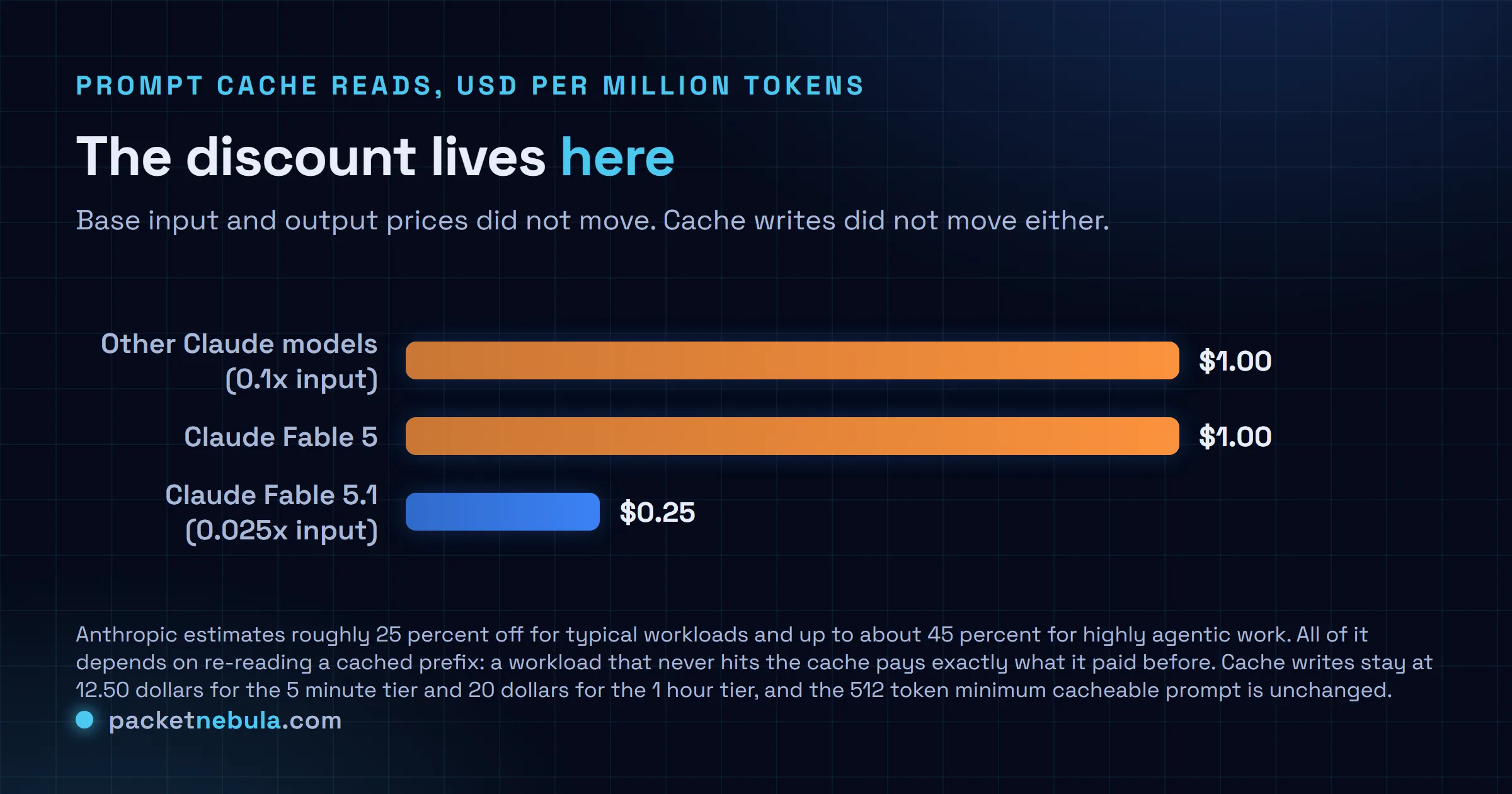
Horizontal bar chart comparing prompt cache read prices in dollars per million tokens, showing one dollar for Claude Fable 5 and for other Claude models at zero point one times the base input price, against twenty five cents for Claude Fable 5.1 and Claude Mythos 5.1 at zero point zero two five times the base input price, with base input unchanged at ten dollars and output unchanged at fifty dollars.
Same headline price. The cache line is the whole discount.

The regressions Anthropic wrote down itself

This is the part we did not expect, and honestly it is the most useful page in the launch. The docs list seven default behaviours that changed for the worse, with no code change on your side.

Parallel tool calling got more variable, so Fable 5.1 may issue one tool call per turn where Fable 5 batched several. Anthropic is blunt that this costs tokens, round trips and wall-clock time without improving answers, and the fix is a one-line batching instruction in your prompt. At low effort it answers from memory more often instead of calling search. It writes fewer progress updates during long tool runs, which can make an agentic turn look frozen to your users. It rewrites whole files where a targeted edit would do. Its prose is denser. It formats less in chat. And when summarising documents it is likelier to reproduce source passages without marking them as quotations, which is a genuine problem if you are publishing the output.

Every one of those has a documented prompting fix. Still, a vendor publishing a list of ways its new flagship behaves worse than the old one is rare, and it beats finding out from your token bill.

What the benchmarks say, and what the footnote says

The gains are large where they are large. Terminal-Bench-Science 0.1 goes from 24.7% on Fable 5 to 52.6%. Terminal-Bench 4.0 goes 42.0% to 55.8%. The rest is incremental: CursorBench 3.2.0 moves 70.5% to 73.4%, Humanity’s Last Exam with tools 63.8% to 65.0%, OSWorld 2.0 72.9% to 77.9%.

Now the footnote. Anthropic evaluated Fable 5.1 with production safeguards on, and where those safeguards intervened the model scored a zero. On the remaining interventions, cybersecurity tasks were completed by Claude Opus 4.8 and biology tasks by Claude Opus 5. The company says this likely reduces the scores of both Fable models. It also gives a standard error of 3.5 to 4.5 points on Terminal-Bench-Science, which is worth holding next to that 52.6 before anyone builds a slide out of it.
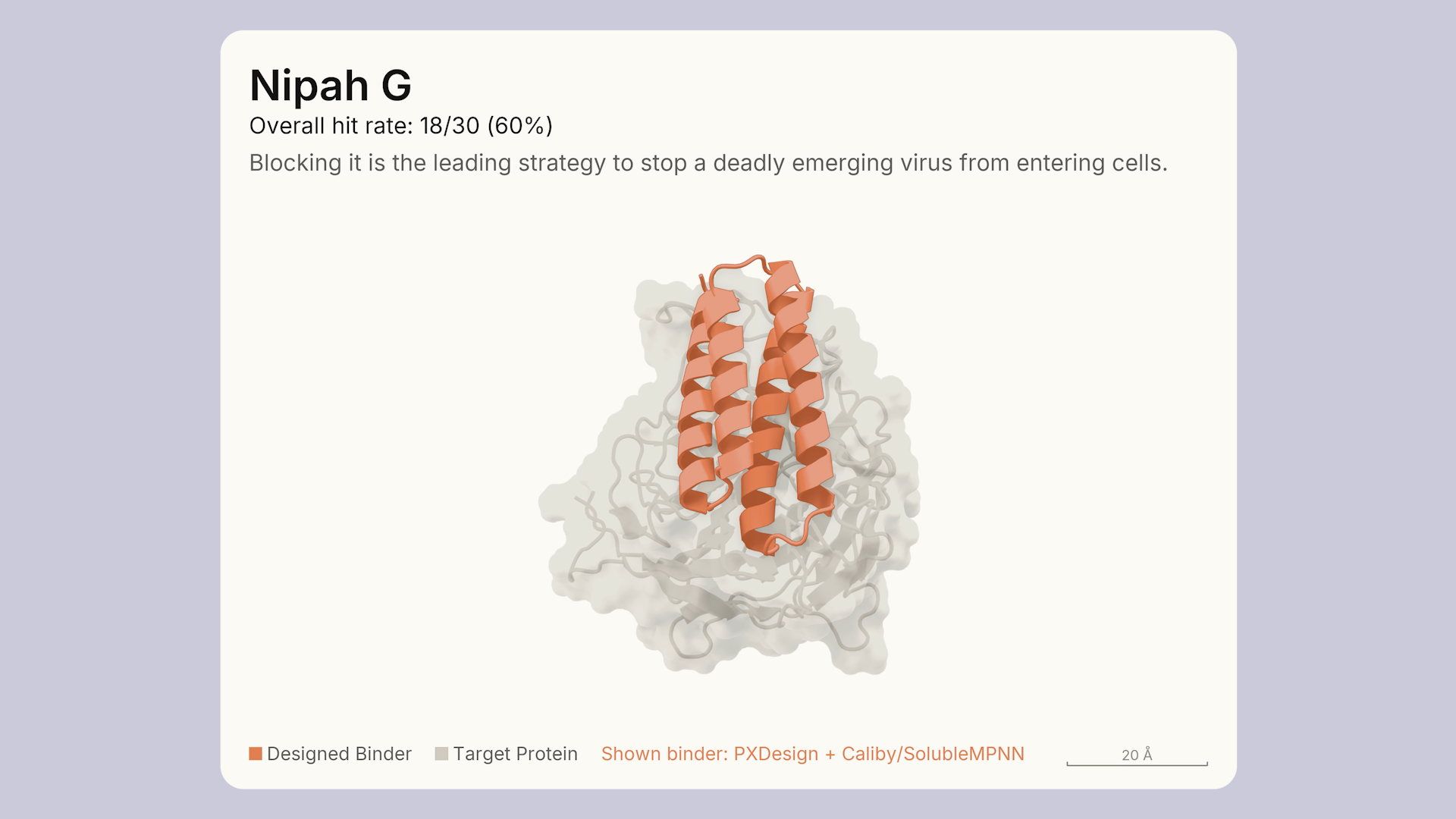
Still frame from the Claude Fable 5.1 launch video showing model-designed protein binders in orange docked against twelve grey target proteins, rendered as ESMFold2 structure predictions. Image: Anthropic. Watch the full protein binder demo on Anthropic’s announcement page.

The science demo is the headline capability claim: binders designed for 12 targets in Adaptyv Bio’s protein design competitions, with a hit rate of nearly 50% where 10 to 15% is typical. Anthropic says every design in that video was confirmed to bind in the lab, and the structures shown are ESMFold2 predictions rather than solved structures. Impressive, and about as relevant to your build pipeline as a Formula 1 lap time is to your commute.

So do you switch

Anthropic’s own guidance says start with Claude Opus 5 for most workloads, at $5 and $25, and move to Fable 5.1 for demanding reasoning and long-horizon agentic work, or when your Opus 5 evals at higher effort still fall short. That is the vendor telling you not to default to its newest model. Take it.

If you are already on Fable 5, the migration is a model ID and then five checks: strip tool_choice any and tool, keep history append-only, re-tune effort from the default of high, watch for tool calls that stopped batching, then re-run your evals. Refusal handling, fallback and token counts carry over unchanged. Permitted fallback targets are Opus 4.8 and Opus 5.

Two things to note before you sign anything. Both 5.1 models are Covered Models with 30-day retention, and zero data retention needs express authorisation from Anthropic until Enterprise Frontier Safeguards ships later this fall. And output carries Anthropic’s statistical text watermark on every platform, with C2PA credentials on images and video pulled through the Files API.

We will come back to this once there is independent benchmarking that is not run with the vendor’s safeguards zeroing out its own tasks.

Sources

The launch, the pricing rationale and the protein design figures come from Anthropic’s announcement, Introducing Claude Fable 5.1 and Claude Mythos 5.1, published 1 September 2026, including the video still reproduced above. The breaking changes, model IDs, cache read pricing, behaviour regressions and migration steps are from the Claude platform documentation, What’s new in Claude Fable 5.1. The 1 September release date, the availability list and the beta headers are confirmed in the Claude API release notes, and the comparison against Opus 5, Sonnet 5 and Haiku 4.5 is from the models overview.

Frequently asked questions

What is the model ID for Claude Fable 5.1?

claude-fable-5-1 on the Claude API, Google Cloud, Microsoft Foundry and Claude Platform on AWS. On Amazon Bedrock it is anthropic.claude-fable-5-1. Claude Mythos 5.1 is claude-mythos-5-1 and is restricted to Project Glasswing participants, so most people will never get a key for it.

Why does tool_choice any return a 400 on Fable 5.1?

Thinking is always on for this model, and a forced tool call would skip it. Anthropic's reasoning is that the model would end up writing its working-out into the tool arguments instead, which degrades argument quality. Only tool_choice auto and none are accepted. The same validation applies on the token counting endpoint, which catches people who validate requests there first.

How do I get schema-valid JSON without forced tool use?

Two documented routes. Keep tool_choice auto and set strict true with strict tool use, or move the schema over to structured outputs. If the problem is that the model replies in text rather than calling the tool at all, say so in the prompt (for example, use the get_weather tool to answer). Anthropic says Fable 5.1 follows explicit tool instructions reliably, which is the sort of claim you want to check against your own evals rather than take on faith.

Is Fable 5.1 actually cheaper than Fable 5?

Base input and output are identical at $10 and $50 per million tokens. The entire saving sits in cache reads, which drop from 0.1 times the base input price to 0.025 times, so $0.25 per million instead of $1. Anthropic estimates roughly 25 percent off for typical workloads and up to about 45 percent for highly agentic work. If your workload does not re-read a cached prefix, you save nothing.

Should I move off Claude Opus 5?

Anthropic's own docs say no for most workloads. The guidance is to start with Opus 5 and reach for Fable 5.1 for demanding reasoning and long-horizon agentic work, or when your evals on Opus 5 at higher effort still fall short. Opus 5 is half the price at $5 and $25. Fable 5.1 being the newest model does not make it the right default.

Can I use Fable 5.1 with zero data retention?

Not by default. Both 5.1 models carry 30-day retention and are not available under zero data retention unless Anthropic expressly authorises it. The announcement says eligible customers can use Fable 5.1 with ZDR until the new Enterprise Frontier Safeguards system arrives later this fall. Eligible and expressly authorised are the same gate, and neither page defines it.

Tags: aianthropicapillmnewspricing
Share198Tweet124
stephane

stephane

  • Trending
  • Comments
  • Latest
Answer card: Proton Lumo 2.0 is private by policy, not by locality. Saved history is locked so even Proton cannot read it, but the prompt is decrypted on a Proton EU server to answer it, then forgotten.

Proton Lumo 2.0 review: how private is it, really?

3 September 2026
The Agentic Coding section of the official Hy4 preview benchmark appendix published by Tencent, a table comparing Hy3 and Hy4 preview against DeepSeek V4 Pro 0813, Qwen 3.8 Max, GLM 5.3, Kimi K3, GPT 5.6 Sol and Claude Opus 5 across SWE-bench Multilingual, SWE-bench Pro, DeepSWE, three SWE Atlas tasks, SWE-Marathon, Terminal-Bench 2.1, NL2Repo-Bench, CyberGym, ProgramBench, PostTrainBench and Harbor-Index.

Tencent’s 770B Hy4 tops one benchmark row in 46

3 September 2026
Answer card: Qwen 3.7 Max is API-only and cannot run locally yet; the open Qwen models (Qwen 3.6 27B, qwen3:8b to 32b) run offline via Ollama.

Qwen 3.7 local: what you can actually run offline

22 June 2026
Answer card: JWTs are not encrypted, anyone can read them; the signature proves who issued the token, not who may read it.

Are JWTs encrypted? No, and the difference will bite you

0
Answer card: a random 8 character password falls in under 2 hours offline, while 16 random characters hold for 1.4 trillion years at the same speed.

How long does it take to crack a password in 2026?

0
Answer card: three DNS records decide if your mail lands or bounces; SPF lists allowed senders, DKIM signs messages, DMARC sets the failure policy.

SPF, DKIM and DMARC explained: the records your email needs

0
Answer card stating that Qwen-Image-2.1, released on 20 September 2026, ships open weights with a 7 billion parameter diffusion transformer, a Qwen3-VL 8B text encoder and an RGBA VAE totalling about 33 gigabytes in BF16, under the Qwen Research License that limits use to research or evaluation and requires a separate commercial licence, unlike the Apache 2.0 licence of Qwen-Image 1.0.

Qwen-Image-2.1 brings the weights back, but not the Apache licence

21 September 2026
Answer card stating that Ternary Bonsai 2 27B, released by PrismML on 17 September 2026 under Apache 2.0, packs Qwen3.8 27B into 5.95 gigabytes at 1.72 bits per weight, keeps 98.2 percent of the 14-benchmark average, about 75 percent on SWE-bench Verified and Terminal-Bench 2.1, and needs PrismML's llama.cpp fork to run.

Does Bonsai 2 27B really keep 98% of Qwen3.8 in 5.95 GB?

20 September 2026
Answer card stating that Jev 1.13 from TypeSafe AI is a decision model in early access since 15 September 2026 that returns typed probabilities instead of text, priced at 42 dollars per billion input tokens with output tokens free, answering in 70 to 500 milliseconds, with a 64K token request budget, text input only, and a documented list of things it does badly, including counting and dates.

Jev 1.13 bills $42 a billion tokens, and it can’t count

19 September 2026
  • About
  • Contact
  • Privacy
  • Legal

Copyright © 2026 Stephane Cardon.

Welcome Back!

Login to your account below

Forgotten Password?

Retrieve your password

Please enter your username or email address to reset your password.

Log In
No Result
View All Result
  • Home
  • Articles
    • Security
    • Network
    • Dev
    • Sysadmin
    • SEO
    • Email & DNS
  • Tools
    • Network tools: free, fast, no signup
    • Security tools: free, fast, no signup
    • Developer tools: free, fast, no signup
    • Sysadmin tools: free, fast, no signup
    • SEO tools: free, fast, no signup
    • Email & DNS tools: free, fast, no signup
  • Download
  • About

Copyright © 2026 Stephane Cardon.