
• Latest
  • Trending
  • All
Official Amazon announcement graphic for the acquisition, showing the AWS logo and the DuckLabs logo side by side in white on a magenta and pink gradient background.

AWS bought DuckLabs, and DuckDB stays MIT

3 September 2026
Answer card for Claude Opus 5.5: 4 dollars in and 20 dollars out per million tokens, down from 5 and 25, with cache reads at 20 cents.

Claude Opus 5.5 drops to $4 and $20, and breaks four Opus 5 habits

23 September 2026
The official xAI announcement card for Grok 4.7, white type on a dark grey and navy gradient.

Grok 4.7 keeps $2 and $6, and its gains over 4.6 are xhigh versus high

22 September 2026
Answer card stating that Qwen-Image-2.1, released on 20 September 2026, ships open weights with a 7 billion parameter diffusion transformer, a Qwen3-VL 8B text encoder and an RGBA VAE totalling about 33 gigabytes in BF16, under the Qwen Research License that limits use to research or evaluation and requires a separate commercial licence, unlike the Apache 2.0 licence of Qwen-Image 1.0.

Qwen-Image-2.1 brings the weights back, but not the Apache licence

21 September 2026
Answer card stating that Ternary Bonsai 2 27B, released by PrismML on 17 September 2026 under Apache 2.0, packs Qwen3.8 27B into 5.95 gigabytes at 1.72 bits per weight, keeps 98.2 percent of the 14-benchmark average, about 75 percent on SWE-bench Verified and Terminal-Bench 2.1, and needs PrismML's llama.cpp fork to run.

Does Bonsai 2 27B really keep 98% of Qwen3.8 in 5.95 GB?

20 September 2026
Answer card stating that Jev 1.13 from TypeSafe AI is a decision model in early access since 15 September 2026 that returns typed probabilities instead of text, priced at 42 dollars per billion input tokens with output tokens free, answering in 70 to 500 milliseconds, with a 64K token request budget, text input only, and a documented list of things it does badly, including counting and dates.

Jev 1.13 bills $42 a billion tokens, and it can’t count

19 September 2026
Answer card stating that Qwen3.8-Omni-Flash launched on 17 September 2026 as an API only model on Alibaba Cloud Model Studio, taking text, images, audio and video in a 1M token context and returning text only, priced at 0.15 dollars per million input tokens for every modality and 0.47 dollars per million output tokens in the international regions, with no open weights published and the Qwen-Live Harness GitHub repository returning 404.

Qwen3.8-Omni-Flash bills audio at $0.15 and ships no weights

18 September 2026
Answer card stating that on 15 September 2026 AWS said it is unable to restore access to resources and data hosted exclusively in the Middle East Bahrain region me-south-1 and in the mec1-az2 zone of the UAE region, because the damage spanned multiple Availability Zones and exceeded what multi-AZ services are designed to withstand.

AWS can’t restore me-south-1, six months after the drone strikes

17 September 2026
Answer card stating that Google released Gemini 3.8 Live and Gemini 3.8 Live Extended Thinking on 15 September 2026 at 3 dollars per million audio input tokens and 12 dollars out, that the thinking model requires asynchronous tools, and that Artificial Analysis scores it 82.6 on its Speech to Speech Quality Index.

Gemini 3.8 Live Extended Thinking rejects any tool that blocks

16 September 2026
Answer card summarising the Atria Dawn Preview release: 744B GLM-5.2 base, MIT licence, 1.5 TB BF16 and 756 GB FP8 checkpoints, 256K context, top on five of sixteen benchmark rows and trailing on SWE-bench Pro.

Atria Dawn Preview is 744B under MIT, and the BF16 weighs 1.5 TB

15 September 2026
Answer card stating that OpenAI released the Agents API in public beta on 10 September 2026 with no separate fee, billed through model tokens, tool calls and hosted sandbox time, with a choice of OpenAI hosted, self hosted or partner sandboxes, US only data residency and no Zero Data Retention support.

OpenAI’s Agents API has no fee, no ZDR and a one hour sandbox clock

14 September 2026
Answer card: Sakana Fugu Max at $2 and $6 per million tokens, Fugu Ultra v2 unchanged at $5 and $30, and Sakana saying Ultra v2 scores without Fable 5 or GPT-6 Astra in its pool.

Fugu Max costs $2 and $6 while Fugu Ultra v2 runs without Fable 5

13 September 2026
Answer card stating that DeepSeek released DeepSeek-V4.1-Flash on 10 September 2026 as a 552 billion parameter mixture of experts model with a new causal encoder decoder architecture that activates 8 billion parameters on input and 16 billion on output, with native vision, a one million token context and MIT licensed weights, that the API model name is now deepseek-flash at 0.15 dollars per million input tokens and 0.60 dollars per million output tokens off peak, and that DeepSeek announced V4 Pro would be routed to V4.1-Flash from 14 September and reversed that on 11 September.

DeepSeek V4.1-Flash arrived, and the V4 Pro retirement lasted a day

12 September 2026
  • About
  • Contact
  • Privacy
  • Legal
Wednesday, September 23, 2026
  • Login
Packet Nebula
  • Home
  • Articles
    • Security
    • Network
    • Dev
    • Sysadmin
    • SEO
    • Email & DNS
  • Tools
    • Network tools: free, fast, no signup
    • Security tools: free, fast, no signup
    • Developer tools: free, fast, no signup
    • Sysadmin tools: free, fast, no signup
    • SEO tools: free, fast, no signup
    • Email & DNS tools: free, fast, no signup
  • Download
  • About
No Result
View All Result
Packet Nebula
No Result
View All Result
Home Dev

AWS bought DuckLabs, and DuckDB stays MIT

by stephane
3 September 2026
in Dev
0
Official Amazon announcement graphic for the acquisition, showing the AWS logo and the DuckLabs logo side by side in white on a magenta and pink gradient background.
494
SHARES
1.4k
VIEWS
Share on FacebookShare on Twitter

You ran `pip install duckdb` this morning and nothing was different. Good, because that is the honest answer here: AWS signed a definitive agreement on 26 August to buy DuckLabs, the small Amsterdam company that writes DuckDB, and the database stays free under the MIT licence held by the independent DuckDB Foundation. The team becomes an AWS subsidiary in early September, still run by the two researchers who built the thing at CWI in 2018. Terms undisclosed. So far, so calm. Then we went and read the Foundation own page, and the number that stuck was three, because that is how many seats its board has, and two of them are about to be occupied by AWS employees.

The short answer

AWS is buying DuckLabs, the Amsterdam company behind DuckDB, and the team becomes a wholly owned subsidiary in early September 2026. Terms were not disclosed. DuckDB, DuckLake and Quack stay MIT under the independent DuckDB Foundation, which owns the IP and the trademarks. Nothing in your pipeline changes today. The part worth watching is who sets priorities, not who holds the copyright.
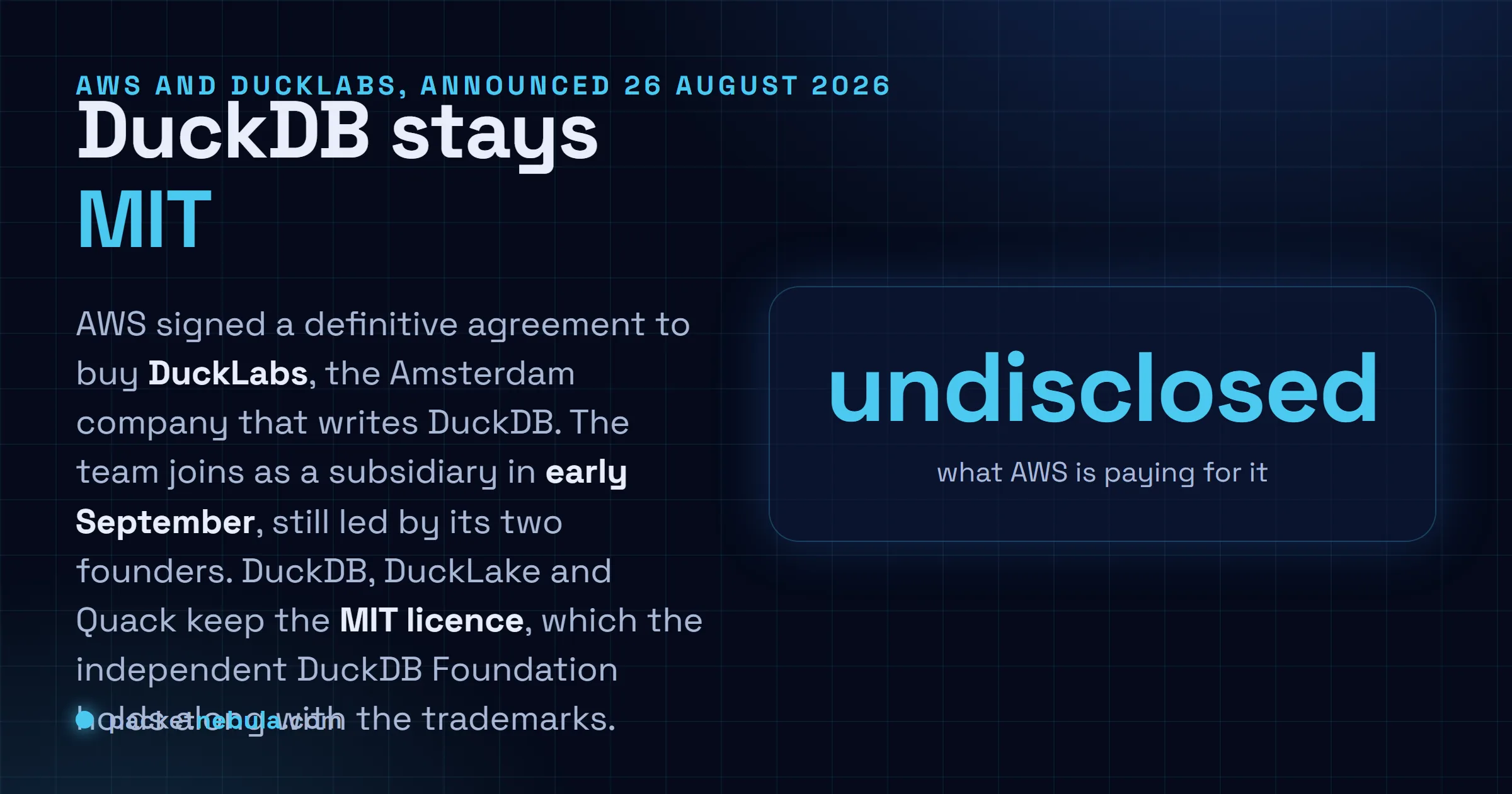
26 Augdefinitive agreement signed
MITlicence, held irrevocably by the Foundation
2 of 3Foundation board seats now inside AWS
Answer card stating that AWS signed a definitive agreement on 26 August 2026 to acquire DuckLabs, the Amsterdam company behind DuckDB, that the team becomes a wholly owned AWS subsidiary in early September 2026 still led by its two founders, that DuckDB, DuckLake, Quack and the extensions stay free and open source under the MIT licence held by the independent DuckDB Foundation, and that the financial terms were not disclosed.
The deal in one card. The licence answer is the easy half.

What AWS actually bought

Official Amazon announcement graphic showing the AWS logo and the DuckLabs logo side by side in white on a magenta and pink gradient.

Image: Amazon

DuckLabs is not DuckDB. That distinction carries the whole story, and most of the coverage flattened it.

DuckDB is an in-process analytical database. No server, no daemon, no port to open. You import it into Python or R or a Node script and it runs columnar OLAP queries inside your own process, against Parquet files or CSVs or S3 objects, whatever you point it at. It came out of CWI Amsterdam, the Dutch research institute responsible for a good share of the decent ideas in analytical databases, and it got popular because it deleted an entire tier of infrastructure for anyone whose data fits on one machine. Which, for most people, it does.

DuckLabs is the company Hannes Muhleisen and Mark Raasveldt built to develop it. Roughly: the people who write the commits. That is what AWS signed for on 26 August, with closing expected shortly and DuckLabs saying it becomes a wholly owned subsidiary in early September. Both founders keep leading the team and the technical direction from inside Amazon.

The Foundation, a separate Dutch non-profit, was not part of the deal at all.

The licence is genuinely fine. That is not the question
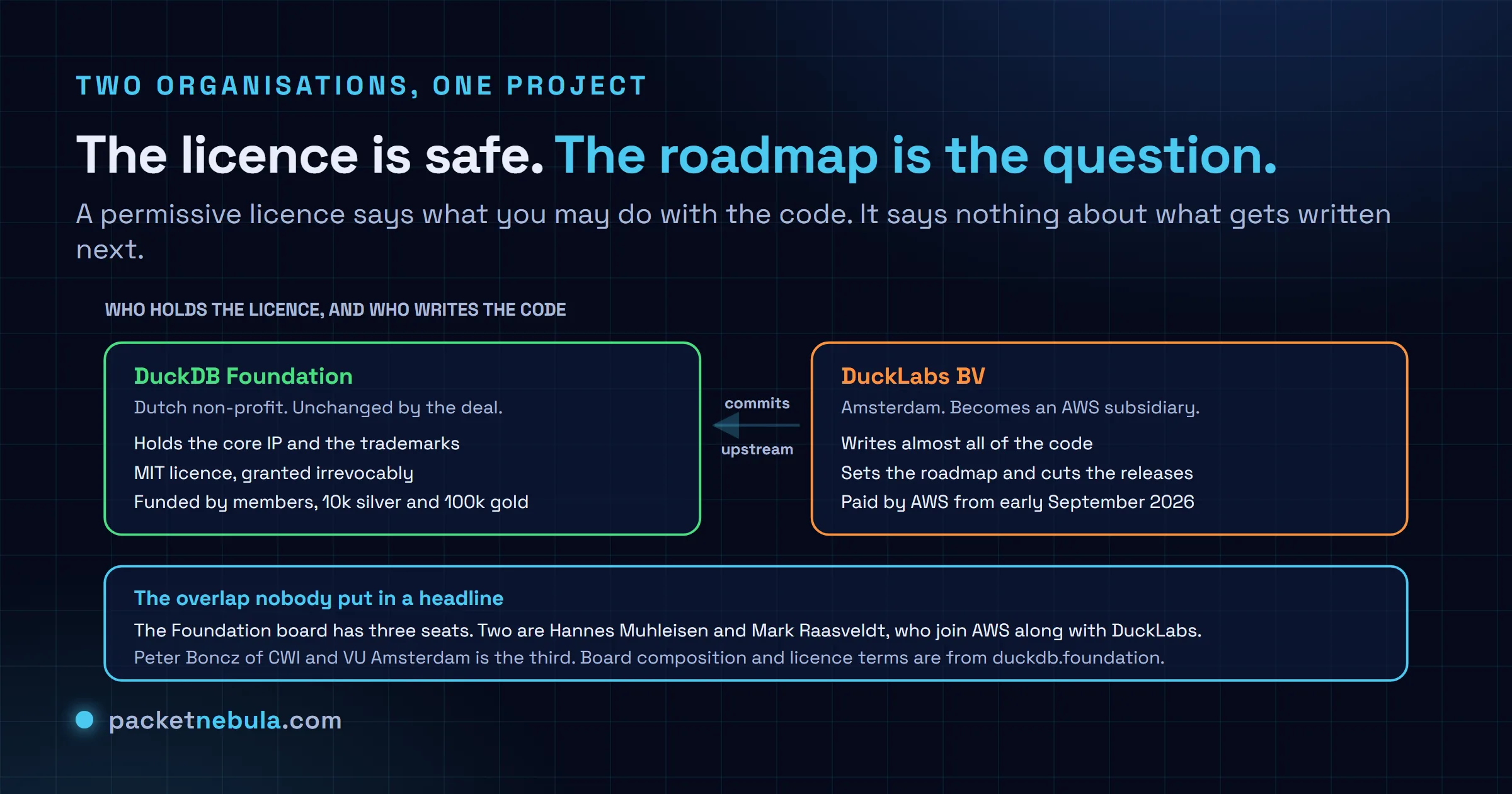
Diagram splitting the DuckDB Foundation, a Dutch non-profit holding the core intellectual property and trademarks under an irrevocable MIT licence and funded by silver members at ten thousand euros and gold members at one hundred thousand euros a year, from DuckLabs BV of Amsterdam which writes almost all of the code, sets the roadmap, cuts the releases and is paid by AWS from early September 2026, with a note that two of the three Foundation board seats belong to Hannes Muhleisen and Mark Raasveldt who are joining AWS while Peter Boncz of CWI and VU Amsterdam holds the third.
Ownership on the left, labour on the right. The bottom strip is where they meet.

The Foundation page is unusually blunt for a governance page. It holds the core IP and the trademarks of DuckDB, DuckLake and Quack, and those projects are distributed under MIT irrevocably. DuckLabs repeated the commitment on announcement day, saying there are no changes to roadmap, licensing or governance model.

We believe them. Not out of charity: an irrevocable MIT grant on code that is already published cannot be walked back by anyone, new owner included. Fork rights survive an acquisition. So the “will they close it” panic that fills every thread like this one is aimed at the wrong risk.

The real one is quieter. Read the two boxes again. One organisation owns the licence, a different organisation writes the code, and only one of those two has a payroll. Nearly all contributions and strategic direction have come from DuckLabs, which makes the Foundation a strong legal shell around a project whose actual momentum sits somewhere else. And the shell has three board seats, two belonging to people who from September collect an Amazon salary.

None of which is sinister. Muhleisen has said openly that the Foundation role should expand, and that a Technical Advisory Board is coming so anyone betting on DuckDB gets a channel that stays independent. Correct instinct. It is also a quiet admission that today’s arrangement is thin.

Honestly, I think the licence obsession in open source works as a comfort blanket. Licences protect what already exists. What gets built next is decided by whoever employs the committers, and that changed hands this week.

Why AWS wanted it

The strategic logic is not subtle, and AWS wrote it down itself. It wants to pair DuckDB, which it calls a superpower at everyday queries of a terabyte or less, with the exabyte scale of S3 and the existing analytics line of Redshift, Athena, EMR, Glue ETL and SageMaker. Read that as the long push to make S3 somewhere you compute rather than somewhere you park files.

There is precedent inside the building. AWS says Amazon Quick has been running on DuckDB since October 2025, has served over 2.5 billion queries on it, and saw average query latency fall by around 30 percent. Those are Amazon numbers and nobody has audited them, but they explain the purchase better than the press language does. They shipped it, it worked, they bought the team.

The ecosystem reaction has been calmer than you would expect. MotherDuck, which sells a managed DuckDB cloud and had the most to lose, called the move predictable and probably good for the project, while noting the familiar pattern of waiting for an open source project to get big and then launching it as a service. Its chief executive also allowed the take might age badly, comparing his own optimism to being relaxed about “inviting the wolves over for a dinner party”. The company has since started offering enterprise DuckDB support, something it deliberately avoided while DuckLabs was independent.

That last detail is the interesting one. A commercial support gap opened, and somebody filled it inside a week.

What we would actually do about it
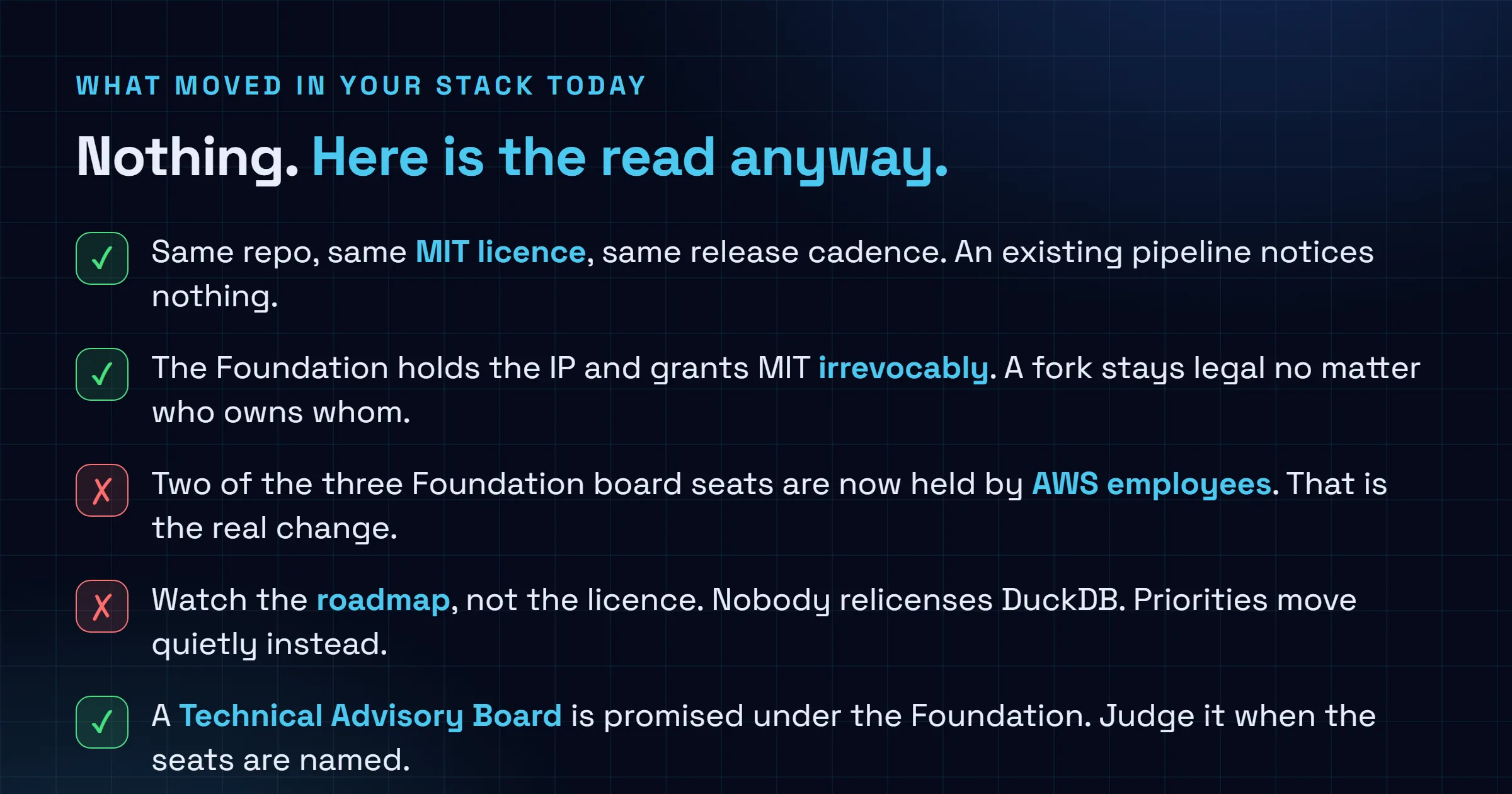
Checklist of what the AWS acquisition of DuckLabs changes for a team already running DuckDB, covering that nothing moved on 28 August 2026 with the same repository, licence and release cadence, that the Foundation holds the intellectual property under an irrevocable MIT grant so a fork stays legal whatever happens, that two of the three Foundation board seats now belong to AWS employees, that roadmap pressure rather than licensing is the thing worth watching, and that a Technical Advisory Board has been promised under the Foundation and should be judged when its seats are actually named.
Five lines. Four of them are just paying attention.

Nothing urgent, which is a boring answer and also the true one. Pin your DuckDB version the way you should have been doing anyway, pin the extension versions with it, and get on with your afternoon.

What we would actually watch over the next year is which extensions get love. DuckDB reads and writes Google Sheets and queries BigQuery through community extensions today, and its Parquet and Iceberg support treats every object store as equal. If two years from now the S3 paths are noticeably smoother than the rest, you have your answer about roadmap capture without anyone having touched the licence file.

For the wider shape of this, we wrote about what the reported Nvidia deal for Hugging Face changes in much the same terms: the neutral layer of the stack keeps getting bought, and the licence is rarely the part that moves. Same week and the same company, pointing the other way: Amazon is also closing Mechanical Turk on 30 September.

One prediction, and I might be wrong about it. A managed DuckDB service on AWS ships before the end of 2027, it will be good, and it will make that Foundation advisory board matter a great deal more than it does today.

Sources

AWS published the announcement on the AWS Big Data Blog on 26 August 2026, and the corporate note carrying the announcement graphic sits on About Amazon. DuckLabs published its own statement the same day, DuckLabs to Join AWS, Projects to Remain Open Source. Licence terms, IP ownership, membership tiers and the three board seats come from duckdb.foundation. The Register covered the contribution imbalance and the Muhleisen comments on expanding the Foundation in its report on the acquisition, and MotherDuck set out its own position in a post from its chief executive.

Frequently asked questions

Is DuckDB still open source after the AWS acquisition?

Yes. DuckDB, DuckLake, Quack and the extensions stay under the MIT licence, and that licence is not AWS to change: the non-profit DuckDB Foundation holds the core intellectual property and the trademarks, and grants MIT irrevocably. DuckLabs, the company being bought, is the team that writes the code, which is a different thing from the entity that owns it.

What exactly did AWS buy?

DuckLabs BV, the Amsterdam company founded by Hannes Muhleisen and Mark Raasveldt to develop DuckDB commercially. AWS announced a definitive agreement on 26 August 2026, and DuckLabs said it expects to become a wholly owned AWS subsidiary in early September. Financial terms were not disclosed by either side. The DuckDB Foundation was not part of the transaction.

Will DuckDB get relicensed or go closed source?

Almost certainly not, and it would be difficult even if someone wanted it. The Foundation holds the IP under an irrevocable MIT grant, so every version published so far stays MIT forever and anyone may fork it. The realistic risk is not licensing. It is that the roadmap starts favouring the workloads that matter to a cloud provider, which no licence prevents.

Does anything break in my existing DuckDB setup?

No. Nothing moved on 28 August 2026. Same repository, same release cadence, same MIT terms, same extension install path. If you pin versions you are already doing the only hygiene this deal calls for. There is no migration, no account to create and no deprecation notice attached to the announcement.

Who keeps AWS honest on the DuckDB roadmap now?

On paper, the Foundation board, which has three seats: Hannes Muhleisen as chair, Mark Raasveldt, and Peter Boncz of CWI and VU Amsterdam. The first two are joining AWS with DuckLabs, so Boncz is the one board member with no line into Amazon. DuckLabs has said it will add a Technical Advisory Board under the Foundation so heavy users and rival vendors get a formal channel into the roadmap. Worth judging once the seats are actually named.

Tags: awsbig-techdatabaseinfrastructurenewsopen-source
Share198Tweet124
stephane

stephane

  • Trending
  • Comments
  • Latest
Answer card: Proton Lumo 2.0 is private by policy, not by locality. Saved history is locked so even Proton cannot read it, but the prompt is decrypted on a Proton EU server to answer it, then forgotten.

Proton Lumo 2.0 review: how private is it, really?

3 September 2026
The Agentic Coding section of the official Hy4 preview benchmark appendix published by Tencent, a table comparing Hy3 and Hy4 preview against DeepSeek V4 Pro 0813, Qwen 3.8 Max, GLM 5.3, Kimi K3, GPT 5.6 Sol and Claude Opus 5 across SWE-bench Multilingual, SWE-bench Pro, DeepSWE, three SWE Atlas tasks, SWE-Marathon, Terminal-Bench 2.1, NL2Repo-Bench, CyberGym, ProgramBench, PostTrainBench and Harbor-Index.

Tencent’s 770B Hy4 tops one benchmark row in 46

3 September 2026
Answer card: Qwen 3.7 Max is API-only and cannot run locally yet; the open Qwen models (Qwen 3.6 27B, qwen3:8b to 32b) run offline via Ollama.

Qwen 3.7 local: what you can actually run offline

22 June 2026
Answer card: JWTs are not encrypted, anyone can read them; the signature proves who issued the token, not who may read it.

Are JWTs encrypted? No, and the difference will bite you

0
Answer card: a random 8 character password falls in under 2 hours offline, while 16 random characters hold for 1.4 trillion years at the same speed.

How long does it take to crack a password in 2026?

0
Answer card: three DNS records decide if your mail lands or bounces; SPF lists allowed senders, DKIM signs messages, DMARC sets the failure policy.

SPF, DKIM and DMARC explained: the records your email needs

0
Answer card for Claude Opus 5.5: 4 dollars in and 20 dollars out per million tokens, down from 5 and 25, with cache reads at 20 cents.

Claude Opus 5.5 drops to $4 and $20, and breaks four Opus 5 habits

23 September 2026
The official xAI announcement card for Grok 4.7, white type on a dark grey and navy gradient.

Grok 4.7 keeps $2 and $6, and its gains over 4.6 are xhigh versus high

22 September 2026
Answer card stating that Qwen-Image-2.1, released on 20 September 2026, ships open weights with a 7 billion parameter diffusion transformer, a Qwen3-VL 8B text encoder and an RGBA VAE totalling about 33 gigabytes in BF16, under the Qwen Research License that limits use to research or evaluation and requires a separate commercial licence, unlike the Apache 2.0 licence of Qwen-Image 1.0.

Qwen-Image-2.1 brings the weights back, but not the Apache licence

21 September 2026
  • About
  • Contact
  • Privacy
  • Legal

Copyright © 2026 Stephane Cardon.

Welcome Back!

Login to your account below

Forgotten Password?

Retrieve your password

Please enter your username or email address to reset your password.

Log In
No Result
View All Result
  • Home
  • Articles
    • Security
    • Network
    • Dev
    • Sysadmin
    • SEO
    • Email & DNS
  • Tools
    • Network tools: free, fast, no signup
    • Security tools: free, fast, no signup
    • Developer tools: free, fast, no signup
    • Sysadmin tools: free, fast, no signup
    • SEO tools: free, fast, no signup
    • Email & DNS tools: free, fast, no signup
  • Download
  • About

Copyright © 2026 Stephane Cardon.