
• Latest
  • Trending
  • All
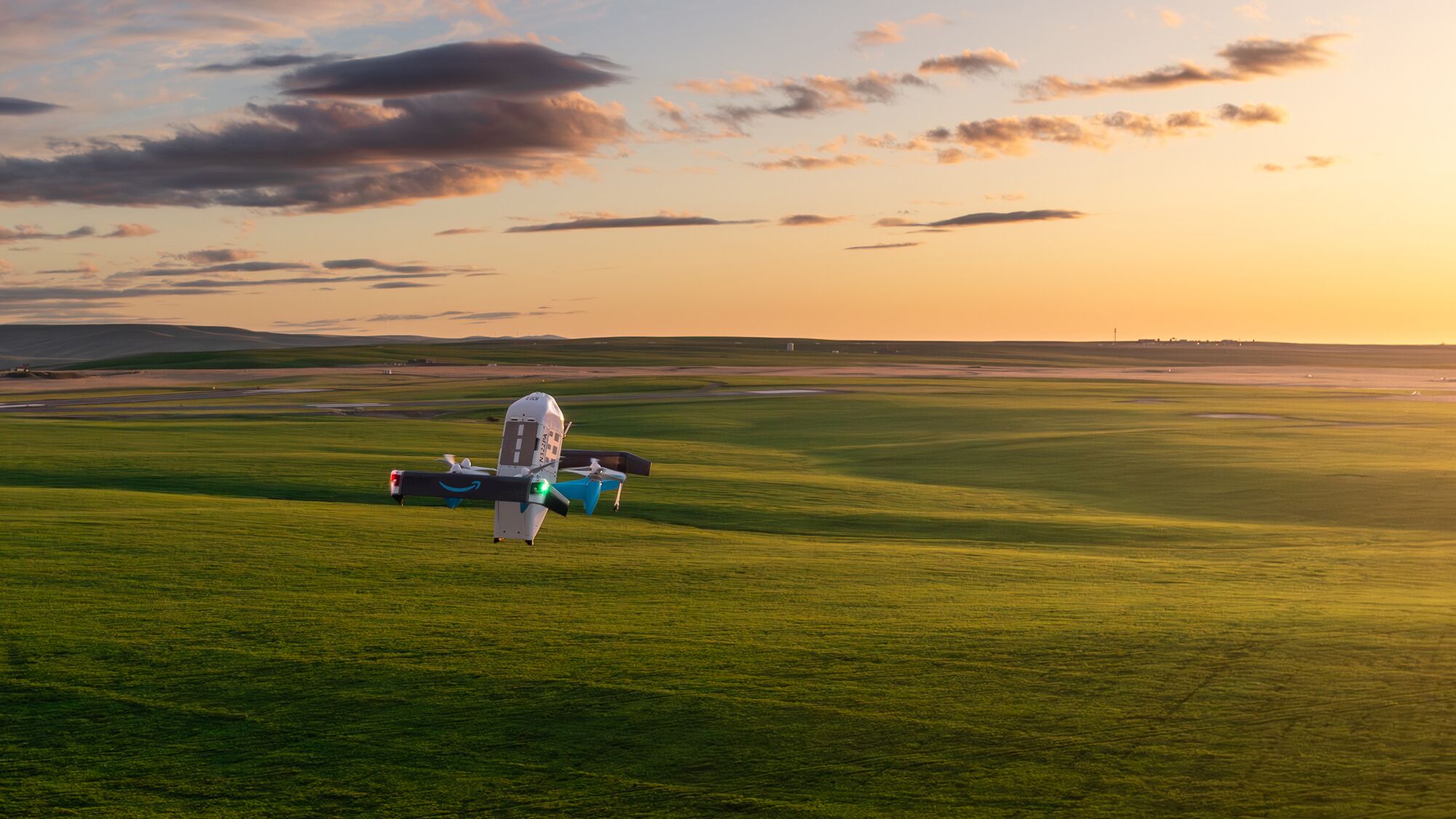
Official Amazon photograph of a Prime Air delivery drone hovering low over open green grassland at sunset, its rotors blurred, with a long flat horizon behind it.

Prime Air promises 500 cities from 11 drone sites

3 September 2026
Answer card stating that Qwen-Image-2.1, released on 20 September 2026, ships open weights with a 7 billion parameter diffusion transformer, a Qwen3-VL 8B text encoder and an RGBA VAE totalling about 33 gigabytes in BF16, under the Qwen Research License that limits use to research or evaluation and requires a separate commercial licence, unlike the Apache 2.0 licence of Qwen-Image 1.0.

Qwen-Image-2.1 brings the weights back, but not the Apache licence

21 September 2026
Answer card stating that Ternary Bonsai 2 27B, released by PrismML on 17 September 2026 under Apache 2.0, packs Qwen3.8 27B into 5.95 gigabytes at 1.72 bits per weight, keeps 98.2 percent of the 14-benchmark average, about 75 percent on SWE-bench Verified and Terminal-Bench 2.1, and needs PrismML's llama.cpp fork to run.

Does Bonsai 2 27B really keep 98% of Qwen3.8 in 5.95 GB?

20 September 2026
Answer card stating that Jev 1.13 from TypeSafe AI is a decision model in early access since 15 September 2026 that returns typed probabilities instead of text, priced at 42 dollars per billion input tokens with output tokens free, answering in 70 to 500 milliseconds, with a 64K token request budget, text input only, and a documented list of things it does badly, including counting and dates.

Jev 1.13 bills $42 a billion tokens, and it can’t count

19 September 2026
Answer card stating that Qwen3.8-Omni-Flash launched on 17 September 2026 as an API only model on Alibaba Cloud Model Studio, taking text, images, audio and video in a 1M token context and returning text only, priced at 0.15 dollars per million input tokens for every modality and 0.47 dollars per million output tokens in the international regions, with no open weights published and the Qwen-Live Harness GitHub repository returning 404.

Qwen3.8-Omni-Flash bills audio at $0.15 and ships no weights

18 September 2026
Answer card stating that on 15 September 2026 AWS said it is unable to restore access to resources and data hosted exclusively in the Middle East Bahrain region me-south-1 and in the mec1-az2 zone of the UAE region, because the damage spanned multiple Availability Zones and exceeded what multi-AZ services are designed to withstand.

AWS can’t restore me-south-1, six months after the drone strikes

17 September 2026
Answer card stating that Google released Gemini 3.8 Live and Gemini 3.8 Live Extended Thinking on 15 September 2026 at 3 dollars per million audio input tokens and 12 dollars out, that the thinking model requires asynchronous tools, and that Artificial Analysis scores it 82.6 on its Speech to Speech Quality Index.

Gemini 3.8 Live Extended Thinking rejects any tool that blocks

16 September 2026
Answer card summarising the Atria Dawn Preview release: 744B GLM-5.2 base, MIT licence, 1.5 TB BF16 and 756 GB FP8 checkpoints, 256K context, top on five of sixteen benchmark rows and trailing on SWE-bench Pro.

Atria Dawn Preview is 744B under MIT, and the BF16 weighs 1.5 TB

15 September 2026
Answer card stating that OpenAI released the Agents API in public beta on 10 September 2026 with no separate fee, billed through model tokens, tool calls and hosted sandbox time, with a choice of OpenAI hosted, self hosted or partner sandboxes, US only data residency and no Zero Data Retention support.

OpenAI’s Agents API has no fee, no ZDR and a one hour sandbox clock

14 September 2026
Answer card: Sakana Fugu Max at $2 and $6 per million tokens, Fugu Ultra v2 unchanged at $5 and $30, and Sakana saying Ultra v2 scores without Fable 5 or GPT-6 Astra in its pool.

Fugu Max costs $2 and $6 while Fugu Ultra v2 runs without Fable 5

13 September 2026
Answer card stating that DeepSeek released DeepSeek-V4.1-Flash on 10 September 2026 as a 552 billion parameter mixture of experts model with a new causal encoder decoder architecture that activates 8 billion parameters on input and 16 billion on output, with native vision, a one million token context and MIT licensed weights, that the API model name is now deepseek-flash at 0.15 dollars per million input tokens and 0.60 dollars per million output tokens off peak, and that DeepSeek announced V4 Pro would be routed to V4.1-Flash from 14 September and reversed that on 11 September.

DeepSeek V4.1-Flash arrived, and the V4 Pro retirement lasted a day

12 September 2026
Answer card stating that Cognition released SWE-2 on 10 September 2026, a coding model post-trained from Kimi K3, scoring 50.0 percent on FrontierCode 1.1 Main against 50.9 percent for Claude Fable 5.1 and 27.3 percent on Terminal-Bench 4 against 55.8 percent, available only inside Devin.

SWE-2 trails Fable 5.1 by one point, and by 28 on Terminal-Bench 4

11 September 2026
Answer card for Meta Muse, free to 100 million tokens a week then $20 a month, launched 8 September 2026 for United States adults only, running in a dedicated per user virtual machine.

Does Meta Muse do enough to earn your inbox and a card on file?

9 September 2026
  • About
  • Contact
  • Privacy
  • Legal
Monday, September 21, 2026
  • Login
Packet Nebula
  • Home
  • Articles
    • Security
    • Network
    • Dev
    • Sysadmin
    • SEO
    • Email & DNS
  • Tools
    • Network tools: free, fast, no signup
    • Security tools: free, fast, no signup
    • Developer tools: free, fast, no signup
    • Sysadmin tools: free, fast, no signup
    • SEO tools: free, fast, no signup
    • Email & DNS tools: free, fast, no signup
  • Download
  • About
No Result
View All Result
Packet Nebula
No Result
View All Result
Home Dev

Prime Air promises 500 cities from 11 drone sites

by stephane
3 September 2026
in Dev
0
Official Amazon photograph of a Prime Air delivery drone hovering low over open green grassland at sunset, its rotors blurred, with a long flat horizon behind it.
495
SHARES
1.4k
VIEWS
Share on FacebookShare on Twitter

Five metro areas got named. Chicago, Syracuse, Cleveland, Atlanta, Boise. Amazon's post on 19 August says Prime Air will reach nearly 500 US cities and towns by the end of 2026, which it calls a sixfold increase on where it stands now, and where it stands now is 11 sites across seven states. So the target is real and the arithmetic is unforgiving. Take Amazon's own word sixfold, apply it to 11, and you land near 66 sites. That's roughly 55 launches in the 19 weeks left in the year, straight through the peak shopping season, with five of them named and none of them dated. We went and counted what the company actually states, because the gap between a town count and a site count is where this story lives.

The short answer

On 19 August Amazon said Prime Air drone delivery will reach nearly 500 US cities and towns by the end of 2026, a sixfold rise on a footprint of 11 sites in seven states. Each site flies a 7.5 mile radius around a fulfilment centre. Payload tops out at 5 pounds in a large shoebox. Prime members pay nothing over 50 dollars, 2.99 below it, 4.99 without Prime. Five upcoming metro areas are named, none is dated, and Amazon never publishes the site count its own target implies.
11Prime Air sites running today
~500cities and towns promised by 31 December
175 sq micovered per site
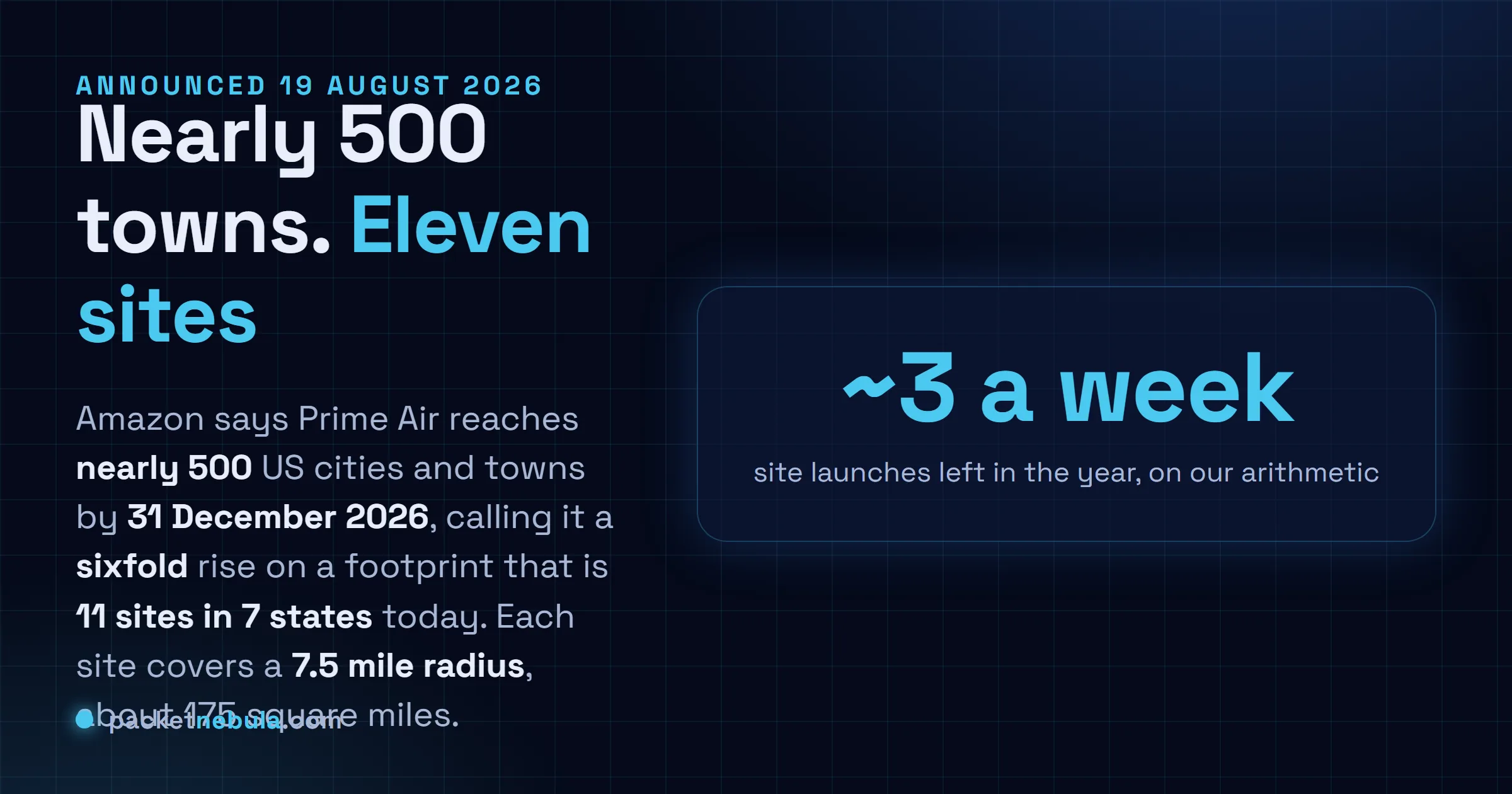
Answer card: Amazon said on 19 August 2026 that Prime Air will reach nearly 500 US cities and towns by 31 December 2026, a sixfold rise on 11 sites in seven states, each covering a 7.5 mile radius of about 175 square miles, leaving roughly three site launches a week for the rest of the year.
The target and the footprint, in the units each one was published in.

The two numbers are counted differently

Here’s the thing that took us a second read to catch. Amazon states its ambition in cities and towns, and its footprint in sites. Those aren’t the same unit, and the release never converts one into the other.

A Prime Air site sits at a fulfilment centre and serves roughly 175 square miles. Amazon spells out the shape: anyone within a 7.5 mile radius of the centre can order. Run the circle and 7.5 miles gives you about 177 square miles, so the two figures are the same claim stated twice. Fine. But a 7.5 mile circle dropped on American suburbia doesn’t contain one municipality. It contains a dozen small ones, plus slices of two big ones, plus a few unincorporated places that a marketing team can reasonably call towns.

So 500 cities and towns is not 500 launches. On our arithmetic it’s nearer 66 sites, and that number comes from Amazon’s own adjective rather than from anything it published.
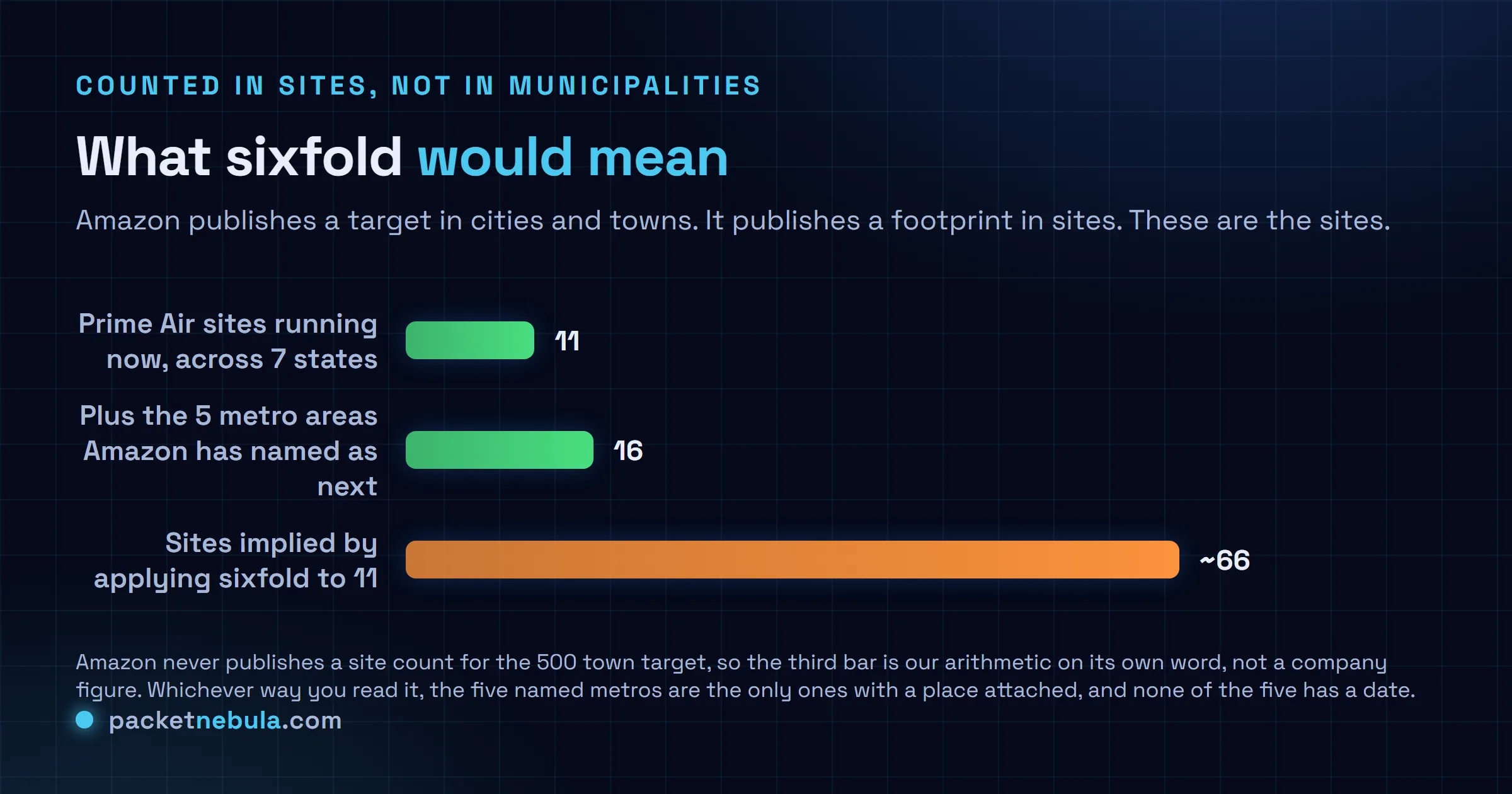
Bar comparison: 11 Prime Air sites operating today across seven states, 16 once the five named metro areas are added, and roughly 66 sites implied by applying Amazon's own word sixfold to the current count of 11.
Amazon publishes the target in towns and the footprint in sites. Counted in sites, the year gets short.

Fifty-five launches, nineteen weeks

From the announcement to 31 December is 134 days. Call it 19 weeks. Going from 11 sites to something near 66 inside that window means about three new sites a week, every week, across the busiest quarter Amazon has.

I might be wrong about the exact target, because the site count is the number Amazon chose not to give. But you can’t make the schedule comfortable under any reading. Halve our estimate and it’s still a launch and a half a week through Black Friday.

The named list is short: Chicago, Syracuse, Cleveland, Atlanta, Boise. Five metros, no dates. Everything past that is “more communities to come later this year”, which is the sentence a company writes when the sites aren’t signed yet.

Worth saying what did already happen, though. Amazon launched Prime Air in Darlington, England, the first time the service has flown outside the US, and it says it has made hundreds of thousands of drone deliveries this year with thousands going out daily. That’s not a pilot any more. It’s small, and it’s real.

What you actually get, if a site opens near you

The service envelope is narrow and Amazon is upfront about it. Five pounds, and it has to fit in a large shoebox. The company puts that at more than 60 percent of the items people buy most often, naming electronics, cosmetics, medications and household products as typical.

Pricing is the part that surprised us. Prime members pay nothing on orders of 50 dollars or more, 2.99 below that, and non-members pay 4.99. That’s cheap enough to become a habit rather than a novelty, which is presumably the point. Delivery lands in as fast as 30 minutes, though Amazon’s own copy says most orders arrive around 60.

The aircraft is the MK30, which Amazon says has double the range and half the noise of its earlier drones. Noise is not a footnote here. Suburban drone programmes get killed by neighbours long before they get killed by regulators.

On regulation, Prime Air holds FAA Part 135 certification, the framework used by commercial air carriers. That matters for scaling, because Part 135 certificates attach to the operator rather than to each town, so opening site number 40 isn’t a fresh certification cycle. It’s real estate, staffing and airspace work. Slow, but not gated on Washington the way a robotaxi exemption is.
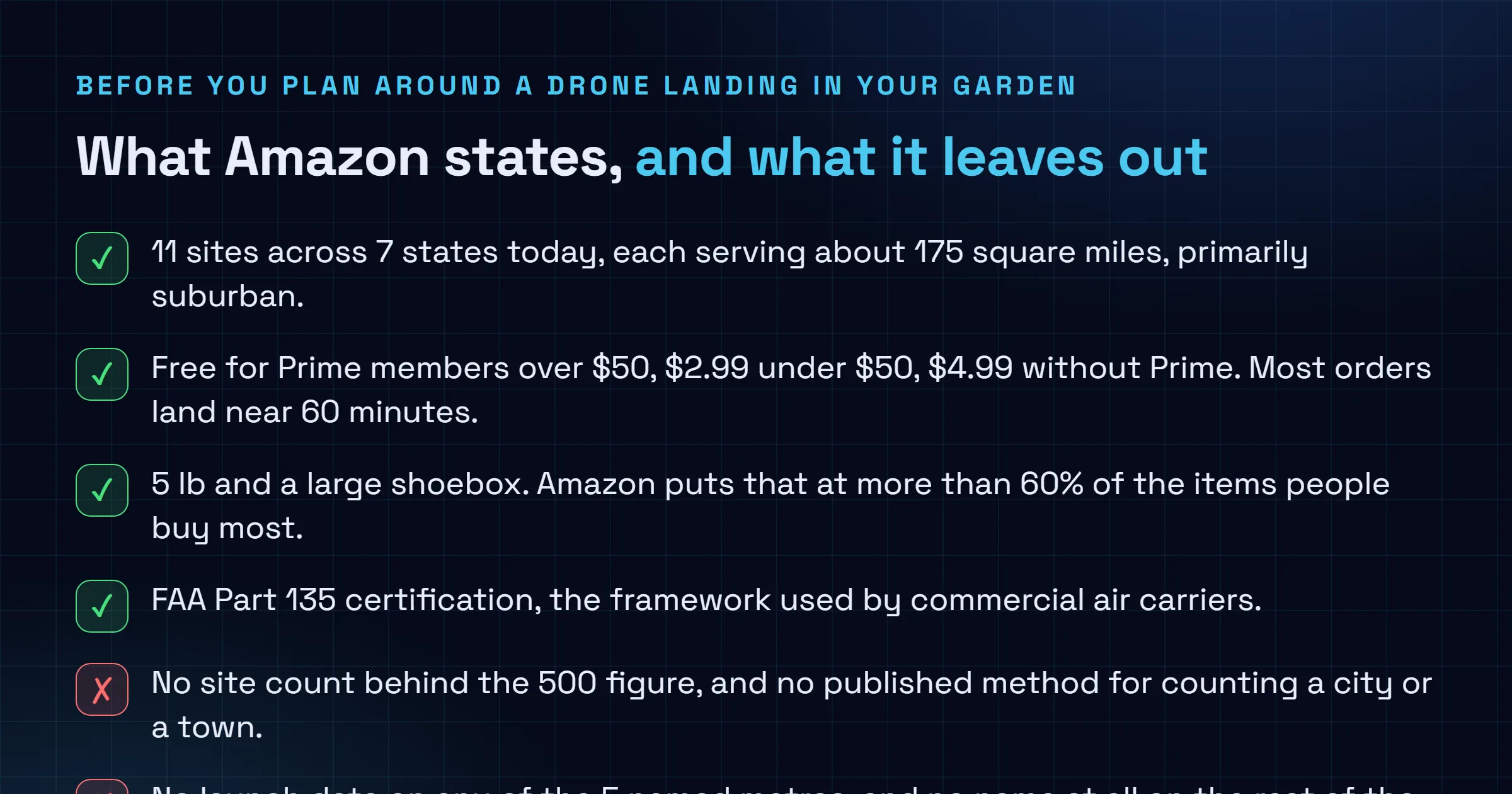
Checklist separating what Amazon confirms about Prime Air (11 sites in seven states, about 175 square miles each, free for Prime over 50 dollars, 2.99 under, 4.99 without Prime, 5 pound payload in a large shoebox covering over 60 percent of frequent purchases, FAA Part 135 certification) from what it leaves out (no site count behind the 500 figure, no method for counting a city or town, no launch date on any named metro).
Four solid facts, two holes. The holes are both about the schedule.

Our read

We’ve watched enough fleet announcements to know the tell. When a company reports the promise in one unit and the base in another, the conversion is usually the unflattering part. Same pattern we flagged when an autonomous fleet licence turned out to cover 15 cars.

None of which makes this vapour. Amazon has certificated aircraft flying daily deliveries in seven states, at a price that undercuts most same-day options, and TechCrunch notes the programme has had real incidents to learn from, including a drone striking a crane at the Tolleson site in 2025. That’s what an operating programme looks like.

Just hold the 500 loosely. Watch the site count instead, and watch whether Chicago and Atlanta actually open before the holidays. If they don’t, the year-end number is going to be doing a lot of work with the phrase “cities and towns”.
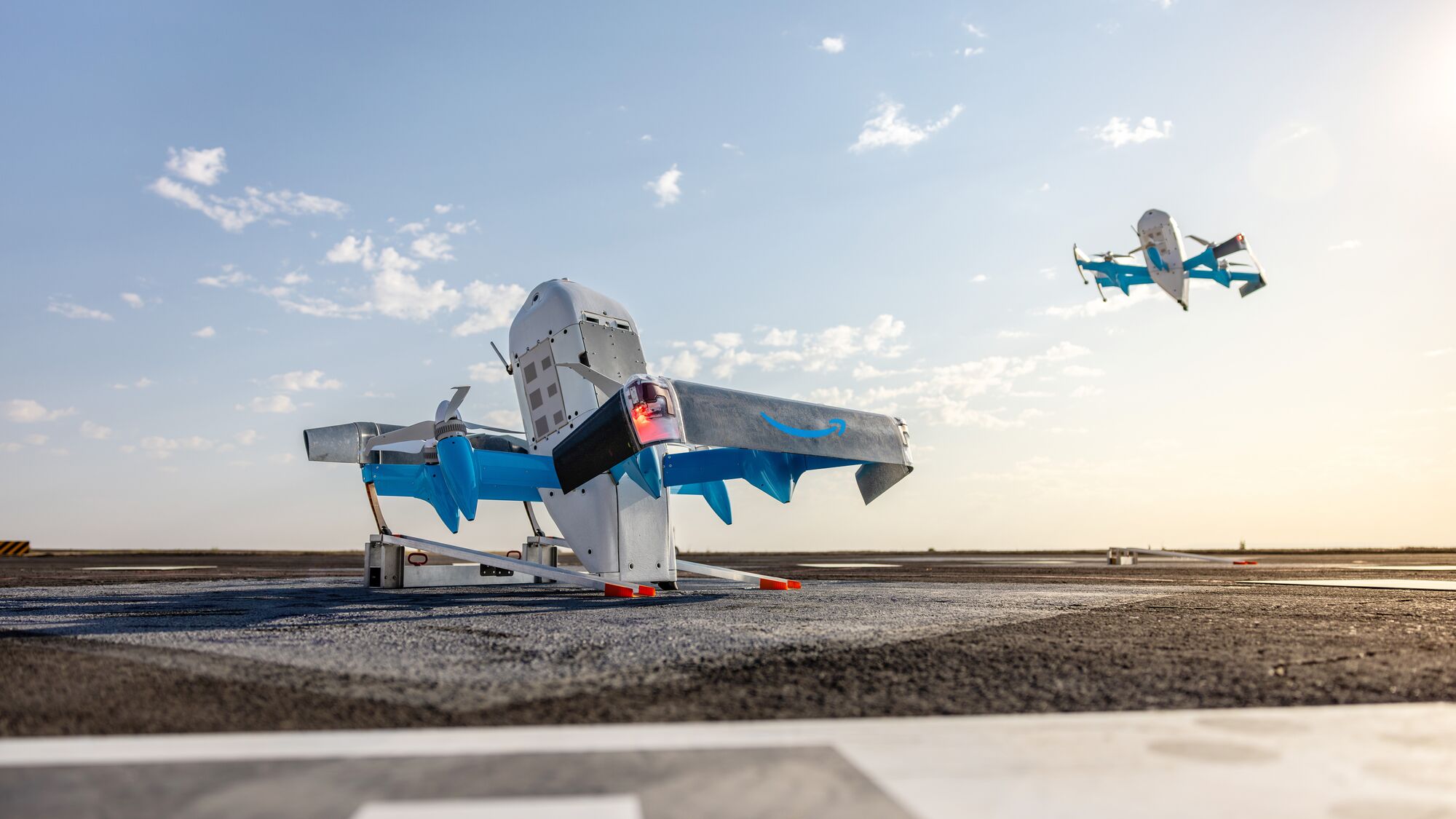
Official Amazon photograph of two MK30 Prime Air delivery drones, hexagonal white and grey airframes with six enclosed rotor housings, on a pale surface in bright studio lighting.

Image: Amazon, MK30 delivery drone, from its MK30 announcement.

Sources

Announcement details, the list of 11 current sites, the 175 square mile and 7.5 mile radius figures, pricing, the 5 pound limit, the MK30 range and noise claims, FAA Part 135 certification, the Darlington launch and the David Carbon quote all come from Amazon’s own release, Amazon Prime Air drone delivery is expanding to nearly 500 US cities and towns this year, published 19 August 2026. Independent coverage and the Tolleson crane incident come from TechCrunch, same date. The sixfold framing is Amazon’s word; the roughly 66 site figure is our arithmetic on it and is not a company projection.

Frequently asked questions

Is Amazon drone delivery available in my city?

Only if you live near one of 11 Prime Air sites, and only within about 7.5 miles of the fulfilment centre. As of 19 August 2026 those sites are Tolleson in Arizona, Ruskin in Florida, Kansas City in Kansas, Papillion in Nebraska, Baton Rouge in Louisiana, Hazel Park and Pontiac in Michigan, and Richmond, San Antonio, Richardson and Waco in Texas. Amazon has said it will launch soon in the Chicago, Syracuse, Cleveland, Atlanta and Boise metro areas, without giving a date for any of them.

How much does Prime Air drone delivery cost?

Prime members pay nothing on orders of 50 dollars or more, and 2.99 dollars on orders below that. Customers without Prime pay 4.99 dollars. Amazon says orders arrive in as fast as 30 minutes, with most arriving around 60 minutes.

What can actually be delivered by drone?

Nearly anything at or under 5 pounds that fits in a large shoebox. Amazon puts that at more than 60 percent of the items customers buy most often, and gives everyday examples like electronics, cosmetics, medications and household products. Anything heavier or bulkier goes by van as usual.

Does Amazon say how many new drone sites it needs to hit 500 cities?

No. That is the missing number. Amazon publishes its target in cities and towns and its current footprint in sites, and never reconciles the two, so nobody outside the company can check the schedule. Our figure of roughly 66 sites comes from applying Amazon's own word sixfold to the 11 it runs today. Treat it as arithmetic on a company adjective, not as a company forecast.

What regulatory approval does Prime Air hold?

FAA Part 135 certification, the same framework used by commercial air carriers, which Amazon describes as the highest level of FAA oversight for drone delivery operations. Amazon also cites an onboard detect-and-avoid system using cameras and sensors. Part 135 covers the operator rather than each individual site, so the constraint on scaling is operational rather than a fresh certificate per town.

Tags: amazondroneslogisticsnewsregulationrobotics
Share198Tweet124
stephane

stephane

  • Trending
  • Comments
  • Latest
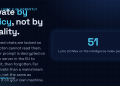
Answer card: Proton Lumo 2.0 is private by policy, not by locality. Saved history is locked so even Proton cannot read it, but the prompt is decrypted on a Proton EU server to answer it, then forgotten.

Proton Lumo 2.0 review: how private is it, really?

3 September 2026
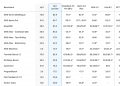
The Agentic Coding section of the official Hy4 preview benchmark appendix published by Tencent, a table comparing Hy3 and Hy4 preview against DeepSeek V4 Pro 0813, Qwen 3.8 Max, GLM 5.3, Kimi K3, GPT 5.6 Sol and Claude Opus 5 across SWE-bench Multilingual, SWE-bench Pro, DeepSWE, three SWE Atlas tasks, SWE-Marathon, Terminal-Bench 2.1, NL2Repo-Bench, CyberGym, ProgramBench, PostTrainBench and Harbor-Index.

Tencent’s 770B Hy4 tops one benchmark row in 46

3 September 2026
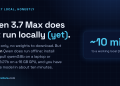
Answer card: Qwen 3.7 Max is API-only and cannot run locally yet; the open Qwen models (Qwen 3.6 27B, qwen3:8b to 32b) run offline via Ollama.

Qwen 3.7 local: what you can actually run offline

22 June 2026
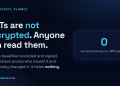
Answer card: JWTs are not encrypted, anyone can read them; the signature proves who issued the token, not who may read it.

Are JWTs encrypted? No, and the difference will bite you

0
Answer card: a random 8 character password falls in under 2 hours offline, while 16 random characters hold for 1.4 trillion years at the same speed.

How long does it take to crack a password in 2026?

0
Answer card: three DNS records decide if your mail lands or bounces; SPF lists allowed senders, DKIM signs messages, DMARC sets the failure policy.

SPF, DKIM and DMARC explained: the records your email needs

0
Answer card stating that Qwen-Image-2.1, released on 20 September 2026, ships open weights with a 7 billion parameter diffusion transformer, a Qwen3-VL 8B text encoder and an RGBA VAE totalling about 33 gigabytes in BF16, under the Qwen Research License that limits use to research or evaluation and requires a separate commercial licence, unlike the Apache 2.0 licence of Qwen-Image 1.0.

Qwen-Image-2.1 brings the weights back, but not the Apache licence

21 September 2026
Answer card stating that Ternary Bonsai 2 27B, released by PrismML on 17 September 2026 under Apache 2.0, packs Qwen3.8 27B into 5.95 gigabytes at 1.72 bits per weight, keeps 98.2 percent of the 14-benchmark average, about 75 percent on SWE-bench Verified and Terminal-Bench 2.1, and needs PrismML's llama.cpp fork to run.

Does Bonsai 2 27B really keep 98% of Qwen3.8 in 5.95 GB?

20 September 2026
Answer card stating that Jev 1.13 from TypeSafe AI is a decision model in early access since 15 September 2026 that returns typed probabilities instead of text, priced at 42 dollars per billion input tokens with output tokens free, answering in 70 to 500 milliseconds, with a 64K token request budget, text input only, and a documented list of things it does badly, including counting and dates.

Jev 1.13 bills $42 a billion tokens, and it can’t count

19 September 2026
  • About
  • Contact
  • Privacy
  • Legal

Copyright © 2026 Stephane Cardon.

Welcome Back!

Login to your account below

Forgotten Password?

Retrieve your password

Please enter your username or email address to reset your password.

Log In
No Result
View All Result
  • Home
  • Articles
    • Security
    • Network
    • Dev
    • Sysadmin
    • SEO
    • Email & DNS
  • Tools
    • Network tools: free, fast, no signup
    • Security tools: free, fast, no signup
    • Developer tools: free, fast, no signup
    • Sysadmin tools: free, fast, no signup
    • SEO tools: free, fast, no signup
    • Email & DNS tools: free, fast, no signup
  • Download
  • About

Copyright © 2026 Stephane Cardon.