
• Latest
  • Trending
  • All
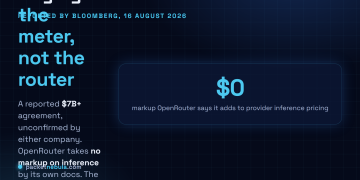
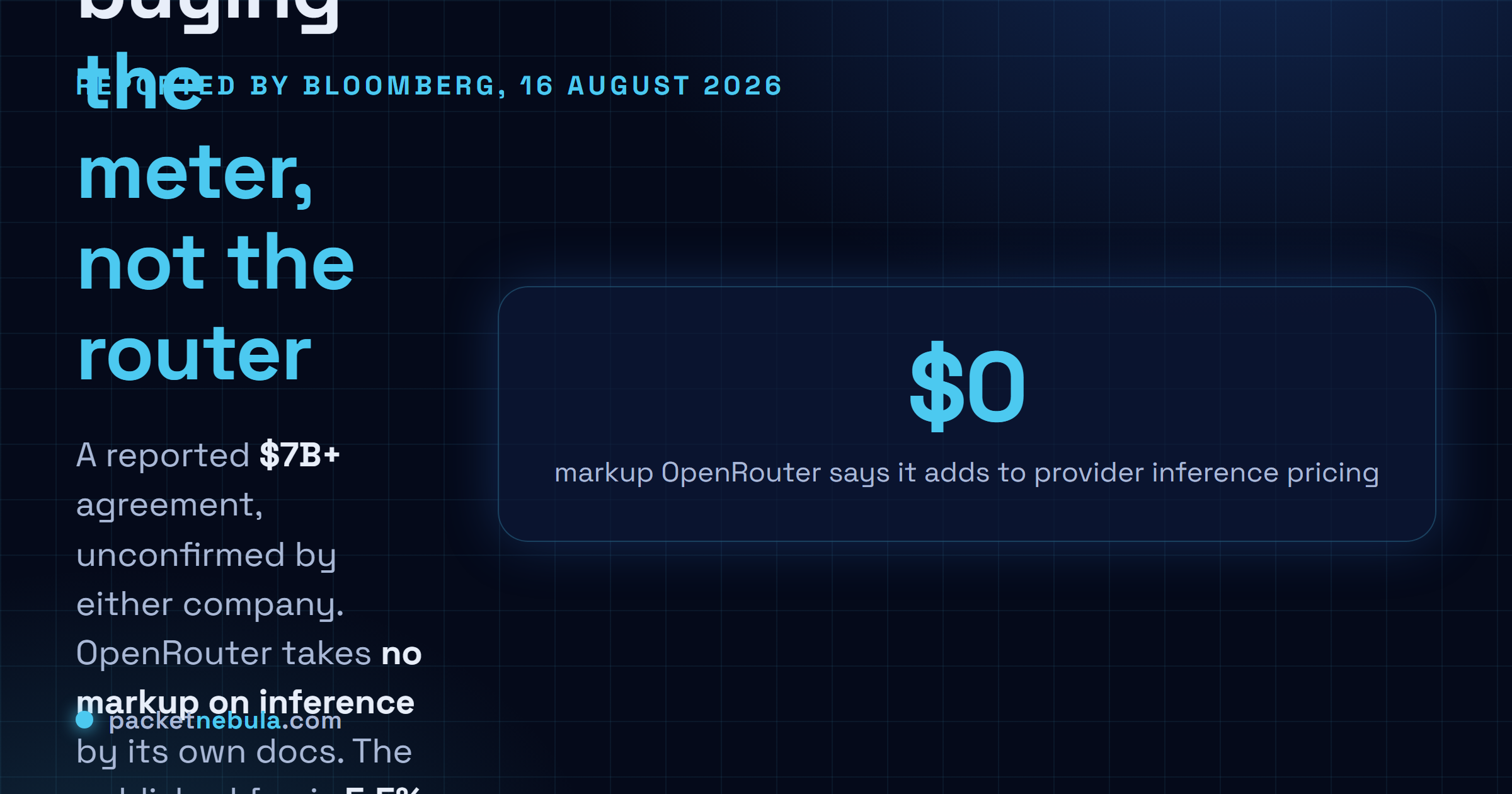
Answer card summarising the reported Stripe acquisition of OpenRouter for more than $7 billion on 16 August 2026, unconfirmed by either company, and OpenRouter's published pricing of no inference markup with a 5.5% fee on credit top ups.

Stripe is reportedly buying OpenRouter for over $7B

3 September 2026
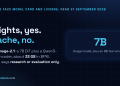
Answer card stating that Qwen-Image-2.1, released on 20 September 2026, ships open weights with a 7 billion parameter diffusion transformer, a Qwen3-VL 8B text encoder and an RGBA VAE totalling about 33 gigabytes in BF16, under the Qwen Research License that limits use to research or evaluation and requires a separate commercial licence, unlike the Apache 2.0 licence of Qwen-Image 1.0.

Qwen-Image-2.1 brings the weights back, but not the Apache licence

21 September 2026
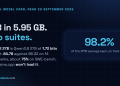
Answer card stating that Ternary Bonsai 2 27B, released by PrismML on 17 September 2026 under Apache 2.0, packs Qwen3.8 27B into 5.95 gigabytes at 1.72 bits per weight, keeps 98.2 percent of the 14-benchmark average, about 75 percent on SWE-bench Verified and Terminal-Bench 2.1, and needs PrismML's llama.cpp fork to run.

Does Bonsai 2 27B really keep 98% of Qwen3.8 in 5.95 GB?

20 September 2026
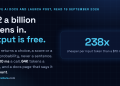
Answer card stating that Jev 1.13 from TypeSafe AI is a decision model in early access since 15 September 2026 that returns typed probabilities instead of text, priced at 42 dollars per billion input tokens with output tokens free, answering in 70 to 500 milliseconds, with a 64K token request budget, text input only, and a documented list of things it does badly, including counting and dates.

Jev 1.13 bills $42 a billion tokens, and it can’t count

19 September 2026
Answer card stating that Qwen3.8-Omni-Flash launched on 17 September 2026 as an API only model on Alibaba Cloud Model Studio, taking text, images, audio and video in a 1M token context and returning text only, priced at 0.15 dollars per million input tokens for every modality and 0.47 dollars per million output tokens in the international regions, with no open weights published and the Qwen-Live Harness GitHub repository returning 404.

Qwen3.8-Omni-Flash bills audio at $0.15 and ships no weights

18 September 2026
Answer card stating that on 15 September 2026 AWS said it is unable to restore access to resources and data hosted exclusively in the Middle East Bahrain region me-south-1 and in the mec1-az2 zone of the UAE region, because the damage spanned multiple Availability Zones and exceeded what multi-AZ services are designed to withstand.

AWS can’t restore me-south-1, six months after the drone strikes

17 September 2026
Answer card stating that Google released Gemini 3.8 Live and Gemini 3.8 Live Extended Thinking on 15 September 2026 at 3 dollars per million audio input tokens and 12 dollars out, that the thinking model requires asynchronous tools, and that Artificial Analysis scores it 82.6 on its Speech to Speech Quality Index.

Gemini 3.8 Live Extended Thinking rejects any tool that blocks

16 September 2026
Answer card summarising the Atria Dawn Preview release: 744B GLM-5.2 base, MIT licence, 1.5 TB BF16 and 756 GB FP8 checkpoints, 256K context, top on five of sixteen benchmark rows and trailing on SWE-bench Pro.

Atria Dawn Preview is 744B under MIT, and the BF16 weighs 1.5 TB

15 September 2026
Answer card stating that OpenAI released the Agents API in public beta on 10 September 2026 with no separate fee, billed through model tokens, tool calls and hosted sandbox time, with a choice of OpenAI hosted, self hosted or partner sandboxes, US only data residency and no Zero Data Retention support.

OpenAI’s Agents API has no fee, no ZDR and a one hour sandbox clock

14 September 2026
Answer card: Sakana Fugu Max at $2 and $6 per million tokens, Fugu Ultra v2 unchanged at $5 and $30, and Sakana saying Ultra v2 scores without Fable 5 or GPT-6 Astra in its pool.

Fugu Max costs $2 and $6 while Fugu Ultra v2 runs without Fable 5

13 September 2026
Answer card stating that DeepSeek released DeepSeek-V4.1-Flash on 10 September 2026 as a 552 billion parameter mixture of experts model with a new causal encoder decoder architecture that activates 8 billion parameters on input and 16 billion on output, with native vision, a one million token context and MIT licensed weights, that the API model name is now deepseek-flash at 0.15 dollars per million input tokens and 0.60 dollars per million output tokens off peak, and that DeepSeek announced V4 Pro would be routed to V4.1-Flash from 14 September and reversed that on 11 September.

DeepSeek V4.1-Flash arrived, and the V4 Pro retirement lasted a day

12 September 2026
Answer card stating that Cognition released SWE-2 on 10 September 2026, a coding model post-trained from Kimi K3, scoring 50.0 percent on FrontierCode 1.1 Main against 50.9 percent for Claude Fable 5.1 and 27.3 percent on Terminal-Bench 4 against 55.8 percent, available only inside Devin.

SWE-2 trails Fable 5.1 by one point, and by 28 on Terminal-Bench 4

11 September 2026
Answer card for Meta Muse, free to 100 million tokens a week then $20 a month, launched 8 September 2026 for United States adults only, running in a dedicated per user virtual machine.

Does Meta Muse do enough to earn your inbox and a card on file?

9 September 2026
  • About
  • Contact
  • Privacy
  • Legal
Monday, September 21, 2026
  • Login
Packet Nebula
  • Home
  • Articles
    • Security
    • Network
    • Dev
    • Sysadmin
    • SEO
    • Email & DNS
  • Tools
    • Network tools: free, fast, no signup
    • Security tools: free, fast, no signup
    • Developer tools: free, fast, no signup
    • Sysadmin tools: free, fast, no signup
    • SEO tools: free, fast, no signup
    • Email & DNS tools: free, fast, no signup
  • Download
  • About
No Result
View All Result
Packet Nebula
No Result
View All Result
Home Dev

Stripe is reportedly buying OpenRouter for over $7B

by stephane
3 September 2026
in Dev
0
Answer card summarising the reported Stripe acquisition of OpenRouter for more than $7 billion on 16 August 2026, unconfirmed by either company, and OpenRouter's published pricing of no inference markup with a 5.5% fee on credit top ups.
497
SHARES
1.4k
VIEWS
Share on FacebookShare on Twitter

Open your OpenRouter dashboard this morning and it looks exactly like it did last week. Same keys, same balance, same model picker, same everything. That is the honest answer to the news: Bloomberg reported on 16 August that Stripe has finalised an agreement to buy OpenRouter for more than $7 billion, and since then neither company has published a word. Stripe told TechCrunch it does not comment on rumours or speculation. So nothing has moved for anyone shipping against the API today. What we find interesting is not the price. It is what Stripe is actually buying, because OpenRouter adds no markup to inference. Its own docs say so. The published fee is 5.5% when you top up credits, and that top up already runs through Stripe.

The short answer

Bloomberg reported on 16 August that Stripe finalised an agreement to acquire OpenRouter for more than $7 billion. Stripe declined to comment, OpenRouter has posted nothing, and no part of the API changed. The detail worth your attention is what the asset actually is. OpenRouter says it adds no markup to inference, so the published revenue is a payment fee on top ups plus a cut on bring your own key overage. Stripe is buying a meter, and it was already processing the payments running through it.
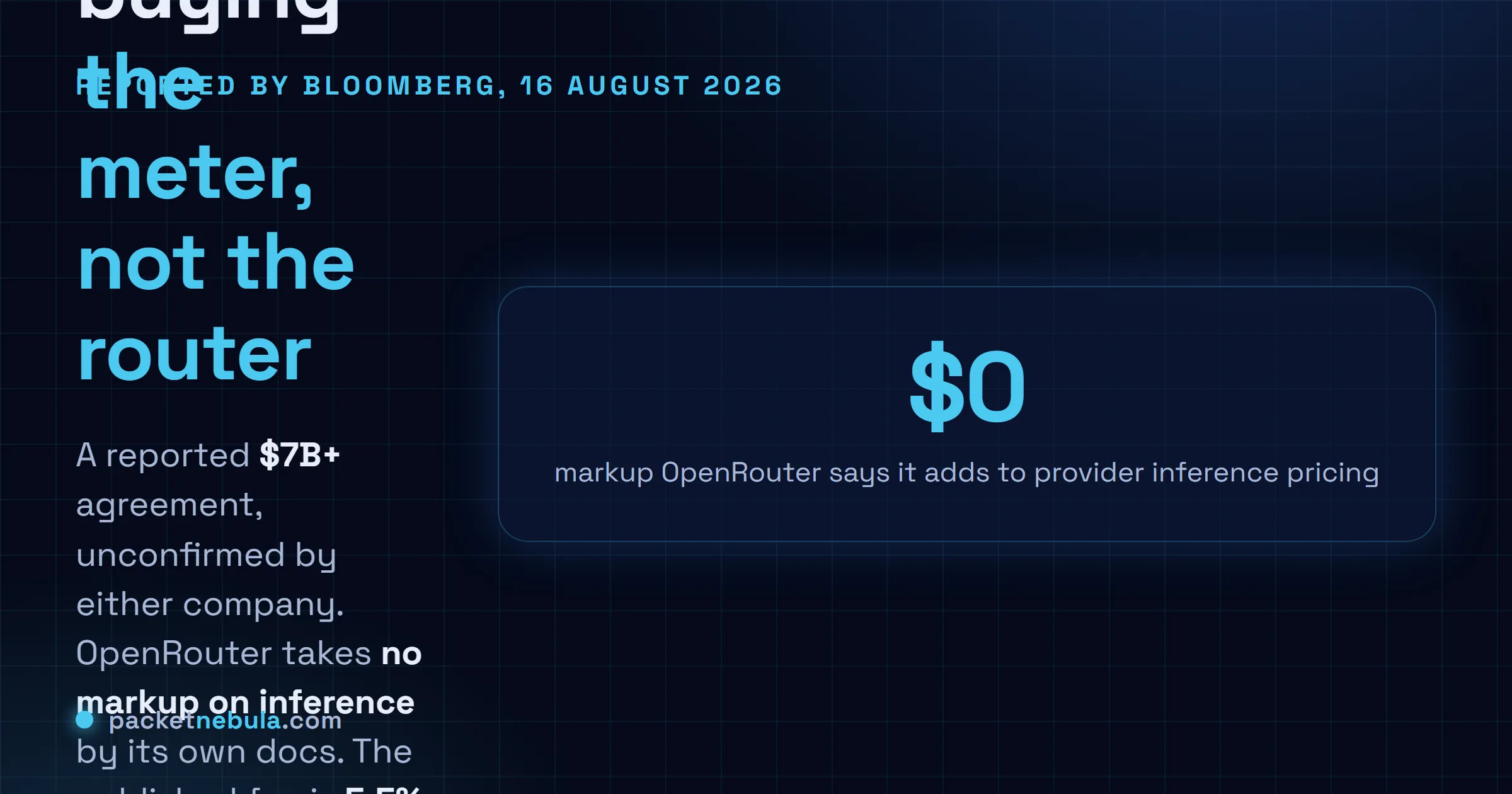
$7B+reported price, unconfirmed by either company
$1.3BOpenRouter valuation at its Series B in May 2026
5.5%fee OpenRouter publishes on card credit top ups
Answer card: Bloomberg reported on 16 August 2026 that Stripe finalised an agreement to acquire OpenRouter for more than 7 billion dollars, neither company has confirmed it and Stripe declined to comment, while OpenRouter's own documentation states no markup on inference pricing and a 5.5 percent fee on credit top ups processed by Stripe.
Reported, not announced. That distinction does a lot of work this week.

What was actually reported

Bloomberg put it out on 16 August, on unnamed sources, in one sentence:

“Stripe has finalized an agreement to acquire OpenRouter, a startup that helps companies switch between artificial intelligence models, for more than $7 billion, according to people familiar with the matter.”

Bloomberg (@business on X), 16 August 2026.

TechCrunch, Fortune and The Next Web all ran it the same day or the next, all tracing back to the same reporting. Stripe’s line to TechCrunch was that it does not comment on rumours or speculation. OpenRouter has said nothing at all.

The number has history. On 23 July the Wall Street Journal reported talks that could value OpenRouter near $10 billion. Three weeks later the reported agreement is above $7 billion. So the price came down by roughly a third somewhere in there, if you believe both leaks, which you probably should hold loosely. Either way it is a long way above the $1.3 billion the company was reportedly worth at its $113 million Series B in May, with Sequoia, Andreessen Horowitz, Menlo Ventures and Alphabet’s CapitalG on the cap table.
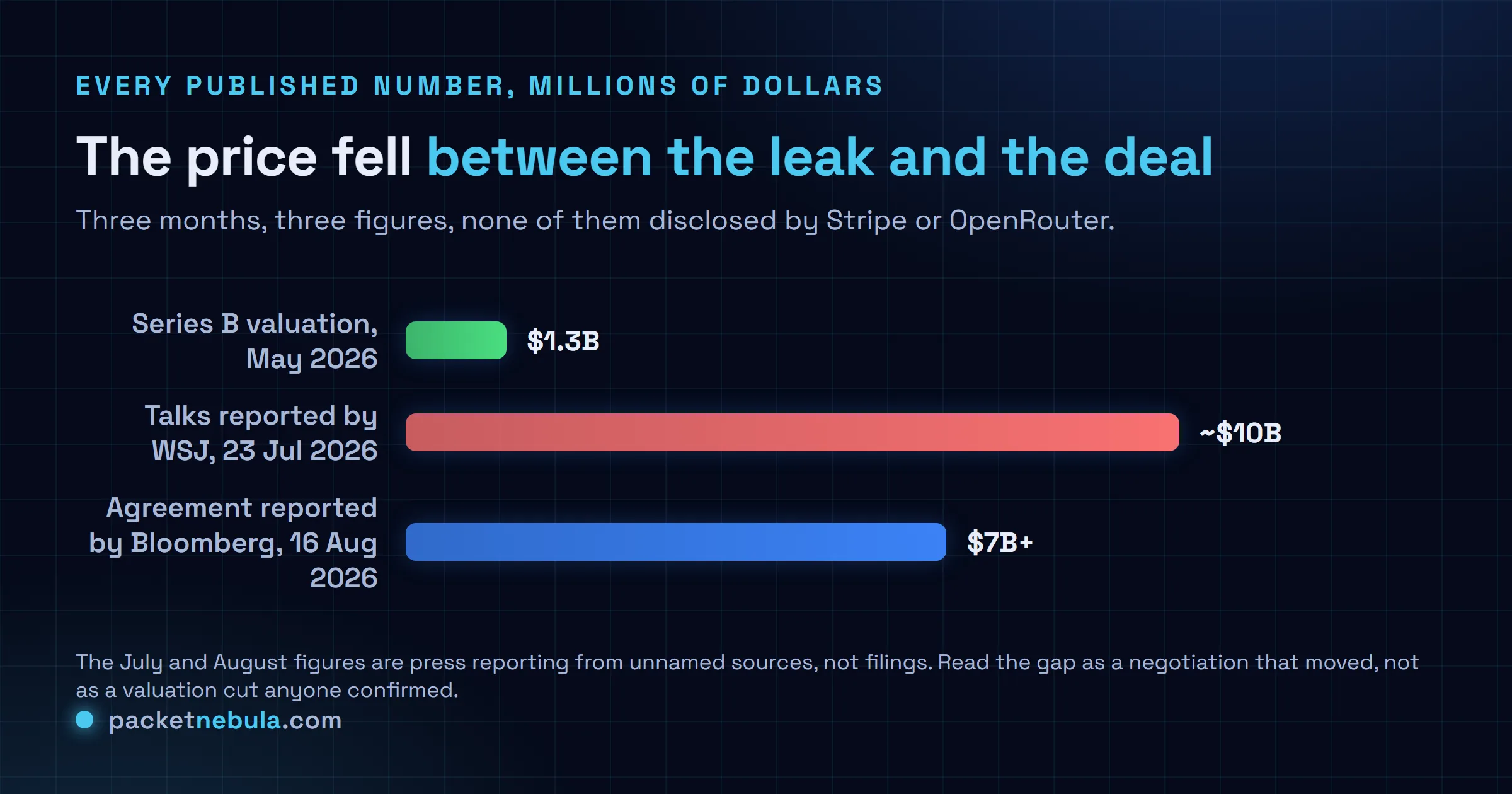
Comparison chart in millions of dollars of the three published numbers attached to OpenRouter during 2026: a 1.3 billion dollar Series B valuation in May, roughly 10 billion dollars in acquisition talks reported by the Wall Street Journal on 23 July, and a more than 7 billion dollar agreement reported by Bloomberg on 16 August.
Eighty two days between the Series B and the reported deal. Nobody has filed any of these.

The part the coverage keeps getting wrong

Read enough of the write ups and you will see a claim that OpenRouter takes a cut of about 5% of inference spend. It does not, at least not the way that is written. OpenRouter’s own FAQ is blunt about it: no markup on inference pricing. You pay what the provider charges.

Here is what it does publish. Buying credits by card costs 5.5% with an $0.80 minimum, and that card processing runs on Stripe. Topping up in crypto through Coinbase costs 5%. Bring your own key is free up to a monthly allowance, listed at $25,000 for pay as you go and $200,000 for enterprise, above which OpenRouter takes 5% of what the same call would have cost on its platform.

Sit with that for a second. The headline product is neutral model routing. The published money is a payment fee, a wallet, and a metering charge on usage that does not even touch OpenRouter’s own provider accounts. Stripe is not buying an algorithm. It is buying a billing surface with, by OpenRouter’s own homepage counters, 10M+ global users, 500+ models, 80+ providers and 200T+ tokens a month flowing through it.

Stripe was already inside the building

This is the detail that made the deal click for us, and it is first party rather than leaked. On 29 January 2026, Stripe published a customer story about OpenRouter. Not a rumour, an actual page on the Stripe newsroom. OpenRouter was using Stripe Invoicing to bill on flexible terms, Stripe Tax for global tax collection, and Radar for Fraud Teams to manage risk. Alex Atallah, OpenRouter’s co-founder and chief executive, was quoted in it. The story cited over 5 million developers at the time, which is roughly half the number the homepage shows now.

So the acquirer had a seven month view of the target’s transaction volume, refund behaviour, fraud profile and growth curve before anyone reported a price. Honestly, I think that explains the multiple better than any strategic narrative about the AI economy does. You pay a different number for a business you have been metering yourself.
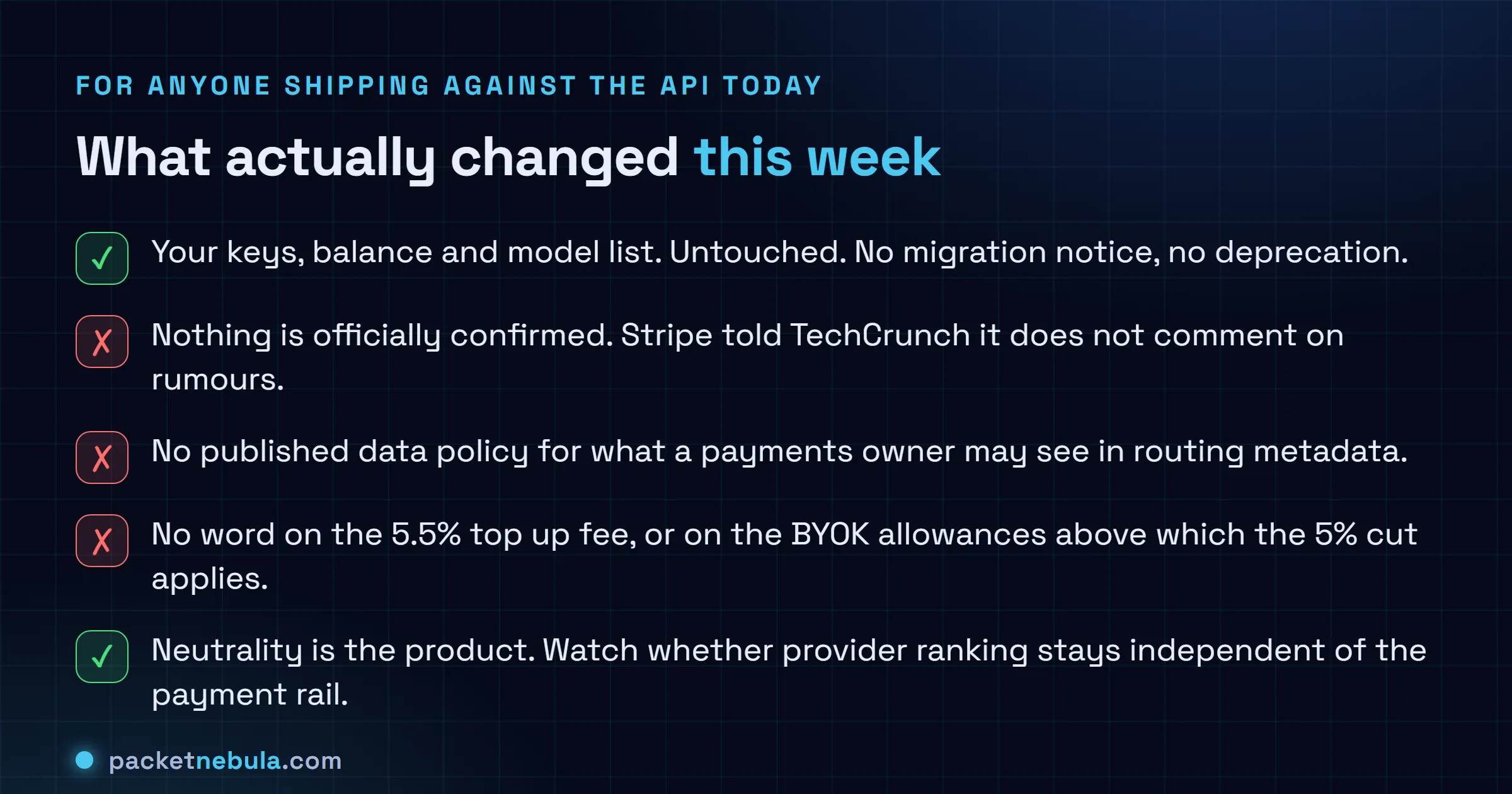
Checklist of what changed for developers using OpenRouter this week: keys, balance and model list untouched with no migration notice, nothing officially confirmed with Stripe declining to comment, no published data policy for routing metadata, no word on the 5.5 percent top up fee or the bring your own key allowances, and provider neutrality identified as the thing worth watching.
Four of these five are absences. That is what an unannounced deal looks like.

What we would actually do about it

Nothing, this week. That is not a dodge, it is the correct answer. There is no announcement to react to, and if the deal is real it faces a regulatory review that runs in months.

What is worth doing is a small amount of hygiene, the kind that is cheap now and annoying later. Know which of your services call OpenRouter directly and which could point at a provider endpoint tomorrow, because OpenRouter’s API is OpenAI compatible and that cuts both ways. If you have been leaning on it to dodge the pricing swings that keep hitting model APIs, that reason has not gone anywhere. And if the gateway is how you keep testing which model is actually cheapest for your workload, keep doing it.

The thing I would genuinely watch is neutrality. Atallah has described OpenRouter as the equivalent of Stripe for AI, a single access point that prevents lock in. That pitch got funnier this week. A router is only worth anything while it is indifferent to who wins, and indifference is harder to hold when your owner has commercial relationships with most of the industry. No evidence of any tilt exists. There is just now a reason to check.

The other open question is data. Routing metadata is not prompt content, but it is a very good picture of what a company is building, at what volume, on which model. Nobody has published a policy for what a payments parent may do with that. Until somebody does, treat it as unanswered rather than fine.

Sources

Bloomberg, Stripe finalizes deal to acquire OpenRouter for over $7 billion, 16 August 2026. TechCrunch, Stripe will reportedly acquire AI gateway startup OpenRouter for $7B+, 16 August 2026. The Next Web, Stripe reportedly acquires OpenRouter for over $7bn, 17 August 2026. Stripe newsroom, Stripe powers OpenRouter’s global AI model access, 29 January 2026. OpenRouter, documentation FAQ on fees and BYOK allowances and homepage usage counters, read 18 August 2026. PYMNTS on the Wall Street Journal report, Stripe eyes $10 billion deal for OpenRouter, 24 July 2026.

Frequently asked questions

Has Stripe officially confirmed it is buying OpenRouter?

No. As of 18 August 2026 the deal exists only in press reporting. Bloomberg reported on 16 August that an agreement had been finalised at more than $7 billion, citing people familiar with the matter, and Fortune, TechCrunch and The Next Web followed the same sourcing. A Stripe spokesperson told TechCrunch the company does not comment on rumours or speculation. There is no post on the Stripe newsroom and none on the OpenRouter blog. Treat every number here as reporting rather than disclosure.

Does anything change for my OpenRouter API keys or billing today?

Nothing published. No migration notice, no deprecation, no pricing change, no new terms. Keys keep working, credits keep drawing down, the model list is the same. If a deal closes there will normally be a regulatory review before anything touches the product, and that takes months rather than days. The sensible move is to change nothing in production until Stripe or OpenRouter publishes actual product and data policy terms.

How does OpenRouter make money if it does not mark up inference?

Through payment and account fees, at least the ones it publishes. OpenRouter's FAQ states there is no markup on inference pricing, so you pay provider rates. What it does charge is 5.5% with a $0.80 minimum on credit purchases made by card through Stripe, 5% on crypto top ups through Coinbase, and a 5% fee on bring your own key usage above the monthly allowance, which the docs put at $25,000 for pay as you go and $200,000 for enterprise. There may well be private enterprise arrangements we cannot see, so read this as the published model rather than the whole income statement.

Why would a payments company pay $7 billion for a model router?

Because routing is where AI spend gets metered, and metering is a payments problem. OpenRouter sits in front of 500+ models from 80+ providers and reports 10M+ global users and 200T+ monthly tokens on its homepage. Every one of those calls is a priced event that somebody has to count, bill and reconcile across dozens of vendors. That is closer to Stripe's existing business than it looks. Worth noting that Stripe already published a case study in January 2026 describing OpenRouter as a customer using Stripe Invoicing, Stripe Tax and Radar, so this is a buyer acquiring a company that was already on its rails.

What is the risk for developers if the deal goes through?

Neutrality. The whole reason to route through a gateway is that it does not care which model wins, and OpenRouter's CEO Alex Atallah has pitched it as preventing lock in. An owner with its own commercial relationships across the industry has, in principle, reasons to prefer some providers over others. We are not saying that will happen and there is no evidence of it. It is simply the thing to watch, along with what routing metadata a payments parent can see.

Tags: aiapibig-techinfrastructurellmnews
Share199Tweet124
stephane

stephane

  • Trending
  • Comments
  • Latest
Answer card: Proton Lumo 2.0 is private by policy, not by locality. Saved history is locked so even Proton cannot read it, but the prompt is decrypted on a Proton EU server to answer it, then forgotten.

Proton Lumo 2.0 review: how private is it, really?

3 September 2026
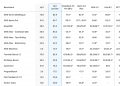
The Agentic Coding section of the official Hy4 preview benchmark appendix published by Tencent, a table comparing Hy3 and Hy4 preview against DeepSeek V4 Pro 0813, Qwen 3.8 Max, GLM 5.3, Kimi K3, GPT 5.6 Sol and Claude Opus 5 across SWE-bench Multilingual, SWE-bench Pro, DeepSWE, three SWE Atlas tasks, SWE-Marathon, Terminal-Bench 2.1, NL2Repo-Bench, CyberGym, ProgramBench, PostTrainBench and Harbor-Index.

Tencent’s 770B Hy4 tops one benchmark row in 46

3 September 2026
Answer card: Qwen 3.7 Max is API-only and cannot run locally yet; the open Qwen models (Qwen 3.6 27B, qwen3:8b to 32b) run offline via Ollama.

Qwen 3.7 local: what you can actually run offline

22 June 2026
Answer card: JWTs are not encrypted, anyone can read them; the signature proves who issued the token, not who may read it.

Are JWTs encrypted? No, and the difference will bite you

0
Answer card: a random 8 character password falls in under 2 hours offline, while 16 random characters hold for 1.4 trillion years at the same speed.

How long does it take to crack a password in 2026?

0
Answer card: three DNS records decide if your mail lands or bounces; SPF lists allowed senders, DKIM signs messages, DMARC sets the failure policy.

SPF, DKIM and DMARC explained: the records your email needs

0
Answer card stating that Qwen-Image-2.1, released on 20 September 2026, ships open weights with a 7 billion parameter diffusion transformer, a Qwen3-VL 8B text encoder and an RGBA VAE totalling about 33 gigabytes in BF16, under the Qwen Research License that limits use to research or evaluation and requires a separate commercial licence, unlike the Apache 2.0 licence of Qwen-Image 1.0.

Qwen-Image-2.1 brings the weights back, but not the Apache licence

21 September 2026
Answer card stating that Ternary Bonsai 2 27B, released by PrismML on 17 September 2026 under Apache 2.0, packs Qwen3.8 27B into 5.95 gigabytes at 1.72 bits per weight, keeps 98.2 percent of the 14-benchmark average, about 75 percent on SWE-bench Verified and Terminal-Bench 2.1, and needs PrismML's llama.cpp fork to run.

Does Bonsai 2 27B really keep 98% of Qwen3.8 in 5.95 GB?

20 September 2026
Answer card stating that Jev 1.13 from TypeSafe AI is a decision model in early access since 15 September 2026 that returns typed probabilities instead of text, priced at 42 dollars per billion input tokens with output tokens free, answering in 70 to 500 milliseconds, with a 64K token request budget, text input only, and a documented list of things it does badly, including counting and dates.

Jev 1.13 bills $42 a billion tokens, and it can’t count

19 September 2026
  • About
  • Contact
  • Privacy
  • Legal

Copyright © 2026 Stephane Cardon.

Welcome Back!

Login to your account below

Forgotten Password?

Retrieve your password

Please enter your username or email address to reset your password.

Log In
No Result
View All Result
  • Home
  • Articles
    • Security
    • Network
    • Dev
    • Sysadmin
    • SEO
    • Email & DNS
  • Tools
    • Network tools: free, fast, no signup
    • Security tools: free, fast, no signup
    • Developer tools: free, fast, no signup
    • Sysadmin tools: free, fast, no signup
    • SEO tools: free, fast, no signup
    • Email & DNS tools: free, fast, no signup
  • Download
  • About

Copyright © 2026 Stephane Cardon.