
• Latest
  • Trending
  • All
A Verne-branded white robotaxi driving past the Croatian National Theatre in Zagreb, from the Verne press material for Europe first commercial robotaxi service, which runs Pony.ai autonomous driving technology.

Uber and Pony.ai promised 2,000 robotaxis and named one city

3 September 2026
The official xAI announcement card for Grok 4.7, white type on a dark grey and navy gradient.

Grok 4.7 keeps $2 and $6, and its gains over 4.6 are xhigh versus high

22 September 2026
Answer card stating that Qwen-Image-2.1, released on 20 September 2026, ships open weights with a 7 billion parameter diffusion transformer, a Qwen3-VL 8B text encoder and an RGBA VAE totalling about 33 gigabytes in BF16, under the Qwen Research License that limits use to research or evaluation and requires a separate commercial licence, unlike the Apache 2.0 licence of Qwen-Image 1.0.

Qwen-Image-2.1 brings the weights back, but not the Apache licence

21 September 2026
Answer card stating that Ternary Bonsai 2 27B, released by PrismML on 17 September 2026 under Apache 2.0, packs Qwen3.8 27B into 5.95 gigabytes at 1.72 bits per weight, keeps 98.2 percent of the 14-benchmark average, about 75 percent on SWE-bench Verified and Terminal-Bench 2.1, and needs PrismML's llama.cpp fork to run.

Does Bonsai 2 27B really keep 98% of Qwen3.8 in 5.95 GB?

20 September 2026
Answer card stating that Jev 1.13 from TypeSafe AI is a decision model in early access since 15 September 2026 that returns typed probabilities instead of text, priced at 42 dollars per billion input tokens with output tokens free, answering in 70 to 500 milliseconds, with a 64K token request budget, text input only, and a documented list of things it does badly, including counting and dates.

Jev 1.13 bills $42 a billion tokens, and it can’t count

19 September 2026
Answer card stating that Qwen3.8-Omni-Flash launched on 17 September 2026 as an API only model on Alibaba Cloud Model Studio, taking text, images, audio and video in a 1M token context and returning text only, priced at 0.15 dollars per million input tokens for every modality and 0.47 dollars per million output tokens in the international regions, with no open weights published and the Qwen-Live Harness GitHub repository returning 404.

Qwen3.8-Omni-Flash bills audio at $0.15 and ships no weights

18 September 2026
Answer card stating that on 15 September 2026 AWS said it is unable to restore access to resources and data hosted exclusively in the Middle East Bahrain region me-south-1 and in the mec1-az2 zone of the UAE region, because the damage spanned multiple Availability Zones and exceeded what multi-AZ services are designed to withstand.

AWS can’t restore me-south-1, six months after the drone strikes

17 September 2026
Answer card stating that Google released Gemini 3.8 Live and Gemini 3.8 Live Extended Thinking on 15 September 2026 at 3 dollars per million audio input tokens and 12 dollars out, that the thinking model requires asynchronous tools, and that Artificial Analysis scores it 82.6 on its Speech to Speech Quality Index.

Gemini 3.8 Live Extended Thinking rejects any tool that blocks

16 September 2026
Answer card summarising the Atria Dawn Preview release: 744B GLM-5.2 base, MIT licence, 1.5 TB BF16 and 756 GB FP8 checkpoints, 256K context, top on five of sixteen benchmark rows and trailing on SWE-bench Pro.

Atria Dawn Preview is 744B under MIT, and the BF16 weighs 1.5 TB

15 September 2026
Answer card stating that OpenAI released the Agents API in public beta on 10 September 2026 with no separate fee, billed through model tokens, tool calls and hosted sandbox time, with a choice of OpenAI hosted, self hosted or partner sandboxes, US only data residency and no Zero Data Retention support.

OpenAI’s Agents API has no fee, no ZDR and a one hour sandbox clock

14 September 2026
Answer card: Sakana Fugu Max at $2 and $6 per million tokens, Fugu Ultra v2 unchanged at $5 and $30, and Sakana saying Ultra v2 scores without Fable 5 or GPT-6 Astra in its pool.

Fugu Max costs $2 and $6 while Fugu Ultra v2 runs without Fable 5

13 September 2026
Answer card stating that DeepSeek released DeepSeek-V4.1-Flash on 10 September 2026 as a 552 billion parameter mixture of experts model with a new causal encoder decoder architecture that activates 8 billion parameters on input and 16 billion on output, with native vision, a one million token context and MIT licensed weights, that the API model name is now deepseek-flash at 0.15 dollars per million input tokens and 0.60 dollars per million output tokens off peak, and that DeepSeek announced V4 Pro would be routed to V4.1-Flash from 14 September and reversed that on 11 September.

DeepSeek V4.1-Flash arrived, and the V4 Pro retirement lasted a day

12 September 2026
Answer card stating that Cognition released SWE-2 on 10 September 2026, a coding model post-trained from Kimi K3, scoring 50.0 percent on FrontierCode 1.1 Main against 50.9 percent for Claude Fable 5.1 and 27.3 percent on Terminal-Bench 4 against 55.8 percent, available only inside Devin.

SWE-2 trails Fable 5.1 by one point, and by 28 on Terminal-Bench 4

11 September 2026
  • About
  • Contact
  • Privacy
  • Legal
Tuesday, September 22, 2026
  • Login
Packet Nebula
  • Home
  • Articles
    • Security
    • Network
    • Dev
    • Sysadmin
    • SEO
    • Email & DNS
  • Tools
    • Network tools: free, fast, no signup
    • Security tools: free, fast, no signup
    • Developer tools: free, fast, no signup
    • Sysadmin tools: free, fast, no signup
    • SEO tools: free, fast, no signup
    • Email & DNS tools: free, fast, no signup
  • Download
  • About
No Result
View All Result
Packet Nebula
No Result
View All Result
Home Dev

Uber and Pony.ai promised 2,000 robotaxis and named one city

by stephane
3 September 2026
in Dev
0
A Verne-branded white robotaxi driving past the Croatian National Theatre in Zagreb, from the Verne press material for Europe first commercial robotaxi service, which runs Pony.ai autonomous driving technology.
491
SHARES
1.4k
VIEWS
Share on FacebookShare on Twitter

Ten cars. That is the whole robotaxi fleet carrying paying passengers in Europe on this partnership right now, a handful of Arcfox SUVs doing flat 1.99 euro rides around Zagreb with a safety operator sat behind the wheel. On 14 August, Pony.ai and Uber said they plan to put more than 2,000 robotaxis across Europe, growing from that Zagreb service into four more cities. Which cities? Not disclosed. Starting when? Also not disclosed. We have read enough of these to recognise the shape, where the number is the announcement and the number happens to be two hundred times the fleet that exists.

The short answer

Pony.ai and Uber said on 14 August 2026 that they plan to deploy more than 2,000 robotaxis across Europe, expanding from the Zagreb service to four more cities announced in phases. Pony.ai brings the Level 4 stack, Uber brings the app, a local partner owns the fleet. No city names, no dates, no per city vehicle counts and no financial terms. The Zagreb service it builds on went live on 8 April with 10 cars, a flat 1.99 euro fare and a safety operator in every seat.
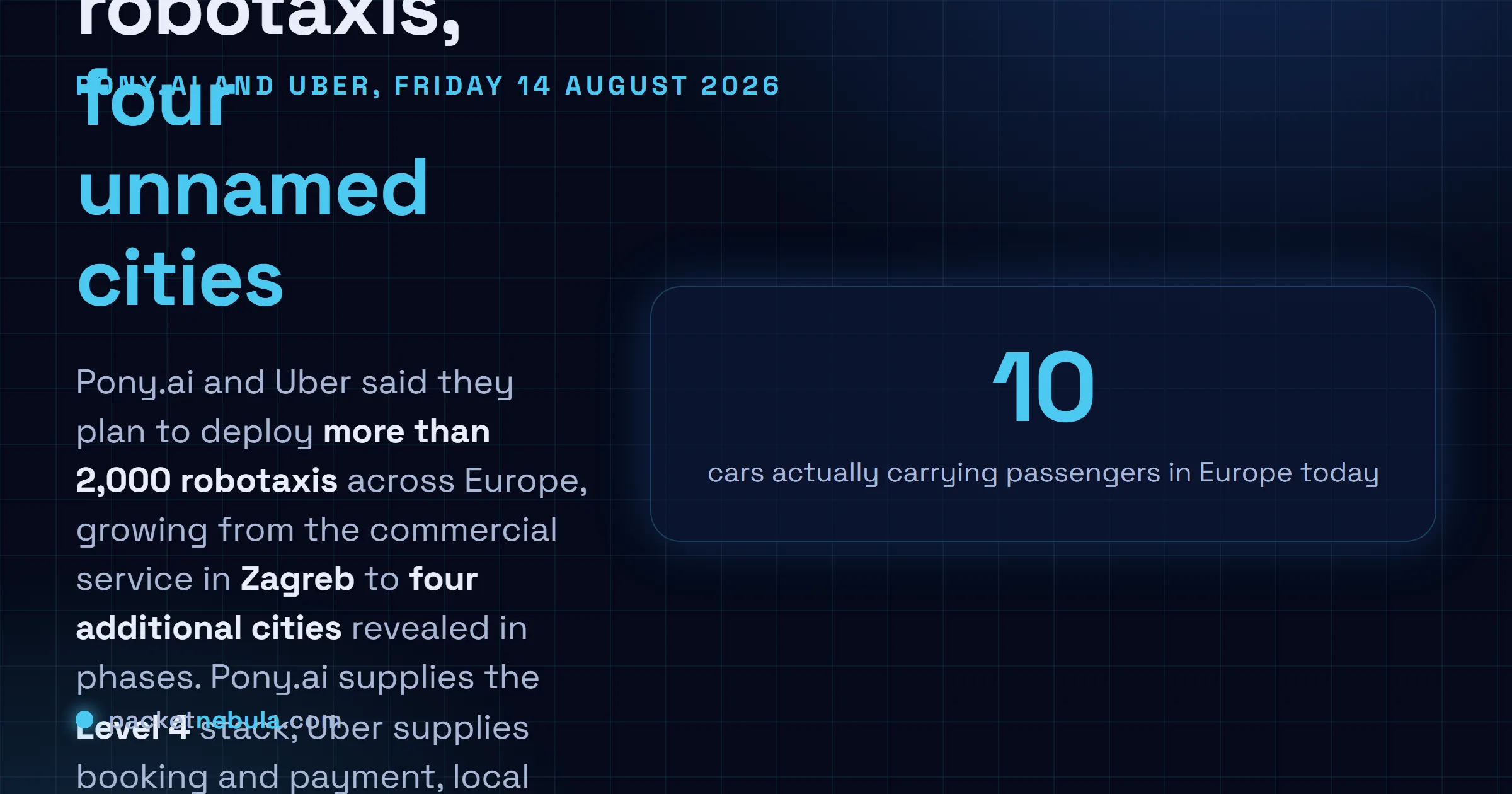
2,000+robotaxis announced
10cars running in Europe today
0of the four new cities named
Answer card: on 14 August 2026 Pony.ai and Uber announced plans for more than 2,000 robotaxis across Europe, expanding from Zagreb to four additional unnamed cities, with no launch dates, no per city vehicle counts and no financial terms, while the Zagreb service it scales from runs 10 cars with a safety operator on board.
The announcement in one card. The small number at the bottom is the one doing the work.

What was actually signed

Read the release carefully and the committed part is thinner than the headline. Pony.ai and Uber expanded a partnership that has existed since May 2025. Pony.ai supplies its Level 4 autonomous driving technology and the operational know-how it built in China. Uber supplies the demand side, so booking, payment and customer service through the app. A local company owns the cars and does the unglamorous work of cleaning, charging and maintaining them.

That structure is the genuinely interesting bit, and it is easy to skip past. Nobody in this deal is proposing to own a European fleet from Guangzhou or San Francisco. The capital and the depot sit with a local operator, which in Zagreb means Verne, spun out of the hypercar maker Rimac.

Sarfraz Maredia, who runs autonomous mobility and delivery at Uber, put it as moving “from individual launches to repeatable commercial scale”. Pony.ai founder James Peng talked about bringing services “to more European cities”. Neither sentence contains a city or a date, and I do not think that is an accident.
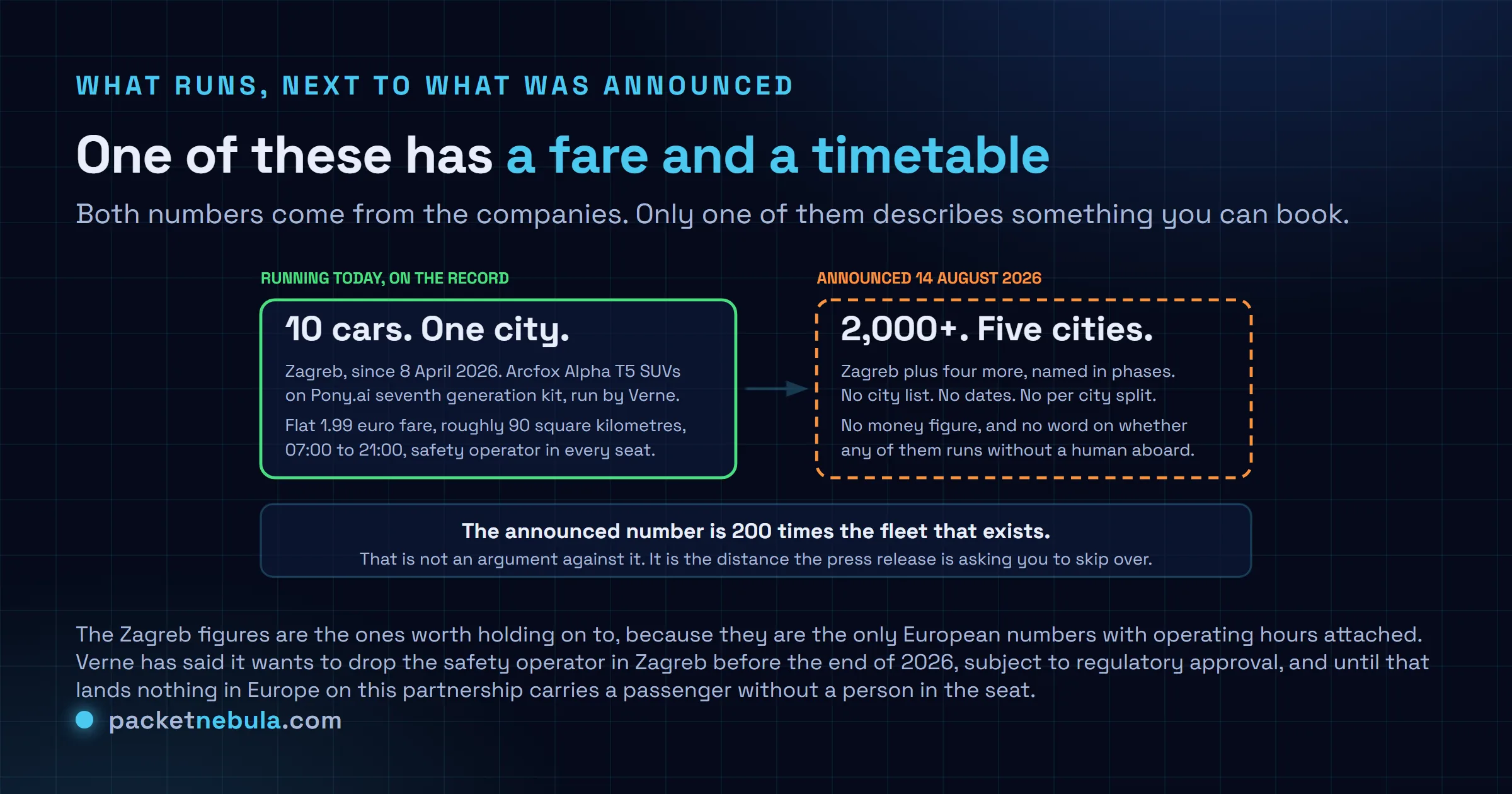
Diagram comparing the Zagreb robotaxi service running since 8 April 2026, which is 10 Arcfox Alpha T5 vehicles with a safety operator covering roughly 90 square kilometres at a flat 1.99 euro fare, against the announced deployment of more than 2,000 robotaxis across five European cities with no names, dates or vehicle counts published.
Both numbers are the companies' own. Only the left one has operating hours.

The service it scales from is ten cars

Here is where the story gets concrete, because Zagreb is unusually well documented.

Europe’s first commercial robotaxi service went live on 8 April 2026. Ten Arcfox Alpha T5 electric SUVs, built by BAIC, running Pony.ai’s seventh generation autonomous driving hardware. A flat fare of 1.99 euro no matter how far you go. Roughly 90 square kilometres of coverage across the city centre and some southern districts, running 07:00 to 21:00. Around 300 active riders, with a waiting list reported in the thousands.

And a trained safety operator sitting behind the wheel of every single one.

A Verne-branded white robotaxi drives past the Croatian National Theatre in Zagreb while a passenger holding a phone stands in the foreground, from Verne's press material for Europe's first commercial robotaxi service.

Image: Verne, from its announcement of Europe’s first commercial robotaxi service. Company promotional photography, which is worth remembering when you look at how empty that road is.

Verne has said it wants to drop the safety operator in Zagreb before the end of 2026, subject to regulatory approval. Worth being precise about what that sentence is. It is a company goal with a regulatory condition attached, and the condition has not been met. Until it is, the European end of this partnership carries a person in the driver’s seat on every trip, which is the same position Wayve and Uber are in on the London side, where TfL licensed up to 15 cars on 5 August with a human driver legally required.

Why the missing city list matters more than the missing dates

Vague timing in an announcement is normal. Vague geography is not, and in Europe it is the whole ballgame.

Autonomous vehicle permission on this continent is granted nation by nation, sometimes city by city, under regimes that mostly were not written with driverless cars in mind. Germany has a framework. France has one. The UK built a new one and switched on its passenger service permits in May 2026. They do not recognise each other, and none of them recognises a Chinese driverless permit. So a plan to enter four European cities is really four separate regulatory projects, on four timelines, with four sets of local politics about taxi licensing and jobs.

Which is exactly why the cities are not named yet. I would guess the list is not settled because the permits are not settled, and naming a city you then fail to enter is a worse headline than naming none.
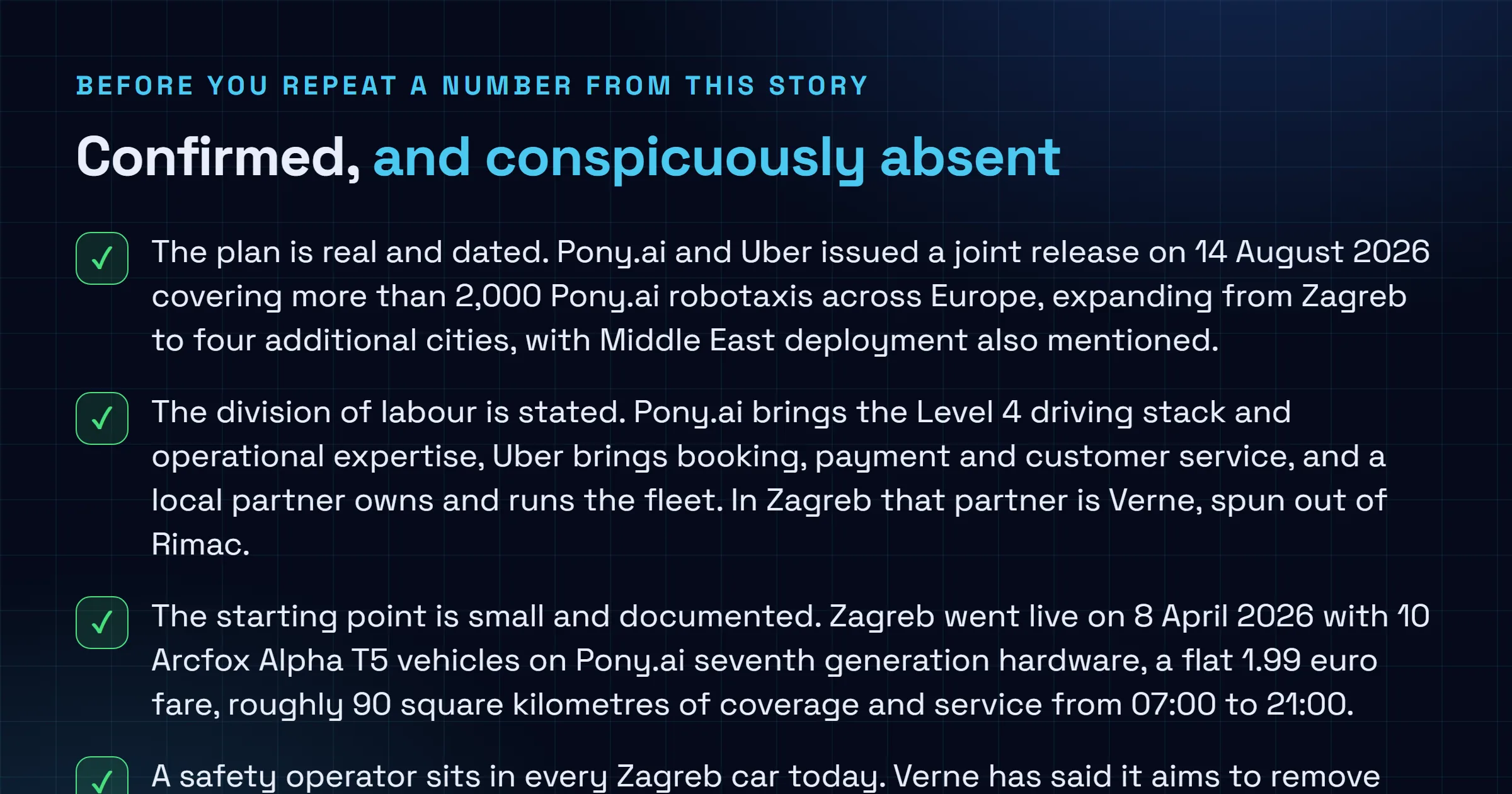
Checklist separating what is confirmed about the Pony.ai and Uber European robotaxi expansion of 14 August 2026, including the partnership structure and the documented Zagreb figures, from what remains unpublished, including city names, launch dates, per city fleet splits, financial terms and any European driverless approval.
Left column is sourced. Right column is what nobody has published.

The part that is genuinely strong

I have been sceptical for six paragraphs, so let me put the other side properly, because it is stronger than the sceptical reflex suggests.

Pony.ai is not a demo company. It runs paid, fully driverless robotaxi services in China’s four tier-one cities, and it says it has reached city-wide breakeven unit economics in multiple markets. That claim is the company’s own and nobody outside has audited it, so hold it loosely. But operating driverless at fare-paying scale is a thing very few firms on earth have done at all, and it is a completely different achievement from a pilot with a safety driver.

The joint-deployment model is also smarter than a straight fleet play. Splitting the stack from the platform from the local operator means the hard local problems, which are depots, permits, cleaning, charging and municipal relations, land on a company that already lives there. That is a structure that can actually repeat across borders, which is more than most robotaxi expansion plans can say.

So the plan is credible in a way that, say, a pure announcement from a startup with no revenue would not be. The gap between credible and scheduled is just wider than the headline number implies.

What to watch instead of the 2,000

If you want to know whether this is happening, ignore the fleet target. Three things will tell you first, and none of them will arrive as a press release with a big number in it.

Watch whether Verne gets its Zagreb driverless approval before the end of the year, because that is the first European regulator to actually say yes to an empty driver’s seat on this stack. Watch which city gets named next, since the country tells you which regulatory regime the companies think they can clear fastest. Then watch whether Verne’s own purpose-built vehicle, the two-seater with no steering wheel it plans to build near Zagreb, reaches production, because the Arcfox fleet was always described as a bridge.

The thing about robotaxi announcements is that they are cheap and the permits are expensive. Cities that took the enthusiasm at face value are the ones now arguing with their robotaxi operators in court about where the cars park overnight. Two thousand cars is a real ambition from a company that has earned some benefit of the doubt. It is also, today, ten cars and a waiting list.

Sources: the expansion, the 2,000 vehicle figure, the four additional cities, the Middle East mention, the division of labour and both executive quotes are in the joint Pony.ai and Uber press release (14 August 2026), which also carries the China driverless and breakeven unit economics claims. Coverage and the absence of named cities or dates from TechCrunch, heise online and CnEVPost. The Zagreb launch date, the Arcfox Alpha T5 vehicles, the safety operator requirement and Verne’s driverless target are reported by The Next Web, with the 10 vehicle fleet size, the flat 1.99 euro fare, the roughly 90 square kilometre zone and the 07:00 to 21:00 hours in this Zagreb service report. Pony.ai’s own launch announcement covers the April start. Image: Verne.

Frequently asked questions

What did Pony.ai and Uber actually announce on 14 August 2026?

An expansion of an existing partnership, with plans to deploy more than 2,000 Pony.ai robotaxis across Europe. The service in Zagreb is the starting point and it grows to four additional European cities, which the companies said would be announced in phases. The Middle East is mentioned as a further deployment target. Pony.ai provides the Level 4 autonomous driving technology and operational expertise, Uber provides customer access through its platform, and a local operator owns and runs the fleet.

Which four cities are getting the robotaxis?

Nobody has said. That is the single biggest gap in the announcement. The companies stated only that details would be released in phases, and no country list exists either. Zagreb is the fifth and only named city, and it is the one already running. Verne, the Croatian operator, has separately said it has permitting discussions underway with a number of cities across the EU, UK and Middle East, but that is a different company talking about its own pipeline rather than a confirmed list for this deal.

Are these cars driverless?

Not in Europe. Every Zagreb vehicle carries a trained safety operator behind the wheel, and the operator Verne has said it aims to move to fully driverless running before the end of 2026 subject to regulatory approval. That is a stated goal, not a granted permission. Pony.ai does run paid, fully driverless services in China tier-one cities, which is a genuine track record, but a Chinese driverless permit carries no weight with a European regulator.

How big is the Zagreb service today?

Small and precisely documented, which is what makes it useful. It launched on 8 April 2026 with 10 Arcfox Alpha T5 electric SUVs running Pony.ai seventh generation autonomous driving hardware. The fare is a flat 1.99 euro regardless of distance, the operating zone is roughly 90 square kilometres covering the city centre and selected southern districts, and service runs from 07:00 to 21:00. Verne is the fleet owner and operator, and it was spun out of the Croatian hypercar maker Rimac.

How does this compare with Uber other European robotaxi deal?

Uber says it has partnered with more than 30 autonomous vehicle companies, so it places a lot of these bets. The instructive contrast is London, where Transport for London licensed Wayve vehicles on 5 August 2026 for up to 15 cars on a trial basis, with a human driver legally required on every trip. London has a small number attached to an actual permission. This announcement has a large number attached to an intention. Both are real, and they are not the same kind of thing.

Tags: autonomous-vehicleseuropenewsregulationroboticsuber
Share196Tweet123
stephane

stephane

  • Trending
  • Comments
  • Latest
Answer card: Proton Lumo 2.0 is private by policy, not by locality. Saved history is locked so even Proton cannot read it, but the prompt is decrypted on a Proton EU server to answer it, then forgotten.

Proton Lumo 2.0 review: how private is it, really?

3 September 2026
The Agentic Coding section of the official Hy4 preview benchmark appendix published by Tencent, a table comparing Hy3 and Hy4 preview against DeepSeek V4 Pro 0813, Qwen 3.8 Max, GLM 5.3, Kimi K3, GPT 5.6 Sol and Claude Opus 5 across SWE-bench Multilingual, SWE-bench Pro, DeepSWE, three SWE Atlas tasks, SWE-Marathon, Terminal-Bench 2.1, NL2Repo-Bench, CyberGym, ProgramBench, PostTrainBench and Harbor-Index.

Tencent’s 770B Hy4 tops one benchmark row in 46

3 September 2026
Answer card: Qwen 3.7 Max is API-only and cannot run locally yet; the open Qwen models (Qwen 3.6 27B, qwen3:8b to 32b) run offline via Ollama.

Qwen 3.7 local: what you can actually run offline

22 June 2026
Answer card: JWTs are not encrypted, anyone can read them; the signature proves who issued the token, not who may read it.

Are JWTs encrypted? No, and the difference will bite you

0
Answer card: a random 8 character password falls in under 2 hours offline, while 16 random characters hold for 1.4 trillion years at the same speed.

How long does it take to crack a password in 2026?

0
Answer card: three DNS records decide if your mail lands or bounces; SPF lists allowed senders, DKIM signs messages, DMARC sets the failure policy.

SPF, DKIM and DMARC explained: the records your email needs

0
The official xAI announcement card for Grok 4.7, white type on a dark grey and navy gradient.

Grok 4.7 keeps $2 and $6, and its gains over 4.6 are xhigh versus high

22 September 2026
Answer card stating that Qwen-Image-2.1, released on 20 September 2026, ships open weights with a 7 billion parameter diffusion transformer, a Qwen3-VL 8B text encoder and an RGBA VAE totalling about 33 gigabytes in BF16, under the Qwen Research License that limits use to research or evaluation and requires a separate commercial licence, unlike the Apache 2.0 licence of Qwen-Image 1.0.

Qwen-Image-2.1 brings the weights back, but not the Apache licence

21 September 2026
Answer card stating that Ternary Bonsai 2 27B, released by PrismML on 17 September 2026 under Apache 2.0, packs Qwen3.8 27B into 5.95 gigabytes at 1.72 bits per weight, keeps 98.2 percent of the 14-benchmark average, about 75 percent on SWE-bench Verified and Terminal-Bench 2.1, and needs PrismML's llama.cpp fork to run.

Does Bonsai 2 27B really keep 98% of Qwen3.8 in 5.95 GB?

20 September 2026
  • About
  • Contact
  • Privacy
  • Legal

Copyright © 2026 Stephane Cardon.

Welcome Back!

Login to your account below

Forgotten Password?

Retrieve your password

Please enter your username or email address to reset your password.

Log In
No Result
View All Result
  • Home
  • Articles
    • Security
    • Network
    • Dev
    • Sysadmin
    • SEO
    • Email & DNS
  • Tools
    • Network tools: free, fast, no signup
    • Security tools: free, fast, no signup
    • Developer tools: free, fast, no signup
    • Sysadmin tools: free, fast, no signup
    • SEO tools: free, fast, no signup
    • Email & DNS tools: free, fast, no signup
  • Download
  • About

Copyright © 2026 Stephane Cardon.