
• Latest
  • Trending
  • All
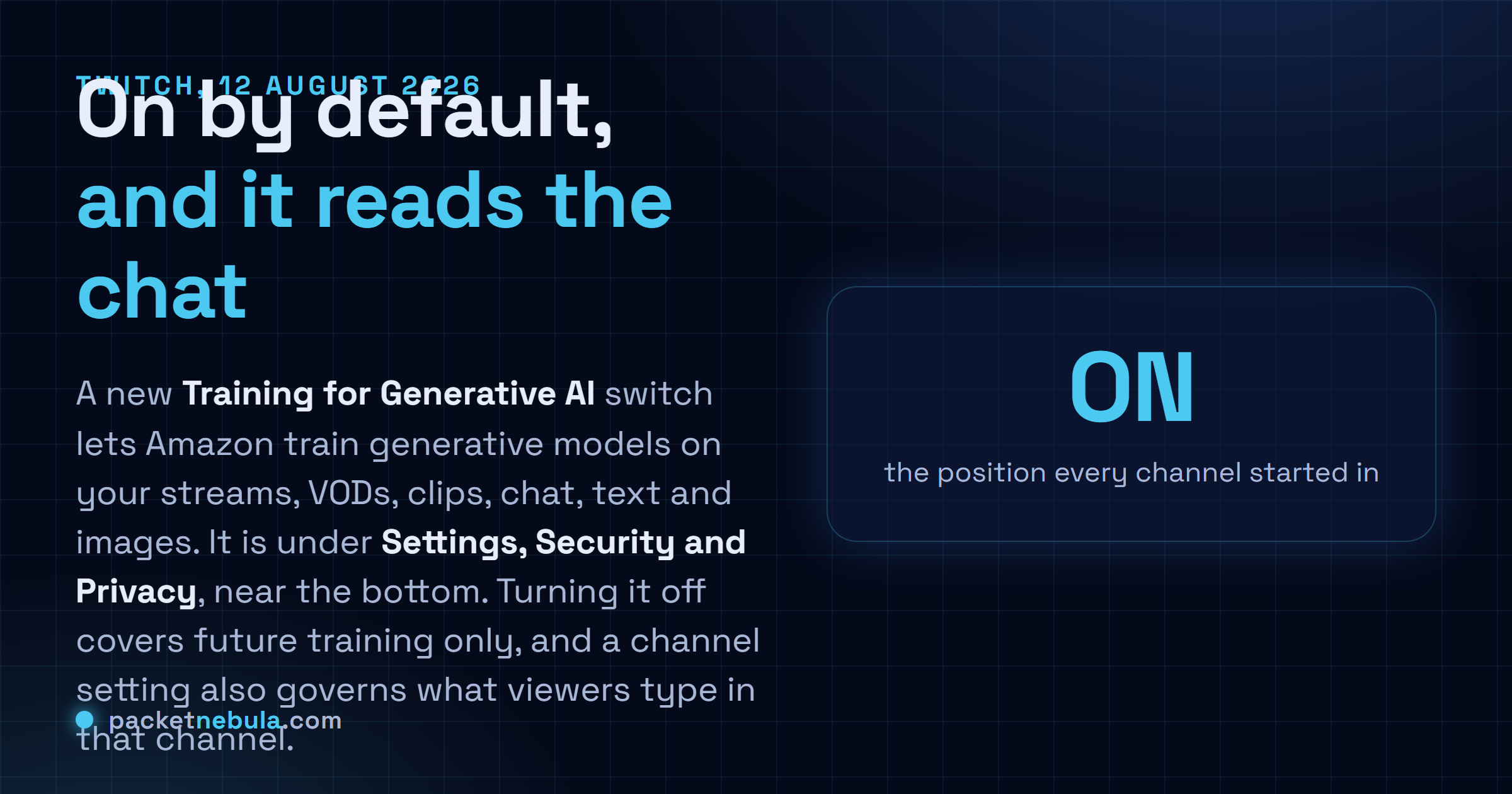
Answer card explaining that on 12 August 2026 Twitch added a Training for Generative AI setting, enabled by default, allowing Amazon to train generative AI content models on channel streams, videos on demand, clips, chat, text and images, found under Settings then Security and Privacy, with the opt-out applying only to future training.

Twitch’s AI training toggle is on, and it covers your chat

13 August 2026
Answer card stating that Qwen-Image-2.1, released on 20 September 2026, ships open weights with a 7 billion parameter diffusion transformer, a Qwen3-VL 8B text encoder and an RGBA VAE totalling about 33 gigabytes in BF16, under the Qwen Research License that limits use to research or evaluation and requires a separate commercial licence, unlike the Apache 2.0 licence of Qwen-Image 1.0.

Qwen-Image-2.1 brings the weights back, but not the Apache licence

21 September 2026
Answer card stating that Ternary Bonsai 2 27B, released by PrismML on 17 September 2026 under Apache 2.0, packs Qwen3.8 27B into 5.95 gigabytes at 1.72 bits per weight, keeps 98.2 percent of the 14-benchmark average, about 75 percent on SWE-bench Verified and Terminal-Bench 2.1, and needs PrismML's llama.cpp fork to run.

Does Bonsai 2 27B really keep 98% of Qwen3.8 in 5.95 GB?

20 September 2026
Answer card stating that Jev 1.13 from TypeSafe AI is a decision model in early access since 15 September 2026 that returns typed probabilities instead of text, priced at 42 dollars per billion input tokens with output tokens free, answering in 70 to 500 milliseconds, with a 64K token request budget, text input only, and a documented list of things it does badly, including counting and dates.

Jev 1.13 bills $42 a billion tokens, and it can’t count

19 September 2026
Answer card stating that Qwen3.8-Omni-Flash launched on 17 September 2026 as an API only model on Alibaba Cloud Model Studio, taking text, images, audio and video in a 1M token context and returning text only, priced at 0.15 dollars per million input tokens for every modality and 0.47 dollars per million output tokens in the international regions, with no open weights published and the Qwen-Live Harness GitHub repository returning 404.

Qwen3.8-Omni-Flash bills audio at $0.15 and ships no weights

18 September 2026
Answer card stating that on 15 September 2026 AWS said it is unable to restore access to resources and data hosted exclusively in the Middle East Bahrain region me-south-1 and in the mec1-az2 zone of the UAE region, because the damage spanned multiple Availability Zones and exceeded what multi-AZ services are designed to withstand.

AWS can’t restore me-south-1, six months after the drone strikes

17 September 2026
Answer card stating that Google released Gemini 3.8 Live and Gemini 3.8 Live Extended Thinking on 15 September 2026 at 3 dollars per million audio input tokens and 12 dollars out, that the thinking model requires asynchronous tools, and that Artificial Analysis scores it 82.6 on its Speech to Speech Quality Index.

Gemini 3.8 Live Extended Thinking rejects any tool that blocks

16 September 2026
Answer card summarising the Atria Dawn Preview release: 744B GLM-5.2 base, MIT licence, 1.5 TB BF16 and 756 GB FP8 checkpoints, 256K context, top on five of sixteen benchmark rows and trailing on SWE-bench Pro.

Atria Dawn Preview is 744B under MIT, and the BF16 weighs 1.5 TB

15 September 2026
Answer card stating that OpenAI released the Agents API in public beta on 10 September 2026 with no separate fee, billed through model tokens, tool calls and hosted sandbox time, with a choice of OpenAI hosted, self hosted or partner sandboxes, US only data residency and no Zero Data Retention support.

OpenAI’s Agents API has no fee, no ZDR and a one hour sandbox clock

14 September 2026
Answer card: Sakana Fugu Max at $2 and $6 per million tokens, Fugu Ultra v2 unchanged at $5 and $30, and Sakana saying Ultra v2 scores without Fable 5 or GPT-6 Astra in its pool.

Fugu Max costs $2 and $6 while Fugu Ultra v2 runs without Fable 5

13 September 2026
Answer card stating that DeepSeek released DeepSeek-V4.1-Flash on 10 September 2026 as a 552 billion parameter mixture of experts model with a new causal encoder decoder architecture that activates 8 billion parameters on input and 16 billion on output, with native vision, a one million token context and MIT licensed weights, that the API model name is now deepseek-flash at 0.15 dollars per million input tokens and 0.60 dollars per million output tokens off peak, and that DeepSeek announced V4 Pro would be routed to V4.1-Flash from 14 September and reversed that on 11 September.

DeepSeek V4.1-Flash arrived, and the V4 Pro retirement lasted a day

12 September 2026
Answer card stating that Cognition released SWE-2 on 10 September 2026, a coding model post-trained from Kimi K3, scoring 50.0 percent on FrontierCode 1.1 Main against 50.9 percent for Claude Fable 5.1 and 27.3 percent on Terminal-Bench 4 against 55.8 percent, available only inside Devin.

SWE-2 trails Fable 5.1 by one point, and by 28 on Terminal-Bench 4

11 September 2026
Answer card for Meta Muse, free to 100 million tokens a week then $20 a month, launched 8 September 2026 for United States adults only, running in a dedicated per user virtual machine.

Does Meta Muse do enough to earn your inbox and a card on file?

9 September 2026
  • About
  • Contact
  • Privacy
  • Legal
Monday, September 21, 2026
  • Login
Packet Nebula
  • Home
  • Articles
    • Security
    • Network
    • Dev
    • Sysadmin
    • SEO
    • Email & DNS
  • Tools
    • Network tools: free, fast, no signup
    • Security tools: free, fast, no signup
    • Developer tools: free, fast, no signup
    • Sysadmin tools: free, fast, no signup
    • SEO tools: free, fast, no signup
    • Email & DNS tools: free, fast, no signup
  • Download
  • About
No Result
View All Result
Packet Nebula
No Result
View All Result
Home Dev

Twitch’s AI training toggle is on, and it covers your chat

by stephane
13 August 2026
in Dev
0
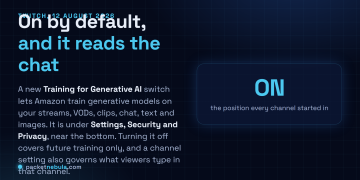
Answer card explaining that on 12 August 2026 Twitch added a Training for Generative AI setting, enabled by default, allowing Amazon to train generative AI content models on channel streams, videos on demand, clips, chat, text and images, found under Settings then Security and Privacy, with the opt-out applying only to future training.
491
SHARES
1.4k
VIEWS
Share on FacebookShare on Twitter

You went to bed a streamer and woke up a training set. On 12 August Twitch shipped a setting called Training for Generative AI, switched on for everybody, that lets Amazon train generative models on your streams, VODs, clips, chat and whatever text and images sit on your channel. It's in Settings, under Security and Privacy, near the bottom of the page. Flip it off and you're out, going forward. Then there's the part that got buried under the outrage cycle, which is that the switch is yours but the consent isn't only yours. Someone typing in your chat has no toggle of their own. Yours is the one that decides, for all of them.

The short answer

Twitch added a Training for Generative AI setting on 12 August 2026, enabled by default, letting Amazon train generative models on channel streams, VODs, clips, chat, text and images. It lives under Settings, Security and Privacy. Turning it off applies to future training only. It does not stop captions, recommendations, monetization tooling or AutoMod. And a channel’s setting governs what viewers type in that channel’s chat, because viewers get no setting at all.
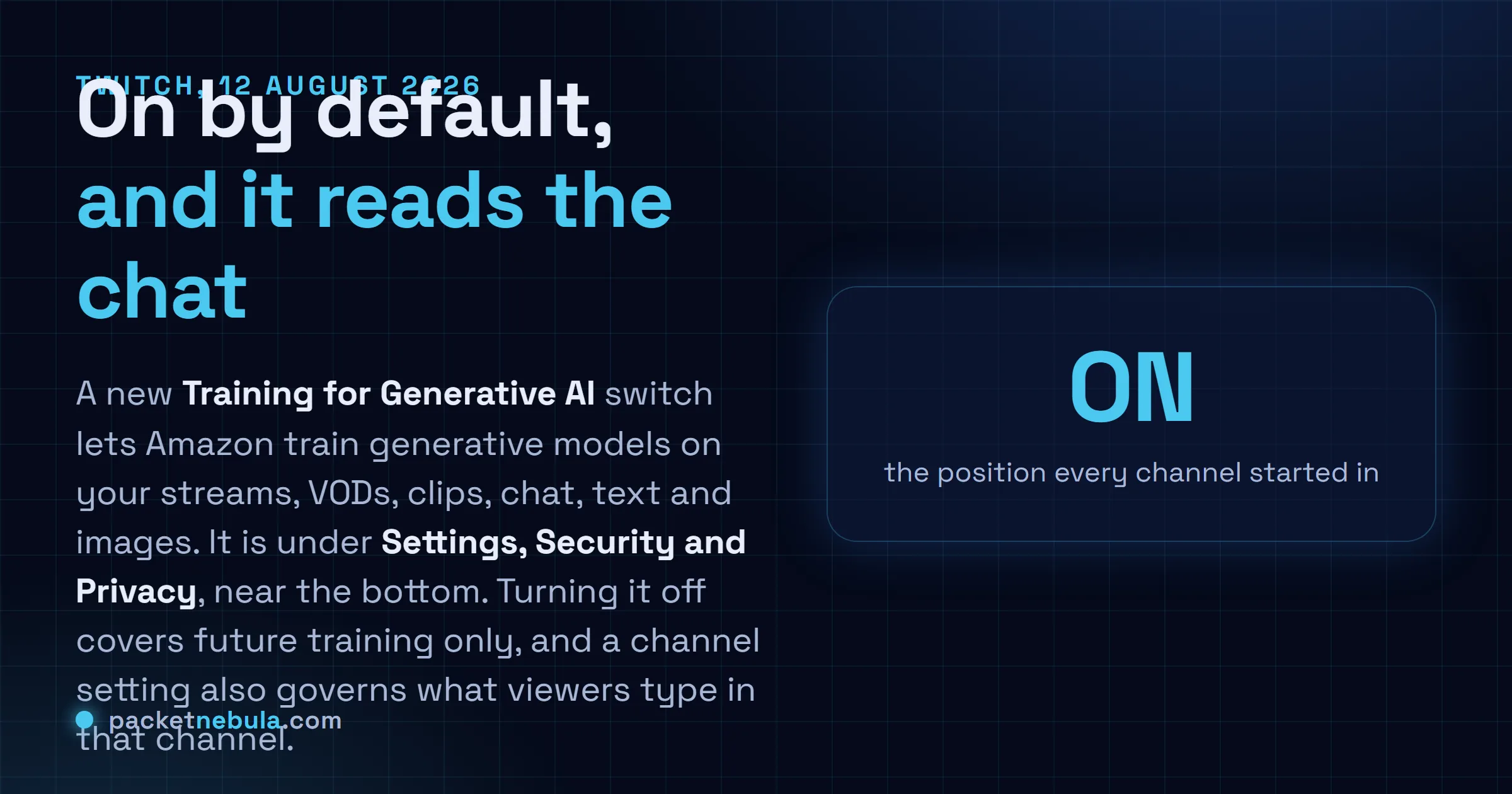
12 Augthe toggle appeared
ONdefault, every channel
0control a viewer has
Answer card stating that Twitch added a Training for Generative AI setting on 12 August 2026, enabled by default, which permits Amazon to train generative AI content models on a channel's streams, videos on demand, clips, chat, text and images, located under Settings then Security and Privacy, with the opt-out applying only to future training.
The change in one card. Note the direction of the default.

Thirty seconds, if you know where to look

Avatar, top right. Settings. Security and Privacy. Scroll down, past the things you’d expect a security tab to hold, and there it is: Training for Generative AI. On mobile the path is Profile, then Settings, then the same tab.

The toggle is on. It was on before you read this, and it went on without you touching anything, which is the whole reason the story travelled. Switch it off and Amazon stops using your channel’s output to train generative models that produce text, audio, images or video.

The scope is broader than the word “streams” suggests. Live broadcasts and their VODs, sure. Also clips, highlights, chat logs, and the text and images sitting on your channel page. If it’s content and it’s yours, assume it’s in.

Going forward, anyway. Nothing in the wording reaches backwards.

Your switch, their words

This is the part we’d lead with, and almost nobody did.

Twitch has been clear that if you post in someone else’s chat, their setting decides what happens to your message. Not yours. You can hold your own channel’s toggle off with both hands and still have every sentence you type in a friend’s stream go into the pile, because the consent attached to the room, not to the person speaking in it.

Think about what that means at scale. A channel with forty thousand concurrent viewers has one switch, held by one person, answering for forty thousand people who never saw it. A moderator who typed in that chat for three years never had a decision to make.

We’re not calling that illegitimate. Twitch owns the platform and the terms are the terms. But it is a consent model where the unit of consent is the venue rather than the speaker, and if you’ve ever built anything with user-generated content you know that distinction gets ugly the moment somebody asks for their data back.
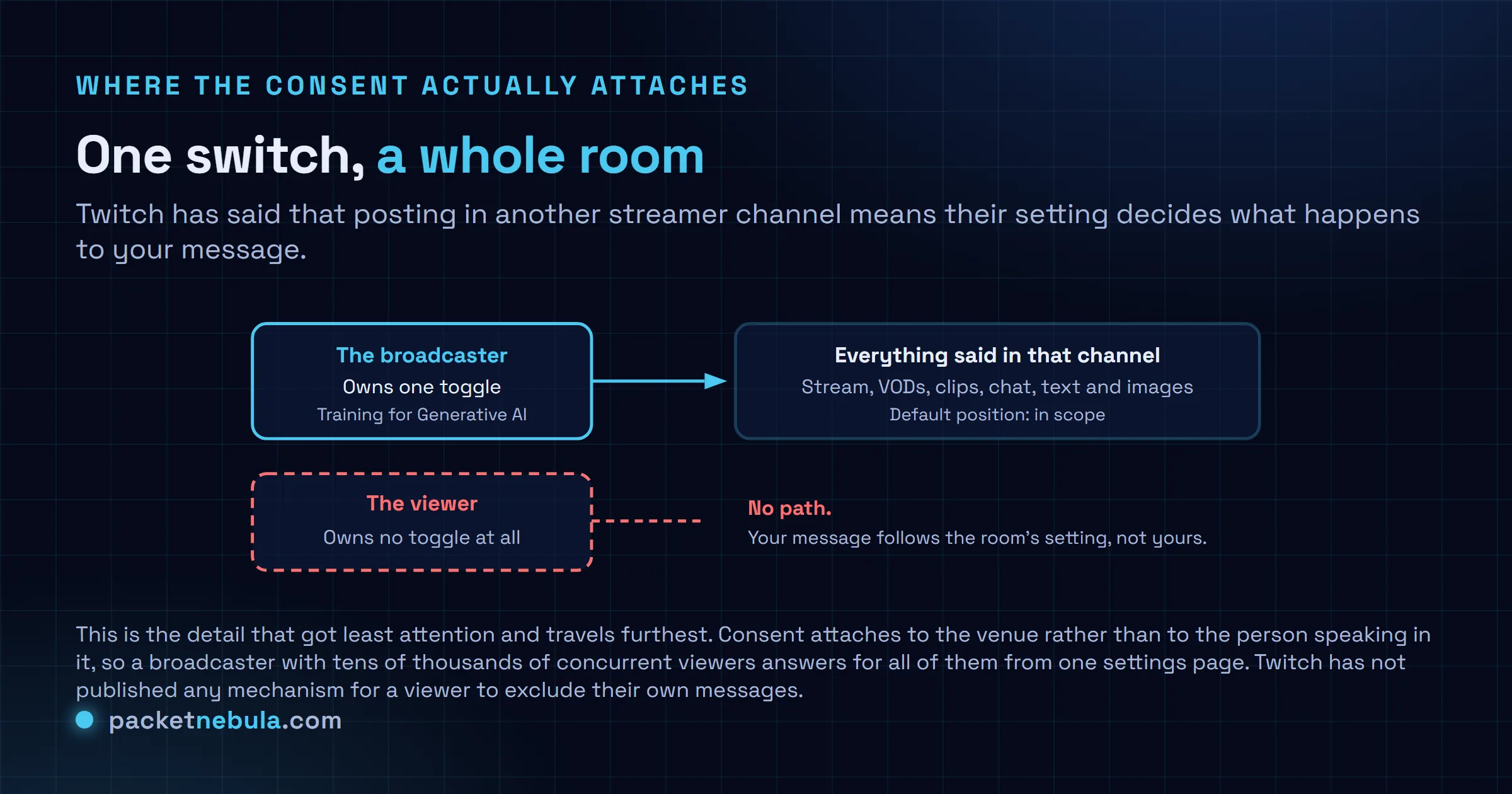
Diagram showing that one broadcaster's Training for Generative AI toggle governs the chat messages of every viewer in that channel, with viewers having no equivalent setting of their own, so consent attaches to the channel rather than to the person typing.
One toggle, held by one account, answering for everyone in the room.

”Nobody would opt in”

Chief product officer Mike Minton was asked why the thing ships on rather than off. His answer, to TechCrunch: “If this was opt-in, nobody would opt in. That’s honestly the answer.”

Credit where it’s due. That’s a rare piece of on-record candour about default design, and it’s more useful than any policy page, because it tells you the product team already ran the numbers on consent and didn’t like them.

It also concedes the point. A default that only works because it’s a default is a default doing the arguing.

Minton was equally frank about the other half, saying he didn’t know whether Twitch video had already been used, because he didn’t know what Amazon had done. Two companies, one org chart, and the person who owns the product can’t tell you where the tapes went. Honestly, that answer worries us more than the toggle does.

What flipping it off does not buy you

Read the label again. Training for Generative AI. Generative, and training, and that’s the boundary.

AutoMod keeps reading your chat. Captions keep running on your audio. Recommendations keep profiling your channel, and the sponsorship, growth and monetization machinery keeps chewing through the same content it always did. Twitch has said some of this can’t be turned off individually because it protects the whole community, which for AutoMod is a fair argument and for the monetization tooling is a different kind of argument.

So the toggle isn’t an AI opt-out. It’s an opt-out from one specific downstream use, the one where your voice ends up inside a model that generates new voices. Worth having. Not the same as the headline.

What’s still unconfirmed

There was no announcement post. The setting showed up and the docs were the record, which several outlets noted independently and which matches what we could find looking for one.

No model family is named. “Generative AI content models at Amazon” covers a lot of ground and commits to nothing. There’s no published retention or deletion path, no way for a broadcaster to verify exclusion after flipping the switch, and no statement either way on content ingested before 12 August. We’re marking all of that as unknown rather than guessing, because a guess here would be worth exactly nothing to you.

If you stream, go flip it. If you build on somebody else’s platform, the more durable lesson is the one Minton said out loud: the default is where the real policy lives, and it gets set by whoever owns the settings page. We’ve watched the same argument play out over the $1.5B Anthropic author settlement, and over what a privacy-first assistant actually keeps off the server. Different companies, same question about who decided.
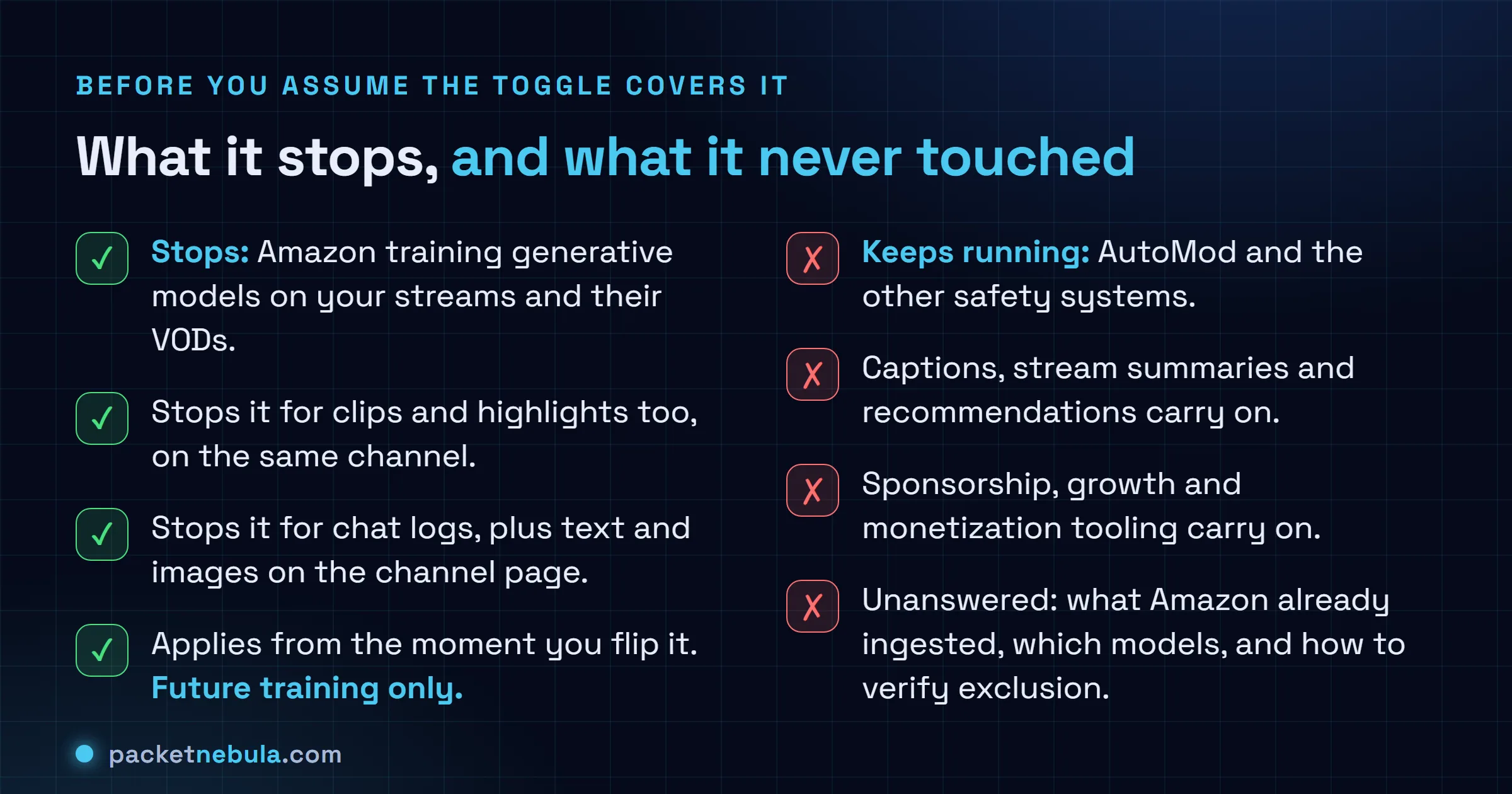
Checklist comparing what the Twitch Training for Generative AI opt-out stops, namely Amazon generative model training on streams, videos on demand, clips, chat, text and images going forward, against what keeps running regardless, namely AutoMod, captions, recommendations, sponsorship and growth tooling and monetization features, plus the items nobody has confirmed.
What the switch covers, what it never touched, and what nobody will say.

Sources

Reported by TechCrunch on 12 August 2026, including the Minton quotes. Scope and viewer chat handling from Engadget, with the settings path and the list of AI features outside the opt-out in Engadget’s walkthrough. Community reaction and the default-on framing cross-checked against PC Gamer and Ars Technica. Twitch published no announcement post we could find, so the setting itself is the primary record.

Frequently asked questions

Where exactly is the Twitch AI training setting?

On the web, click your avatar in the top right, open Settings, choose the Security and Privacy tab, then scroll to Training for Generative AI near the bottom. On mobile it is Profile, then Settings, then Security and Privacy. The toggle is enabled by default, so leaving it alone means your channel content is in scope.

Does opting out remove content Amazon already trained on?

No. The wording covers future training only, and nothing published says anything about content already ingested. Asked directly whether Twitch videos had already been used, chief product officer Mike Minton told TechCrunch he did not know the answer because he did not know what Amazon had done. Nobody has offered a deletion path.

If I opt out, does that protect my viewers' chat messages?

Yes for your channel, and only for your channel. Twitch has said that if you post in another streamer's chat, that streamer's setting governs whether your message is used. Viewers have no control over their own messages. One broadcaster's toggle answers for every person who types in that room.

What does the opt-out NOT stop?

Plenty. The setting covers generative AI content models at Amazon, not machine learning across Twitch. Captions, recommendations, sponsorship and growth tooling, monetization features and safety systems such as AutoMod keep processing your content either way. Twitch has said some of these cannot be individually disabled because they protect the whole community.

Did Twitch announce this?

Not with a blog post. The setting appeared on 12 August and the documentation is the record, which is why the story broke through press coverage and community threads rather than an announcement. Twitch executives spoke about it afterwards, including on record about why the default is on.

Which Amazon models are being trained on this?

Unstated. The setting refers to generative AI content models at Amazon, covering text, audio, images and video, without naming a product or a model family. There is also no published way to verify that a channel with the toggle off has actually been excluded.

Tags: aiamazonbig-technewspolicyprivacy
Share196Tweet123
stephane

stephane

  • Trending
  • Comments
  • Latest
Answer card: Proton Lumo 2.0 is private by policy, not by locality. Saved history is locked so even Proton cannot read it, but the prompt is decrypted on a Proton EU server to answer it, then forgotten.

Proton Lumo 2.0 review: how private is it, really?

3 September 2026
The Agentic Coding section of the official Hy4 preview benchmark appendix published by Tencent, a table comparing Hy3 and Hy4 preview against DeepSeek V4 Pro 0813, Qwen 3.8 Max, GLM 5.3, Kimi K3, GPT 5.6 Sol and Claude Opus 5 across SWE-bench Multilingual, SWE-bench Pro, DeepSWE, three SWE Atlas tasks, SWE-Marathon, Terminal-Bench 2.1, NL2Repo-Bench, CyberGym, ProgramBench, PostTrainBench and Harbor-Index.

Tencent’s 770B Hy4 tops one benchmark row in 46

3 September 2026
Answer card: Qwen 3.7 Max is API-only and cannot run locally yet; the open Qwen models (Qwen 3.6 27B, qwen3:8b to 32b) run offline via Ollama.

Qwen 3.7 local: what you can actually run offline

22 June 2026
Answer card: JWTs are not encrypted, anyone can read them; the signature proves who issued the token, not who may read it.

Are JWTs encrypted? No, and the difference will bite you

0
Answer card: a random 8 character password falls in under 2 hours offline, while 16 random characters hold for 1.4 trillion years at the same speed.

How long does it take to crack a password in 2026?

0
Answer card: three DNS records decide if your mail lands or bounces; SPF lists allowed senders, DKIM signs messages, DMARC sets the failure policy.

SPF, DKIM and DMARC explained: the records your email needs

0
Answer card stating that Qwen-Image-2.1, released on 20 September 2026, ships open weights with a 7 billion parameter diffusion transformer, a Qwen3-VL 8B text encoder and an RGBA VAE totalling about 33 gigabytes in BF16, under the Qwen Research License that limits use to research or evaluation and requires a separate commercial licence, unlike the Apache 2.0 licence of Qwen-Image 1.0.

Qwen-Image-2.1 brings the weights back, but not the Apache licence

21 September 2026
Answer card stating that Ternary Bonsai 2 27B, released by PrismML on 17 September 2026 under Apache 2.0, packs Qwen3.8 27B into 5.95 gigabytes at 1.72 bits per weight, keeps 98.2 percent of the 14-benchmark average, about 75 percent on SWE-bench Verified and Terminal-Bench 2.1, and needs PrismML's llama.cpp fork to run.

Does Bonsai 2 27B really keep 98% of Qwen3.8 in 5.95 GB?

20 September 2026
Answer card stating that Jev 1.13 from TypeSafe AI is a decision model in early access since 15 September 2026 that returns typed probabilities instead of text, priced at 42 dollars per billion input tokens with output tokens free, answering in 70 to 500 milliseconds, with a 64K token request budget, text input only, and a documented list of things it does badly, including counting and dates.

Jev 1.13 bills $42 a billion tokens, and it can’t count

19 September 2026
  • About
  • Contact
  • Privacy
  • Legal

Copyright © 2026 Stephane Cardon.

Welcome Back!

Login to your account below

Forgotten Password?

Retrieve your password

Please enter your username or email address to reset your password.

Log In
No Result
View All Result
  • Home
  • Articles
    • Security
    • Network
    • Dev
    • Sysadmin
    • SEO
    • Email & DNS
  • Tools
    • Network tools: free, fast, no signup
    • Security tools: free, fast, no signup
    • Developer tools: free, fast, no signup
    • Sysadmin tools: free, fast, no signup
    • SEO tools: free, fast, no signup
    • Email & DNS tools: free, fast, no signup
  • Download
  • About

Copyright © 2026 Stephane Cardon.