
• Latest
  • Trending
  • All
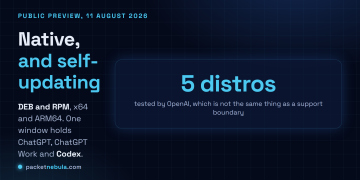
Answer card summarising the ChatGPT desktop app for Linux public preview of 11 August 2026: DEB and RPM packages for x64 and ARM64, five tested distributions, and one window holding ChatGPT, ChatGPT Work and Codex.

ChatGPT desktop for Linux: the .deb adds an OpenAI apt repo

12 August 2026
Answer card for Claude Opus 5.5: 4 dollars in and 20 dollars out per million tokens, down from 5 and 25, with cache reads at 20 cents.

Claude Opus 5.5 drops to $4 and $20, and breaks four Opus 5 habits

23 September 2026
The official xAI announcement card for Grok 4.7, white type on a dark grey and navy gradient.

Grok 4.7 keeps $2 and $6, and its gains over 4.6 are xhigh versus high

22 September 2026
Answer card stating that Qwen-Image-2.1, released on 20 September 2026, ships open weights with a 7 billion parameter diffusion transformer, a Qwen3-VL 8B text encoder and an RGBA VAE totalling about 33 gigabytes in BF16, under the Qwen Research License that limits use to research or evaluation and requires a separate commercial licence, unlike the Apache 2.0 licence of Qwen-Image 1.0.

Qwen-Image-2.1 brings the weights back, but not the Apache licence

21 September 2026
Answer card stating that Ternary Bonsai 2 27B, released by PrismML on 17 September 2026 under Apache 2.0, packs Qwen3.8 27B into 5.95 gigabytes at 1.72 bits per weight, keeps 98.2 percent of the 14-benchmark average, about 75 percent on SWE-bench Verified and Terminal-Bench 2.1, and needs PrismML's llama.cpp fork to run.

Does Bonsai 2 27B really keep 98% of Qwen3.8 in 5.95 GB?

20 September 2026
Answer card stating that Jev 1.13 from TypeSafe AI is a decision model in early access since 15 September 2026 that returns typed probabilities instead of text, priced at 42 dollars per billion input tokens with output tokens free, answering in 70 to 500 milliseconds, with a 64K token request budget, text input only, and a documented list of things it does badly, including counting and dates.

Jev 1.13 bills $42 a billion tokens, and it can’t count

19 September 2026
Answer card stating that Qwen3.8-Omni-Flash launched on 17 September 2026 as an API only model on Alibaba Cloud Model Studio, taking text, images, audio and video in a 1M token context and returning text only, priced at 0.15 dollars per million input tokens for every modality and 0.47 dollars per million output tokens in the international regions, with no open weights published and the Qwen-Live Harness GitHub repository returning 404.

Qwen3.8-Omni-Flash bills audio at $0.15 and ships no weights

18 September 2026
Answer card stating that on 15 September 2026 AWS said it is unable to restore access to resources and data hosted exclusively in the Middle East Bahrain region me-south-1 and in the mec1-az2 zone of the UAE region, because the damage spanned multiple Availability Zones and exceeded what multi-AZ services are designed to withstand.

AWS can’t restore me-south-1, six months after the drone strikes

17 September 2026
Answer card stating that Google released Gemini 3.8 Live and Gemini 3.8 Live Extended Thinking on 15 September 2026 at 3 dollars per million audio input tokens and 12 dollars out, that the thinking model requires asynchronous tools, and that Artificial Analysis scores it 82.6 on its Speech to Speech Quality Index.

Gemini 3.8 Live Extended Thinking rejects any tool that blocks

16 September 2026
Answer card summarising the Atria Dawn Preview release: 744B GLM-5.2 base, MIT licence, 1.5 TB BF16 and 756 GB FP8 checkpoints, 256K context, top on five of sixteen benchmark rows and trailing on SWE-bench Pro.

Atria Dawn Preview is 744B under MIT, and the BF16 weighs 1.5 TB

15 September 2026
Answer card stating that OpenAI released the Agents API in public beta on 10 September 2026 with no separate fee, billed through model tokens, tool calls and hosted sandbox time, with a choice of OpenAI hosted, self hosted or partner sandboxes, US only data residency and no Zero Data Retention support.

OpenAI’s Agents API has no fee, no ZDR and a one hour sandbox clock

14 September 2026
Answer card: Sakana Fugu Max at $2 and $6 per million tokens, Fugu Ultra v2 unchanged at $5 and $30, and Sakana saying Ultra v2 scores without Fable 5 or GPT-6 Astra in its pool.

Fugu Max costs $2 and $6 while Fugu Ultra v2 runs without Fable 5

13 September 2026
Answer card stating that DeepSeek released DeepSeek-V4.1-Flash on 10 September 2026 as a 552 billion parameter mixture of experts model with a new causal encoder decoder architecture that activates 8 billion parameters on input and 16 billion on output, with native vision, a one million token context and MIT licensed weights, that the API model name is now deepseek-flash at 0.15 dollars per million input tokens and 0.60 dollars per million output tokens off peak, and that DeepSeek announced V4 Pro would be routed to V4.1-Flash from 14 September and reversed that on 11 September.

DeepSeek V4.1-Flash arrived, and the V4 Pro retirement lasted a day

12 September 2026
  • About
  • Contact
  • Privacy
  • Legal
Wednesday, September 23, 2026
  • Login
Packet Nebula
  • Home
  • Articles
    • Security
    • Network
    • Dev
    • Sysadmin
    • SEO
    • Email & DNS
  • Tools
    • Network tools: free, fast, no signup
    • Security tools: free, fast, no signup
    • Developer tools: free, fast, no signup
    • Sysadmin tools: free, fast, no signup
    • SEO tools: free, fast, no signup
    • Email & DNS tools: free, fast, no signup
  • Download
  • About
No Result
View All Result
Packet Nebula
No Result
View All Result
Home Sysadmin

ChatGPT desktop for Linux: the .deb adds an OpenAI apt repo

by stephane
12 August 2026
in Sysadmin
0
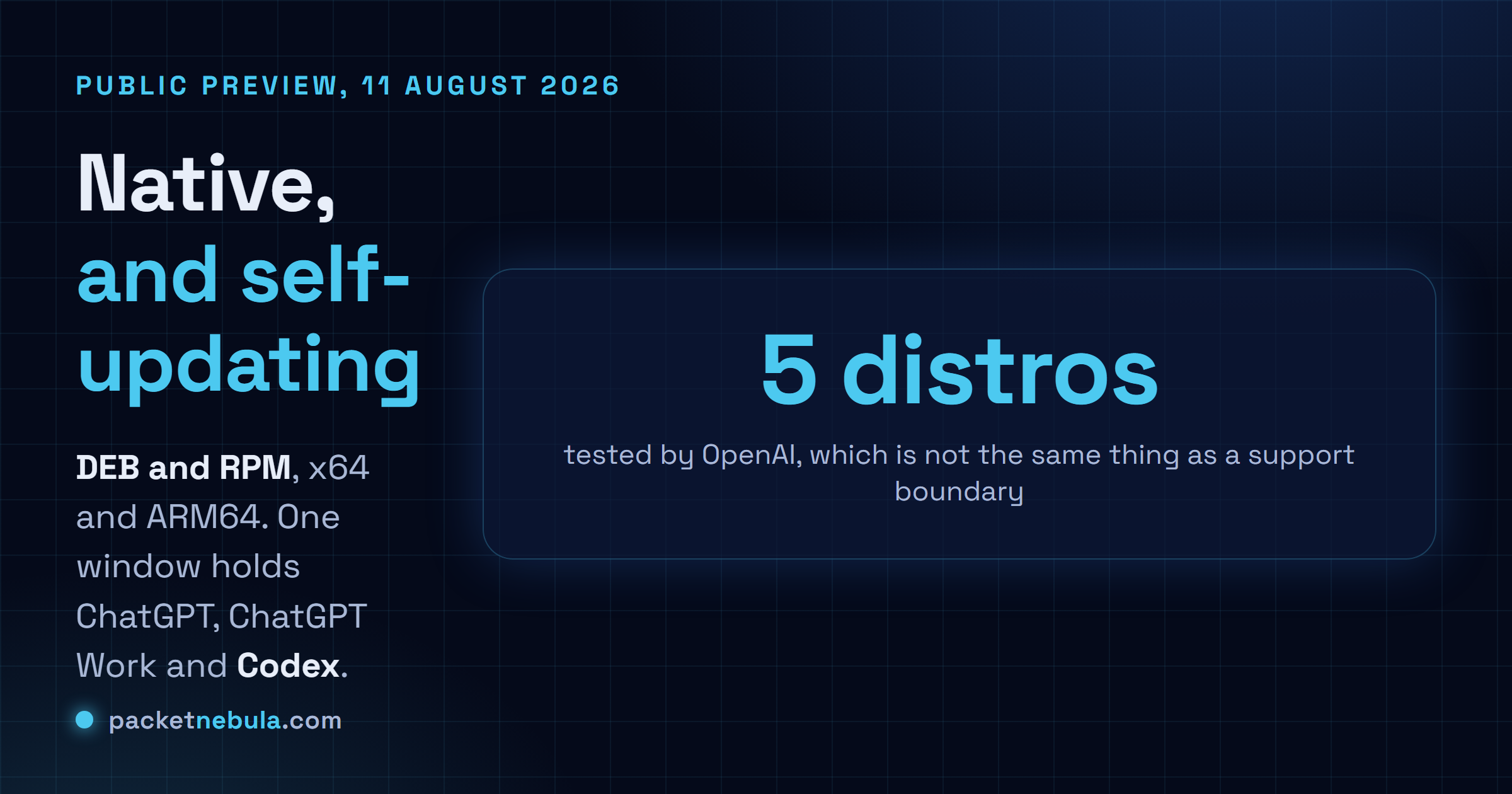
Answer card summarising the ChatGPT desktop app for Linux public preview of 11 August 2026: DEB and RPM packages for x64 and ARM64, five tested distributions, and one window holding ChatGPT, ChatGPT Work and Codex.
500
SHARES
1.4k
VIEWS
Share on FacebookShare on Twitter

Three years of people asking, and on 11 August it turned up: a native ChatGPT desktop app for Linux, public preview, shipping as DEB and RPM packages for x64 and ARM64. OpenAI tested it on Ubuntu 24.04 LTS, Ubuntu 26.04 LTS, Debian 13, and Fedora 43 and 44. One window carries ChatGPT, ChatGPT Work and Codex, and Codex is the piece that opens your local projects and runs commands on your machine. The install is the part worth a minute of your attention, though. Drop the DEB in and an OpenAI repository lands in your apt sources, so every version after this one arrives with your regular system updates. Nothing published tells you how to opt out of that.

The short answer

OpenAI released the ChatGPT desktop app for Linux on 11 August 2026 as a public preview. It ships as DEB and RPM packages for x64 and ARM64, tested on Ubuntu 24.04 and 26.04 LTS, Debian 13, and Fedora 43 and 44. One window holds ChatGPT, ChatGPT Work and Codex. Two details matter more than the launch itself: installing the DEB adds an OpenAI repository to your apt sources, and the Codex half of the app edits local files and runs commands.
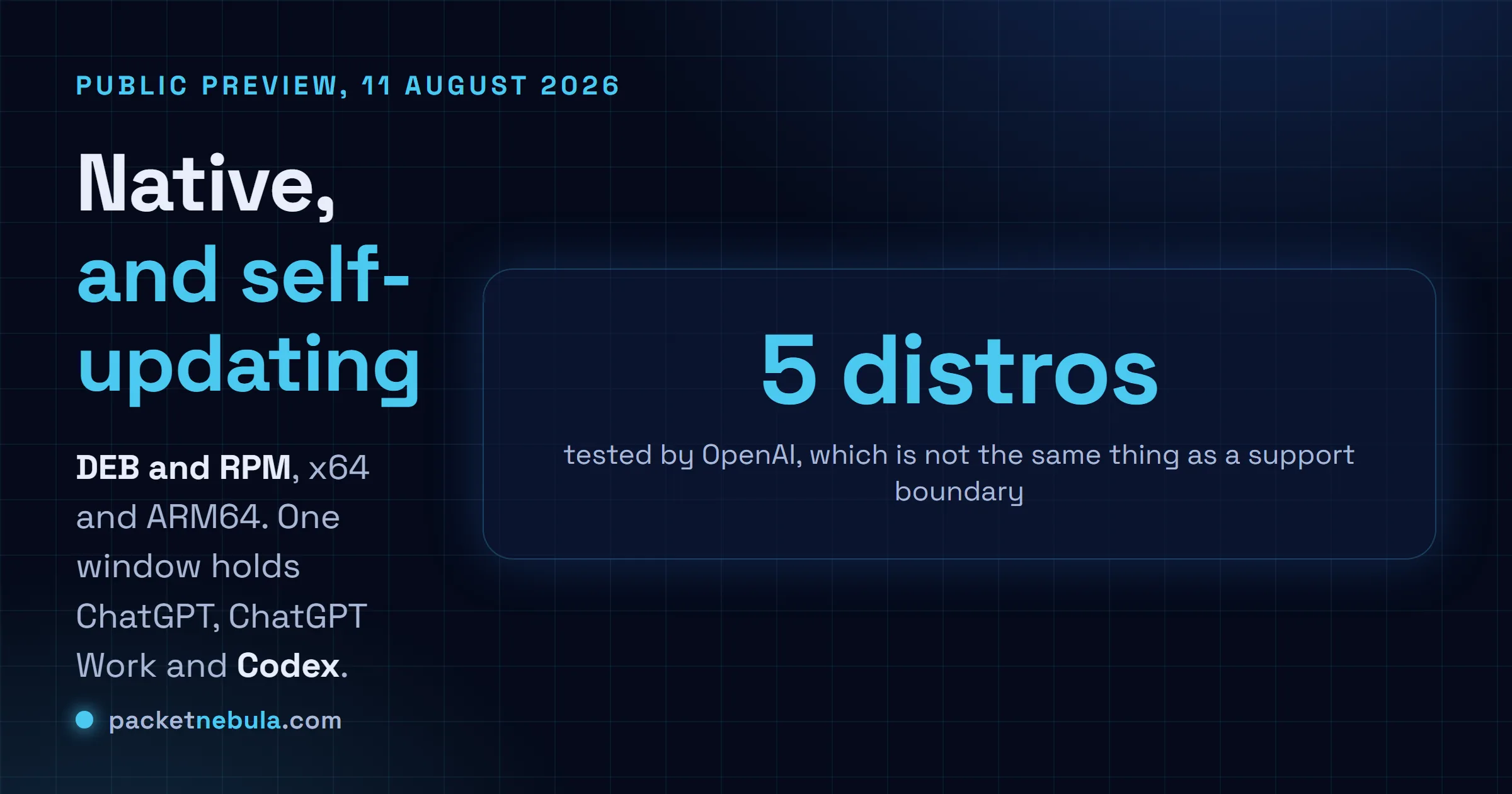
11 Augpublic preview, the first official native Linux client
DEB + RPMx64 and ARM64, downloaded from openai.com/codex
5 distrostested, which is not the same as a support boundary
Answer card: OpenAI released the ChatGPT desktop app for Linux as a public preview on 11 August 2026, shipping as DEB and RPM packages for x64 and ARM64, tested on five distributions, with ChatGPT, ChatGPT Work and Codex in a single window.
The packaging is the story here, more than the app.

What actually shipped

A desktop client, at last. Linux was, by OpenAI’s own account, one of the most requested platforms, and the gap had become slightly absurd: the company selling coding agents to developers had no client for the operating system most of them deploy to.

The build is a single window with a mode switch in the top left. Chat on one side, Codex on the other, plus ChatGPT Work for the longer agentic tasks, and a browser pane built into the app so pages open without leaving it. Downloads live at openai.com/codex rather than in any distribution’s archive. It’s closed source. Anthropic got a Claude desktop app onto Linux roughly a month earlier, so this is catch-up rather than a first, though the Codex integration is the piece with no obvious equivalent.

Public preview, in OpenAI’s words, which is the usual signal: expect bugs, expect integrations that work on Tuesday and not Wednesday. Some features still want a paid plan.

The DEB writes to your apt sources

Here’s the line that made us stop reading the feature list. Install the DEB and an OpenAI repository gets added to your system, and from then on new versions install through apt with everything else.

On your own laptop that’s a nice touch. Nobody enjoys checking a vendor’s download page every three weeks.

On a machine you’re responsible for, it’s a different object. You haven’t installed an application, you’ve granted a package source, and a package source is a standing permission to put new code on the box at a time you don’t choose. That’s the same trust model as any third-party repo you already run, and plenty of us run several. The difference is what comes down the pipe. This one ships an agent with a shell.

There’s also a hole in the documentation. OpenAI describes the repository behaviour for the DEB. For the RPM, nothing. So if you’re on Fedora 43 or 44, you genuinely don’t know from the published material whether your updates arrive the same way, and you’d have to go look.

Which, honestly, you should do anyway. Look before you install, not after.
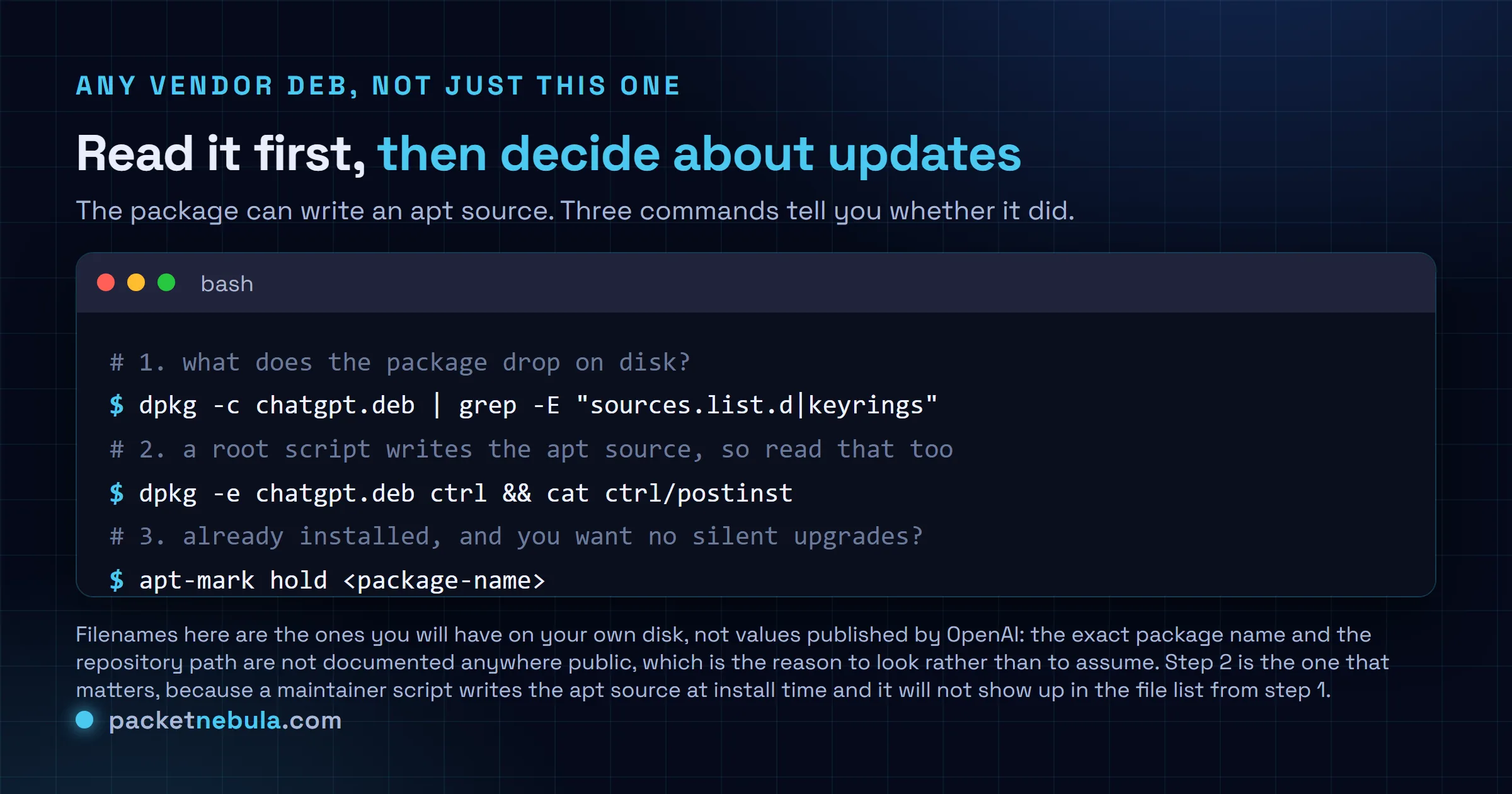
Terminal figure showing three commands to inspect a vendor DEB package: dpkg -c to list packaged files matching sources.list.d or keyrings, dpkg -e to extract and read the postinst maintainer script that writes an apt source, and apt-mark hold to freeze an installed version.
Step two is the one people skip. A maintainer script writes the repo, and it never shows up in the file list.

Two commands answer the question. dpkg -c lists what the package puts on disk, so grep that for sources.list.d and keyrings. But an apt source is more often written by a maintainer script than shipped as a file, so extract the control archive with dpkg -e and read the postinst. That script runs as root at install time. It’s the honest answer to what a package is about to do to your system, and reading it takes about ninety seconds.

If it’s already installed and you’d rather freeze it, apt-mark hold on the package name does that, and deleting the file it left in /etc/apt/sources.list.d takes the repository back out. Neither is documented by OpenAI. Both work, because apt is yours.

Codex is the half with a shell

The chat window is a chat window. Codex is not.

It opens local projects, edits files in place, works with git repositories, runs commands, and reads local files without uploading them. That last bit is genuinely good, and it’s the reason a desktop client beats a browser tab for this kind of work. It’s also the reason the update channel matters more here than it would for, say, a Slack client.

What’s missing is any published boundary. No sandbox description. Nothing on what Codex won’t touch, whether it respects a project scope, or how you’d narrow it if you wanted to. We’re not claiming there’s no boundary. We’re saying nobody has written it down, and on a machine holding customer data or production credentials, “presumably it’s fine” isn’t a control. Worth reading up on Linux file permissions before you point an agent at a home directory, if that’s not already muscle memory.

The wider pattern here is agents getting more autonomy by default across every vendor, which we looked at when Claude Code made auto mode the default. Same direction of travel. The tooling to constrain it is arriving slower than the autonomy is.

The distro list is a test matrix

Five entries: Ubuntu 24.04 LTS, Ubuntu 26.04 LTS, Debian 13, Fedora 43, Fedora 44. OpenAI notes that downstream flavours built on those bases should be fine, which covers Mint, Pop, and most of what people actually run.

Read the verb, though. Tested, not supported. There’s no published support statement, no stated minimum, nothing about Wayland versus X11, and no word on what the app is built with. Arch users have AUR packages that are community work, unofficial, and not OpenAI’s problem if they break.
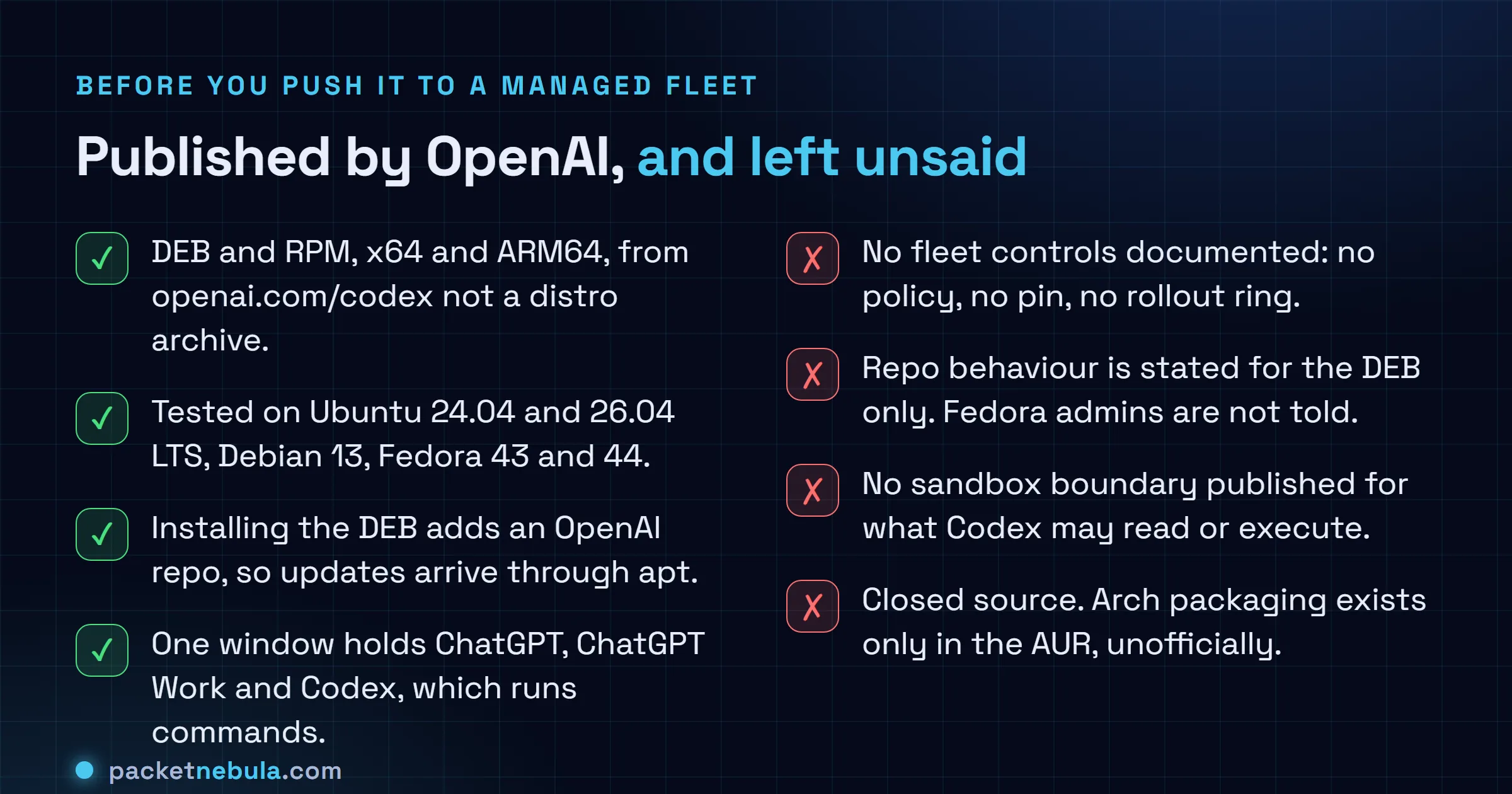
Checklist comparing what OpenAI published about the Linux ChatGPT app, including DEB and RPM packaging, the five tested distributions, the apt repository added by the DEB and the bundled Codex agent, against what was left unsaid, including fleet controls, the RPM update path, any sandbox boundary for Codex, and source availability.
The right-hand column is what an administrator would have asked for first.

The gap that stands out is fleet management. No policy mechanism, no documented way to pin a version, no staged rollout, no way to take the app without the repository. For one developer that’s noise. For anyone running a managed Linux estate it’s the whole conversation, and its absence tells you who this preview was built for.

Should you install it

If it’s your own machine and you already use ChatGPT: yes, obviously. It’s free to try, the local file access is a real improvement over pasting code into a browser, and a preview breaking on your laptop costs you a restart.

If you’re deciding for other people, we’d hold. Not because anything here looks careless, but because the three things you’d need are all missing at once: a support statement, a version pin, and a written boundary for what the agent may touch. Any one of those absent would be normal for a preview. All three, on a package that adds its own auto-updating repository, is a combination worth waiting out for a release or two.

I might be wrong about the urgency. If your developers are already running Codex through the CLI, the desktop app doesn’t widen the blast radius much, and you’ve made this decision already without calling it one.

Sources

Announcement and package details from TechCrunch, with the distribution list and architecture support confirmed by Phoronix and Linuxiac. The apt repository behaviour and the hands-on details of the app window come from OMG! Ubuntu. Downloads are at openai.com/codex.

Frequently asked questions

Which Linux distributions does the ChatGPT desktop app support?

OpenAI tested it on Ubuntu 24.04 LTS, Ubuntu 26.04 LTS, Debian 13, and Fedora 43 and 44, and says downstream flavours built on those bases should work too. Packages come as DEB and RPM, for x64 and ARM64. Arch isn't on the list: what exists there is community packaging in the AUR, which nobody at OpenAI maintains or vouches for. Note the word tested. It's narrower than supported, and OpenAI hasn't published a support boundary at all.

Does installing the .deb change my apt sources?

Yes. OpenAI states that installing the DEB adds an OpenAI repository to your system, so future updates install through apt alongside your other software. That's convenient on a laptop and a decision on a fleet, because it's a standing trust grant rather than a one-off install. The equivalent behaviour for the RPM isn't described anywhere public, so Fedora administrators are working blind on that point.

What can Codex actually touch on my machine?

It opens local projects, edits files, works with git repositories and runs commands, and it reads local files without uploading them. What isn't published is the boundary: no sandbox description, no documented allowlist, nothing on what it refuses. If you keep customer data or production credentials on the same machine, that gap is the thing to think about before you install, not after.

Can I stop it updating itself?

Nothing OpenAI publishes offers a switch, but apt has one: apt-mark hold on the package name freezes the installed version, and removing the file the package dropped in /etc/apt/sources.list.d takes the repository back out. Both are your tools, not OpenAI's, so you own the consequence of a version going stale during a preview.

Is it worth installing while it is still a preview?

On a personal machine, sure, it costs you nothing but disk. On anything managed, we'd wait. Public preview means bugs and integrations that don't always work, the app is closed source, and there's no policy, no version pin and no staged rollout ring documented for administrators. That combination is fine for one developer and awkward for two hundred.

Tags: ailinuxnewsopenaipackagingsysadmin
Share200Tweet125
stephane

stephane

  • Trending
  • Comments
  • Latest
Answer card: Proton Lumo 2.0 is private by policy, not by locality. Saved history is locked so even Proton cannot read it, but the prompt is decrypted on a Proton EU server to answer it, then forgotten.

Proton Lumo 2.0 review: how private is it, really?

3 September 2026
The Agentic Coding section of the official Hy4 preview benchmark appendix published by Tencent, a table comparing Hy3 and Hy4 preview against DeepSeek V4 Pro 0813, Qwen 3.8 Max, GLM 5.3, Kimi K3, GPT 5.6 Sol and Claude Opus 5 across SWE-bench Multilingual, SWE-bench Pro, DeepSWE, three SWE Atlas tasks, SWE-Marathon, Terminal-Bench 2.1, NL2Repo-Bench, CyberGym, ProgramBench, PostTrainBench and Harbor-Index.

Tencent’s 770B Hy4 tops one benchmark row in 46

3 September 2026
Answer card: Qwen 3.7 Max is API-only and cannot run locally yet; the open Qwen models (Qwen 3.6 27B, qwen3:8b to 32b) run offline via Ollama.

Qwen 3.7 local: what you can actually run offline

22 June 2026
Answer card: JWTs are not encrypted, anyone can read them; the signature proves who issued the token, not who may read it.

Are JWTs encrypted? No, and the difference will bite you

0
Answer card: a random 8 character password falls in under 2 hours offline, while 16 random characters hold for 1.4 trillion years at the same speed.

How long does it take to crack a password in 2026?

0
Answer card: three DNS records decide if your mail lands or bounces; SPF lists allowed senders, DKIM signs messages, DMARC sets the failure policy.

SPF, DKIM and DMARC explained: the records your email needs

0
Answer card for Claude Opus 5.5: 4 dollars in and 20 dollars out per million tokens, down from 5 and 25, with cache reads at 20 cents.

Claude Opus 5.5 drops to $4 and $20, and breaks four Opus 5 habits

23 September 2026
The official xAI announcement card for Grok 4.7, white type on a dark grey and navy gradient.

Grok 4.7 keeps $2 and $6, and its gains over 4.6 are xhigh versus high

22 September 2026
Answer card stating that Qwen-Image-2.1, released on 20 September 2026, ships open weights with a 7 billion parameter diffusion transformer, a Qwen3-VL 8B text encoder and an RGBA VAE totalling about 33 gigabytes in BF16, under the Qwen Research License that limits use to research or evaluation and requires a separate commercial licence, unlike the Apache 2.0 licence of Qwen-Image 1.0.

Qwen-Image-2.1 brings the weights back, but not the Apache licence

21 September 2026
  • About
  • Contact
  • Privacy
  • Legal

Copyright © 2026 Stephane Cardon.

Welcome Back!

Login to your account below

Forgotten Password?

Retrieve your password

Please enter your username or email address to reset your password.

Log In
No Result
View All Result
  • Home
  • Articles
    • Security
    • Network
    • Dev
    • Sysadmin
    • SEO
    • Email & DNS
  • Tools
    • Network tools: free, fast, no signup
    • Security tools: free, fast, no signup
    • Developer tools: free, fast, no signup
    • Sysadmin tools: free, fast, no signup
    • SEO tools: free, fast, no signup
    • Email & DNS tools: free, fast, no signup
  • Download
  • About

Copyright © 2026 Stephane Cardon.