
• Latest
  • Trending
  • All
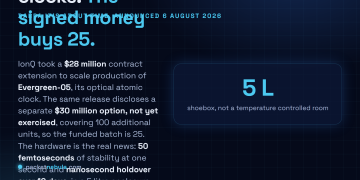
Answer card: IonQ announced a $28 million DARPA contract extension on 6 August 2026 under the It is About Time program, with a further unexercised $30 million option, together covering 125 Evergreen-05 optical atomic clocks, a 5-litre unit delivering 50 femtoseconds of stability at one second and nanosecond holdover over 10 days.

IonQ Evergreen-05: DARPA funds 25 clocks, not 125

7 August 2026
Answer card stating that Ternary Bonsai 2 27B, released by PrismML on 17 September 2026 under Apache 2.0, packs Qwen3.8 27B into 5.95 gigabytes at 1.72 bits per weight, keeps 98.2 percent of the 14-benchmark average, about 75 percent on SWE-bench Verified and Terminal-Bench 2.1, and needs PrismML's llama.cpp fork to run.

Does Bonsai 2 27B really keep 98% of Qwen3.8 in 5.95 GB?

20 September 2026
Answer card stating that Jev 1.13 from TypeSafe AI is a decision model in early access since 15 September 2026 that returns typed probabilities instead of text, priced at 42 dollars per billion input tokens with output tokens free, answering in 70 to 500 milliseconds, with a 64K token request budget, text input only, and a documented list of things it does badly, including counting and dates.

Jev 1.13 bills $42 a billion tokens, and it can’t count

19 September 2026
Answer card stating that Qwen3.8-Omni-Flash launched on 17 September 2026 as an API only model on Alibaba Cloud Model Studio, taking text, images, audio and video in a 1M token context and returning text only, priced at 0.15 dollars per million input tokens for every modality and 0.47 dollars per million output tokens in the international regions, with no open weights published and the Qwen-Live Harness GitHub repository returning 404.

Qwen3.8-Omni-Flash bills audio at $0.15 and ships no weights

18 September 2026
Answer card stating that on 15 September 2026 AWS said it is unable to restore access to resources and data hosted exclusively in the Middle East Bahrain region me-south-1 and in the mec1-az2 zone of the UAE region, because the damage spanned multiple Availability Zones and exceeded what multi-AZ services are designed to withstand.

AWS can’t restore me-south-1, six months after the drone strikes

17 September 2026
Answer card stating that Google released Gemini 3.8 Live and Gemini 3.8 Live Extended Thinking on 15 September 2026 at 3 dollars per million audio input tokens and 12 dollars out, that the thinking model requires asynchronous tools, and that Artificial Analysis scores it 82.6 on its Speech to Speech Quality Index.

Gemini 3.8 Live Extended Thinking rejects any tool that blocks

16 September 2026
Answer card summarising the Atria Dawn Preview release: 744B GLM-5.2 base, MIT licence, 1.5 TB BF16 and 756 GB FP8 checkpoints, 256K context, top on five of sixteen benchmark rows and trailing on SWE-bench Pro.

Atria Dawn Preview is 744B under MIT, and the BF16 weighs 1.5 TB

15 September 2026
Answer card stating that OpenAI released the Agents API in public beta on 10 September 2026 with no separate fee, billed through model tokens, tool calls and hosted sandbox time, with a choice of OpenAI hosted, self hosted or partner sandboxes, US only data residency and no Zero Data Retention support.

OpenAI’s Agents API has no fee, no ZDR and a one hour sandbox clock

14 September 2026
Answer card: Sakana Fugu Max at $2 and $6 per million tokens, Fugu Ultra v2 unchanged at $5 and $30, and Sakana saying Ultra v2 scores without Fable 5 or GPT-6 Astra in its pool.

Fugu Max costs $2 and $6 while Fugu Ultra v2 runs without Fable 5

13 September 2026
Answer card stating that DeepSeek released DeepSeek-V4.1-Flash on 10 September 2026 as a 552 billion parameter mixture of experts model with a new causal encoder decoder architecture that activates 8 billion parameters on input and 16 billion on output, with native vision, a one million token context and MIT licensed weights, that the API model name is now deepseek-flash at 0.15 dollars per million input tokens and 0.60 dollars per million output tokens off peak, and that DeepSeek announced V4 Pro would be routed to V4.1-Flash from 14 September and reversed that on 11 September.

DeepSeek V4.1-Flash arrived, and the V4 Pro retirement lasted a day

12 September 2026
Answer card stating that Cognition released SWE-2 on 10 September 2026, a coding model post-trained from Kimi K3, scoring 50.0 percent on FrontierCode 1.1 Main against 50.9 percent for Claude Fable 5.1 and 27.3 percent on Terminal-Bench 4 against 55.8 percent, available only inside Devin.

SWE-2 trails Fable 5.1 by one point, and by 28 on Terminal-Bench 4

11 September 2026
Answer card for Meta Muse, free to 100 million tokens a week then $20 a month, launched 8 September 2026 for United States adults only, running in a dedicated per user virtual machine.

Does Meta Muse do enough to earn your inbox and a card on file?

9 September 2026
Answer card stating that the public download pages for the VMware Virtual Disk Development Kit on developer.broadcom.com began returning 404 errors on 25 August 2026 with no announcement or deprecation notice, that Broadcom support tells customers the kit is no longer available for use or download, and that release lines 7.0.3.1, 8.x and 9.x are all affected.

Broadcom pulled VDDK 8.0 and 9.0, and the 404 is the only notice

8 September 2026
  • About
  • Contact
  • Privacy
  • Legal
Sunday, September 20, 2026
  • Login
Packet Nebula
  • Home
  • Articles
    • Security
    • Network
    • Dev
    • Sysadmin
    • SEO
    • Email & DNS
  • Tools
    • Network tools: free, fast, no signup
    • Security tools: free, fast, no signup
    • Developer tools: free, fast, no signup
    • Sysadmin tools: free, fast, no signup
    • SEO tools: free, fast, no signup
    • Email & DNS tools: free, fast, no signup
  • Download
  • About
No Result
View All Result
Packet Nebula
No Result
View All Result
Home Dev

IonQ Evergreen-05: DARPA funds 25 clocks, not 125

by stephane
7 August 2026
in Dev
0
Answer card: IonQ announced a $28 million DARPA contract extension on 6 August 2026 under the It is About Time program, with a further unexercised $30 million option, together covering 125 Evergreen-05 optical atomic clocks, a 5-litre unit delivering 50 femtoseconds of stability at one second and nanosecond holdover over 10 days.
492
SHARES
1.4k
VIEWS
Share on FacebookShare on Twitter

IonQ published the announcement on 6 August, then published it again a few hours later marked UPDATED. The second version is the one worth reading. The headline held at 125 Evergreen-05 optical atomic clocks for US government customers, but the money underneath it came apart into two pieces: a $28 million contract extension that is signed, and a further $30 million option that is not exercised. Do the subtraction the release invites and the funded delivery is 25 clocks. The other hundred are a maybe. That isn't a scandal, options are how defence procurement has always worked, and 25 production optical clocks is still a genuine milestone. It just isn't the number the headlines ran with.

The short answer

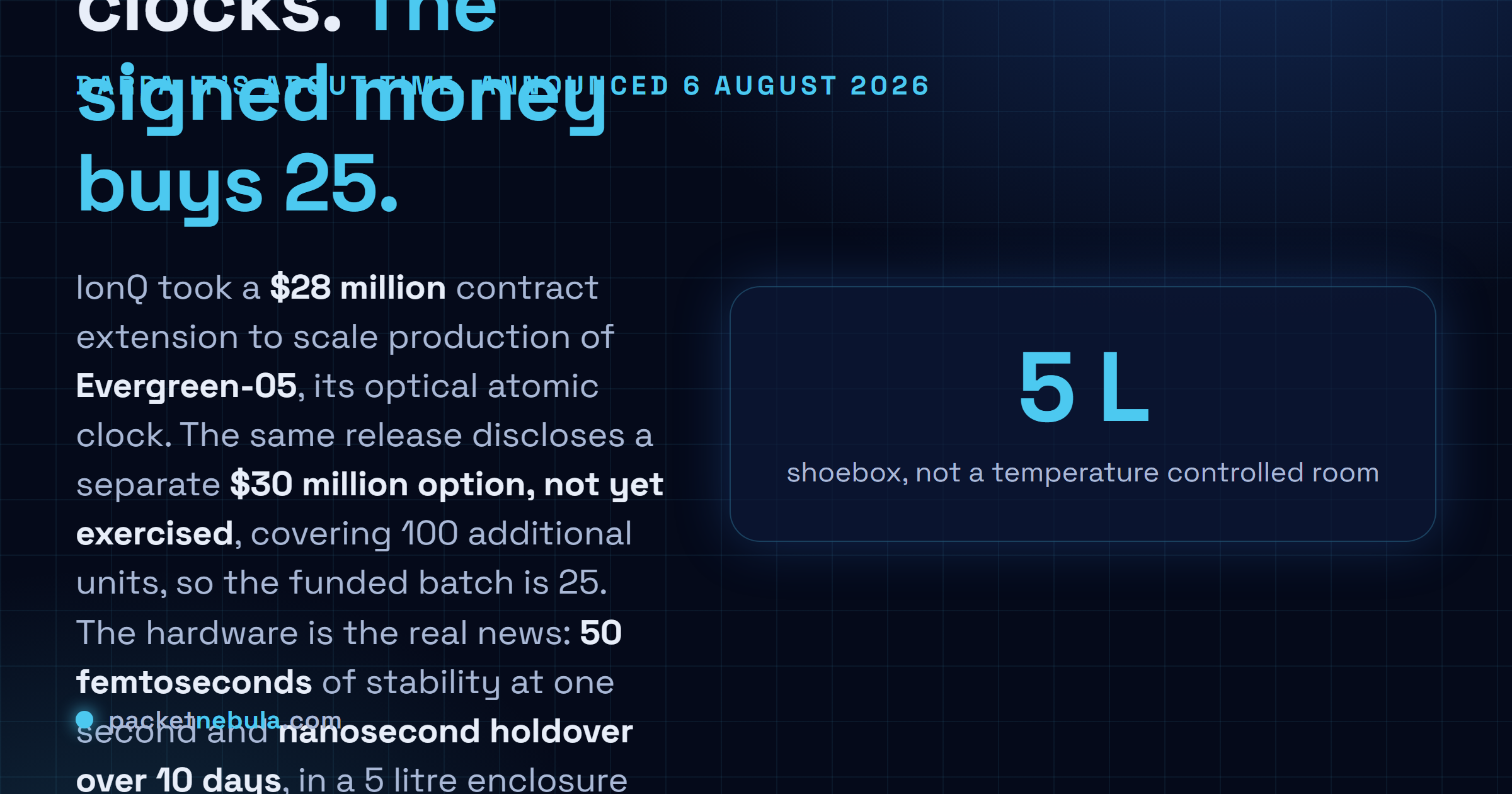
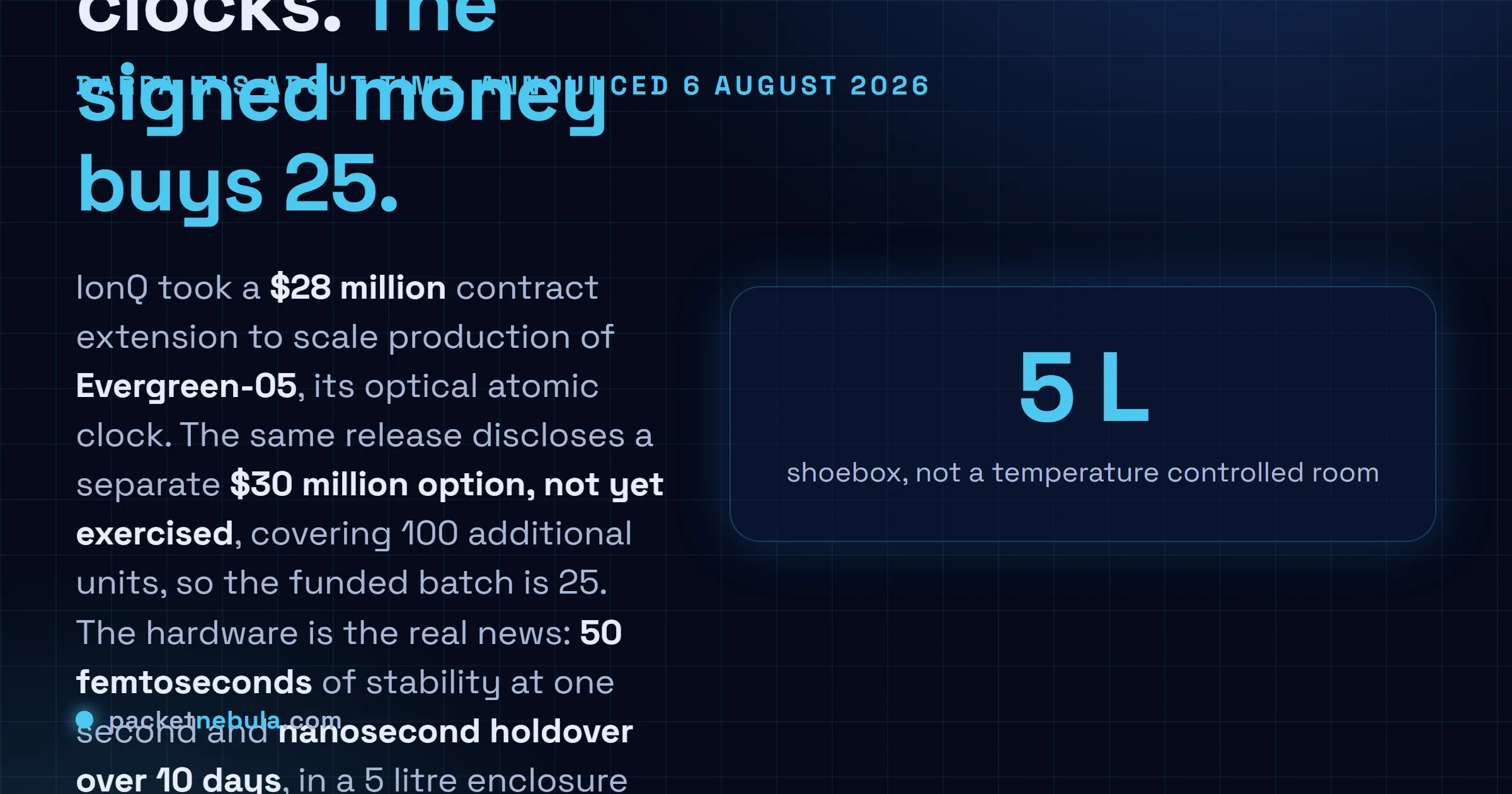
DARPA extended its contract with IonQ by $28 million on 6 August to scale production of the Evergreen-05 optical atomic clock. The release quotes 125 units, but it also discloses a separate $30 million option, not yet exercised, covering 100 of them. So 25 are funded today. The hardware itself is the real story: a 5 litre box holding 50 femtoseconds of stability at one second and nanosecond holdover across 10 days, at one seventy fifth the volume of an active hydrogen maser. It came from Vector Atomic, which IonQ bought in October 2025.
$28Msigned, plus a $30M option not taken
25clocks the signed money covers
10 daysholdover, inside a nanosecond
Answer card: IonQ announced a $28 million DARPA contract extension on 6 August 2026 under the It is About Time program, with a further unexercised $30 million option, together covering 125 Evergreen-05 optical atomic clocks, a 5-litre unit delivering 50 femtoseconds of stability at one second and nanosecond holdover over 10 days.
The one-card version. A shoebox that keeps time without help for ten days, and a purchase order smaller than the headline.

The 125 is a ceiling, not an order

Here is the sentence that reframes the whole announcement, straight from IonQ’s updated release: a further $30 million option, not yet exercised, would cover an additional 100 clocks.

Additional to what? To the batch the signed $28 million pays for. Which leaves 25.

We’re not calling that misleading. Every outlet that ran “IonQ will deliver 125 atomic clocks” was quoting the company’s own headline, and the company then went back and clarified its own release the same day, which is the opposite of hiding something. But the shape matters if you’re reading this as a signal about the market. Twenty five production optical clocks is a pilot buy. A hundred more is DARPA reserving the right to like the pilot. Those are different levels of confidence, and only one of them has money behind it right now.

The $15 million IonQ is putting in itself points the same direction. Production space, manufacturing and test equipment, support staff. You spend that when you’re building a line you expect to run past the first order, not when you already have 125 units booked.

What the box actually does

Strip the contract off and the engineering holds up on its own.

Fifty femtoseconds of stability at one second. Nanosecond holdover over 10 days. That second figure is the one to sit with, because holdover is the whole game in timing. Any clock is accurate while something better is steering it. The question operators care about is what happens when the reference goes away, and Evergreen-05’s answer is that it drifts less than a nanosecond over a week and a half, alone, in a five litre enclosure.

For scale, IonQ says that’s one seventy fifth of the volume of an active hydrogen maser at comparable performance. Masers are the things that live in temperature controlled rooms and get their own maintenance contracts. This is luggage.

The 30 million year line in the press release, less than one second of error, is the same holdover number extrapolated far past anything anyone will ever measure. It’s a nice unit conversion. I’d ignore it. The ten day figure is a spec you could test.
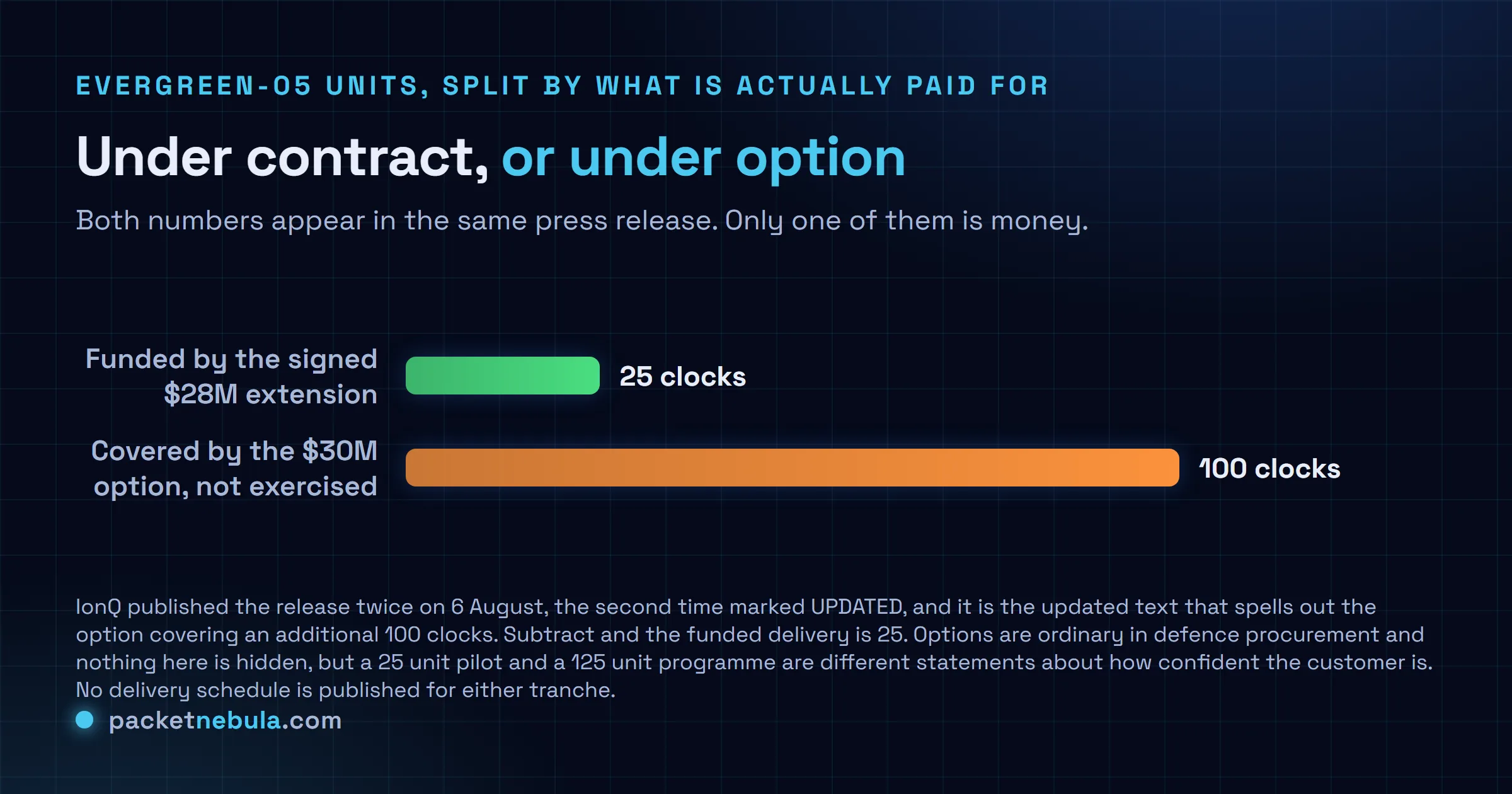
Comparison bars: of the 125 Evergreen-05 optical atomic clocks in IonQ's DARPA announcement, 25 are covered by the signed $28 million extension and 100 depend on a $30 million option that has not been exercised.
Same announcement, two very different commitments. The dark bar is money. The light bar is an option.

Why a quantum computing company is shipping clocks

Because it bought one that already was.

Vector Atomic built Evergreen-05, and DARPA has been funding that lineage since 2019, when Vector was a one year old startup in Pleasanton. The original vehicle was the Robust Optical Clock Network programme. IonQ acquired the company in October 2025 to push into quantum position, navigation and timing, and this contract is that acquisition paying out.

Worth being precise about, because the ticker moves on the word quantum and the two businesses aren’t the same bet. IonQ’s trapped-ion computers are a long horizon wager on error corrected qubits. Optical clocks are quantum sensing, an area that has been shipping working hardware for decades. Marty Boyd, who co-founded Vector Atomic and now runs IonQ’s timekeeping division, put the history plainly: DARPA’s initial support “was critical to prove the core concepts of our clock.”

Same week, IonQ’s other acquisition, Capella, picked up a National Reconnaissance Office award for commercial radar imagery. Two defence contracts, two acquired subsidiaries, zero qubits. Read the company accordingly.

Does any of this reach your rack

Honestly, no, and I want to be straight about that rather than manufacture relevance.

Twenty five units going to US government customers is not a product you can order, and the applications named are radar, secure communications and precision geolocation. Not enterprise time sync. If you run a network, your holdover problem is almost certainly solved by a GNSS disciplined grandmaster with a rubidium or good OCXO holdover oscillator, and it’s solved cheaply.

Where it gets interesting is the direction. GNSS jamming and spoofing stopped being an exotic threat somewhere over the last few years, and the answer has been either accept degraded holdover or buy a maser you can’t afford. A shoebox that holds a nanosecond for ten days sits exactly in that gap. It isn’t for sale to you today, but production contracts are how a lab instrument becomes a catalogue item, and Vector Atomic already sells a rackmount iodine clock, the Evergreen-30, for anyone who wants to price what that market looks like now.
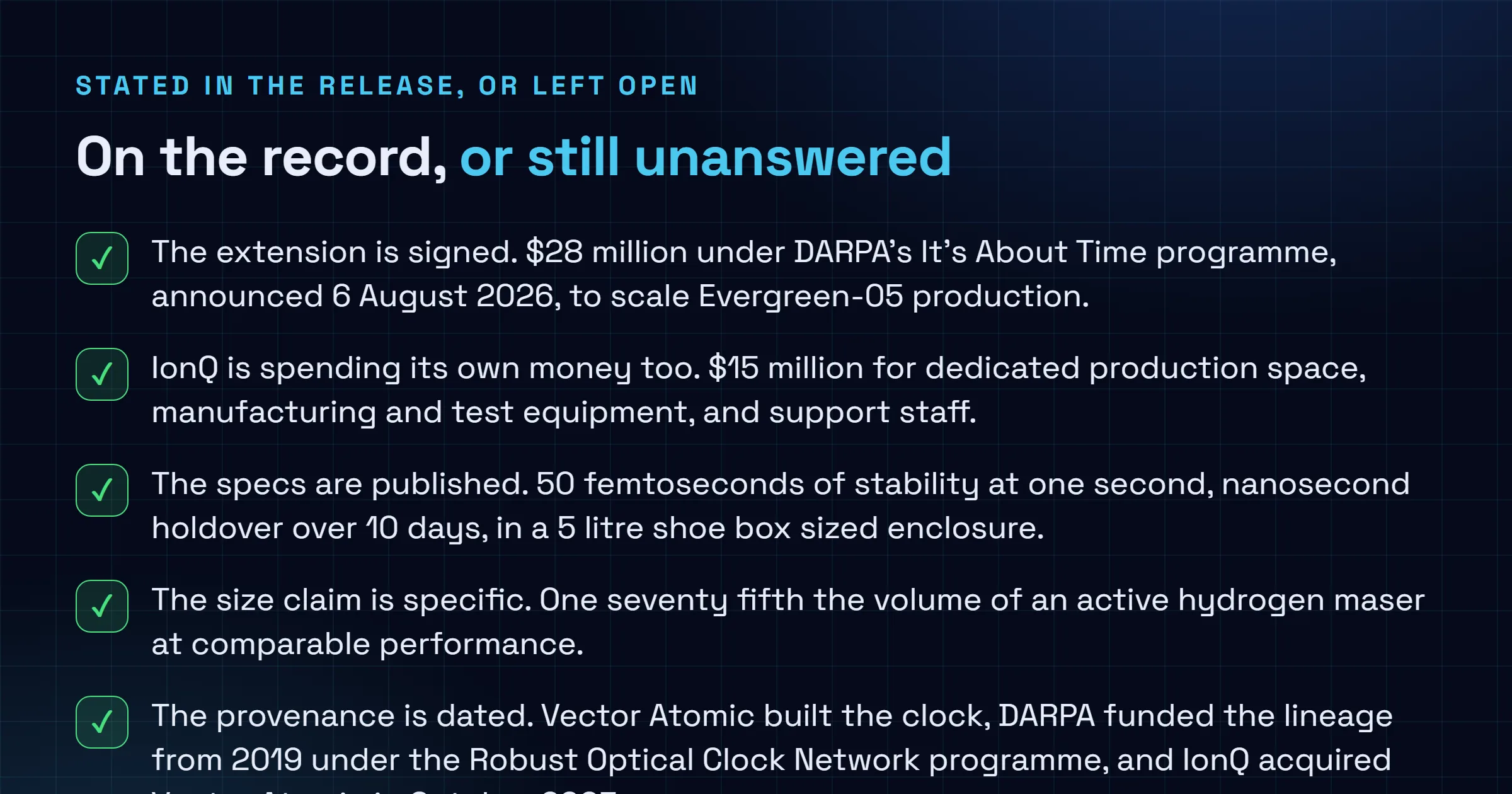
Checklist of what IonQ's DARPA atomic clock announcement confirms in writing, including the $28 million extension, the 5 litre form factor, the 50 femtosecond stability and the October 2025 Vector Atomic acquisition, against what it leaves open, including the unexercised option, the absent delivery schedule and the lack of independent verification.
What the release actually states, and what it leaves for later.

For the wider quantum picture, the same reading discipline applies to the computing side: DARPA’s $125M PsiQuantum agreement funds verification rather than a working machine, and the IBM and HRL silicon spin qubit work is a materials result, not a product. Clocks are the part of this field that already ships.

Sources

  • IonQ newsroom, “UPDATED: DARPA Selects IonQ to Produce Next-Generation Atomic Clocks”, 6 August 2026, for the contract value, the $30 million option covering 100 additional clocks, the $15 million investment and the executive quotes.
  • Quantum Computing Report, for the Vector Atomic and Capella acquisition timeline and the NRO radar award.
  • Interesting Engineering, for the form factor and stability specifications.
  • Investing News Network, carrying the full press release text including the Robust Optical Clock Network history.

Frequently asked questions

What exactly did IonQ win from DARPA?

A $28 million contract extension under DARPA's It's About Time program, announced 6 August 2026, to scale production of its Evergreen-05 optical atomic clock. IonQ's updated release adds a further $30 million option that has not been exercised, and states that the option would cover an additional 100 clocks. The full 125 units quoted in the headline therefore depend on that option being taken up. IonQ says it will invest $15 million of its own money in production space, manufacturing and test equipment, and support staff.

How accurate is the Evergreen-05?

IonQ publishes two figures. Timing stability of 50 femtoseconds at one second, and nanosecond holdover over 10 days, meaning the clock stays within about a nanosecond of true time for ten days with no external reference to steer it. The company projects that out to less than one second of error over 30 million years. Treat the 30 million year line as marketing arithmetic rather than a measured result. The holdover number is the one an operator would actually care about.

Why is a quantum computing company selling atomic clocks?

Because it bought one. IonQ acquired Vector Atomic in October 2025 to move into quantum position, navigation and timing, and Evergreen-05 is Vector Atomic's design. DARPA had been funding that core technology since 2019, originally through the Robust Optical Clock Network programme, long before IonQ was involved. So this contract validates a sensing business IonQ acquired, not its trapped-ion quantum computers. The two share a physics department and very little else.

Can I buy one of these for my own timing stack?

Not this unit. The Evergreen-05 run is a government delivery, and 25 funded units is not a commercial product line. Vector Atomic does sell a rackmount sibling, the iodine-based Evergreen-30, if you want to look at what a commercial optical clock costs. For almost every network, the honest answer is that a GNSS-disciplined grandmaster plus a decent oven-controlled or rubidium oscillator already covers your holdover requirement, and the gap this closes only opens up when GNSS is denied for days.

Does this have anything to do with breaking encryption?

No. Optical clocks measure time, they do not factor integers. Nothing in this announcement moves the date on which a quantum computer threatens RSA or ECC. If that is your worry, the migration to post-quantum cryptography is the thing with an actual calendar attached, and it proceeds on its own schedule regardless of how many clocks DARPA orders.

Tags: atomic-clockdarpaionqnewsquantumtiming
Share197Tweet123
stephane

stephane

  • Trending
  • Comments
  • Latest
Answer card: Proton Lumo 2.0 is private by policy, not by locality. Saved history is locked so even Proton cannot read it, but the prompt is decrypted on a Proton EU server to answer it, then forgotten.

Proton Lumo 2.0 review: how private is it, really?

3 September 2026
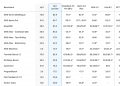
The Agentic Coding section of the official Hy4 preview benchmark appendix published by Tencent, a table comparing Hy3 and Hy4 preview against DeepSeek V4 Pro 0813, Qwen 3.8 Max, GLM 5.3, Kimi K3, GPT 5.6 Sol and Claude Opus 5 across SWE-bench Multilingual, SWE-bench Pro, DeepSWE, three SWE Atlas tasks, SWE-Marathon, Terminal-Bench 2.1, NL2Repo-Bench, CyberGym, ProgramBench, PostTrainBench and Harbor-Index.

Tencent’s 770B Hy4 tops one benchmark row in 46

3 September 2026
Answer card: Qwen 3.7 Max is API-only and cannot run locally yet; the open Qwen models (Qwen 3.6 27B, qwen3:8b to 32b) run offline via Ollama.

Qwen 3.7 local: what you can actually run offline

22 June 2026
Answer card: JWTs are not encrypted, anyone can read them; the signature proves who issued the token, not who may read it.

Are JWTs encrypted? No, and the difference will bite you

0
Answer card: a random 8 character password falls in under 2 hours offline, while 16 random characters hold for 1.4 trillion years at the same speed.

How long does it take to crack a password in 2026?

0
Answer card: three DNS records decide if your mail lands or bounces; SPF lists allowed senders, DKIM signs messages, DMARC sets the failure policy.

SPF, DKIM and DMARC explained: the records your email needs

0
Answer card stating that Ternary Bonsai 2 27B, released by PrismML on 17 September 2026 under Apache 2.0, packs Qwen3.8 27B into 5.95 gigabytes at 1.72 bits per weight, keeps 98.2 percent of the 14-benchmark average, about 75 percent on SWE-bench Verified and Terminal-Bench 2.1, and needs PrismML's llama.cpp fork to run.

Does Bonsai 2 27B really keep 98% of Qwen3.8 in 5.95 GB?

20 September 2026
Answer card stating that Jev 1.13 from TypeSafe AI is a decision model in early access since 15 September 2026 that returns typed probabilities instead of text, priced at 42 dollars per billion input tokens with output tokens free, answering in 70 to 500 milliseconds, with a 64K token request budget, text input only, and a documented list of things it does badly, including counting and dates.

Jev 1.13 bills $42 a billion tokens, and it can’t count

19 September 2026
Answer card stating that Qwen3.8-Omni-Flash launched on 17 September 2026 as an API only model on Alibaba Cloud Model Studio, taking text, images, audio and video in a 1M token context and returning text only, priced at 0.15 dollars per million input tokens for every modality and 0.47 dollars per million output tokens in the international regions, with no open weights published and the Qwen-Live Harness GitHub repository returning 404.

Qwen3.8-Omni-Flash bills audio at $0.15 and ships no weights

18 September 2026
  • About
  • Contact
  • Privacy
  • Legal

Copyright © 2026 Stephane Cardon.

Welcome Back!

Login to your account below

Forgotten Password?

Retrieve your password

Please enter your username or email address to reset your password.

Log In
No Result
View All Result
  • Home
  • Articles
    • Security
    • Network
    • Dev
    • Sysadmin
    • SEO
    • Email & DNS
  • Tools
    • Network tools: free, fast, no signup
    • Security tools: free, fast, no signup
    • Developer tools: free, fast, no signup
    • Sysadmin tools: free, fast, no signup
    • SEO tools: free, fast, no signup
    • Email & DNS tools: free, fast, no signup
  • Download
  • About

Copyright © 2026 Stephane Cardon.