
• Latest
  • Trending
  • All
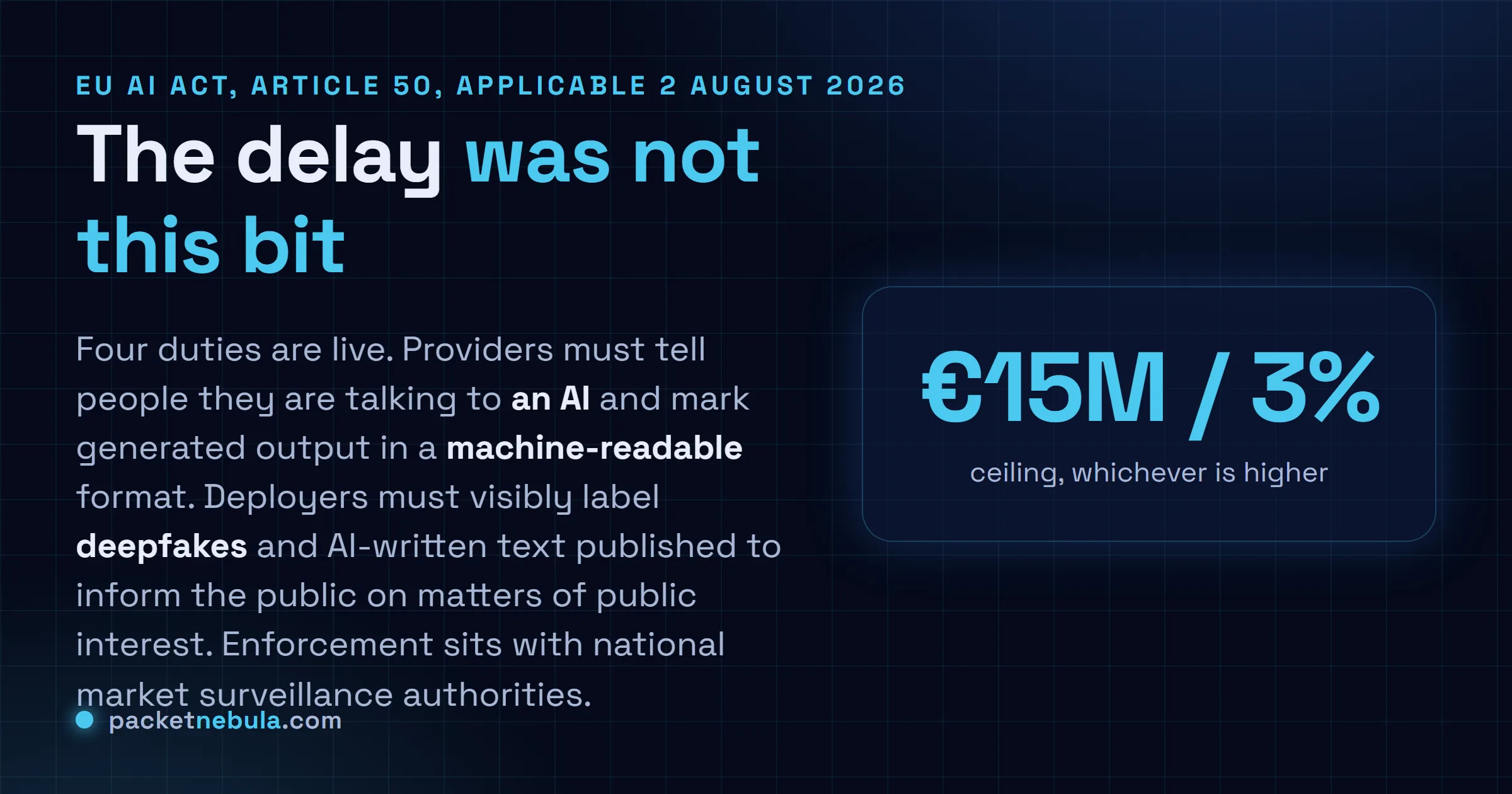
Answer card: Article 50 of the EU AI Act became applicable on 2 August 2026, covering AI interaction disclosure, machine-readable marking of generative output, deepfake labelling and AI-generated public interest text, with fines up to 15 million euros or 3 percent of worldwide turnover.

What Article 50 of the EU AI Act makes you label

3 September 2026
Answer card stating that Qwen3.8-Omni-Flash launched on 17 September 2026 as an API only model on Alibaba Cloud Model Studio, taking text, images, audio and video in a 1M token context and returning text only, priced at 0.15 dollars per million input tokens for every modality and 0.47 dollars per million output tokens in the international regions, with no open weights published and the Qwen-Live Harness GitHub repository returning 404.

Qwen3.8-Omni-Flash bills audio at $0.15 and ships no weights

18 September 2026
Answer card stating that on 15 September 2026 AWS said it is unable to restore access to resources and data hosted exclusively in the Middle East Bahrain region me-south-1 and in the mec1-az2 zone of the UAE region, because the damage spanned multiple Availability Zones and exceeded what multi-AZ services are designed to withstand.

AWS can’t restore me-south-1, six months after the drone strikes

17 September 2026
Answer card stating that Google released Gemini 3.8 Live and Gemini 3.8 Live Extended Thinking on 15 September 2026 at 3 dollars per million audio input tokens and 12 dollars out, that the thinking model requires asynchronous tools, and that Artificial Analysis scores it 82.6 on its Speech to Speech Quality Index.

Gemini 3.8 Live Extended Thinking rejects any tool that blocks

16 September 2026
Answer card summarising the Atria Dawn Preview release: 744B GLM-5.2 base, MIT licence, 1.5 TB BF16 and 756 GB FP8 checkpoints, 256K context, top on five of sixteen benchmark rows and trailing on SWE-bench Pro.

Atria Dawn Preview is 744B under MIT, and the BF16 weighs 1.5 TB

15 September 2026
Answer card stating that OpenAI released the Agents API in public beta on 10 September 2026 with no separate fee, billed through model tokens, tool calls and hosted sandbox time, with a choice of OpenAI hosted, self hosted or partner sandboxes, US only data residency and no Zero Data Retention support.

OpenAI’s Agents API has no fee, no ZDR and a one hour sandbox clock

14 September 2026
Answer card: Sakana Fugu Max at $2 and $6 per million tokens, Fugu Ultra v2 unchanged at $5 and $30, and Sakana saying Ultra v2 scores without Fable 5 or GPT-6 Astra in its pool.

Fugu Max costs $2 and $6 while Fugu Ultra v2 runs without Fable 5

13 September 2026
Answer card stating that DeepSeek released DeepSeek-V4.1-Flash on 10 September 2026 as a 552 billion parameter mixture of experts model with a new causal encoder decoder architecture that activates 8 billion parameters on input and 16 billion on output, with native vision, a one million token context and MIT licensed weights, that the API model name is now deepseek-flash at 0.15 dollars per million input tokens and 0.60 dollars per million output tokens off peak, and that DeepSeek announced V4 Pro would be routed to V4.1-Flash from 14 September and reversed that on 11 September.

DeepSeek V4.1-Flash arrived, and the V4 Pro retirement lasted a day

12 September 2026
Answer card stating that Cognition released SWE-2 on 10 September 2026, a coding model post-trained from Kimi K3, scoring 50.0 percent on FrontierCode 1.1 Main against 50.9 percent for Claude Fable 5.1 and 27.3 percent on Terminal-Bench 4 against 55.8 percent, available only inside Devin.

SWE-2 trails Fable 5.1 by one point, and by 28 on Terminal-Bench 4

11 September 2026
Answer card for Meta Muse, free to 100 million tokens a week then $20 a month, launched 8 September 2026 for United States adults only, running in a dedicated per user virtual machine.

Does Meta Muse do enough to earn your inbox and a card on file?

9 September 2026
Answer card stating that the public download pages for the VMware Virtual Disk Development Kit on developer.broadcom.com began returning 404 errors on 25 August 2026 with no announcement or deprecation notice, that Broadcom support tells customers the kit is no longer available for use or download, and that release lines 7.0.3.1, 8.x and 9.x are all affected.

Broadcom pulled VDDK 8.0 and 9.0, and the 404 is the only notice

8 September 2026
Answer card stating that OpenAI published its research acceleration measurements on 6 September 2026, that as of mid August 2026 its research organisation logged 3.1 agent workdays of coding agent runtime for every workday of human labour normalised to a standard eight hour day, and that OpenAI states this should not be read as a 3.1 times productivity gain because it measures runtime rather than delivered output.

OpenAI’s 3.1 agent-workdays per human day is not a 3.1x gain

7 September 2026
Answer card stating that Mullvad announced on 3 September 2026 that it is shutting down its public encrypted domain name system servers on 2 November 2026 and sponsoring the Quad9 Foundation instead, with 194.242.2.2 and its five sibling addresses all going away, and virtual private network customers unaffected.

Mullvad’s DNS servers go dark on 2 November, and Quad9 blocks no ads

5 September 2026
  • About
  • Contact
  • Privacy
  • Legal
Friday, September 18, 2026
  • Login
Packet Nebula
  • Home
  • Articles
    • Security
    • Network
    • Dev
    • Sysadmin
    • SEO
    • Email & DNS
  • Tools
    • Network tools: free, fast, no signup
    • Security tools: free, fast, no signup
    • Developer tools: free, fast, no signup
    • Sysadmin tools: free, fast, no signup
    • SEO tools: free, fast, no signup
    • Email & DNS tools: free, fast, no signup
  • Download
  • About
No Result
View All Result
Packet Nebula
No Result
View All Result
Home Dev

What Article 50 of the EU AI Act makes you label

by stephane
3 September 2026
in Dev
0
Answer card: Article 50 of the EU AI Act became applicable on 2 August 2026, covering AI interaction disclosure, machine-readable marking of generative output, deepfake labelling and AI-generated public interest text, with fines up to 15 million euros or 3 percent of worldwide turnover.
491
SHARES
1.4k
VIEWS
Share on FacebookShare on Twitter

Somebody on your team read that Brussels postponed the AI Act and filed it under next year. Half right. The high risk rules did slip, some of them into 2028, but Article 50 landed on schedule on 2 August 2026 and it is the one that touches ordinary products: if you run a chatbot, generate images or audio, publish AI-written text on matters of public interest, or ship a generative model other people build on, you now owe somebody a disclosure. We spent the afternoon in the text rather than the summaries, because the summaries kept merging two different deadlines into one. They are not the same deadline. One of them was already in force when you woke up this morning.

The short answer

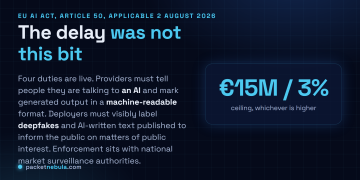
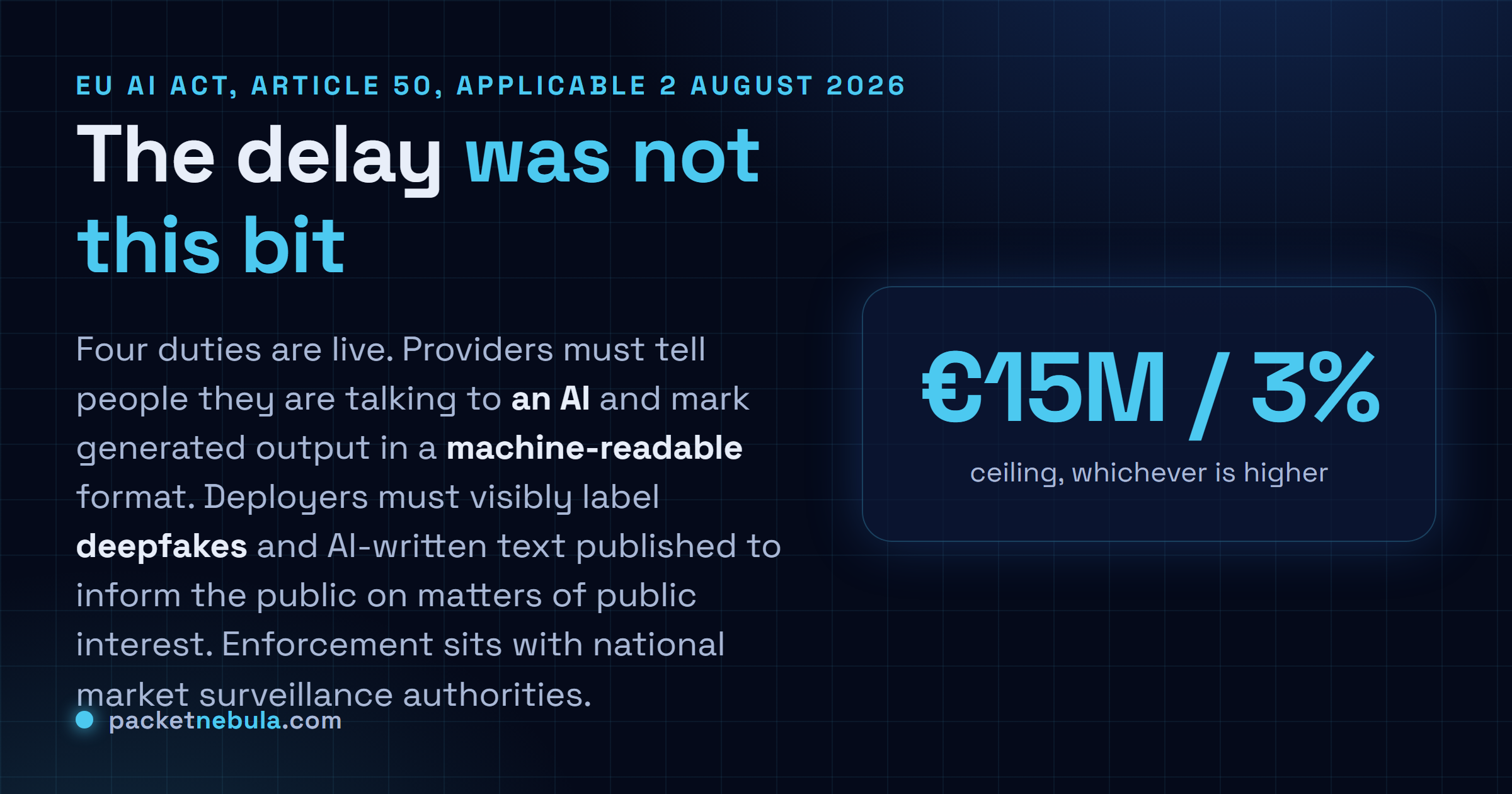
The EU AI Act transparency rules are in force. Providers must disclose that a user is talking to an AI and machine-mark generative output. Deployers must visibly label deepfakes and AI-written text published on matters of public interest. The delay you read about in the spring moved the high risk obligations, not these. If a human edits your published text and owns it, the text duty does not reach you.
2 Aug 2026Article 50 applied
€15M / 3%ceiling, whichever is higher
2 Dec 2026marking grace, old systems only
Answer card: Article 50 of the EU AI Act became applicable on 2 August 2026, covering AI interaction disclosure, machine-readable marking of generative output, deepfake labelling and AI-generated public interest text, with fines up to 15 million euros or 3 percent of worldwide turnover.
Four duties, two audiences. Most teams only owe two of them, and pick the wrong two.

The delay was real. It just wasn’t this one.

The Digital Omnibus is where the confusion starts. Council and Parliament reached provisional political agreement on 7 May 2026 and rewrote the high risk calendar, pushing Annex III obligations from 2 August 2026 out to 2 December 2027 and Annex I products to 2 August 2028. Formal adoption still hasn’t happened. That’s a genuine reprieve, and it earned the coverage it got.

It didn’t touch Article 50.

So the transparency duties applied on Sunday, on the original schedule, to systems that were never classed high risk to begin with. Your support chatbot isn’t high risk. It’s still in scope here. That gap between what got delayed and what people think got delayed is the whole story this week.
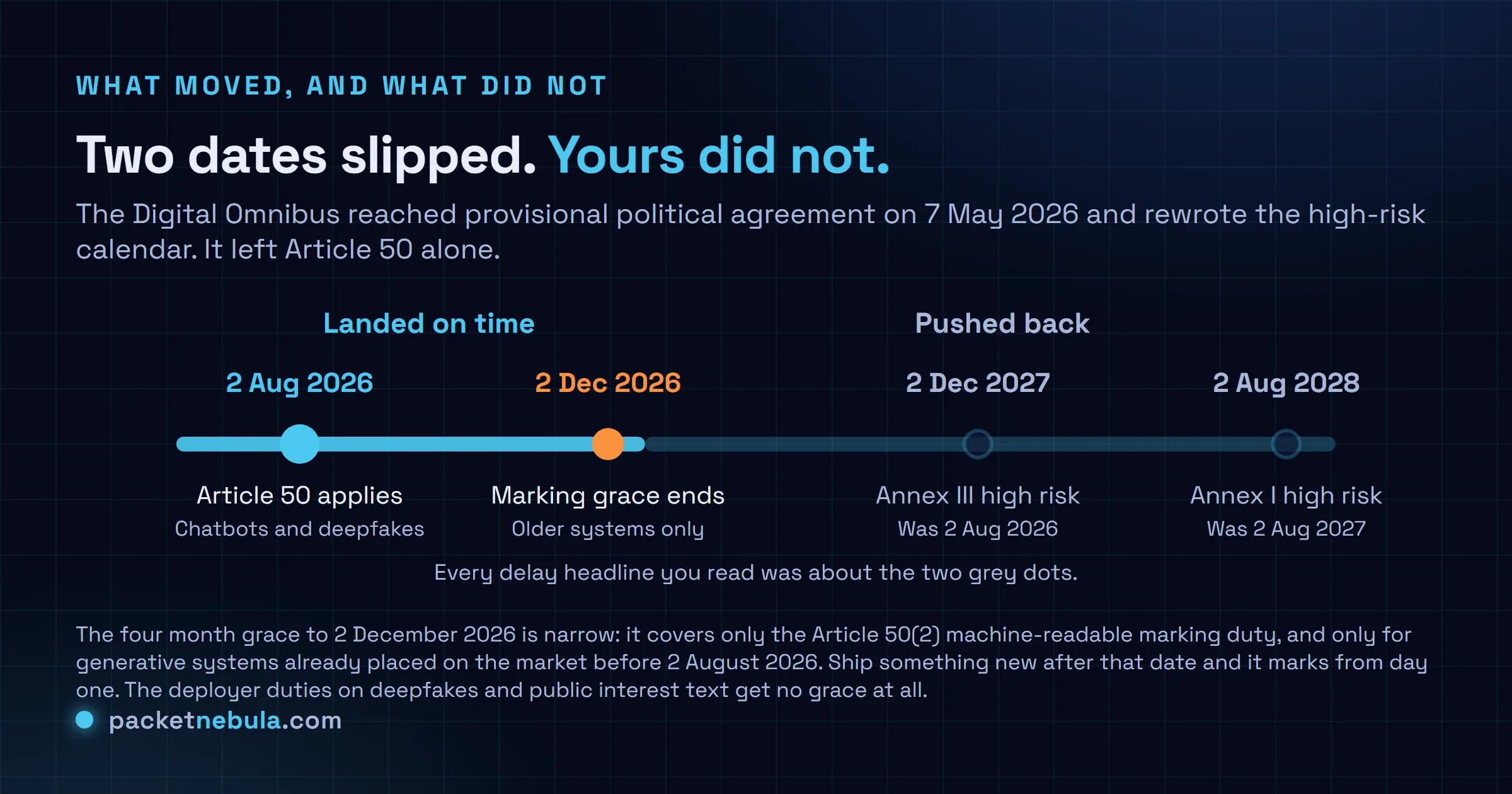
Timeline showing Article 50 transparency applying on 2 August 2026 and the marking grace ending 2 December 2026, against the high-risk obligations the Digital Omnibus moved to 2 December 2027 and 2 August 2028.
The two grey dots moved. The blue one never did.

Four duties, and only two are yours

Article 50 splits along a line worth getting right, because guessing wrong puts the obligation on the wrong company. Paragraphs 1 and 2 bind providers. Paragraphs 3 and 4 bind deployers. Building on someone else’s model does not make you the provider of it.

Providers owe two things. People have to know they’re dealing with an AI system, told from the start of the first interaction in a clear and distinguishable manner, unless it’s obvious to a reasonably well-informed person. And generative output has to be marked in a machine-readable format and detectable as artificially generated or manipulated.

Deployers owe the visible half. Deepfakes get disclosed in a way a human can perceive, which means a visible or audible label and not a line buried in EXIF. AI-generated text published to inform the public on matters of public interest gets labelled too, politics and public health being the examples the Commission reaches for. The third deployer duty covers emotion recognition and biometric categorisation. If you run one of those, you already know.

One nuance that catches people who ship image or video generation: the marking duty is on the provider of the system, so if you’re wrapping a hosted model, the mark is meant to come from upstream. Worth checking whether it actually does. When Flux 3 shipped video and audio with weights promised later, questions like this were exactly what nobody had answered yet.

The exemption most publishers live under

The public interest text duty has a hole in it, and it’s a wide one. Text that went through substantive human review, where a natural or legal person holds editorial responsibility for the publication, isn’t caught. That describes most editorial workflows that were already working properly. Draft with a model, have an editor read it and own it, and paragraph 4 doesn’t reach you.

We know how that reads coming from a site that publishes daily. So, plainly: this piece was checked against the Commission’s own FAQ and the legal text before it went up, and a person owns it. That’s the standard the Act describes. It isn’t a high bar. It’s just one you have to clear rather than assert.

Two other carve-outs matter. AI performing an assistive function for standard editing, grammar correction being the stock example, doesn’t trigger the marking duty. And evidently artistic or satirical work needs only disclosure that doesn’t hamper the display or enjoyment of the work.

None of this is escaped by being outside the EU. The obligations reach non-EU companies where the output lands with users in Europe.

Live obligation, missing yardstick

Now the awkward part. The duty is in force and there’s no test for passing it.

The text asks for marking that’s effective, reliable, robust and interoperable. Four adjectives, no technology. No named watermark scheme, no metadata format, nothing you can point an auditor at. The harmonised standards meant to fill that gap are late, and not quietly: the Commission recorded significant delays in implementing decision C(2025)3871 back in June 2025, and they weren’t ready for August.

What exists instead is a voluntary Code of Practice, final version published on 10 June 2026. Read it and you find an unusually honest admission for a compliance document, that no single marking technique meets the Act’s requirements. So it asks signatories to run at least two complementary machine-readable layers and to offer a detection mechanism users and researchers can check against. Voluntary, though. Signing is evidence of good faith rather than a safe harbour. The Commission also promised guidelines clarifying the scope of Article 50 alongside the Code, and we haven’t found them published.

Enforcement runs through national market surveillance authorities. The ceiling in Article 99(4) is 15 million euros or 3 percent of total worldwide annual turnover, whichever is higher, with SMEs capped at whichever is lower. Nobody has been fined, and no authority has said what a clear and distinguishable label looks like to them. I’d expect the first real answer to arrive as an enforcement action rather than guidance, which is a rotten way to find out.

Industry pushback isn’t the usual noise either. Karen Massin at Google warned that a flood of overlapping labels makes it “harder for people to get the clear context they need”, and there’s something to that, because a label that appears on everything stops carrying information. Ashley Casovan gave the flatter response, that we hear this with every compliance requirement, “and yet, the world turns”.

The pattern rhymes with what happened when Google took its €890M DMA fine: the rule arrives stated as an outcome, the specifics get worked out later against whoever tests them first.

If you ship anything generative into Europe, the boring next hour is the right one. Work out whether you’re the provider or the deployer on each surface, then look at what a user actually sees before they type. The chatbot disclosure is the cheapest of the four to get right and the easiest to have skipped.

Sources

The obligations, the deepfake definition in Article 3(60), the exemptions and the 2 December 2026 marking grace are taken from the European Commission FAQ, Transparency obligations under Article 50 of the AI Act, with the article-by-article breakdown cross-checked against the Article 50 guide and the fine ceilings against Article 99. That Article 50 was not postponed by the Digital Omnibus, and the 7 May 2026 provisional agreement moving the high risk dates, is reported by aiactblog.nl and Gibson Dunn. The Code of Practice publication date, its voluntary status and the two-layer marking commitment come from Jones Day, and the harmonised standards delay recorded in C(2025)3871 from Plesner. The Massin and Casovan quotes are as reported by Euronews on 2 August 2026. One caveat on the grace period: most sources put it at four months to 2 December 2026, while Plesner’s reading of an earlier Omnibus draft cited six months to 2 February 2027. The Commission FAQ says 2 December 2026, and that is the date used above.

Frequently asked questions

Did the Digital Omnibus delay the AI Act transparency rules?

No. The provisional political agreement of 7 May 2026 moved the high risk obligations, Annex III out to 2 December 2027 and Annex I products to 2 August 2028, and formal adoption is still pending. It left Article 50 where it was. The transparency duties applied from 2 August 2026 on the original schedule. The only Article 50 concession is a four month grace on the machine-readable marking duty in paragraph 2, and only for generative systems already placed on the market before that date.

Do I have to label AI-assisted articles on my own site?

Probably not, if a human edits them. The Article 50(4) duty covers text published to inform the public on matters of public interest, and it carves out text that underwent substantive human review or editorial control where a natural or legal person holds editorial responsibility for the publication. A normal editorial workflow clears that. Fully automated publishing on politics or public health does not, and that is the case the provision was written for.

What counts as a deepfake under the AI Act?

Article 3(60) sets three cumulative criteria: the content resembles existing persons, objects, places or events, it appears authentic or truthful, and that appearance is false. All three have to hold. Deployers must disclose deepfakes in a clear and distinguishable manner that a person can actually perceive, so a visible or audible label rather than metadata alone. Evidently artistic, creative, satirical or fictional work only needs disclosure that does not hamper the display or enjoyment of the work.

Which watermarking technology does the AI Act require?

None. The text asks for marking that is effective, reliable, robust and interoperable, and names no scheme at all. The harmonised standards meant to fill that gap are late, formally recorded as significantly delayed in Commission implementing decision C(2025)3871 of 23 June 2025. The voluntary Code of Practice published on 10 June 2026 concedes that no single marking technique meets the requirements, and asks signatories to run at least two complementary machine-readable layers plus a detection mechanism. Signing it is evidence of good faith, not a safe harbour.

Does Article 50 apply to companies outside the EU?

Yes, where the output is used in the EU. A US or UK company serving European users is in scope, the same extraterritorial reach the GDPR established. Enforcement runs through national market surveillance authorities, and the ceiling in Article 99(4) is 15 million euros or 3 percent of total worldwide annual turnover, whichever is higher. For SMEs and startups the fine is capped at whichever of the two is lower.

Tags: aicomplianceeulegalllmnews
Share196Tweet123
stephane

stephane

  • Trending
  • Comments
  • Latest
Answer card: Proton Lumo 2.0 is private by policy, not by locality. Saved history is locked so even Proton cannot read it, but the prompt is decrypted on a Proton EU server to answer it, then forgotten.

Proton Lumo 2.0 review: how private is it, really?

3 September 2026
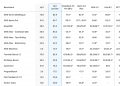
The Agentic Coding section of the official Hy4 preview benchmark appendix published by Tencent, a table comparing Hy3 and Hy4 preview against DeepSeek V4 Pro 0813, Qwen 3.8 Max, GLM 5.3, Kimi K3, GPT 5.6 Sol and Claude Opus 5 across SWE-bench Multilingual, SWE-bench Pro, DeepSWE, three SWE Atlas tasks, SWE-Marathon, Terminal-Bench 2.1, NL2Repo-Bench, CyberGym, ProgramBench, PostTrainBench and Harbor-Index.

Tencent’s 770B Hy4 tops one benchmark row in 46

3 September 2026
Answer card: Qwen 3.7 Max is API-only and cannot run locally yet; the open Qwen models (Qwen 3.6 27B, qwen3:8b to 32b) run offline via Ollama.

Qwen 3.7 local: what you can actually run offline

22 June 2026
Answer card: JWTs are not encrypted, anyone can read them; the signature proves who issued the token, not who may read it.

Are JWTs encrypted? No, and the difference will bite you

0
Answer card: a random 8 character password falls in under 2 hours offline, while 16 random characters hold for 1.4 trillion years at the same speed.

How long does it take to crack a password in 2026?

0
Answer card: three DNS records decide if your mail lands or bounces; SPF lists allowed senders, DKIM signs messages, DMARC sets the failure policy.

SPF, DKIM and DMARC explained: the records your email needs

0
Answer card stating that Qwen3.8-Omni-Flash launched on 17 September 2026 as an API only model on Alibaba Cloud Model Studio, taking text, images, audio and video in a 1M token context and returning text only, priced at 0.15 dollars per million input tokens for every modality and 0.47 dollars per million output tokens in the international regions, with no open weights published and the Qwen-Live Harness GitHub repository returning 404.

Qwen3.8-Omni-Flash bills audio at $0.15 and ships no weights

18 September 2026
Answer card stating that on 15 September 2026 AWS said it is unable to restore access to resources and data hosted exclusively in the Middle East Bahrain region me-south-1 and in the mec1-az2 zone of the UAE region, because the damage spanned multiple Availability Zones and exceeded what multi-AZ services are designed to withstand.

AWS can’t restore me-south-1, six months after the drone strikes

17 September 2026
Answer card stating that Google released Gemini 3.8 Live and Gemini 3.8 Live Extended Thinking on 15 September 2026 at 3 dollars per million audio input tokens and 12 dollars out, that the thinking model requires asynchronous tools, and that Artificial Analysis scores it 82.6 on its Speech to Speech Quality Index.

Gemini 3.8 Live Extended Thinking rejects any tool that blocks

16 September 2026
  • About
  • Contact
  • Privacy
  • Legal

Copyright © 2026 Stephane Cardon.

Welcome Back!

Login to your account below

Forgotten Password?

Retrieve your password

Please enter your username or email address to reset your password.

Log In
No Result
View All Result
  • Home
  • Articles
    • Security
    • Network
    • Dev
    • Sysadmin
    • SEO
    • Email & DNS
  • Tools
    • Network tools: free, fast, no signup
    • Security tools: free, fast, no signup
    • Developer tools: free, fast, no signup
    • Sysadmin tools: free, fast, no signup
    • SEO tools: free, fast, no signup
    • Email & DNS tools: free, fast, no signup
  • Download
  • About

Copyright © 2026 Stephane Cardon.