
• Latest
  • Trending
  • All
Answer card summarising Seagate fiscal Q4 2026: 50TB-class drives qualify in late 2027 and ship in 2028, nearline exabytes are allocated into calendar 2028, and price per exabyte rose about 10 percent year over year.

Seagate 50TB HAMR drives: 2028, not 2027

31 July 2026
Answer card stating that Qwen3.8-Omni-Flash launched on 17 September 2026 as an API only model on Alibaba Cloud Model Studio, taking text, images, audio and video in a 1M token context and returning text only, priced at 0.15 dollars per million input tokens for every modality and 0.47 dollars per million output tokens in the international regions, with no open weights published and the Qwen-Live Harness GitHub repository returning 404.

Qwen3.8-Omni-Flash bills audio at $0.15 and ships no weights

18 September 2026
Answer card stating that on 15 September 2026 AWS said it is unable to restore access to resources and data hosted exclusively in the Middle East Bahrain region me-south-1 and in the mec1-az2 zone of the UAE region, because the damage spanned multiple Availability Zones and exceeded what multi-AZ services are designed to withstand.

AWS can’t restore me-south-1, six months after the drone strikes

17 September 2026
Answer card stating that Google released Gemini 3.8 Live and Gemini 3.8 Live Extended Thinking on 15 September 2026 at 3 dollars per million audio input tokens and 12 dollars out, that the thinking model requires asynchronous tools, and that Artificial Analysis scores it 82.6 on its Speech to Speech Quality Index.

Gemini 3.8 Live Extended Thinking rejects any tool that blocks

16 September 2026
Answer card summarising the Atria Dawn Preview release: 744B GLM-5.2 base, MIT licence, 1.5 TB BF16 and 756 GB FP8 checkpoints, 256K context, top on five of sixteen benchmark rows and trailing on SWE-bench Pro.

Atria Dawn Preview is 744B under MIT, and the BF16 weighs 1.5 TB

15 September 2026
Answer card stating that OpenAI released the Agents API in public beta on 10 September 2026 with no separate fee, billed through model tokens, tool calls and hosted sandbox time, with a choice of OpenAI hosted, self hosted or partner sandboxes, US only data residency and no Zero Data Retention support.

OpenAI’s Agents API has no fee, no ZDR and a one hour sandbox clock

14 September 2026
Answer card: Sakana Fugu Max at $2 and $6 per million tokens, Fugu Ultra v2 unchanged at $5 and $30, and Sakana saying Ultra v2 scores without Fable 5 or GPT-6 Astra in its pool.

Fugu Max costs $2 and $6 while Fugu Ultra v2 runs without Fable 5

13 September 2026
Answer card stating that DeepSeek released DeepSeek-V4.1-Flash on 10 September 2026 as a 552 billion parameter mixture of experts model with a new causal encoder decoder architecture that activates 8 billion parameters on input and 16 billion on output, with native vision, a one million token context and MIT licensed weights, that the API model name is now deepseek-flash at 0.15 dollars per million input tokens and 0.60 dollars per million output tokens off peak, and that DeepSeek announced V4 Pro would be routed to V4.1-Flash from 14 September and reversed that on 11 September.

DeepSeek V4.1-Flash arrived, and the V4 Pro retirement lasted a day

12 September 2026
Answer card stating that Cognition released SWE-2 on 10 September 2026, a coding model post-trained from Kimi K3, scoring 50.0 percent on FrontierCode 1.1 Main against 50.9 percent for Claude Fable 5.1 and 27.3 percent on Terminal-Bench 4 against 55.8 percent, available only inside Devin.

SWE-2 trails Fable 5.1 by one point, and by 28 on Terminal-Bench 4

11 September 2026
Answer card for Meta Muse, free to 100 million tokens a week then $20 a month, launched 8 September 2026 for United States adults only, running in a dedicated per user virtual machine.

Does Meta Muse do enough to earn your inbox and a card on file?

9 September 2026
Answer card stating that the public download pages for the VMware Virtual Disk Development Kit on developer.broadcom.com began returning 404 errors on 25 August 2026 with no announcement or deprecation notice, that Broadcom support tells customers the kit is no longer available for use or download, and that release lines 7.0.3.1, 8.x and 9.x are all affected.

Broadcom pulled VDDK 8.0 and 9.0, and the 404 is the only notice

8 September 2026
Answer card stating that OpenAI published its research acceleration measurements on 6 September 2026, that as of mid August 2026 its research organisation logged 3.1 agent workdays of coding agent runtime for every workday of human labour normalised to a standard eight hour day, and that OpenAI states this should not be read as a 3.1 times productivity gain because it measures runtime rather than delivered output.

OpenAI’s 3.1 agent-workdays per human day is not a 3.1x gain

7 September 2026
Answer card stating that Mullvad announced on 3 September 2026 that it is shutting down its public encrypted domain name system servers on 2 November 2026 and sponsoring the Quad9 Foundation instead, with 194.242.2.2 and its five sibling addresses all going away, and virtual private network customers unaffected.

Mullvad’s DNS servers go dark on 2 November, and Quad9 blocks no ads

5 September 2026
  • About
  • Contact
  • Privacy
  • Legal
Friday, September 18, 2026
  • Login
Packet Nebula
  • Home
  • Articles
    • Security
    • Network
    • Dev
    • Sysadmin
    • SEO
    • Email & DNS
  • Tools
    • Network tools: free, fast, no signup
    • Security tools: free, fast, no signup
    • Developer tools: free, fast, no signup
    • Sysadmin tools: free, fast, no signup
    • SEO tools: free, fast, no signup
    • Email & DNS tools: free, fast, no signup
  • Download
  • About
No Result
View All Result
Packet Nebula
No Result
View All Result
Home Sysadmin

Seagate 50TB HAMR drives: 2028, not 2027

by stephane
31 July 2026
in Sysadmin
0
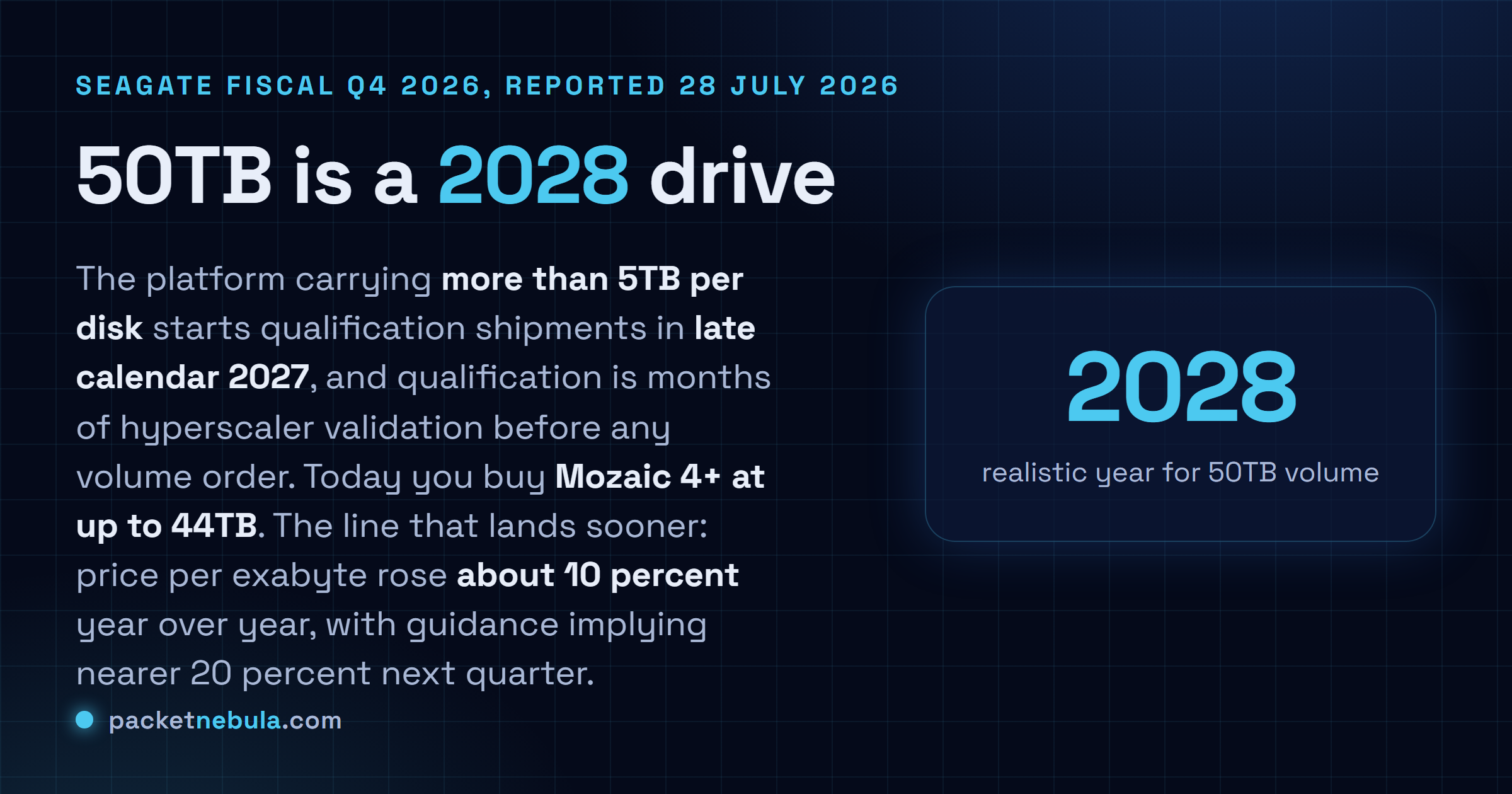
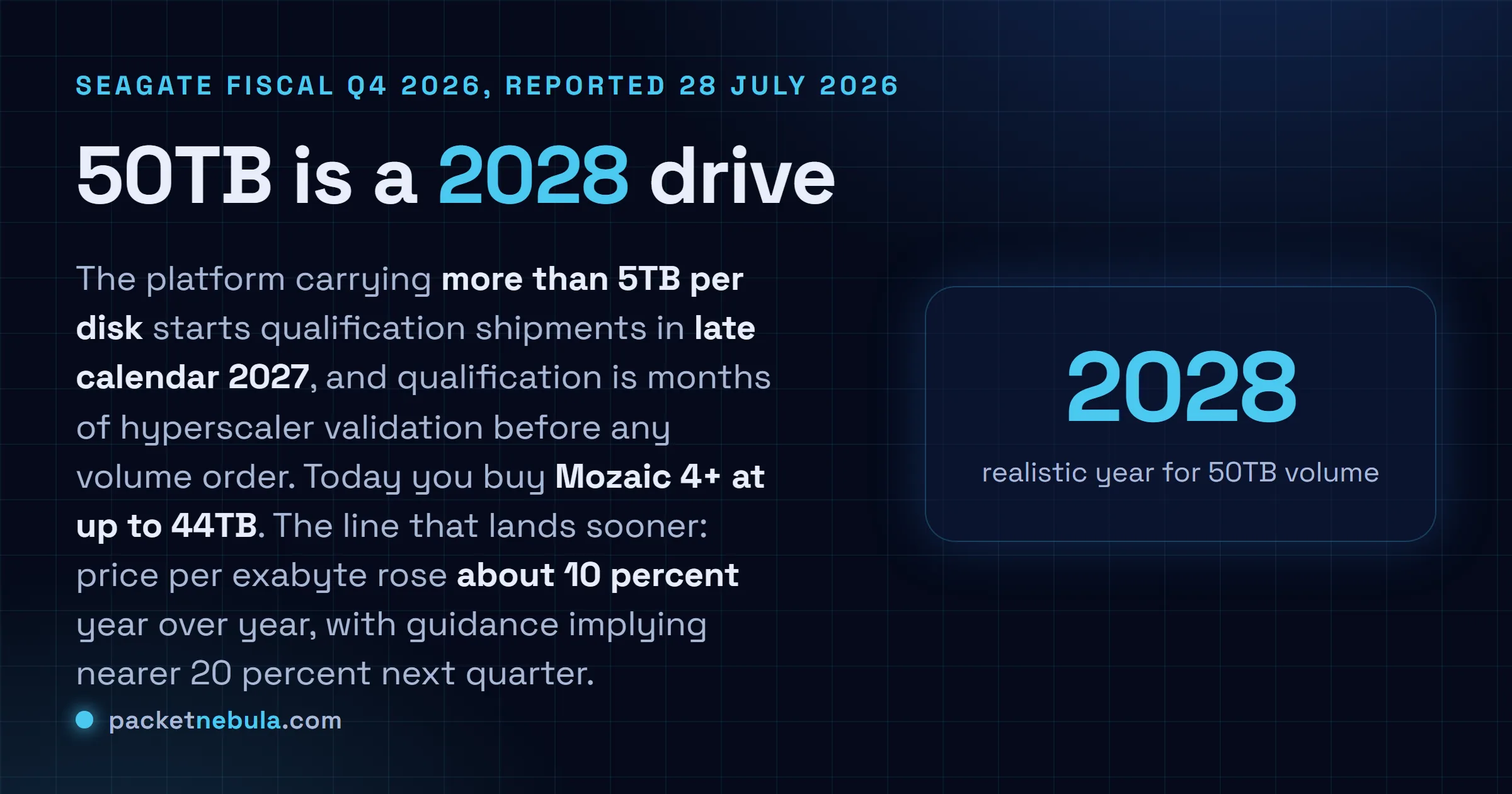
Answer card summarising Seagate fiscal Q4 2026: 50TB-class drives qualify in late 2027 and ship in 2028, nearline exabytes are allocated into calendar 2028, and price per exabyte rose about 10 percent year over year.
494
SHARES
1.4k
VIEWS
Share on FacebookShare on Twitter

Every headline this week put 50TB in the title, which is fair, because a ten platter drive holding fifty terabytes is a genuinely absurd object. Read the actual timing though and the drive lands in 2028, not next year: Seagate told investors on 28 July that the platform doing 5TB or more per disk starts qualification shipments in late calendar 2027, and qualification is the step before customers get real volume. So that's the correction. The part we'd actually plan around is buried in the same call, where the CFO said the gap between supply and demand is now a little bigger than a few quarters ago, and price per exabyte climbed about 10 percent.

The short answer

Seagate reported fiscal Q4 2026 on 28 July: $3.6 billion of revenue, 52.3 percent GAAP gross margin, and a roadmap where drives carrying more than 5TB per disk start qualification in late calendar 2027. That puts 50TB-class drives in 2028. Meanwhile the vast majority of nearline exabytes are already allocated into calendar 2028 and price per exabyte is rising. If you buy storage, the pricing line matters more this year than the capacity headline.
2028when 50TB drives actually ship
~10%price per exabyte, year over year
195 EBshipped to data centre customers in the quarter
Answer card: Seagate 50TB-class drives begin qualification in late calendar 2027 and ship in 2028, nearline exabytes are already allocated into calendar 2028, and price per exabyte rose about 10 percent year over year.
The timing correction, and the number in the same earnings call that lands on your budget first.

Qualification is not shipping

Here is where the 50TB figure comes from. Seagate’s current platform, Mozaic 4+, tops out at 44TB and is in production with two of the largest cloud providers. The next generation moves past 5TB per disk. Stack ten of those platters in one enclosure and you land in 50TB territory, which is the arithmetic CFO Gianluca Romano walked analysts through.

Late calendar 2027 is when those drives go out for qualification.

That word does a lot of work. A hyperscaler takes a new drive, runs it for months against its own failure and firmware expectations, and only then signs a volume order. Nobody buys a nearline drive on a press release. So the honest reading is that 50TB is a 2028 product, and the 2027 date on the roadmap is the start of testing rather than the start of buying. TechSpot and Tom’s Hardware both landed on 2028 for shipments, and we think that’s right.

HAMR itself has stopped being the interesting question, by the way. It hit 40 percent of Seagate’s nearline exabyte shipments this quarter, and the company expects it to reach roughly 70 percent within a year. The heat-assisted recording that took a decade of skepticism is now simply how most of these drives get made.

The number nobody put in a headline

Price per exabyte rose about 10 percent year over year in the quarter. Seagate’s guidance for the September quarter implies closer to 20 percent.

Romano’s phrasing on the call was mild: the gap between supply and demand is now a little bigger than a few quarters ago. Read the margins and it sounds less mild. GAAP gross margin came in at 52.3 percent, on a product category that spent years grinding along in the thirties. Seagate is guiding the September quarter to $4.1 billion of revenue and non-GAAP EPS of $7.30, against $5.71 delivered in the quarter just closed.

Storage vendors do not post those numbers when there’s plenty of supply.

And the allocation picture matches. The vast majority of nearline exabytes are already spoken for into calendar 2028, with customers pushing to reserve 2029. Those are the big cloud contracts, not the drive you’d add to a NAS at home. But it’s the same media, the same heads, the same factories. When a manufacturer can sell every exabyte it makes to hyperscalers at a rising price, the retail channel is not where the discount shows up.
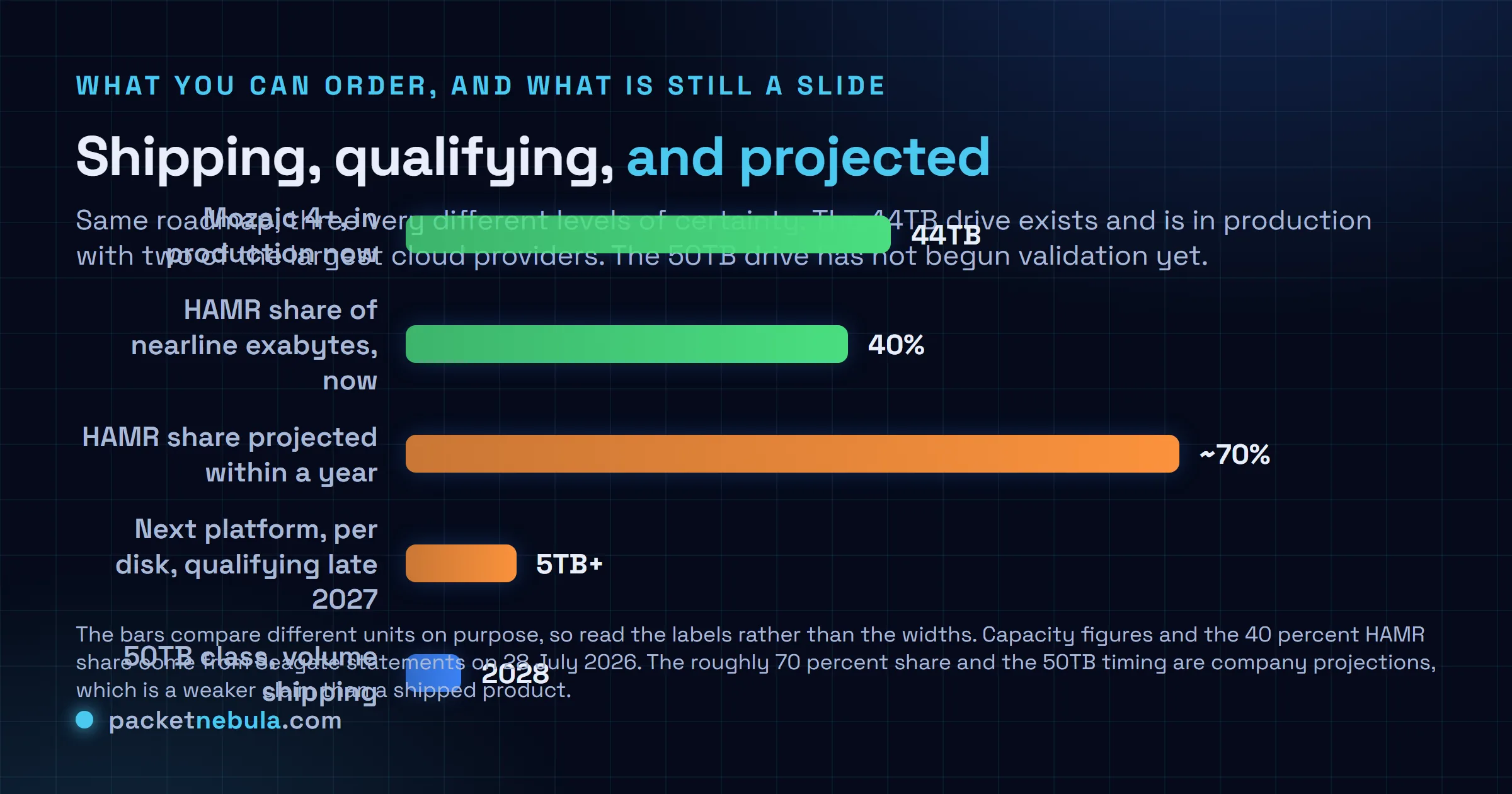
Comparison chart of Seagate capacity milestones: Mozaic 4+ shipping today at up to 44TB, HAMR at 40 percent of nearline exabytes now and around 70 percent expected within a year, more than 5TB per disk entering qualification in late 2027, and 50TB-class volume shipping in 2028.
What ships now, what is being tested, and what is still a roadmap slide.

What we’d do with this

If you’re planning capacity for next year, plan it around 44TB and current pricing, not around a 50TB drive you cannot order. Roadmaps slip. Seagate’s own 30TB generation arrived later than first indicated, and this one has an extra qualification cycle in front of it.

Budget for storage getting more expensive per terabyte. That reverses about fifteen years of assumption, and it’s worth saying out loud to whoever signs your purchase orders before they see the quote.

Then there’s the design problem nobody enjoys. Drives keep growing and the interface does not. Seagate has published no sustained throughput number for the 50TB class, so run it as arithmetic: at 250 MB/s a single pass over 50TB takes roughly 55 hours. A parity rebuild reads every surviving member of the group as well, usually while the array is still serving traffic, usually slower than a clean sequential pass. Two of those drives failing in the same window stops being a thought experiment.

Which is why the shops we talk to keep moving to erasure coding with wider stripes, or to mirrored copies across failure domains, rather than trusting a classic parity rebuild to finish before something else breaks. Honestly, I think the capacity race has outrun the redundancy habits most teams still have.

One small thing worth checking before you size anything: a 50TB drive is 50 decimal terabytes, so your filesystem will report roughly 45.5 TiB. That’s a 9 percent gap, and on a rack of these it’s real money. We wrote up why MB and MiB disagree if you want the full version.

The AI connection, stated plainly

CEO Dave Mosley framed the demand as hyperscalers using hard drives to handle the long tail of AI workloads. That tracks. Training runs live on flash, but the training corpus, the checkpoints, the generated output nobody wants to delete, all of it lands on spinning rust because the cost per terabyte still is not close.

So the AI build-out shows up here as a hard drive shortage, the same way it shows up as a 50MW data centre moratorium in New York and as a memory price spike in phones. Different symptom, one cause.

Full year revenue was $12.2 billion, up 34 percent, with $3.1 billion of free cash flow. For a company that was widely written off as a melting ice cube a few years ago, that’s a strange place to end up.
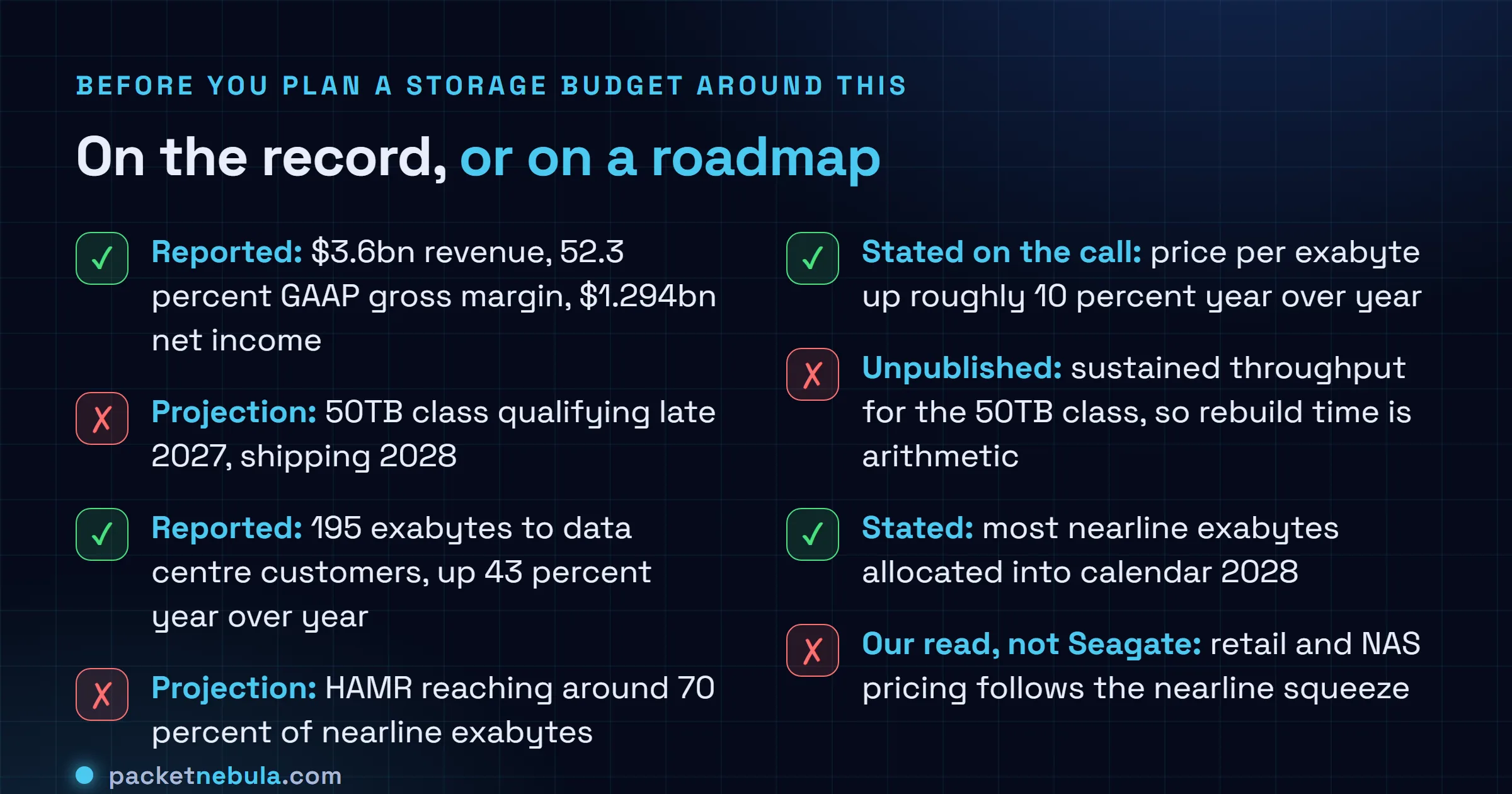
Checklist separating confirmed Seagate statements from roadmap projections: confirmed revenue and margin figures, confirmed allocation into 2028 and rising price per exabyte, versus projected 50TB timing, projected HAMR share and unpublished performance specifications.
Confirmed on the record, versus roadmap. Two different levels of certainty.

Sources

Seagate’s own numbers come from the fiscal Q4 and fiscal year 2026 results published on 28 July 2026, on the Seagate investor relations site. The roadmap and pricing commentary comes from the earnings call the same day, summarised in this call breakdown. Capacity and timing reporting from TechSpot and Tom’s Hardware. The rebuild timing in this piece is our own arithmetic from an assumed sustained rate, not a Seagate specification.

Frequently asked questions

When will Seagate 50TB hard drives actually be available?

Not in 2027. On the 28 July 2026 earnings call Seagate said the next Mozaic platform, the one carrying more than 5TB per disk, begins qualification shipments in late calendar 2027. Qualification means a hyperscaler runs the drive through months of validation before buying at volume, so broad availability lands in 2028. Coverage from Tom's Hardware and TechSpot reads the timing the same way.

What capacity can I buy from Seagate right now?

The current top of the range is the Mozaic 4+ platform at up to 44TB, which Seagate says is qualified and in production with two of the largest cloud providers. HAMR drives accounted for 40 percent of the company's nearline exabyte shipments in the quarter, so this is no longer a pilot technology, it is most of the roadmap.

Are hard drives really sold out through 2028?

For the data centre side, close to it. Seagate told investors the vast majority of its nearline exabytes are already allocated into calendar 2028, and that customers are asking to plan into 2029. That is allocation of the big cloud contracts rather than a note about retail shelves, but the same wafers, media and heads feed both.

Why are hard drive prices going up?

Supply is not keeping up with AI-driven storage demand. Seagate reported price per exabyte up roughly 10 percent year over year in its fiscal Q4, and its guidance implies something nearer 20 percent for the September quarter. CFO Gianluca Romano said the gap between supply and demand is now a little bigger than a few quarters ago. Gross margin of 52.3 percent on GAAP tells the same story from the other end.

How long does a 50TB drive take to rebuild in an array?

Long enough to change how you design storage. Seagate has not published sustained transfer figures for the 50TB class, so treat this as arithmetic rather than a spec: at a sustained 250 MB/s, one full pass over 50TB runs about 55 hours. Parity rebuilds read every other member of the group too, and they usually run slower than that while serving live traffic.

What did Seagate report for fiscal Q4 2026?

Revenue of $3.6 billion for the quarter ended 3 July 2026, GAAP gross margin of 52.3 percent and non-GAAP of 52.7 percent, GAAP diluted EPS of $5.58 and non-GAAP of $5.71, with net income of $1.294 billion. Full year revenue reached $12.2 billion, up 34 percent, on record free cash flow of $3.1 billion. Guidance for the September quarter is $4.1 billion in revenue, plus or minus $100 million.

Tags: datacenterhardwarehddnewsseagatestorage
Share198Tweet124
stephane

stephane

  • Trending
  • Comments
  • Latest
Answer card: Proton Lumo 2.0 is private by policy, not by locality. Saved history is locked so even Proton cannot read it, but the prompt is decrypted on a Proton EU server to answer it, then forgotten.

Proton Lumo 2.0 review: how private is it, really?

3 September 2026
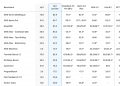
The Agentic Coding section of the official Hy4 preview benchmark appendix published by Tencent, a table comparing Hy3 and Hy4 preview against DeepSeek V4 Pro 0813, Qwen 3.8 Max, GLM 5.3, Kimi K3, GPT 5.6 Sol and Claude Opus 5 across SWE-bench Multilingual, SWE-bench Pro, DeepSWE, three SWE Atlas tasks, SWE-Marathon, Terminal-Bench 2.1, NL2Repo-Bench, CyberGym, ProgramBench, PostTrainBench and Harbor-Index.

Tencent’s 770B Hy4 tops one benchmark row in 46

3 September 2026
Answer card: Qwen 3.7 Max is API-only and cannot run locally yet; the open Qwen models (Qwen 3.6 27B, qwen3:8b to 32b) run offline via Ollama.

Qwen 3.7 local: what you can actually run offline

22 June 2026
Answer card: JWTs are not encrypted, anyone can read them; the signature proves who issued the token, not who may read it.

Are JWTs encrypted? No, and the difference will bite you

0
Answer card: a random 8 character password falls in under 2 hours offline, while 16 random characters hold for 1.4 trillion years at the same speed.

How long does it take to crack a password in 2026?

0
Answer card: three DNS records decide if your mail lands or bounces; SPF lists allowed senders, DKIM signs messages, DMARC sets the failure policy.

SPF, DKIM and DMARC explained: the records your email needs

0
Answer card stating that Qwen3.8-Omni-Flash launched on 17 September 2026 as an API only model on Alibaba Cloud Model Studio, taking text, images, audio and video in a 1M token context and returning text only, priced at 0.15 dollars per million input tokens for every modality and 0.47 dollars per million output tokens in the international regions, with no open weights published and the Qwen-Live Harness GitHub repository returning 404.

Qwen3.8-Omni-Flash bills audio at $0.15 and ships no weights

18 September 2026
Answer card stating that on 15 September 2026 AWS said it is unable to restore access to resources and data hosted exclusively in the Middle East Bahrain region me-south-1 and in the mec1-az2 zone of the UAE region, because the damage spanned multiple Availability Zones and exceeded what multi-AZ services are designed to withstand.

AWS can’t restore me-south-1, six months after the drone strikes

17 September 2026
Answer card stating that Google released Gemini 3.8 Live and Gemini 3.8 Live Extended Thinking on 15 September 2026 at 3 dollars per million audio input tokens and 12 dollars out, that the thinking model requires asynchronous tools, and that Artificial Analysis scores it 82.6 on its Speech to Speech Quality Index.

Gemini 3.8 Live Extended Thinking rejects any tool that blocks

16 September 2026
  • About
  • Contact
  • Privacy
  • Legal

Copyright © 2026 Stephane Cardon.

Welcome Back!

Login to your account below

Forgotten Password?

Retrieve your password

Please enter your username or email address to reset your password.

Log In
No Result
View All Result
  • Home
  • Articles
    • Security
    • Network
    • Dev
    • Sysadmin
    • SEO
    • Email & DNS
  • Tools
    • Network tools: free, fast, no signup
    • Security tools: free, fast, no signup
    • Developer tools: free, fast, no signup
    • Sysadmin tools: free, fast, no signup
    • SEO tools: free, fast, no signup
    • Email & DNS tools: free, fast, no signup
  • Download
  • About

Copyright © 2026 Stephane Cardon.