
• Latest
  • Trending
  • All
Answer card summarising the reported Amazon overrun: a Claude Sonnet author matching tool ran 860 percent over budget to $1.8 million across five months without detection, never shipped, and two further projects added roughly $675,000.

Amazon’s $1.8M Claude bill: 860% over, 5 months unseen

31 July 2026
Answer card stating that on 15 September 2026 AWS said it is unable to restore access to resources and data hosted exclusively in the Middle East Bahrain region me-south-1 and in the mec1-az2 zone of the UAE region, because the damage spanned multiple Availability Zones and exceeded what multi-AZ services are designed to withstand.

AWS can’t restore me-south-1, six months after the drone strikes

17 September 2026
Answer card stating that Google released Gemini 3.8 Live and Gemini 3.8 Live Extended Thinking on 15 September 2026 at 3 dollars per million audio input tokens and 12 dollars out, that the thinking model requires asynchronous tools, and that Artificial Analysis scores it 82.6 on its Speech to Speech Quality Index.

Gemini 3.8 Live Extended Thinking rejects any tool that blocks

16 September 2026
Answer card summarising the Atria Dawn Preview release: 744B GLM-5.2 base, MIT licence, 1.5 TB BF16 and 756 GB FP8 checkpoints, 256K context, top on five of sixteen benchmark rows and trailing on SWE-bench Pro.

Atria Dawn Preview is 744B under MIT, and the BF16 weighs 1.5 TB

15 September 2026
Answer card stating that OpenAI released the Agents API in public beta on 10 September 2026 with no separate fee, billed through model tokens, tool calls and hosted sandbox time, with a choice of OpenAI hosted, self hosted or partner sandboxes, US only data residency and no Zero Data Retention support.

OpenAI’s Agents API has no fee, no ZDR and a one hour sandbox clock

14 September 2026
Answer card: Sakana Fugu Max at $2 and $6 per million tokens, Fugu Ultra v2 unchanged at $5 and $30, and Sakana saying Ultra v2 scores without Fable 5 or GPT-6 Astra in its pool.

Fugu Max costs $2 and $6 while Fugu Ultra v2 runs without Fable 5

13 September 2026
Answer card stating that DeepSeek released DeepSeek-V4.1-Flash on 10 September 2026 as a 552 billion parameter mixture of experts model with a new causal encoder decoder architecture that activates 8 billion parameters on input and 16 billion on output, with native vision, a one million token context and MIT licensed weights, that the API model name is now deepseek-flash at 0.15 dollars per million input tokens and 0.60 dollars per million output tokens off peak, and that DeepSeek announced V4 Pro would be routed to V4.1-Flash from 14 September and reversed that on 11 September.

DeepSeek V4.1-Flash arrived, and the V4 Pro retirement lasted a day

12 September 2026
Answer card stating that Cognition released SWE-2 on 10 September 2026, a coding model post-trained from Kimi K3, scoring 50.0 percent on FrontierCode 1.1 Main against 50.9 percent for Claude Fable 5.1 and 27.3 percent on Terminal-Bench 4 against 55.8 percent, available only inside Devin.

SWE-2 trails Fable 5.1 by one point, and by 28 on Terminal-Bench 4

11 September 2026
Answer card for Meta Muse, free to 100 million tokens a week then $20 a month, launched 8 September 2026 for United States adults only, running in a dedicated per user virtual machine.

Does Meta Muse do enough to earn your inbox and a card on file?

9 September 2026
Answer card stating that the public download pages for the VMware Virtual Disk Development Kit on developer.broadcom.com began returning 404 errors on 25 August 2026 with no announcement or deprecation notice, that Broadcom support tells customers the kit is no longer available for use or download, and that release lines 7.0.3.1, 8.x and 9.x are all affected.

Broadcom pulled VDDK 8.0 and 9.0, and the 404 is the only notice

8 September 2026
Answer card stating that OpenAI published its research acceleration measurements on 6 September 2026, that as of mid August 2026 its research organisation logged 3.1 agent workdays of coding agent runtime for every workday of human labour normalised to a standard eight hour day, and that OpenAI states this should not be read as a 3.1 times productivity gain because it measures runtime rather than delivered output.

OpenAI’s 3.1 agent-workdays per human day is not a 3.1x gain

7 September 2026
Answer card stating that Mullvad announced on 3 September 2026 that it is shutting down its public encrypted domain name system servers on 2 November 2026 and sponsoring the Quad9 Foundation instead, with 194.242.2.2 and its five sibling addresses all going away, and virtual private network customers unaffected.

Mullvad’s DNS servers go dark on 2 November, and Quad9 blocks no ads

5 September 2026
OpenAI announcement image for GPT-6 Astra, a spiral galaxy of white, blue and amber points of light curling around a bright core on a near black star field.

GPT-6 Astra lists at $10 and $50, 2.5x what GPT-5.6 Sol costs

6 September 2026
  • About
  • Contact
  • Privacy
  • Legal
Thursday, September 17, 2026
  • Login
Packet Nebula
  • Home
  • Articles
    • Security
    • Network
    • Dev
    • Sysadmin
    • SEO
    • Email & DNS
  • Tools
    • Network tools: free, fast, no signup
    • Security tools: free, fast, no signup
    • Developer tools: free, fast, no signup
    • Sysadmin tools: free, fast, no signup
    • SEO tools: free, fast, no signup
    • Email & DNS tools: free, fast, no signup
  • Download
  • About
No Result
View All Result
Packet Nebula
No Result
View All Result
Home Dev

Amazon’s $1.8M Claude bill: 860% over, 5 months unseen

by stephane
31 July 2026
in Dev
0
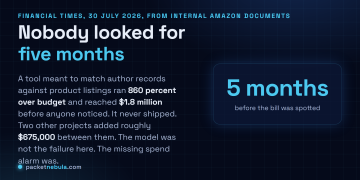
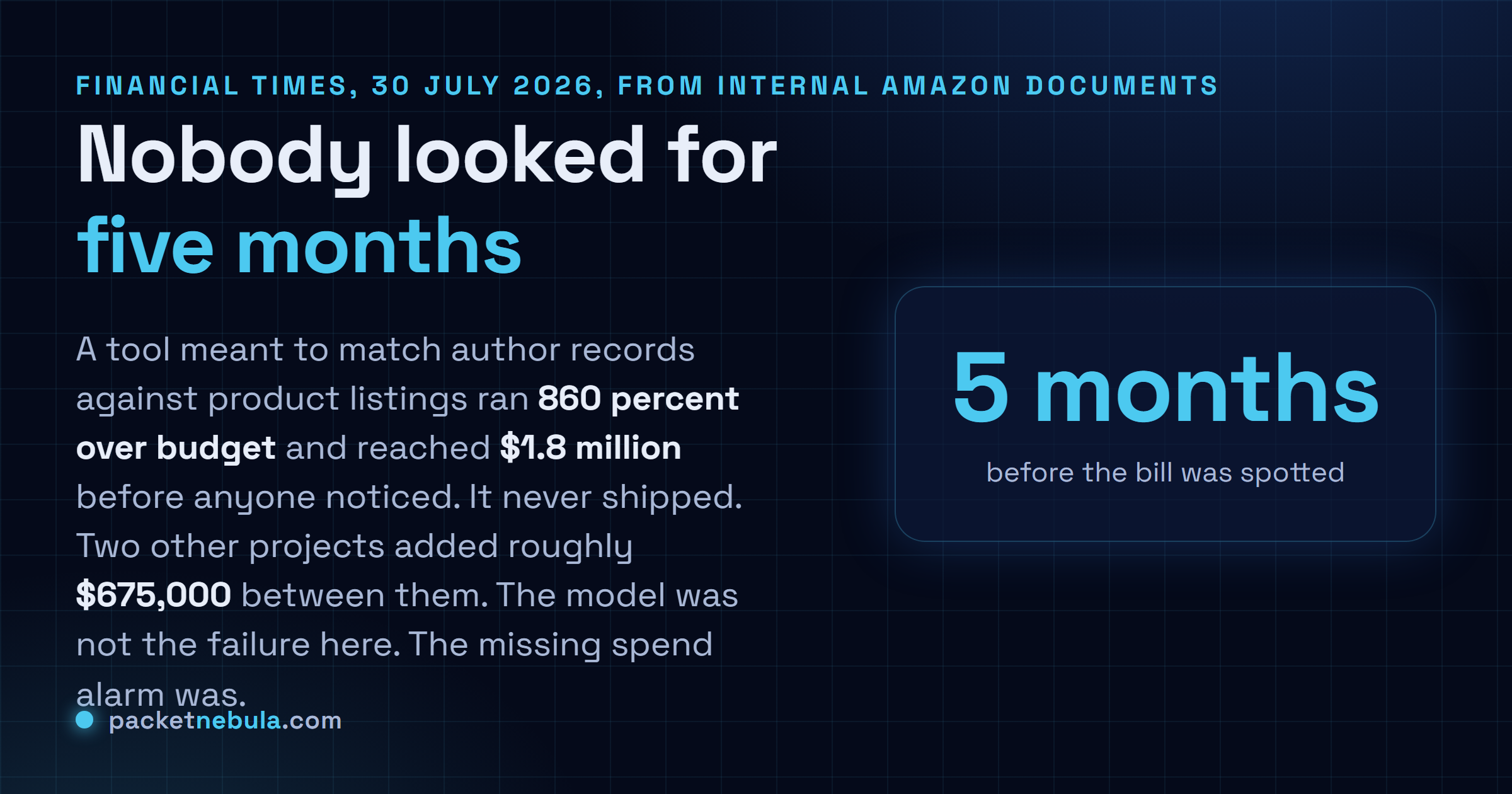
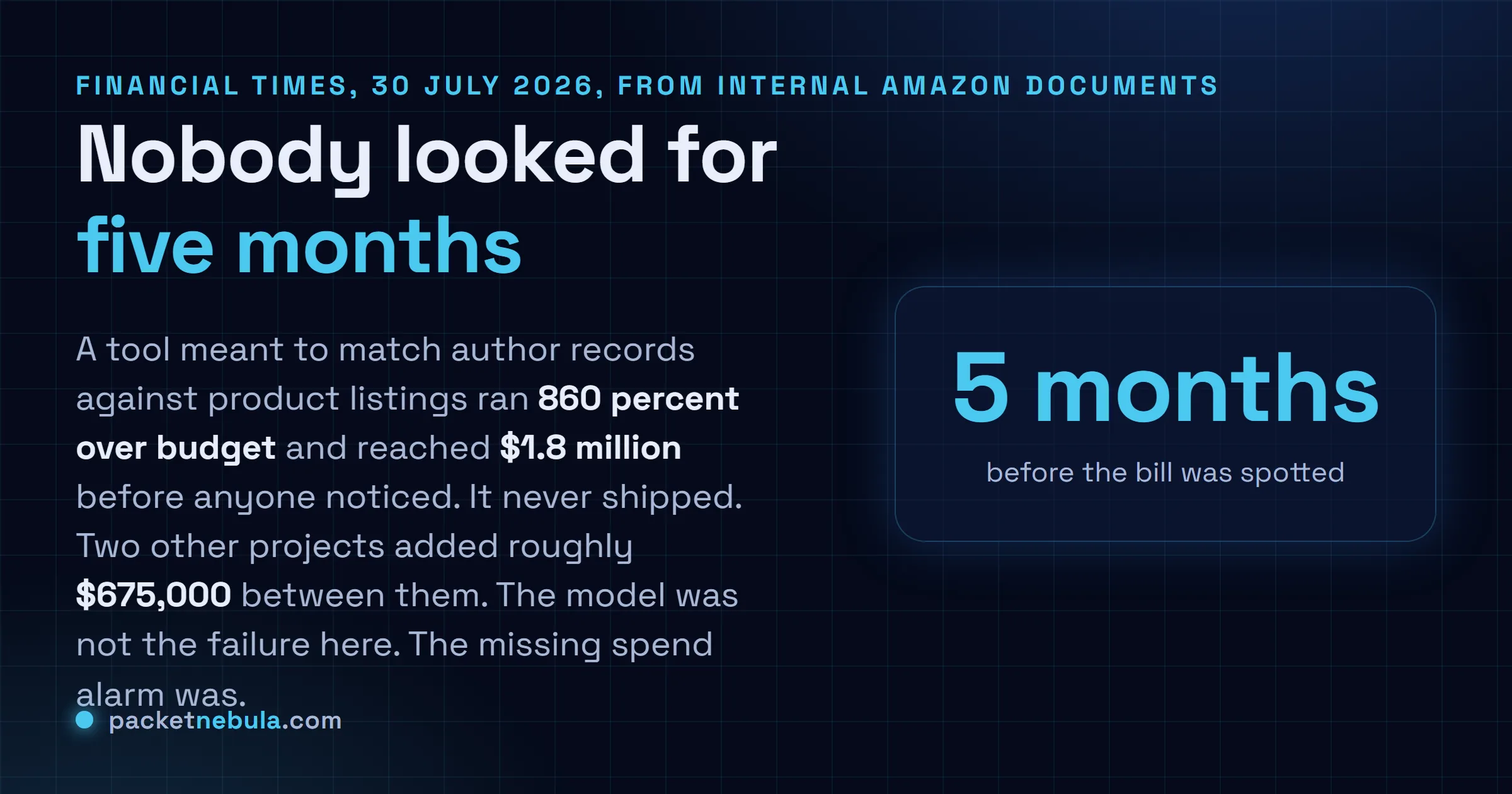
Answer card summarising the reported Amazon overrun: a Claude Sonnet author matching tool ran 860 percent over budget to $1.8 million across five months without detection, never shipped, and two further projects added roughly $675,000.
491
SHARES
1.4k
VIEWS
Share on FacebookShare on Twitter

Somewhere in Amazon's catalogue, a tool was quietly matching author records against product listings. It ran for five months. It never launched, and it burned about $1.8 million in Claude Sonnet tokens, which the Financial Times reported on 30 July from internal documents as an 860 percent overrun. Two smaller projects pushed the unplanned total to roughly $2.5 million. The number isn't really the story, though. Amazon is guiding to something near $200 billion of capital spending this year, so $1.8 million is a rounding error inside a rounding error. Five months is the story. A cloud bill that size used to come with an alarm bolted to it, and this one didn't.

The short answer

The Financial Times reported on 30 July 2026 that an Amazon tool using Claude Sonnet to match author records against product listings ran to $1.8 million before detection, and never launched. Two other projects added roughly $675,000. The failure worth studying isn’t the model choice. It’s that a metered bill ran for five months with nothing watching it.
$1.8Mspent, 860% over budget
5 monthsbefore anyone noticed
$0value shipped, the tool failed
Answer card: an Amazon tool matching author records to product listings ran 860 percent over budget to $1.8 million across five months without detection and never shipped, while two further projects added roughly $675,000, pointing to a missing spend alarm rather than a bad model choice.
The overrun is embarrassing. The detection gap is the actual finding.

What was actually reported

The Financial Times had the documents first, on 30 July. Everyone else has been working from that, us included, so it’s worth being precise about what came from the leak and what didn’t.

Confirmed in the reporting: a tool built to cross-reference author information with product listings on Amazon’s store, running on Anthropic’s Claude Sonnet, reaching roughly $1.8 million at 860 percent over its budget. Five months before anyone spotted it. The deployment failed. Senior engineers brought it to a staff meeting on Tuesday 28 July, where it landed alongside two smaller cases, about $541,000 on financial auditing tooling and about $134,000 on a system meant to speed up deliveries. That last one got caught inside a couple of weeks, which tells you the detection problem isn’t uniform.

Not in the reporting: which Sonnet version ran, whether the billing went through Bedrock or the first-party API, what discount Amazon has negotiated, and the input to output token split. Every token number below is a bracket for that reason.

Amazon’s statement is the one you’d write in its position. As with any new technology, we’re experimenting, learning and improving how we use it. The company also pointed out that this touched a small number of teams inside a corporate workforce around 300,000, which is fair and also slightly beside the point.

The number that should worry you

$1.8 million of Sonnet is a lot of tokens.

At the standard list price of $3 per million input tokens, that’s 600 billion input tokens. Flip it and assume every dollar went to output at $15 per million, and you still land at 120 billion. Reality sits somewhere between, and for a matching job it sits near the top: you send a product listing and an author record in, you get back a short verdict. Heavy in, light out.

By Anthropic’s own rule of thumb of roughly 0.75 words per token, 600 billion tokens is on the order of 450 billion words. For deciding whether a name on a book matches a name in a database.

Honestly, I keep getting stuck on that. Not because a model can’t do the job, it obviously can, but because somewhere in there is a loop that ran and reran without anyone reading the meter. Five months is two quarters. It’s long enough for a budget review to have happened and missed it.
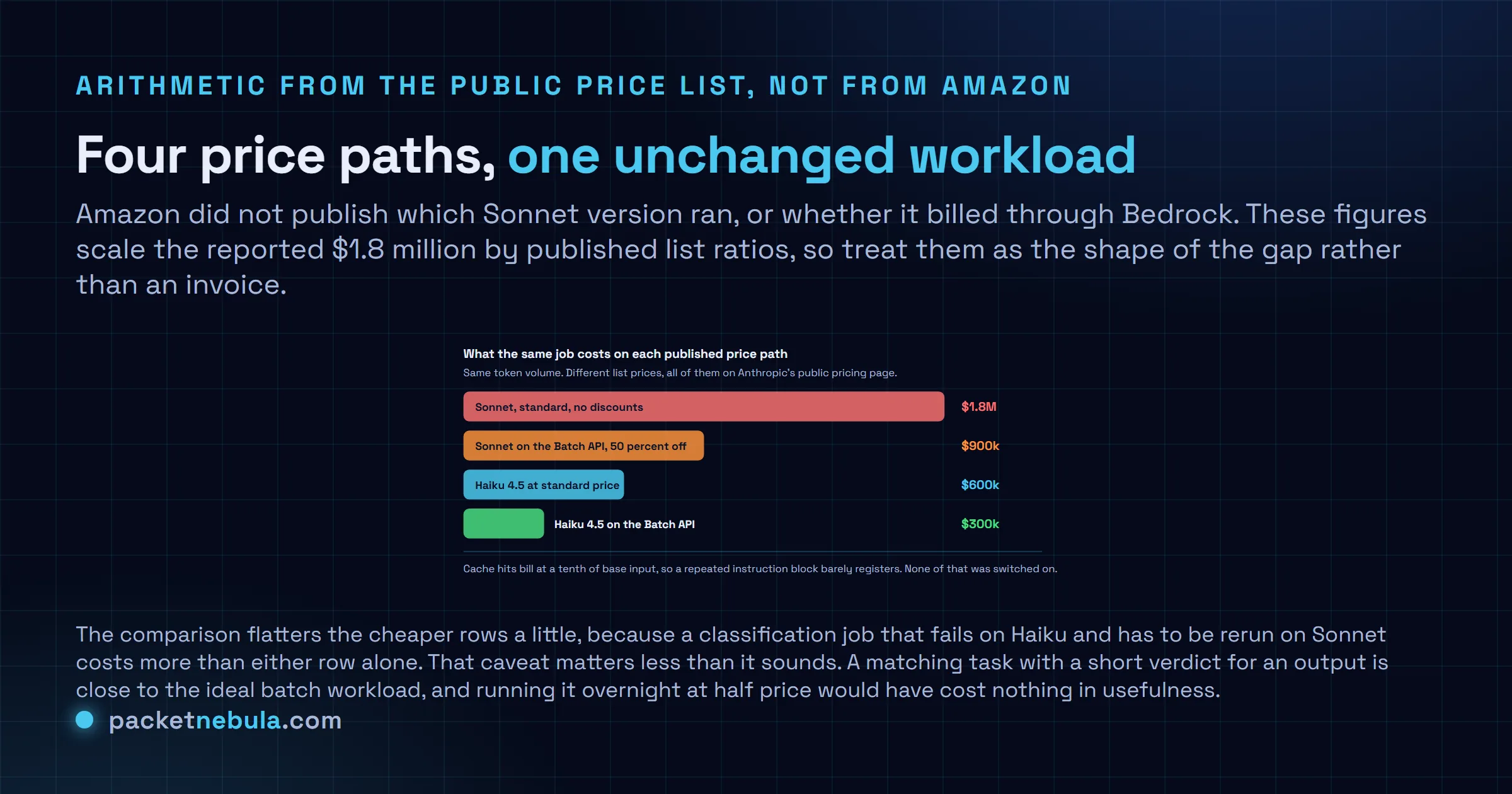
Diagram comparing four published price paths for the same workload: Sonnet at standard pricing costing $1.8 million, Sonnet on the Batch API at $900,000, Haiku 4.5 at standard pricing at $600,000, and Haiku 4.5 on the Batch API at $300,000, with a note that cache hits bill at a tenth of base input.
Every one of these levers was already shipping. None appear to have been pulled.

The levers were sitting right there

Here’s what stings. Anthropic publishes all of this on one page.

The Batch API takes 50 percent off input and output both, for work that doesn’t need an answer this second. An offline catalogue reconciliation is close to the platonic ideal of that workload. Nobody is waiting. Run it overnight, pay half.

Prompt caching bills a cache hit at a tenth of the base input rate. A job that sends the same instruction block and the same schema on every single call is paying full freight for identical bytes, over and over, unless someone sets a cache breakpoint.

And Haiku 4.5 costs $1 and $5 per million tokens against Sonnet’s standard $3 and $15. Exactly a third. For name matching, a smaller model with a tight prompt is often the right call anyway, and the ones it can’t resolve get escalated.

Stack Batch on Haiku and you’re at $0.50 per million input, one sixth of Sonnet’s standard rate. The same workload lands near $300,000 instead of $1.8 million.

That comparison is a little generous to the cheap rows, and I should say so. If Haiku fails on a chunk of records and you rerun those on Sonnet, you’ve paid twice. Fine. Even granting that, the gap between what this cost and what it should have cost is most of an order of magnitude.

What this means if you run an LLM in production

The model tier is the least interesting decision here.

Software has always had cost bugs. An infinite retry loop against a database costs you some CPU and a page. The same bug against a token-metered endpoint costs you money at a rate nothing in your stack is designed to notice, and one Amazon engineer put it exactly that way: bugs that used to be near free became catastrophically expensive once the AI was doing the work.

So the guardrail worth building isn’t a cheaper model. It’s a circuit breaker. A hard per-project spend ceiling that stops calls rather than emailing someone. A daily anomaly check on token volume, not on dollars, since dollars lag. Budget alarms that fire to the team that owns the job instead of to a finance mailbox nobody reads. Amazon says it’s building the automated version of this now, which is a sensible thing to build and an odd thing not to have had.

There’s a second lesson buried in the same story, and it’s about incentives. Amazon has scrapped an internal leaderboard that ranked employees by AI usage. Staff had been gaming it, which anyone could have predicted, and back in May the company had already dealt with people inflating token counts on its internal Kiro platform to climb the board. If you measure adoption by consumption, you will get consumption. You just won’t get adoption.

We wrote about the same shape of problem when an agent swarm ran up $1,339 rebuilding SQLite, and about the cost side of model selection in our breakdown of what each Claude effort level costs. Different scales, same missing meter.
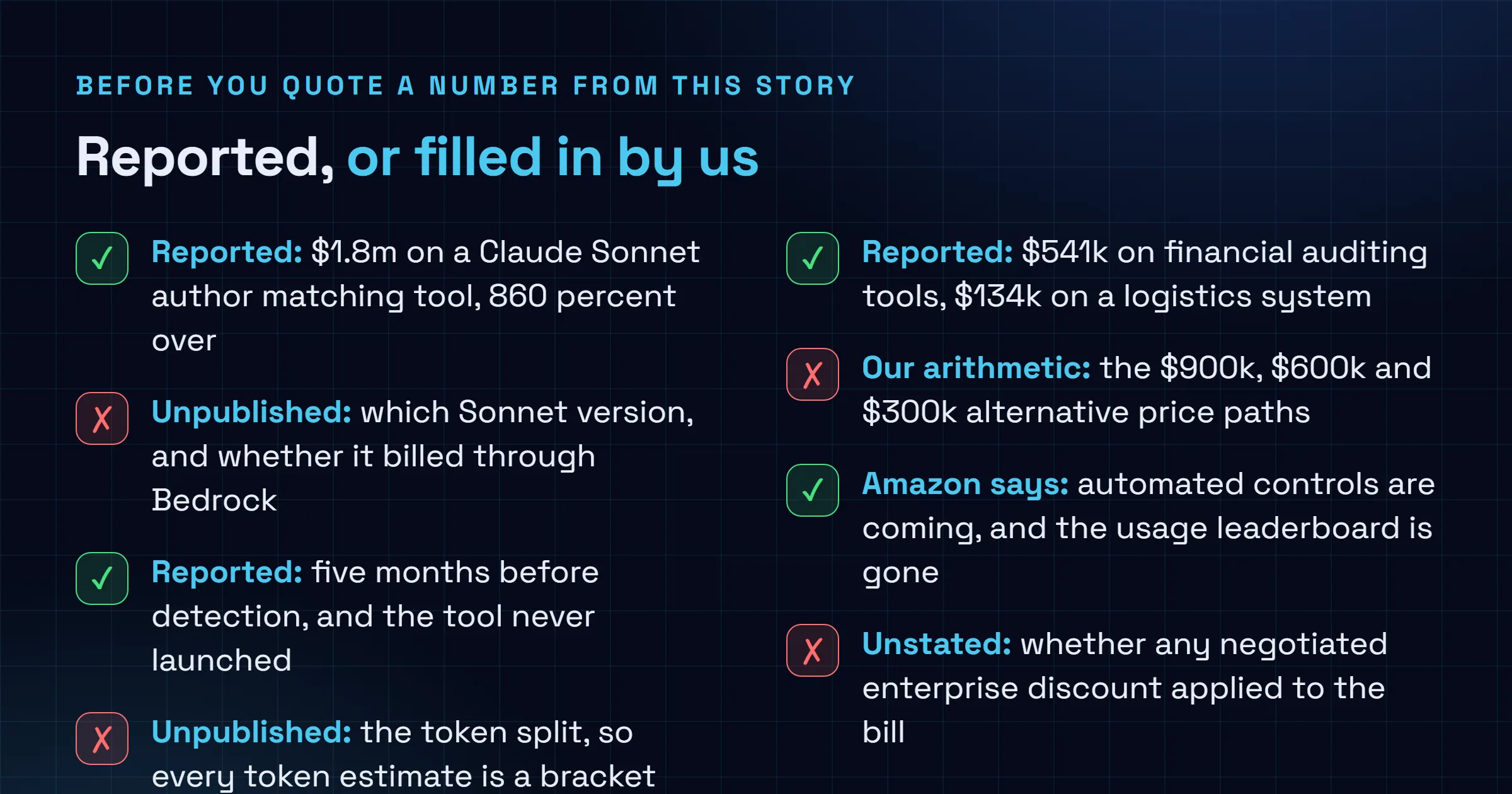
Checklist separating reported facts from inference: reported items include the $1.8 million figure, the 860 percent overrun, five months to detection and the two smaller overruns, while unpublished items include the Sonnet version, the billing platform, the token split and any negotiated discount.
Four of these came from the documents. Four of them are us filling gaps, and labelled as such.

The part nobody at Amazon said out loud

The executive quote doing the rounds is the honest one: it’s hard to figure out how much anything related to AI actually costs.

That’s true, and it’s not a complaint about pricing pages. Token consumption depends on prompt length, on retries, on how chatty a model is when it’s uncertain, on whether your context window is full of things the model didn’t need. None of that is knowable from a design doc. You find it out by running the thing.

Which is precisely why the ceiling has to exist before the first run, not after the first invoice. I might be wrong about how much of this is Amazon-specific, given the company is spending at a scale where $1.8 million genuinely can hide. At a normal company it would have shown up on the first monthly bill and someone would have shouted. That’s not a comfort, though. It just means most teams get caught faster, not that they’ve built anything better.

Sources

Original reporting by the Financial Times, 30 July 2026, from internal Amazon documents. Secondary coverage and quotes via Tom’s Hardware, The Next Web and Oninvest. All per-token prices, the Batch API discount and the cache hit multiplier come from Anthropic’s published pricing documentation. The alternative cost figures are our own arithmetic on those published rates.

Frequently asked questions

How much did Amazon spend on the failed Claude project?

About $1.8 million, on a tool that matched author information against product listings in Amazon's store. The Financial Times reported the figure on 30 July 2026 from internal documents, describing it as 860 percent over the project's budget. The deployment failed and the tool was never launched. Two other efforts overran as well, a financial auditing tool by roughly $541,000 and a delivery logistics system by about $134,000, taking the unplanned total to around $2.5 million.

How did the overspend go unnoticed for five months?

Amazon has not published the mechanism, and that is the interesting gap. What the reporting does say is that senior engineers raised it at a staff meeting on 28 July, and that one executive put the underlying problem plainly: it is hard to figure out how much anything related to AI actually costs. Token billing turns a piece of software into a metered utility, so a loop that used to waste CPU cycles now writes a line on an invoice, and nothing about a normal deployment pipeline watches that line.

What would the same job have cost with cost controls on?

Considerably less, using nothing more exotic than the published price list. The Batch API takes 50 percent off both input and output, so the same volume lands near $900,000. Haiku 4.5 at $1 and $5 per million tokens is a third of Sonnet's standard $3 and $15, so about $600,000. Run Haiku through Batch and it is roughly $300,000. Prompt cache hits bill at a tenth of base input on top of that. These are our ratios applied to the reported figure, not Amazon's accounting.

How many tokens is $1.8 million of Claude Sonnet?

Somewhere between 120 billion and 600 billion, and the split has not been published. At Sonnet's standard $3 per million input tokens, $1.8 million buys 600 billion input tokens. If every dollar had gone to output at $15 per million, it would still be 120 billion. A matching task sends far more in than it gets back, so the real figure sits toward the top of that bracket. By Anthropic's own rough conversion of about 0.75 words per token, 600 billion tokens is on the order of 450 billion words.

What is Amazon changing after this?

Two things have been reported. The company is building automated guardrails that cap project spending before it reaches an invoice, and it has scrapped an internal leaderboard that ranked staff by AI usage, which employees had been gaming. That leaderboard had already produced a problem of its own back in May, when people inflated token usage on the internal Kiro platform to climb it. Amazon's public line is that it is experimenting, learning and improving how it uses the technology.

Tags: aiamazonclaudecloudfinopsllmnews
Share196Tweet123
stephane

stephane

  • Trending
  • Comments
  • Latest
Answer card: Proton Lumo 2.0 is private by policy, not by locality. Saved history is locked so even Proton cannot read it, but the prompt is decrypted on a Proton EU server to answer it, then forgotten.

Proton Lumo 2.0 review: how private is it, really?

3 September 2026
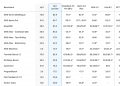
The Agentic Coding section of the official Hy4 preview benchmark appendix published by Tencent, a table comparing Hy3 and Hy4 preview against DeepSeek V4 Pro 0813, Qwen 3.8 Max, GLM 5.3, Kimi K3, GPT 5.6 Sol and Claude Opus 5 across SWE-bench Multilingual, SWE-bench Pro, DeepSWE, three SWE Atlas tasks, SWE-Marathon, Terminal-Bench 2.1, NL2Repo-Bench, CyberGym, ProgramBench, PostTrainBench and Harbor-Index.

Tencent’s 770B Hy4 tops one benchmark row in 46

3 September 2026
Answer card: Qwen 3.7 Max is API-only and cannot run locally yet; the open Qwen models (Qwen 3.6 27B, qwen3:8b to 32b) run offline via Ollama.

Qwen 3.7 local: what you can actually run offline

22 June 2026
Answer card: JWTs are not encrypted, anyone can read them; the signature proves who issued the token, not who may read it.

Are JWTs encrypted? No, and the difference will bite you

0
Answer card: a random 8 character password falls in under 2 hours offline, while 16 random characters hold for 1.4 trillion years at the same speed.

How long does it take to crack a password in 2026?

0
Answer card: three DNS records decide if your mail lands or bounces; SPF lists allowed senders, DKIM signs messages, DMARC sets the failure policy.

SPF, DKIM and DMARC explained: the records your email needs

0
Answer card stating that on 15 September 2026 AWS said it is unable to restore access to resources and data hosted exclusively in the Middle East Bahrain region me-south-1 and in the mec1-az2 zone of the UAE region, because the damage spanned multiple Availability Zones and exceeded what multi-AZ services are designed to withstand.

AWS can’t restore me-south-1, six months after the drone strikes

17 September 2026
Answer card stating that Google released Gemini 3.8 Live and Gemini 3.8 Live Extended Thinking on 15 September 2026 at 3 dollars per million audio input tokens and 12 dollars out, that the thinking model requires asynchronous tools, and that Artificial Analysis scores it 82.6 on its Speech to Speech Quality Index.

Gemini 3.8 Live Extended Thinking rejects any tool that blocks

16 September 2026
Answer card summarising the Atria Dawn Preview release: 744B GLM-5.2 base, MIT licence, 1.5 TB BF16 and 756 GB FP8 checkpoints, 256K context, top on five of sixteen benchmark rows and trailing on SWE-bench Pro.

Atria Dawn Preview is 744B under MIT, and the BF16 weighs 1.5 TB

15 September 2026
  • About
  • Contact
  • Privacy
  • Legal

Copyright © 2026 Stephane Cardon.

Welcome Back!

Login to your account below

Forgotten Password?

Retrieve your password

Please enter your username or email address to reset your password.

Log In
No Result
View All Result
  • Home
  • Articles
    • Security
    • Network
    • Dev
    • Sysadmin
    • SEO
    • Email & DNS
  • Tools
    • Network tools: free, fast, no signup
    • Security tools: free, fast, no signup
    • Developer tools: free, fast, no signup
    • Sysadmin tools: free, fast, no signup
    • SEO tools: free, fast, no signup
    • Email & DNS tools: free, fast, no signup
  • Download
  • About

Copyright © 2026 Stephane Cardon.