
• Latest
  • Trending
  • All
Answer card: Meta is building its own AI chip, Iris, the newest in its in-house MTIA line, made with Broadcom on TSMC, targeting ranking and app inference with production starting in September.

Meta’s Iris chip enters production in September

3 September 2026
Answer card stating that Ternary Bonsai 2 27B, released by PrismML on 17 September 2026 under Apache 2.0, packs Qwen3.8 27B into 5.95 gigabytes at 1.72 bits per weight, keeps 98.2 percent of the 14-benchmark average, about 75 percent on SWE-bench Verified and Terminal-Bench 2.1, and needs PrismML's llama.cpp fork to run.

Does Bonsai 2 27B really keep 98% of Qwen3.8 in 5.95 GB?

20 September 2026
Answer card stating that Jev 1.13 from TypeSafe AI is a decision model in early access since 15 September 2026 that returns typed probabilities instead of text, priced at 42 dollars per billion input tokens with output tokens free, answering in 70 to 500 milliseconds, with a 64K token request budget, text input only, and a documented list of things it does badly, including counting and dates.

Jev 1.13 bills $42 a billion tokens, and it can’t count

19 September 2026
Answer card stating that Qwen3.8-Omni-Flash launched on 17 September 2026 as an API only model on Alibaba Cloud Model Studio, taking text, images, audio and video in a 1M token context and returning text only, priced at 0.15 dollars per million input tokens for every modality and 0.47 dollars per million output tokens in the international regions, with no open weights published and the Qwen-Live Harness GitHub repository returning 404.

Qwen3.8-Omni-Flash bills audio at $0.15 and ships no weights

18 September 2026
Answer card stating that on 15 September 2026 AWS said it is unable to restore access to resources and data hosted exclusively in the Middle East Bahrain region me-south-1 and in the mec1-az2 zone of the UAE region, because the damage spanned multiple Availability Zones and exceeded what multi-AZ services are designed to withstand.

AWS can’t restore me-south-1, six months after the drone strikes

17 September 2026
Answer card stating that Google released Gemini 3.8 Live and Gemini 3.8 Live Extended Thinking on 15 September 2026 at 3 dollars per million audio input tokens and 12 dollars out, that the thinking model requires asynchronous tools, and that Artificial Analysis scores it 82.6 on its Speech to Speech Quality Index.

Gemini 3.8 Live Extended Thinking rejects any tool that blocks

16 September 2026
Answer card summarising the Atria Dawn Preview release: 744B GLM-5.2 base, MIT licence, 1.5 TB BF16 and 756 GB FP8 checkpoints, 256K context, top on five of sixteen benchmark rows and trailing on SWE-bench Pro.

Atria Dawn Preview is 744B under MIT, and the BF16 weighs 1.5 TB

15 September 2026
Answer card stating that OpenAI released the Agents API in public beta on 10 September 2026 with no separate fee, billed through model tokens, tool calls and hosted sandbox time, with a choice of OpenAI hosted, self hosted or partner sandboxes, US only data residency and no Zero Data Retention support.

OpenAI’s Agents API has no fee, no ZDR and a one hour sandbox clock

14 September 2026
Answer card: Sakana Fugu Max at $2 and $6 per million tokens, Fugu Ultra v2 unchanged at $5 and $30, and Sakana saying Ultra v2 scores without Fable 5 or GPT-6 Astra in its pool.

Fugu Max costs $2 and $6 while Fugu Ultra v2 runs without Fable 5

13 September 2026
Answer card stating that DeepSeek released DeepSeek-V4.1-Flash on 10 September 2026 as a 552 billion parameter mixture of experts model with a new causal encoder decoder architecture that activates 8 billion parameters on input and 16 billion on output, with native vision, a one million token context and MIT licensed weights, that the API model name is now deepseek-flash at 0.15 dollars per million input tokens and 0.60 dollars per million output tokens off peak, and that DeepSeek announced V4 Pro would be routed to V4.1-Flash from 14 September and reversed that on 11 September.

DeepSeek V4.1-Flash arrived, and the V4 Pro retirement lasted a day

12 September 2026
Answer card stating that Cognition released SWE-2 on 10 September 2026, a coding model post-trained from Kimi K3, scoring 50.0 percent on FrontierCode 1.1 Main against 50.9 percent for Claude Fable 5.1 and 27.3 percent on Terminal-Bench 4 against 55.8 percent, available only inside Devin.

SWE-2 trails Fable 5.1 by one point, and by 28 on Terminal-Bench 4

11 September 2026
Answer card for Meta Muse, free to 100 million tokens a week then $20 a month, launched 8 September 2026 for United States adults only, running in a dedicated per user virtual machine.

Does Meta Muse do enough to earn your inbox and a card on file?

9 September 2026
Answer card stating that the public download pages for the VMware Virtual Disk Development Kit on developer.broadcom.com began returning 404 errors on 25 August 2026 with no announcement or deprecation notice, that Broadcom support tells customers the kit is no longer available for use or download, and that release lines 7.0.3.1, 8.x and 9.x are all affected.

Broadcom pulled VDDK 8.0 and 9.0, and the 404 is the only notice

8 September 2026
  • About
  • Contact
  • Privacy
  • Legal
Monday, September 21, 2026
  • Login
Packet Nebula
  • Home
  • Articles
    • Security
    • Network
    • Dev
    • Sysadmin
    • SEO
    • Email & DNS
  • Tools
    • Network tools: free, fast, no signup
    • Security tools: free, fast, no signup
    • Developer tools: free, fast, no signup
    • Sysadmin tools: free, fast, no signup
    • SEO tools: free, fast, no signup
    • Email & DNS tools: free, fast, no signup
  • Download
  • About
No Result
View All Result
Packet Nebula
No Result
View All Result
Home Dev

Meta’s Iris chip enters production in September

by stephane
3 September 2026
in Dev
0
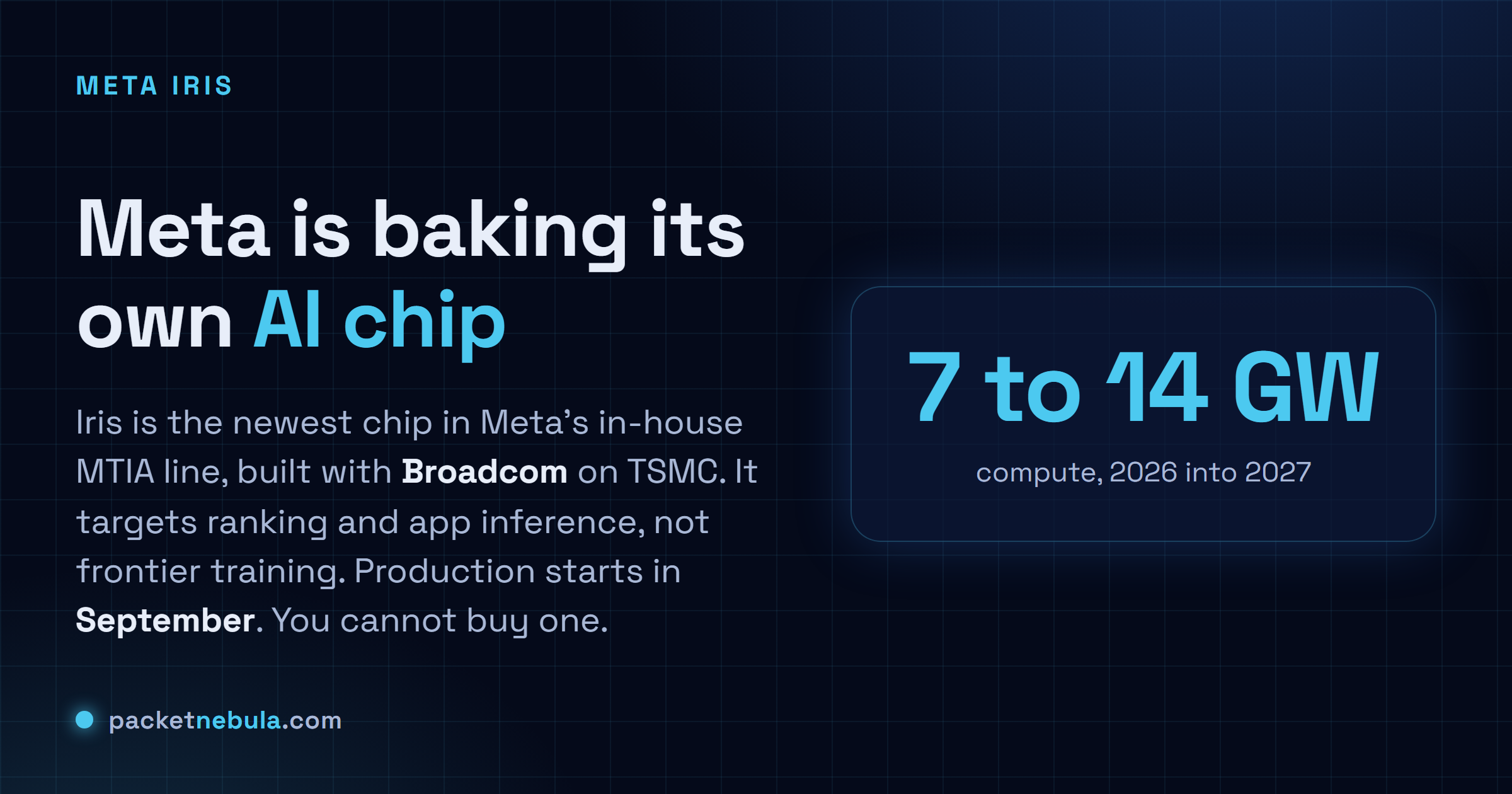
Answer card: Meta is building its own AI chip, Iris, the newest in its in-house MTIA line, made with Broadcom on TSMC, targeting ranking and app inference with production starting in September.
496
SHARES
1.4k
VIEWS
Share on FacebookShare on Twitter

A leaked internal memo, not a keynote, is how we found out Meta has a new chip. On July 9 Reuters reported it: Iris, the latest in Meta's in-house MTIA line, goes into volume production in September, built with Broadcom and fabbed at TSMC. Here's the one-line version we'd give a colleague. It's silicon for the boring, constant work, the ranking and recommendation that runs your Facebook and Instagram feed, not the frontier training that still leans on rented Nvidia and AMD. One chip reportedly cleared validation in about six weeks. It isn't for sale, there's no public benchmark, and nothing lands before the autumn. So the question isn't whether Meta can make a chip. It's whether any of this reaches you.

The short answer

A leaked memo says Meta will put Iris, the newest chip in its in-house MTIA line, into production in September. It targets ranking and app inference, not frontier training, and you cannot buy one. The near-term effect on your work is basically nothing. The slow-burn effect, if it pans out, is Meta leaning less on the Nvidia supply everyone else is fighting over.
Sept 2026production starts
Broadcomdesign partner, TSMC fab
7 to 14 GWcompute, 2026 into 2027
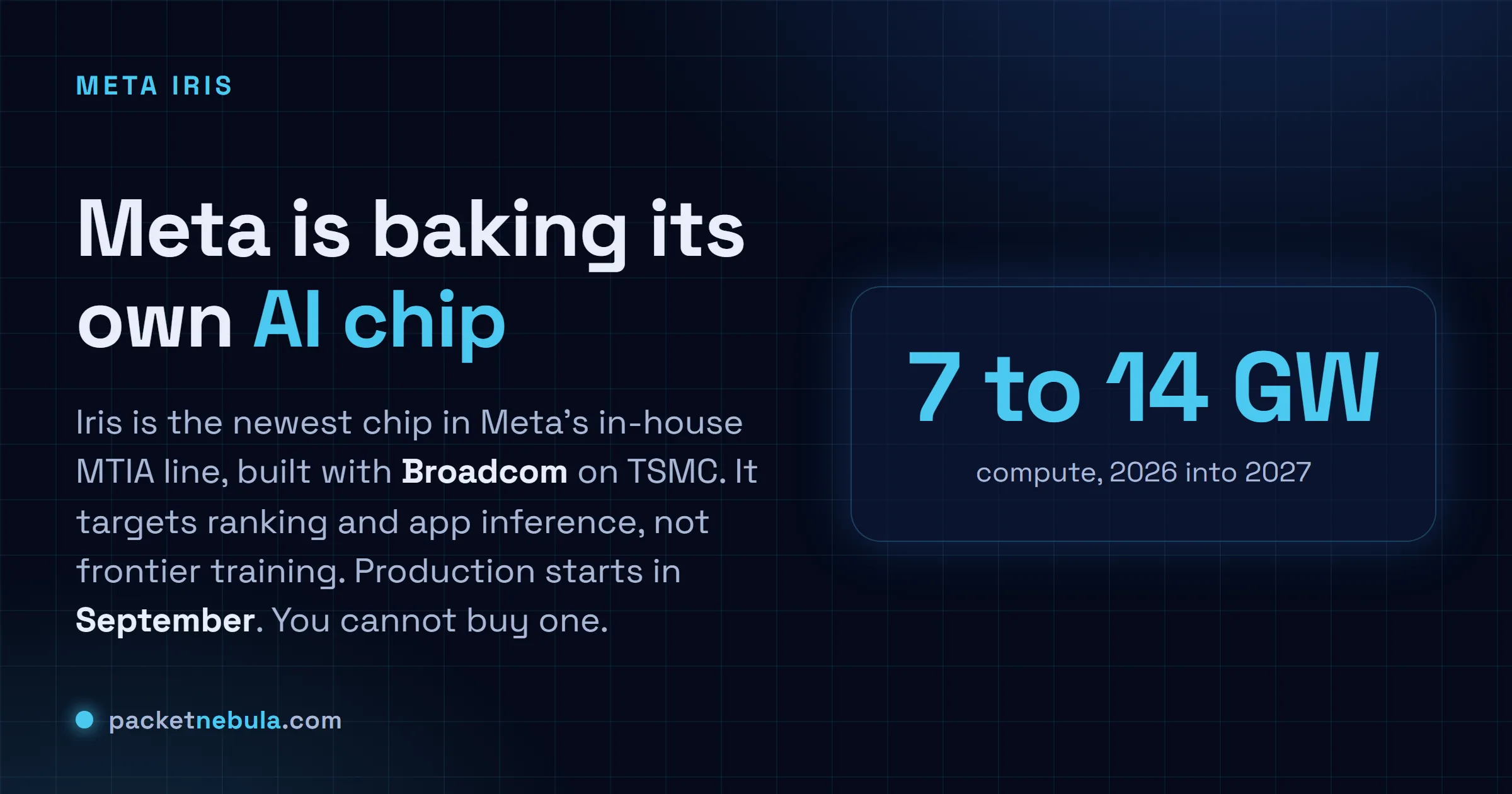
Answer card: Meta is building its own AI chip, Iris, the newest in its in-house MTIA line, built with Broadcom on TSMC, targeting ranking and app inference, with production starting in September and no chip you can buy.
The one-card version. A chip for Meta's own feeds, not one you can rack, and not proven yet.

What Meta actually confirmed (nothing, officially)

Start with how thin the confirmation is. There was no launch event. Reuters got an internal memo on July 9 and reported the plan, and everything below traces back to that. So we’re reading a company’s private roadmap, not a spec sheet. Worth holding onto as you read the numbers.

Here’s what the memo lays out. Iris is the next chip in Meta’s MTIA program, the in-house effort that stands for Meta Training and Inference Accelerator. Broadcom is the design partner, TSMC does the fabrication, and the memo names a supporting cast too: Samsung on memory, SanDisk on storage, Sumitomo on the fiber-optic gear that stitches the racks together. Production is set for September. One chip reportedly sailed through validation in roughly six weeks with no major anomaly, which is the kind of clean run that lets a schedule hold. Meta reportedly wants a fresh MTIA generation about every six months through 2027, each one a modular chiplet design building on the last.

The money behind it is the part that makes you sit up. Meta is trying to roughly double its AI compute, from about 7 gigawatts of capacity in 2026 to 14 in 2027, against projected capital spending somewhere in the $125 to $145 billion range this year. Iris is one lever on that bill.

Ranking and inference, not frontier training

Here’s the distinction that makes sense of the news, and it’s where Iris differs from the other custom-silicon story doing the rounds. Meta isn’t trying to train the next Llama on this thing. The memo points Iris at ranking and recommendation, the models that decide what shows up when you open the app, plus inference for Meta’s products. That’s the workload that never sleeps. Every scroll, every person, all day. At Meta’s scale it’s the meter that never stops spinning, and it’s exactly the kind of steady, predictable job custom silicon eats for lunch.
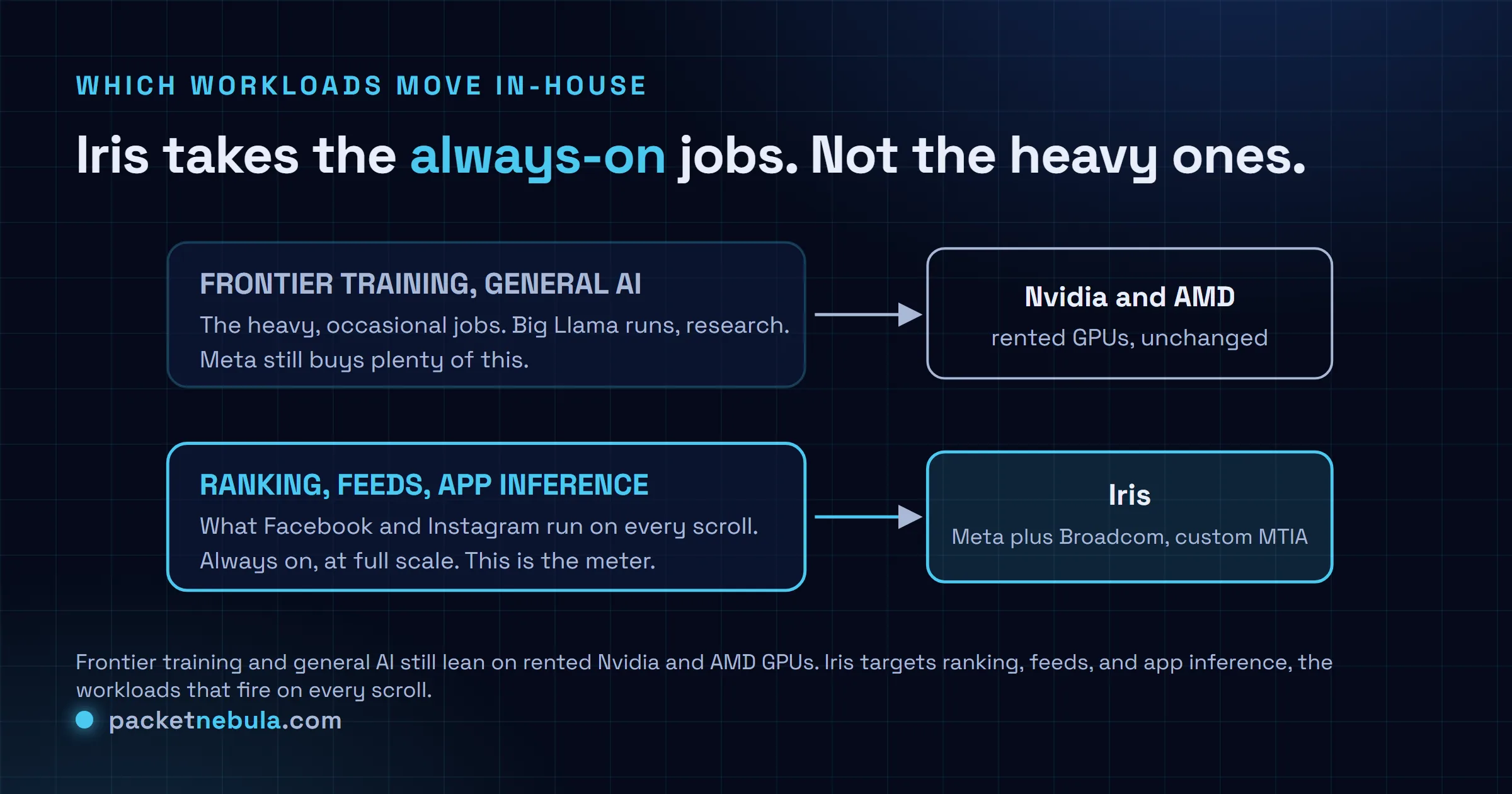
Diagram: frontier training and general AI still run on rented Nvidia and AMD GPUs, while ranking, feeds, and app inference move to Meta's custom Iris chip built with Broadcom.
Two kinds of work. The heavy, occasional jobs stay on rented GPUs. Iris takes the always-on ones.

The frontier stuff, the big training runs and general research, still leans on rented Nvidia and AMD hardware, and Meta was blunt that it expects to keep buying plenty of it. So Iris isn’t a Nvidia killer. It’s Meta carving off the one slice of its workload that’s constant enough to justify its own chip, and letting the GPUs handle the spiky, experimental rest. Every recommendation query Facebook and Instagram serve on Meta’s own metal is a query that doesn’t pay Nvidia’s margin. That, honestly, is the whole point.

If this pattern feels familiar, it should. OpenAI told almost the same story a couple of weeks back with its Jalapeño inference chip, also built with Broadcom, also aimed at the serving side rather than training. Two of the biggest AI spenders, same playbook, same silicon partner. That’s not a coincidence, it’s the shape of the whole market right now.

Does it change your day? Mostly no

Let’s be honest about the reach here. You can’t buy an Iris, you can’t rent one, and it doesn’t touch the quality of anything you use. The Meta apps stay the apps. If you build on Llama or Meta’s API, the models don’t change because the chip underneath them did. This isn’t hardware headed for your homelab, and nothing on the roadmap pretends otherwise.
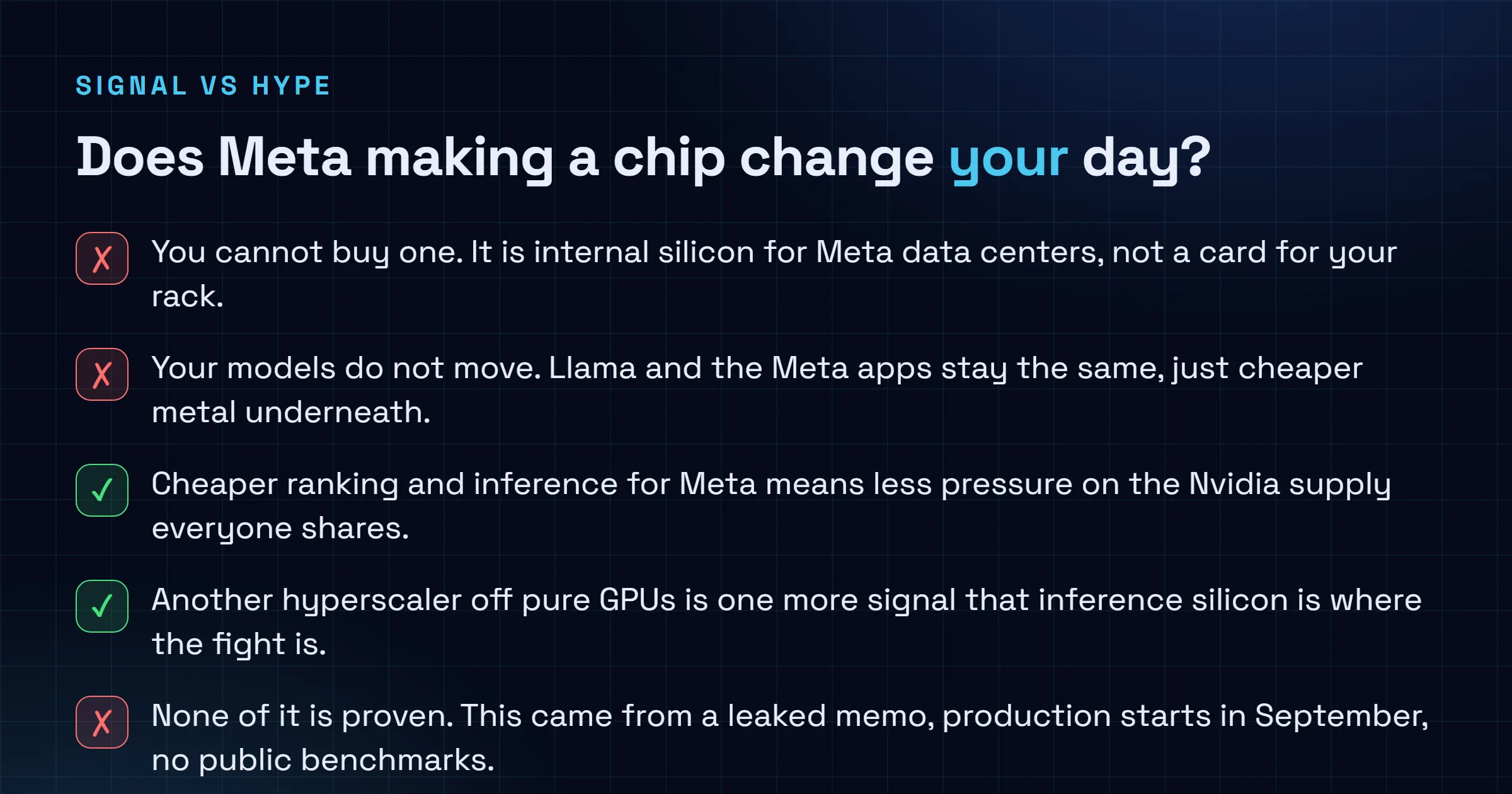
Checklist of what Meta's Iris chip does and does not change for you: you cannot buy it and Meta's models do not move, but cheaper in-house inference eases pressure on shared Nvidia supply and signals inference silicon is where the fight is, and none of it is proven yet.
The honest split between what this changes for you now and what stays hype until it ships.

Where it could matter, slowly, is upstream of you. Every workload a hyperscaler moves off rented GPUs is a bit less demand on the same Nvidia and AMD supply that your cloud bill and your GPU lead times ride on. It’s indirect, it’s diffuse, and you’ll never see a line item for it. But when Meta, OpenAI and the rest each peel their steady inference load onto custom chips, the GPU crunch everyone complains about gets a little less brutal at the margin. That’s a 2027 story at the earliest, and it depends on Iris actually shipping in volume. Still, the direction is real.

The honest read

Iris is a supply-chain move wearing a chip’s clothes. Meta wants to own more of its own stack, spend a little less renting Nvidia’s, and it’s doing what the big clouds have quietly done for years: build custom silicon for the one workload that’s constant enough to pay for itself. Real strategy. Just not a product, and not yours to touch. So don’t re-plan anything around it, don’t read the “six weeks” or the gigawatt targets as gospel from a leaked memo, and don’t expect an Iris instance to show up in any console. Watch whether September’s production date actually holds. That’s where this either becomes a thing or stays a memo.

Sources: Reuters’ exclusive on the Iris production plan, reported via CNBC, and reporting and context from TechCrunch, July 2026. The details here come from an internal Meta memo, not a public announcement, and the timing, capacity and spending figures are not independently verified.

Frequently asked questions

What is Meta's Iris chip?

Iris is the newest chip in Meta's in-house silicon line, known internally as MTIA (Meta Training and Inference Accelerator). Broadcom is the design partner and TSMC handles fabrication. It is built mainly for Meta's ranking and recommendation systems and app inference, the always-on workloads behind Facebook and Instagram, rather than the heavy frontier-model training that still runs on Nvidia and AMD GPUs.

Can I buy a Meta Iris chip?

No. Iris is internal silicon for Meta's own data centers, not a card you can put in a server or a cloud instance you can rent. There is no consumer or enterprise product, and Meta has not announced one.

When does Iris go into production?

According to the memo reported by Reuters, volume production starts in September 2026, after one chip cleared validation testing in about six weeks with no major design issue. That is a manufacturing milestone, not live traffic, so treat deployment timing as still in progress.

Does Iris replace Nvidia GPUs?

Not really. Meta frames Iris as a complement, not a replacement, and says it still expects to spend heavily with Nvidia and AMD. The goal is to move the constant ranking and inference load onto cheaper in-house silicon while frontier training stays on rented GPUs.

How is Iris different from OpenAI's Jalapeño chip?

Both are hyperscalers building custom silicon with Broadcom to lean on Nvidia less. OpenAI's Jalapeño is a pure inference accelerator for serving its models. Meta's Iris is aimed more squarely at ranking and recommendation plus app inference, the workloads that drive its feeds. Same strategy, different target workload.

Tags: aibroadcomhardwareinferencemetanews
Share198Tweet124
stephane

stephane

  • Trending
  • Comments
  • Latest
Answer card: Proton Lumo 2.0 is private by policy, not by locality. Saved history is locked so even Proton cannot read it, but the prompt is decrypted on a Proton EU server to answer it, then forgotten.

Proton Lumo 2.0 review: how private is it, really?

3 September 2026
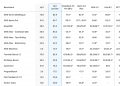
The Agentic Coding section of the official Hy4 preview benchmark appendix published by Tencent, a table comparing Hy3 and Hy4 preview against DeepSeek V4 Pro 0813, Qwen 3.8 Max, GLM 5.3, Kimi K3, GPT 5.6 Sol and Claude Opus 5 across SWE-bench Multilingual, SWE-bench Pro, DeepSWE, three SWE Atlas tasks, SWE-Marathon, Terminal-Bench 2.1, NL2Repo-Bench, CyberGym, ProgramBench, PostTrainBench and Harbor-Index.

Tencent’s 770B Hy4 tops one benchmark row in 46

3 September 2026
Answer card: Qwen 3.7 Max is API-only and cannot run locally yet; the open Qwen models (Qwen 3.6 27B, qwen3:8b to 32b) run offline via Ollama.

Qwen 3.7 local: what you can actually run offline

22 June 2026
Answer card: JWTs are not encrypted, anyone can read them; the signature proves who issued the token, not who may read it.

Are JWTs encrypted? No, and the difference will bite you

0
Answer card: a random 8 character password falls in under 2 hours offline, while 16 random characters hold for 1.4 trillion years at the same speed.

How long does it take to crack a password in 2026?

0
Answer card: three DNS records decide if your mail lands or bounces; SPF lists allowed senders, DKIM signs messages, DMARC sets the failure policy.

SPF, DKIM and DMARC explained: the records your email needs

0
Answer card stating that Ternary Bonsai 2 27B, released by PrismML on 17 September 2026 under Apache 2.0, packs Qwen3.8 27B into 5.95 gigabytes at 1.72 bits per weight, keeps 98.2 percent of the 14-benchmark average, about 75 percent on SWE-bench Verified and Terminal-Bench 2.1, and needs PrismML's llama.cpp fork to run.

Does Bonsai 2 27B really keep 98% of Qwen3.8 in 5.95 GB?

20 September 2026
Answer card stating that Jev 1.13 from TypeSafe AI is a decision model in early access since 15 September 2026 that returns typed probabilities instead of text, priced at 42 dollars per billion input tokens with output tokens free, answering in 70 to 500 milliseconds, with a 64K token request budget, text input only, and a documented list of things it does badly, including counting and dates.

Jev 1.13 bills $42 a billion tokens, and it can’t count

19 September 2026
Answer card stating that Qwen3.8-Omni-Flash launched on 17 September 2026 as an API only model on Alibaba Cloud Model Studio, taking text, images, audio and video in a 1M token context and returning text only, priced at 0.15 dollars per million input tokens for every modality and 0.47 dollars per million output tokens in the international regions, with no open weights published and the Qwen-Live Harness GitHub repository returning 404.

Qwen3.8-Omni-Flash bills audio at $0.15 and ships no weights

18 September 2026
  • About
  • Contact
  • Privacy
  • Legal

Copyright © 2026 Stephane Cardon.

Welcome Back!

Login to your account below

Forgotten Password?

Retrieve your password

Please enter your username or email address to reset your password.

Log In
No Result
View All Result
  • Home
  • Articles
    • Security
    • Network
    • Dev
    • Sysadmin
    • SEO
    • Email & DNS
  • Tools
    • Network tools: free, fast, no signup
    • Security tools: free, fast, no signup
    • Developer tools: free, fast, no signup
    • Sysadmin tools: free, fast, no signup
    • SEO tools: free, fast, no signup
    • Email & DNS tools: free, fast, no signup
  • Download
  • About

Copyright © 2026 Stephane Cardon.