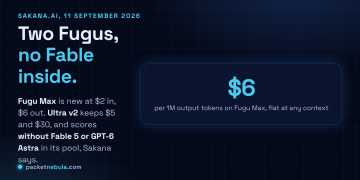





Sakana's June pitch for Fugu was that one API call could hand your task to the best closed model of the moment and you'd never have to care which. On 11 September 2026 the pitch flipped. Fugu Ultra v2, the company says, gets its numbers "without Fable 5, Fable 5.1, or GPT-6-Astra in its agent pool", and a second orchestrator called Fugu Max routes over open and specialist models at $2 per million input tokens and $6 output. We've read the release post against the pricing page, and there's a gap between them worth knowing about before you flip the model string.
The short answer
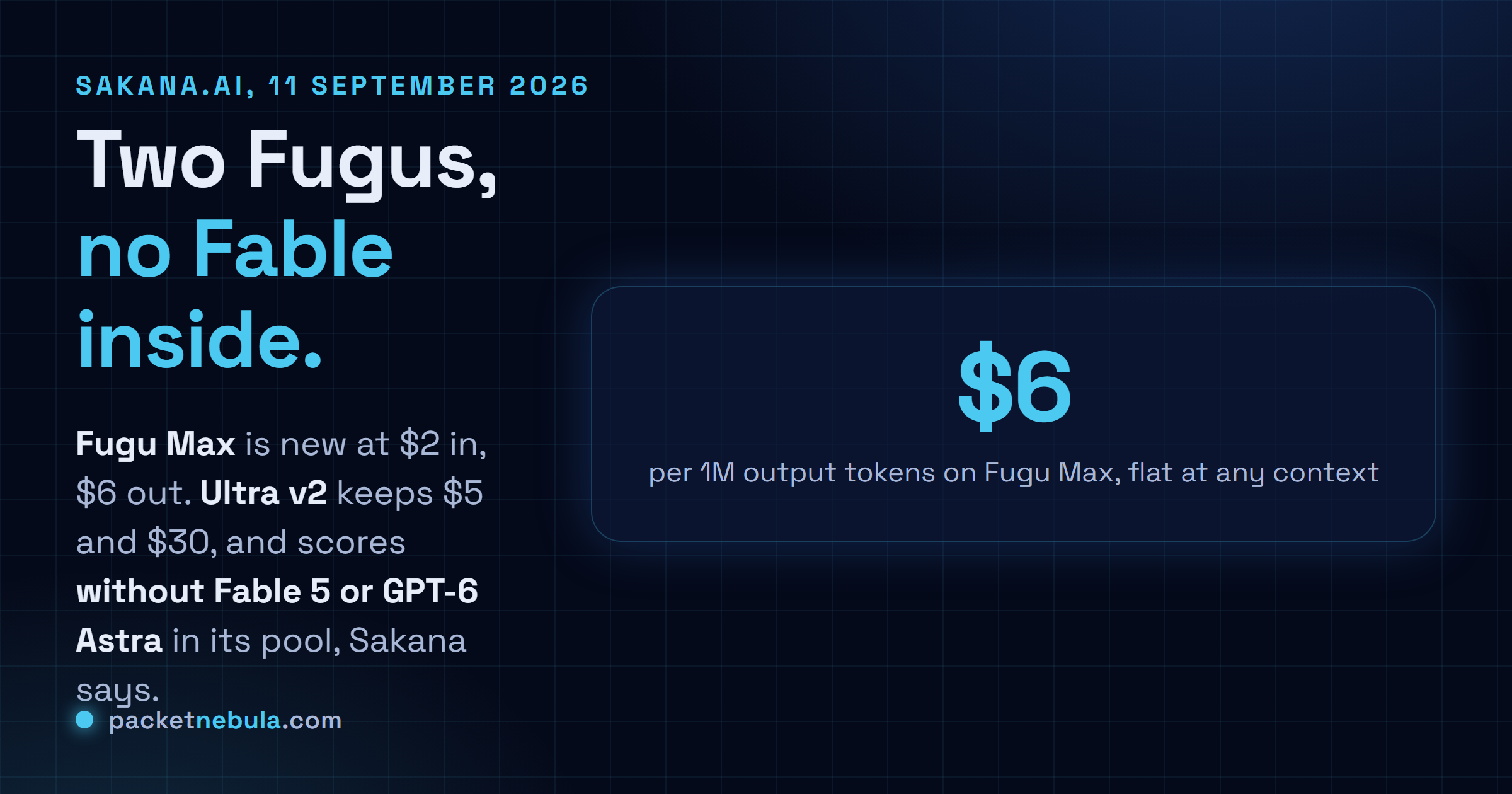
Fugu Max is new: $2 in, $6 out, $0.25 on cached input, flat at any context length, plus $0.007 per web_search or web_fetch call. Its pool is wider than Fugu's and includes the NVIDIA Nemotron family. Fugu Ultra v2 replaces Ultra v1 at the same $5 and $30, with the same doubling to $10 and $45 above 272K tokens of context. Sakana says Ultra v2 takes the best or joint-best score on 5 of the 8 benchmarks it ran, and that it does so with no Fable 5, Fable 5.1 or GPT-6 Astra in the pool. Both are live on the OpenAI-compatible API, and neither is available in the EU or EEA.
What Fugu Max is, and what it isn't
Fugu was never a model in the usual sense. It's an orchestrator, a language model trained (fine-tuning, evolutionary search and reinforcement learning, per Sakana's own description) to split a request into pieces, hand each piece to a model in a swappable pool, call more copies of itself when it wants to, and stitch the answers back into one reply. You send one request to one endpoint. Which models did the work is not exposed, by design.
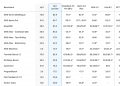
Fugu Max is that orchestrator pointed at a bigger and cheaper pool. The release post says it "expands the pool of models Sakana Fugu can orchestrate, integrating an unprecedented number of open-weights and specialized models, including NVIDIA Nemotron family through our collaboration with NVIDIA". That's the same Nemotron line we looked at in August, the 30B-A3B Lightning release, though Sakana doesn't say which members of the family it uses or how many other open models sit beside them. The routing goal is stated plainly: the leanest model that can still solve the step. On Sakana's table, Max takes the top score on six of its ten rows, Terminal-Bench 2.1 and GPQA Diamond among them, and widens what the company calls the cost-performance frontier on seven of ten.
The pricing is the part that reads cleanly. Two dollars in, six out, a quarter for cached input, and it stays flat however long your context gets. Sakana's comparison is on output only: it says $6 is 40 to 60% below Sonnet 5, GPT 5.6 Terra and Kimi K3. Fair enough on the list price. What the post doesn't say is how many tokens an orchestrated answer burns compared with a single model answering the same prompt, and that ratio is the whole question. More on it below. One more line item people will miss: web search and web fetch are $0.007 a call on Max. Cheap, but an agent loop that searches on every turn will find it.
Ultra v2 and the sentence about Fable
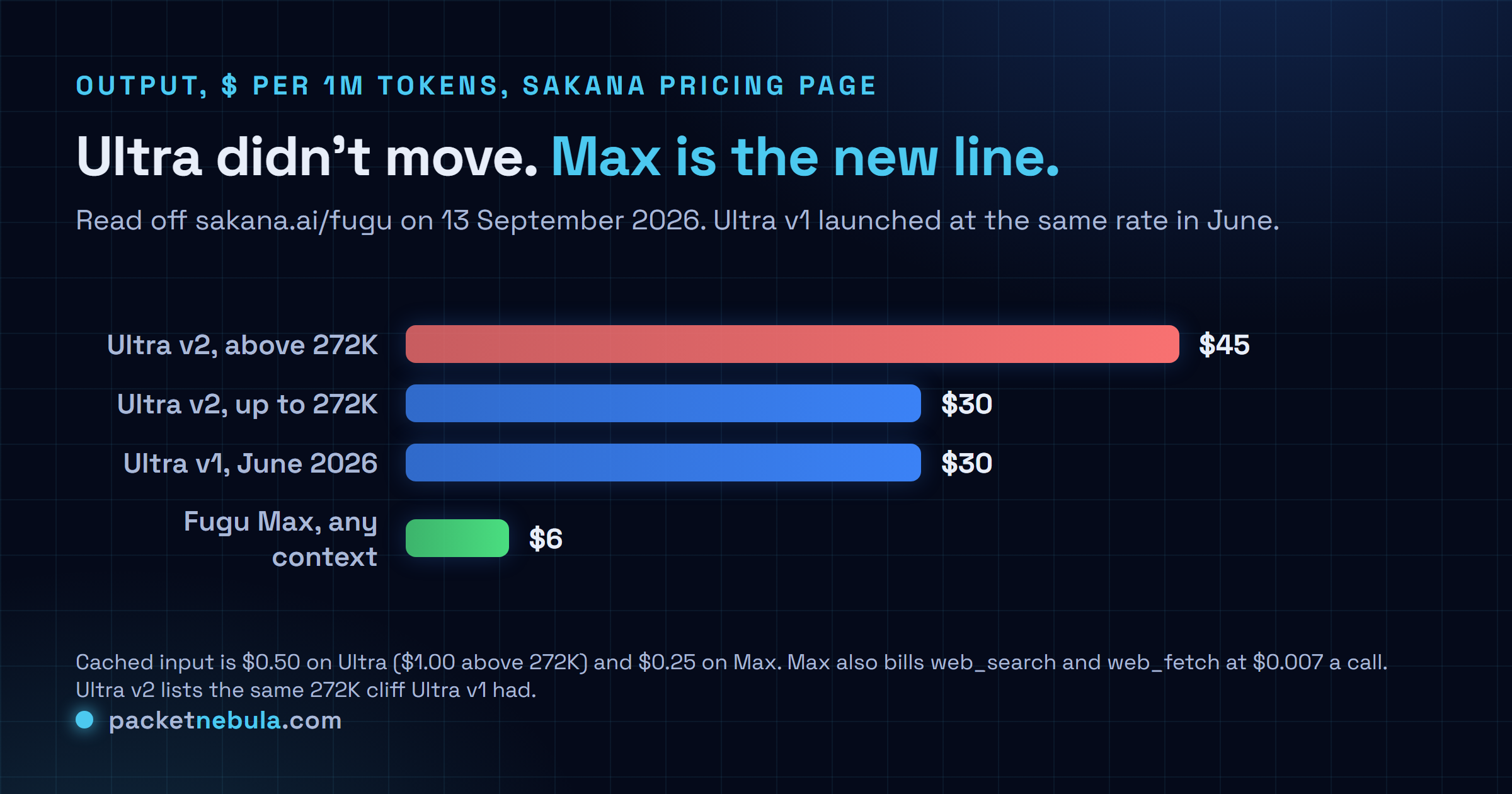
Ultra v2 costs what Ultra v1 cost. Five dollars in, thirty out, fifty cents on a cache hit, and past 272K tokens of context all three double to $10, $45 and $1. The pricing page lists it as fugu-ultra-v2.0, and Sakana says moving from the old Ultra is a single parameter change. Reasoning effort has three settings, high, xhigh and max. Knowledge cutoff is 28 August 2026, which is recent enough to matter for anything that touches this summer's releases.
The sentence Sakana wants you to read is this one: Ultra v2 "achieves these scores without Fable 5, Fable 5.1, or GPT-6-Astra in its agent pool", and it "does not rely on individual proprietary frontier models to deliver frontier output". You have to remember June to hear what that's aimed at. When Ultra v1 launched, the pool was described as Claude Opus 4.8, Gemini 3.1 Pro and GPT-5.5 plus undisclosed open models, and Fable 5 wasn't in it because Fable 5 wasn't available to anyone that month. It came back on 2 July and went permanent on the 20th. An orchestrator whose best answers depend on a model that can vanish for three weeks is a hard sell to a procurement desk. So the v2 message is defensive as much as it's technical: our scores stand even if the two most restricted frontier models disappear tomorrow.
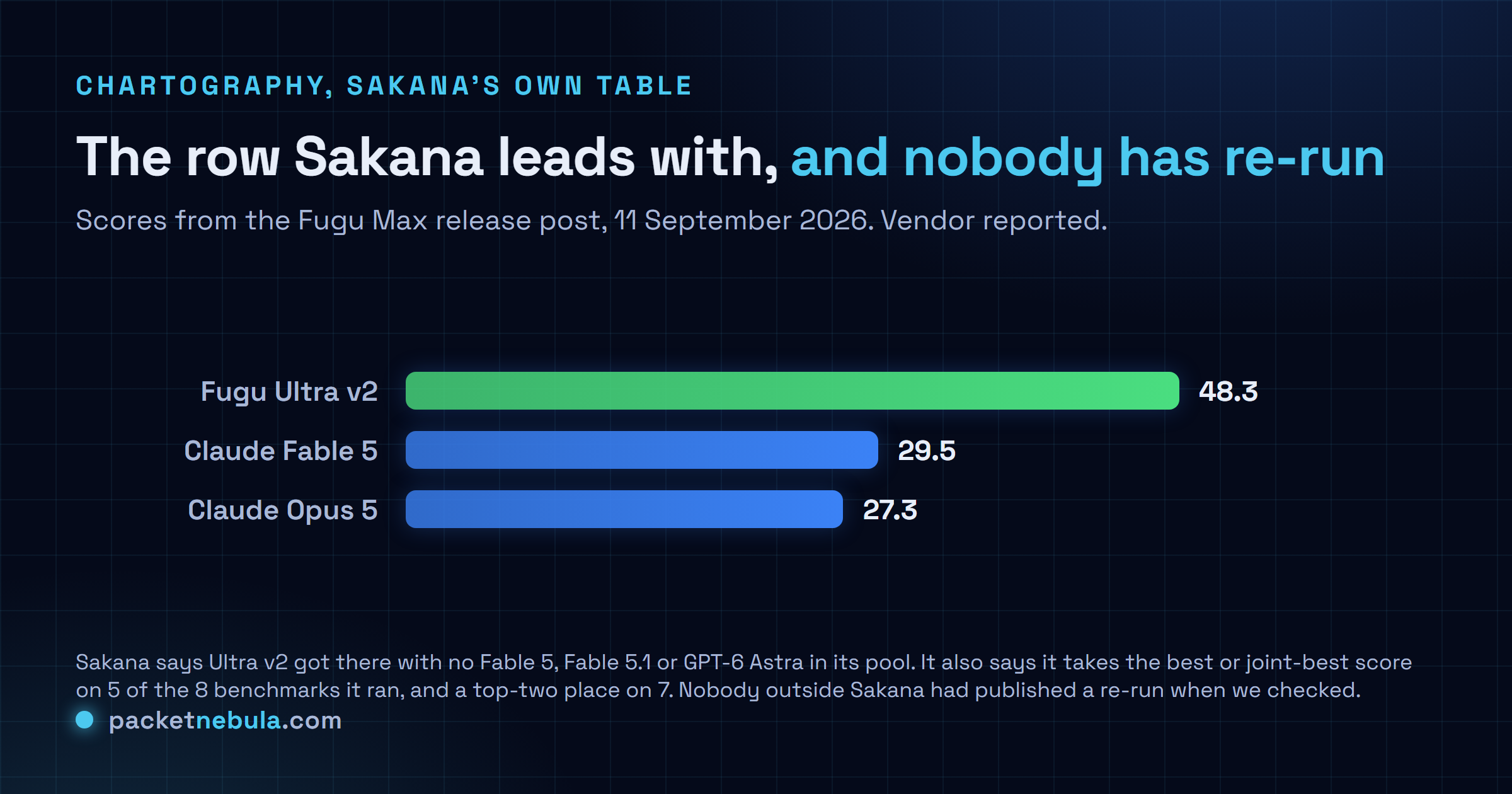
Read it carefully, though. "Without Fable 5, Fable 5.1 or GPT-6 Astra" is not "without any closed model". The post lists three exclusions and describes the rest as "open and specialized models". Whether Opus 4.8 or a Gemini still sits in the Ultra v2 pool, Sakana doesn't say, and the routing is hidden, so you can't check from your side. Honestly, I read the wording as deliberate: precise about the two names people worry about, silent on everything else. I might be wrong and the pool might be entirely open weights now. The post would've said so if it were, I think.
The scores themselves are Sakana's. Chartography 48.3 against 29.5 for Fable 5 and 27.3 for Opus 5, DeepSWE 74.3, best or joint-best on five of eight rows, top two on seven. Nobody outside the company had published a re-run when we checked, and there's no third-party evaluation page for any Fugu model yet. A 19 point lead on a visual reasoning benchmark from an orchestrator that can call a chart-specialist model is plausible. It's also exactly the kind of row you'd put first in a release post.
What your invoice will actually say
Here's the mechanism that matters for anyone budgeting this. When Fugu delegates, the tokens the sub-agents read and write are real tokens, and they count. Sakana's pricing page describes the rate as "a single rate based on the top tier model involved", so you aren't billed once per model, but you are billed for every token the swarm produced on the way to your answer, and the swarm produces more than one model would. A June report on Ultra v1 made the same point: the background work of delegating and verifying isn't absorbed by the provider. How much more? Sakana doesn't publish a multiplier, and since the routing is invisible you can't derive one from a single request.
So the "40 to 60% cheaper" claim is a claim about the price per token, and your bill is price per token times tokens. If Max burns 2x the tokens of a direct call to a mid-tier model, the saving is gone. If it burns 1.2x, it's real. We don't know which, and I'd be suspicious of anyone who says they do without a controlled run. The test is cheap: take a fixed batch of 50 of your own prompts, run them through Max and through whatever you use today, and compare the two invoices, not the two price lists. Do it before the 272K cliff on Ultra as well, because a long-context agent session that crosses that line pays $45 a million on every output token after it, and the pricing page doesn't spell out whether the higher rate applies to the whole request or only the part over the threshold.
Two hard limits to close on. There are no open weights for any Fugu model, so self-hosting is off the table. And the pricing page still says the service is "not yet available in the EU/EEA while we work toward compliance with GDPR and EU-specific regulations", the same line it carried in June. If you're in Europe, this launch changes nothing for you yet, whatever the benchmark table says.
Sources
Sakana AI, Introducing Fugu Max and Fugu Ultra v2, 11 September 2026 (the Nemotron pool statement, the Fable 5, Fable 5.1 and GPT-6 Astra exclusion, the Fugu Max price and the 40 to 60% comparison, the benchmark tables, the single-parameter upgrade, the 28 August cutoff). Sakana AI, Sakana Fugu pricing, read 13 September 2026 (the fugu-ultra-v2.0 identifier, both price tables including the 272K tier and the $0.007 web call rate, the single-rate billing sentence, the EU/EEA statement, the $20, $100 and $200 subscriptions). MarkTechPost, Sakana AI Launches Fugu Max and Fugu Ultra v2, 10 September 2026 (independent reading of the benchmark tables: the six of ten and seven of ten Max rows, Chartography 48.3 against 27.3 and 29.5, DeepSWE 74.3). DeepLearning.AI, The Batch, Fugu blends models task by task, 3 July 2026 (the Ultra v1 pool: Opus 4.8, Gemini 3.1 Pro, GPT-5.5 and undisclosed open models; the v1 price). VentureBeat, No Claude Fable 5? No problem, 22 June 2026 (the background-token billing description and the June Fable 5 access situation). The Fable 5 availability dates are from our own July coverage.
Frequently asked questions
What is Fugu Max?
A multi-agent orchestrator from Sakana AI, released on 11 September 2026. It's a model trained to route each part of a request to another model in a pool and combine the results. Fugu Max uses a wider pool of open-weight and specialist models than the original Fugu, including NVIDIA's Nemotron family, and aims at the cheapest model that can still solve each step. It's sold through Sakana's OpenAI-compatible API. There are no open weights.
How much do Fugu Max and Fugu Ultra v2 cost?
Fugu Max is $2 per million input tokens, $6 per million output and $0.25 on cached input, at any context length, plus $0.007 for each web search or web fetch call. Fugu Ultra v2 is $5 input, $30 output and $0.50 cached up to 272K tokens of context, then $10, $45 and $1.00 above it. That's the same price Ultra v1 launched at in June. Sakana also sells $20, $100 and $200 monthly plans.
Does Fugu Ultra v2 use Claude Fable 5 or GPT-6 Astra?
Sakana says no. The release post states that Ultra v2 reaches its benchmark scores "without Fable 5, Fable 5.1, or GPT-6-Astra in its agent pool" and does not rely on individual proprietary frontier models. It doesn't say the pool contains no closed models at all, and the routing isn't exposed to users, so that can't be verified from outside.
Is Fugu available in the EU?
No. Sakana's pricing page says the service is not yet available in the EU or EEA while the company works toward GDPR compliance. That line was there for the June launch and is still there for Fugu Max and Ultra v2.
Is Fugu Max really cheaper than a single model?
Per token, on the list price, yes: Sakana puts the $6 output rate 40 to 60% below Sonnet 5, GPT 5.6 Terra and Kimi K3. Per task, nobody knows yet. An orchestrator spends tokens on delegation and verification that a single model wouldn't, and those tokens are billed. The only reliable check is to run the same batch of prompts both ways and compare the invoices.