
• Latest
  • Trending
  • All
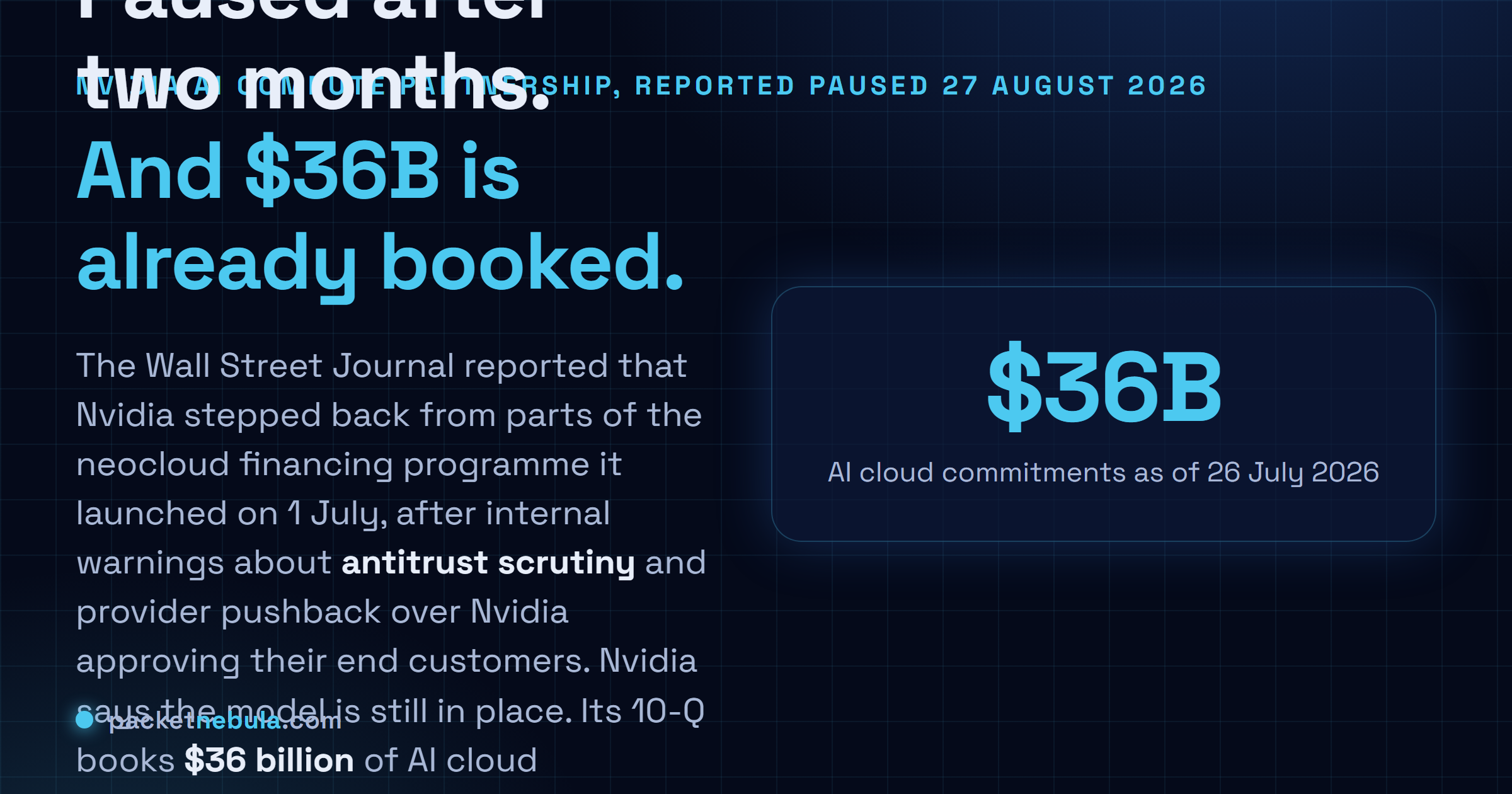
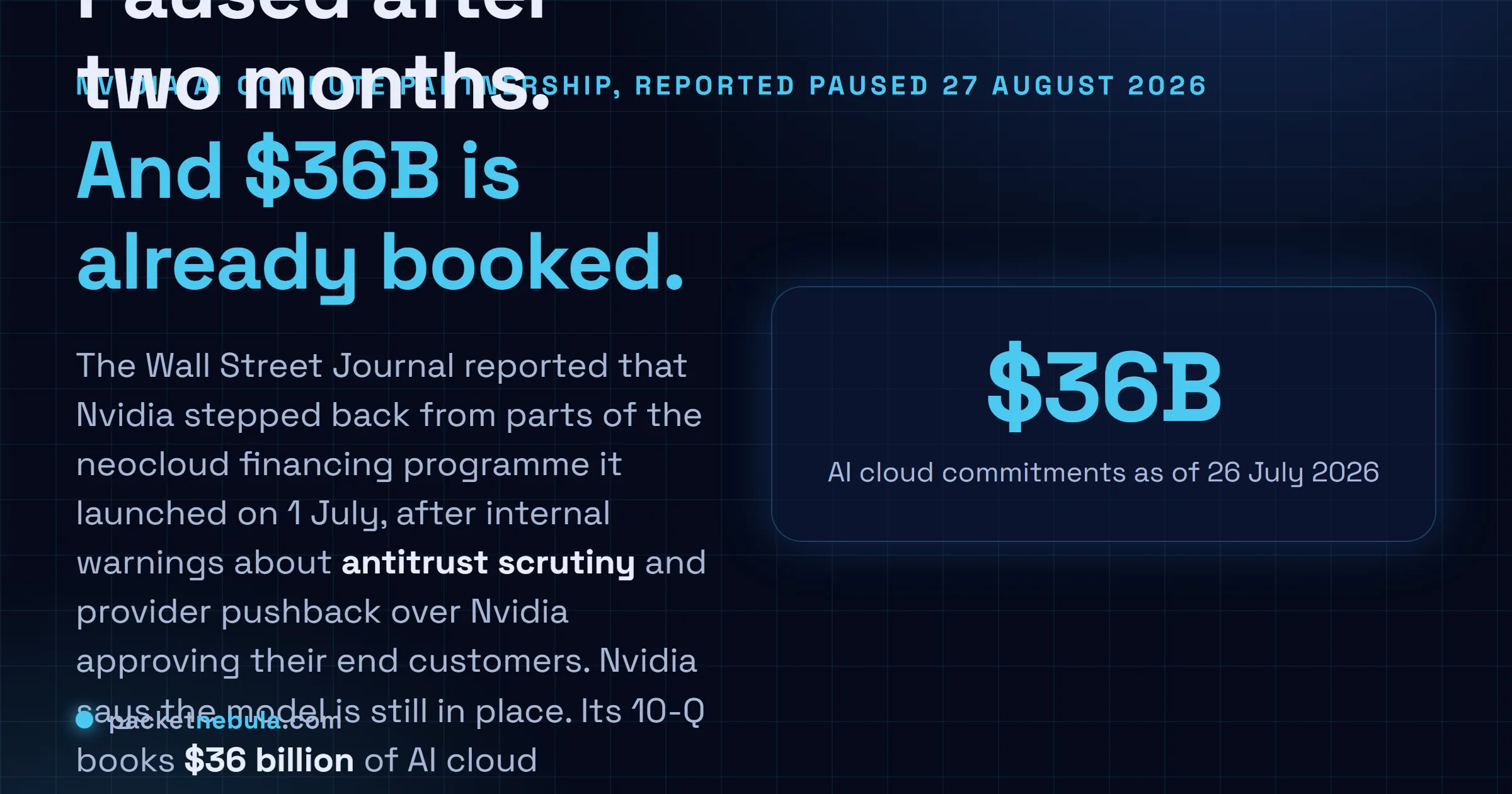
Answer card stating that the Wall Street Journal reported on 27 August 2026 that Nvidia stepped back from parts of the AI Compute Partnership financing programme launched on 1 July, after internal warnings about antitrust scrutiny and provider pushback over Nvidia approving their end customers, that Nvidia says the business model is still in place, and that its quarterly filing books 36 billion dollars of AI cloud agreements with none of it before fiscal 2028.

Nvidia pauses its $36B AI Compute Partnership

29 August 2026
Answer card stating that Ternary Bonsai 2 27B, released by PrismML on 17 September 2026 under Apache 2.0, packs Qwen3.8 27B into 5.95 gigabytes at 1.72 bits per weight, keeps 98.2 percent of the 14-benchmark average, about 75 percent on SWE-bench Verified and Terminal-Bench 2.1, and needs PrismML's llama.cpp fork to run.

Does Bonsai 2 27B really keep 98% of Qwen3.8 in 5.95 GB?

20 September 2026
Answer card stating that Jev 1.13 from TypeSafe AI is a decision model in early access since 15 September 2026 that returns typed probabilities instead of text, priced at 42 dollars per billion input tokens with output tokens free, answering in 70 to 500 milliseconds, with a 64K token request budget, text input only, and a documented list of things it does badly, including counting and dates.

Jev 1.13 bills $42 a billion tokens, and it can’t count

19 September 2026
Answer card stating that Qwen3.8-Omni-Flash launched on 17 September 2026 as an API only model on Alibaba Cloud Model Studio, taking text, images, audio and video in a 1M token context and returning text only, priced at 0.15 dollars per million input tokens for every modality and 0.47 dollars per million output tokens in the international regions, with no open weights published and the Qwen-Live Harness GitHub repository returning 404.

Qwen3.8-Omni-Flash bills audio at $0.15 and ships no weights

18 September 2026
Answer card stating that on 15 September 2026 AWS said it is unable to restore access to resources and data hosted exclusively in the Middle East Bahrain region me-south-1 and in the mec1-az2 zone of the UAE region, because the damage spanned multiple Availability Zones and exceeded what multi-AZ services are designed to withstand.

AWS can’t restore me-south-1, six months after the drone strikes

17 September 2026
Answer card stating that Google released Gemini 3.8 Live and Gemini 3.8 Live Extended Thinking on 15 September 2026 at 3 dollars per million audio input tokens and 12 dollars out, that the thinking model requires asynchronous tools, and that Artificial Analysis scores it 82.6 on its Speech to Speech Quality Index.

Gemini 3.8 Live Extended Thinking rejects any tool that blocks

16 September 2026
Answer card summarising the Atria Dawn Preview release: 744B GLM-5.2 base, MIT licence, 1.5 TB BF16 and 756 GB FP8 checkpoints, 256K context, top on five of sixteen benchmark rows and trailing on SWE-bench Pro.

Atria Dawn Preview is 744B under MIT, and the BF16 weighs 1.5 TB

15 September 2026
Answer card stating that OpenAI released the Agents API in public beta on 10 September 2026 with no separate fee, billed through model tokens, tool calls and hosted sandbox time, with a choice of OpenAI hosted, self hosted or partner sandboxes, US only data residency and no Zero Data Retention support.

OpenAI’s Agents API has no fee, no ZDR and a one hour sandbox clock

14 September 2026
Answer card: Sakana Fugu Max at $2 and $6 per million tokens, Fugu Ultra v2 unchanged at $5 and $30, and Sakana saying Ultra v2 scores without Fable 5 or GPT-6 Astra in its pool.

Fugu Max costs $2 and $6 while Fugu Ultra v2 runs without Fable 5

13 September 2026
Answer card stating that DeepSeek released DeepSeek-V4.1-Flash on 10 September 2026 as a 552 billion parameter mixture of experts model with a new causal encoder decoder architecture that activates 8 billion parameters on input and 16 billion on output, with native vision, a one million token context and MIT licensed weights, that the API model name is now deepseek-flash at 0.15 dollars per million input tokens and 0.60 dollars per million output tokens off peak, and that DeepSeek announced V4 Pro would be routed to V4.1-Flash from 14 September and reversed that on 11 September.

DeepSeek V4.1-Flash arrived, and the V4 Pro retirement lasted a day

12 September 2026
Answer card stating that Cognition released SWE-2 on 10 September 2026, a coding model post-trained from Kimi K3, scoring 50.0 percent on FrontierCode 1.1 Main against 50.9 percent for Claude Fable 5.1 and 27.3 percent on Terminal-Bench 4 against 55.8 percent, available only inside Devin.

SWE-2 trails Fable 5.1 by one point, and by 28 on Terminal-Bench 4

11 September 2026
Answer card for Meta Muse, free to 100 million tokens a week then $20 a month, launched 8 September 2026 for United States adults only, running in a dedicated per user virtual machine.

Does Meta Muse do enough to earn your inbox and a card on file?

9 September 2026
Answer card stating that the public download pages for the VMware Virtual Disk Development Kit on developer.broadcom.com began returning 404 errors on 25 August 2026 with no announcement or deprecation notice, that Broadcom support tells customers the kit is no longer available for use or download, and that release lines 7.0.3.1, 8.x and 9.x are all affected.

Broadcom pulled VDDK 8.0 and 9.0, and the 404 is the only notice

8 September 2026
  • About
  • Contact
  • Privacy
  • Legal
Monday, September 21, 2026
  • Login
Packet Nebula
  • Home
  • Articles
    • Security
    • Network
    • Dev
    • Sysadmin
    • SEO
    • Email & DNS
  • Tools
    • Network tools: free, fast, no signup
    • Security tools: free, fast, no signup
    • Developer tools: free, fast, no signup
    • Sysadmin tools: free, fast, no signup
    • SEO tools: free, fast, no signup
    • Email & DNS tools: free, fast, no signup
  • Download
  • About
No Result
View All Result
Packet Nebula
No Result
View All Result
Home Dev

Nvidia pauses its $36B AI Compute Partnership

by stephane
29 August 2026
in Dev
0
Answer card stating that the Wall Street Journal reported on 27 August 2026 that Nvidia stepped back from parts of the AI Compute Partnership financing programme launched on 1 July, after internal warnings about antitrust scrutiny and provider pushback over Nvidia approving their end customers, that Nvidia says the business model is still in place, and that its quarterly filing books 36 billion dollars of AI cloud agreements with none of it before fiscal 2028.
498
SHARES
1.4k
VIEWS
Share on FacebookShare on Twitter

Two months. That is how long Nvidia's neocloud financing programme ran before the Wall Street Journal reported, on 27 August, that the company had stepped back from parts of it. The programme is the AI Compute Partnership, announced 1 July: Nvidia backstops a small cloud operator by promising to rent unused GPUs back at a fixed rate, which makes lenders comfortable, and in exchange takes a share of what the operator earns above a threshold. Nvidia's reply to the report was that the model is still in place and continues to evolve. So which is it? We went to the quarterly filing rather than the coverage, and the filing describes an arrangement that sits oddly next to the one cloud operators reportedly objected to.

The short answer

The Wall Street Journal reported on 27 August that Nvidia stepped back from deals in the AI Compute Partnership, the neocloud financing programme it launched on 1 July, after internal warnings about antitrust exposure and pushback from providers over Nvidia approving their end customers. Nvidia says the model is still in place. The quarterly filing, published the same week, puts $36 billion of AI cloud agreements on the books and describes terms that do not obviously match what providers were reportedly offered.
$36BAI cloud commitments booked at 26 July 2026
$0of that falling in the rest of fiscal 2027
~210kGPUs across the first two partners
Answer card stating that the Wall Street Journal reported on 27 August 2026 that Nvidia stepped back from parts of its AI Compute Partnership financing programme after antitrust warnings and provider pushback, that Nvidia says the model is still in place, and that its 10-Q books 36 billion dollars of AI cloud agreements with none before fiscal 2028.
Two months from launch to reported pause. The dollar figure came out the same week, from a different document.

What the programme was

Colette Kress and Raj Mirpuri published it on 1 July. The pitch was aimed at operators who have demand and a site but cannot write a nine-figure cheque for accelerators, which describes most of the neocloud tier.

Nvidia’s part is a floor. It commits to cloud service agreements against the capacity, so if the provider cannot fill a hall, Nvidia rents it. A lender looking at that build now sees contracted revenue rather than a bet on a sales pipeline, and prices the debt accordingly. Nvidia gets hardware revenue plus a cut of what the provider earns from real customers on top. The Journal puts that cut at 50 percent of revenue above a threshold, a number Nvidia has never published.

Sharon AI, an Australian operator, signed for up to 40,000 GB300 GPUs on a six-year agreement. Firmus took the bigger side: a DSX campus in Batam, Indonesia, built to Nvidia’s SuperPOD reference architecture, scaling to 360 MW and as many as 170,000 GPUs. Call it 210,000 accelerators between them at launch.

It is a clean idea, honestly. Vendor finance is old, and using guaranteed offtake instead of a loan is a reasonable way to do it when the collateral is a depreciating machine nobody can price in eight years.

The number nobody printed

Every outlet that covered the pause quoted $36 billion. It comes from the 10-Q for the quarter ended 26 July, which was the first time Nvidia disclosed the size of this thing.

Almost nobody printed the rest of the table.
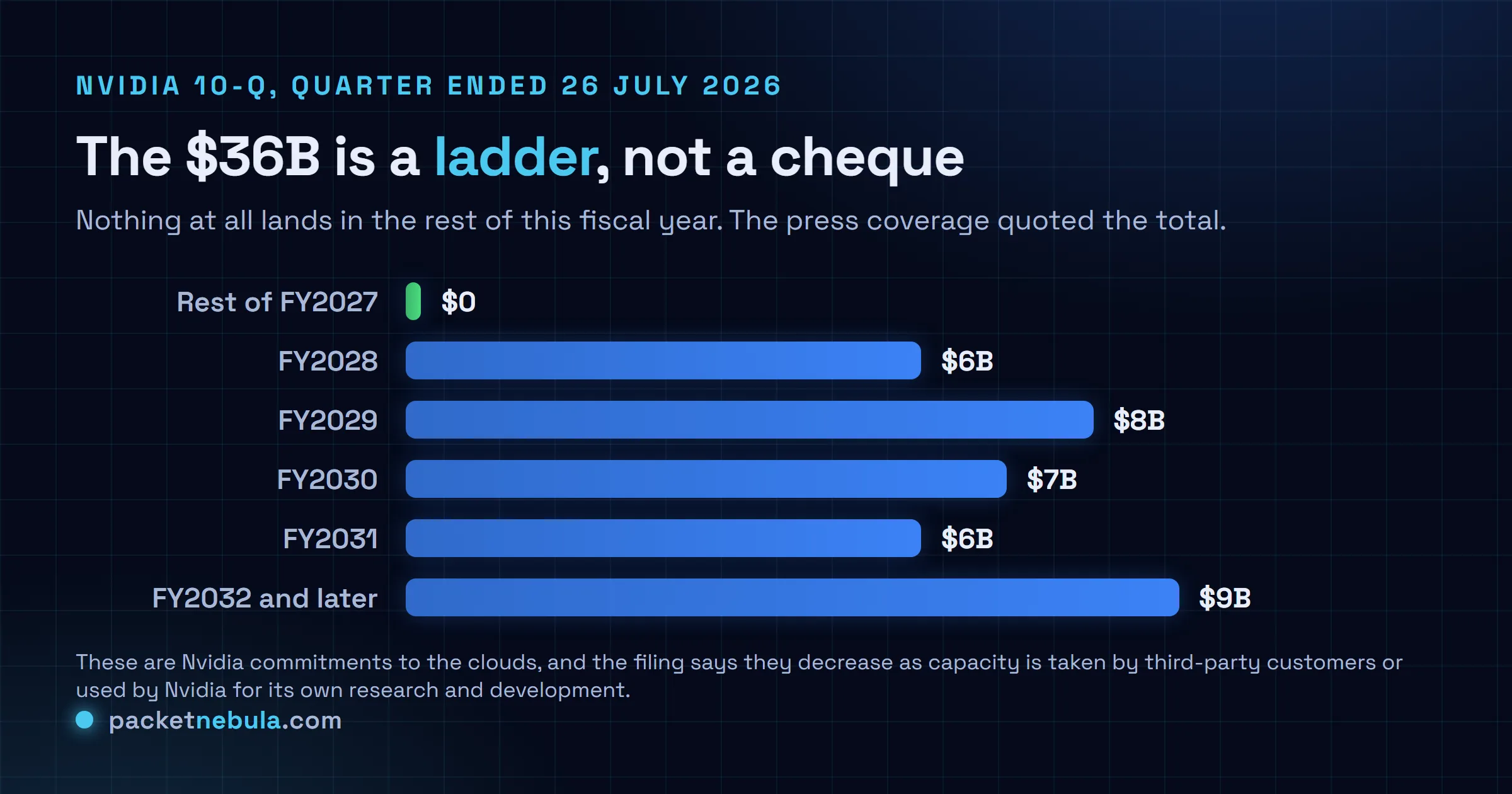
Horizontal bar chart of Nvidia future AI cloud agreement commitments by fiscal year from the 10-Q for the quarter ended 26 July 2026: zero for the remainder of fiscal 2027, six billion dollars in fiscal 2028, eight billion in fiscal 2029, seven billion in fiscal 2030, six billion in fiscal 2031, and nine billion in fiscal 2032 and later.
The same $36 billion, spread the way the filing spreads it. Nothing at all this fiscal year.

Nothing in the remainder of fiscal 2027. Then $6B, $8B, $7B, $6B, and $9B in fiscal 2032 and beyond. So the obligation everyone described as enormous does not start until Nvidia’s fiscal 2028, and it thins out across six years after that.

Two other lines sit near it and are worth knowing about. Nvidia separately carries $3.529 billion of notional land, power and shell guarantees for AI cloud partners, booked as credit derivatives, with partners having placed $712 million in escrow against Nvidia’s exposure and terms running five to seven years. And the SB Energy guaranties behind OpenAI’s Ohio leases, which we went through in detail when they were disclosed, add $105 billion to bring total maximum gross guarantee exposure to $108.5 billion.

The AI Compute Partnership is the smallest of Nvidia’s financing instruments by a wide margin. It is also the only one that got paused.

Where the filing and the reporting disagree

Here is the sentence from the 10-Q, and it is the reason we wrote this up at all:

Under these agreements, AI clouds procure our data center infrastructure products and we commit to cloud service agreements, which the AI clouds can unilaterally stop providing to us and sell to third-party customers at more advantageous rates.

Unilaterally. The filing describes an arrangement where the operator holds the whip: it can pull capacity out from under Nvidia the moment a better-paying tenant appears, and Nvidia’s commitment shrinks as that happens.

Now set that beside what the Journal reported providers were actually told. That they could lease the backstopped GPUs only to customers Nvidia approved. That Nvidia would rather see a hall filled by several small AI companies than by one large one. Some operators pushed back, arguing they should decide who they sell to.
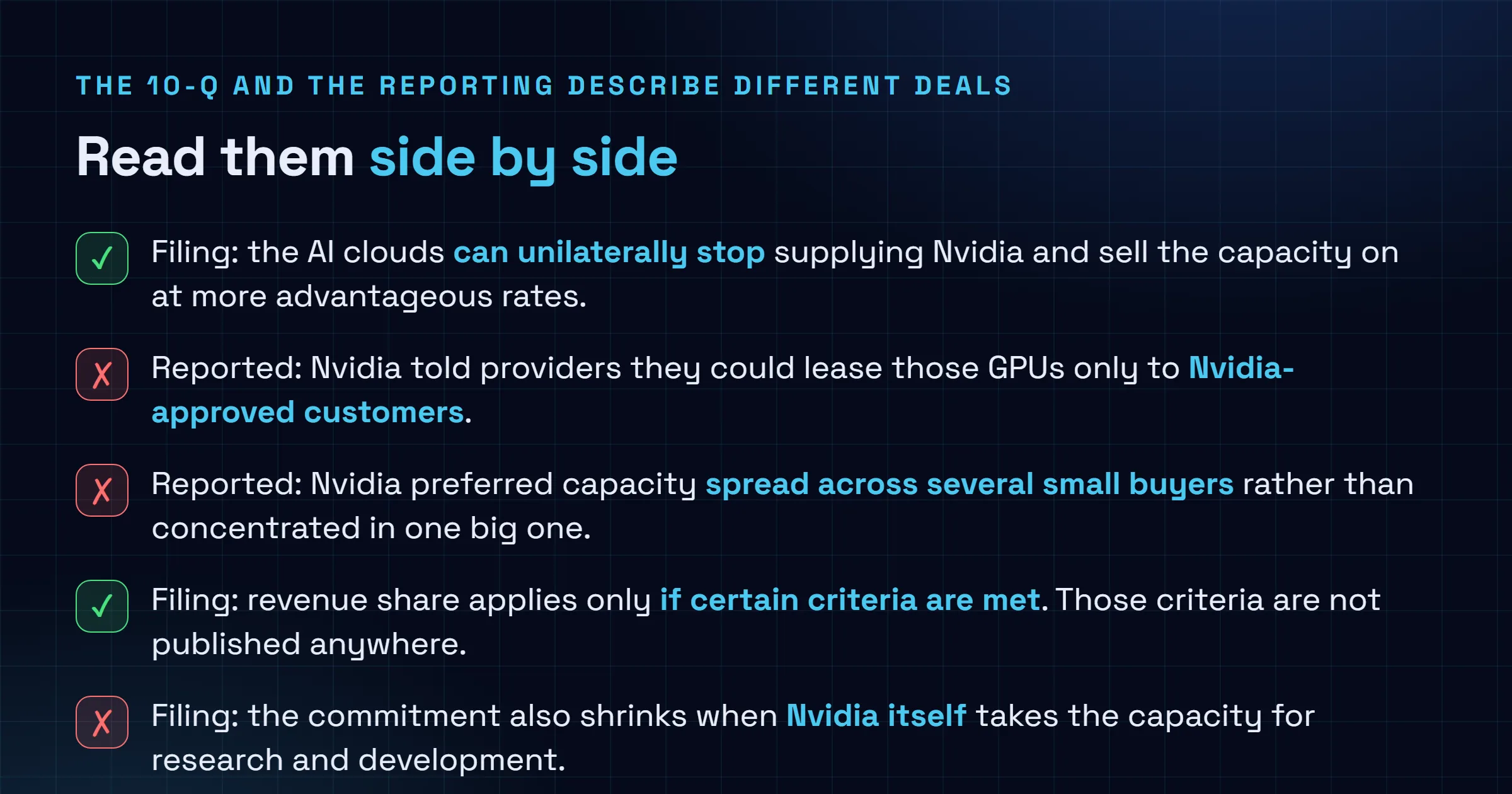
Checklist contrasting Nvidia's filing language, which says AI clouds can unilaterally stop supplying Nvidia and sell capacity to third parties at better rates and makes the revenue share conditional on unpublished criteria, with reporting that Nvidia told providers they could lease only to Nvidia-approved customers and preferred capacity spread across several small buyers.
One document says the operator is free to walk. The other account says the operator needed permission. Both are about the same contracts.

You can reconcile these if you squint. Freedom to sell capacity elsewhere is not the same as freedom to choose the tenant for capacity Nvidia is still backstopping, and a filing summarises where reporting describes a negotiation. Fine. But the gap is real, and it lines up exactly with the part that got paused.

Two smaller things in the same passage deserve a look. The filing says commitments decrease as capacity is used by third-party customers “or by us for our research and development efforts”, meaning Nvidia consuming its own backstopped GPUs drains the obligation the same way a paying customer does. And the revenue share is conditional: “if certain criteria are met, we will participate in revenue share”. Nobody has published the criteria.

About the denial

Nvidia’s line was that the business model introduced in July is still in place and continues to evolve due to high demand. Several outlets ran that as Nvidia denying the pause.

Read it again. It defends the model, not the individual deals, and the Journal’s claim was that specific deals were shelved while the programme could be revamped or folded into something else. Those two statements can both be accurate. I might be too generous here, but a company that had genuinely paused nothing usually says so in five words.

If you rent GPUs from a neocloud

Practically, nothing about your 2026 capacity changes. None of the $36 billion lands before fiscal 2028, and the accelerators in Batam and Australia are being installed regardless of how the financing gets restructured.

What is worth doing is asking two questions of any provider in this programme, before you sign rather than after. Does the contract carry an approval or vetting clause on who the tenant is? And what happens to your reservation if the backstop behind that hall is withdrawn?

The broader shape here is the one we have been tracking since the $500 billion financing platforms were announced on 10 August. Nvidia has three instruments running at once, and they differ mainly in how much say Nvidia gets over the customer’s business. The asset-manager platforms give it none. The Ohio guaranties give it none, with one tenant. The AI Compute Partnership reportedly gave it approval rights over end customers and a view on how capacity should be distributed.

That one is the one on hold. The money was never the problem.

Sources: the programme terms, partner names, GPU counts and the Batam campus figures come from the Nvidia blog post of 1 July 2026 by Colette Kress and Raj Mirpuri. The $36 billion commitment ladder, the quoted filing language, the $3.529 billion of land, power and shell guarantees, the $712 million escrow and the $108.5 billion total exposure come from Nvidia’s 10-Q for the quarter ended 26 July 2026. The pause, the 50 percent revenue share, the Nvidia-approved-customer condition, the capacity distribution preference, the internal antitrust concerns and the Nvidia statement were first reported by the Wall Street Journal on 27 August 2026 and are cited here via Reuters and TNW. Nvidia has not confirmed the reported deal terms.

Frequently asked questions

What is Nvidia's AI Compute Partnership?

A financing model Nvidia announced on 1 July 2026 in a blog post by CFO Colette Kress and Raj Mirpuri. Smaller AI cloud providers, often called neoclouds, buy Nvidia data centre systems without funding the whole purchase upfront, because Nvidia commits to cloud service agreements that let it rent unused capacity back at a fixed rate. That guaranteed floor is what makes lenders willing to finance the build. In return Nvidia takes a share of the revenue the provider earns from third-party customers. The first two partners were Sharon AI, deploying up to 40,000 Grace Blackwell GB300 GPUs, and Firmus, building a 360 MW campus in Batam, Indonesia for up to 170,000 GPUs.

Did Nvidia actually pause the programme?

It depends who you ask, and both answers can be true at once. The Wall Street Journal reported on 27 August 2026 that Nvidia stepped back from deals in the programme the week before, and that it could still revamp the initiative or fold it into another effort. Nvidia told reporters that the new business model it introduced in July is still in place and continues to evolve due to high demand. That statement does not deny pausing individual deals. It defends the model. Several outlets read it as a denial anyway.

Why would this attract antitrust attention?

According to the Journal, some Nvidia employees raised the concern themselves with current and prospective customers, and the sensitivity was about how far Nvidia can dictate how its customers run their businesses. The specific terms reported are that providers could lease the backstopped GPUs only to customers Nvidia approved, and that Nvidia preferred capacity spread across several smaller AI firms rather than concentrated with one large buyer. Nvidia has not confirmed those terms. Whether they would breach any law is not something the reporting establishes, and no regulator has opened a public case on it.

What is the $36 billion figure?

It is the total of Nvidia's future AI cloud agreement commitments as disclosed in the 10-Q for the quarter ended 26 July 2026, and that filing was the first time the scale was public. It breaks down as nothing in the remainder of fiscal 2027, then $6B in fiscal 2028, $8B in fiscal 2029, $7B in fiscal 2030, $6B in fiscal 2031 and $9B in fiscal 2032 and beyond. The filing also says these commitments decrease as capacity is used by third-party customers or by Nvidia for its own research and development.

Should this change how I buy GPU capacity from a neocloud?

It changes the questions, not the plan. If you are pricing capacity at a provider in this programme, worth asking whether your contract carries any approval or vetting clause on who the tenant is, and what happens to your reservation if the backstop behind that hall is withdrawn or restructured. None of the $36 billion lands before fiscal 2028, so nothing about 2026 capacity moves on this news. The risk being repriced here is financing risk, and it sits with the provider rather than with you.

Tags: aibig-techgpuinfrastructurenewsnvidia
Share199Tweet125
stephane

stephane

  • Trending
  • Comments
  • Latest
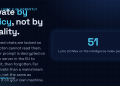
Answer card: Proton Lumo 2.0 is private by policy, not by locality. Saved history is locked so even Proton cannot read it, but the prompt is decrypted on a Proton EU server to answer it, then forgotten.

Proton Lumo 2.0 review: how private is it, really?

3 September 2026
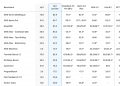
The Agentic Coding section of the official Hy4 preview benchmark appendix published by Tencent, a table comparing Hy3 and Hy4 preview against DeepSeek V4 Pro 0813, Qwen 3.8 Max, GLM 5.3, Kimi K3, GPT 5.6 Sol and Claude Opus 5 across SWE-bench Multilingual, SWE-bench Pro, DeepSWE, three SWE Atlas tasks, SWE-Marathon, Terminal-Bench 2.1, NL2Repo-Bench, CyberGym, ProgramBench, PostTrainBench and Harbor-Index.

Tencent’s 770B Hy4 tops one benchmark row in 46

3 September 2026
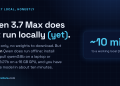
Answer card: Qwen 3.7 Max is API-only and cannot run locally yet; the open Qwen models (Qwen 3.6 27B, qwen3:8b to 32b) run offline via Ollama.

Qwen 3.7 local: what you can actually run offline

22 June 2026
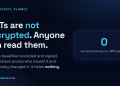
Answer card: JWTs are not encrypted, anyone can read them; the signature proves who issued the token, not who may read it.

Are JWTs encrypted? No, and the difference will bite you

0
Answer card: a random 8 character password falls in under 2 hours offline, while 16 random characters hold for 1.4 trillion years at the same speed.

How long does it take to crack a password in 2026?

0
Answer card: three DNS records decide if your mail lands or bounces; SPF lists allowed senders, DKIM signs messages, DMARC sets the failure policy.

SPF, DKIM and DMARC explained: the records your email needs

0
Answer card stating that Ternary Bonsai 2 27B, released by PrismML on 17 September 2026 under Apache 2.0, packs Qwen3.8 27B into 5.95 gigabytes at 1.72 bits per weight, keeps 98.2 percent of the 14-benchmark average, about 75 percent on SWE-bench Verified and Terminal-Bench 2.1, and needs PrismML's llama.cpp fork to run.

Does Bonsai 2 27B really keep 98% of Qwen3.8 in 5.95 GB?

20 September 2026
Answer card stating that Jev 1.13 from TypeSafe AI is a decision model in early access since 15 September 2026 that returns typed probabilities instead of text, priced at 42 dollars per billion input tokens with output tokens free, answering in 70 to 500 milliseconds, with a 64K token request budget, text input only, and a documented list of things it does badly, including counting and dates.

Jev 1.13 bills $42 a billion tokens, and it can’t count

19 September 2026
Answer card stating that Qwen3.8-Omni-Flash launched on 17 September 2026 as an API only model on Alibaba Cloud Model Studio, taking text, images, audio and video in a 1M token context and returning text only, priced at 0.15 dollars per million input tokens for every modality and 0.47 dollars per million output tokens in the international regions, with no open weights published and the Qwen-Live Harness GitHub repository returning 404.

Qwen3.8-Omni-Flash bills audio at $0.15 and ships no weights

18 September 2026
  • About
  • Contact
  • Privacy
  • Legal

Copyright © 2026 Stephane Cardon.

Welcome Back!

Login to your account below

Forgotten Password?

Retrieve your password

Please enter your username or email address to reset your password.

Log In
No Result
View All Result
  • Home
  • Articles
    • Security
    • Network
    • Dev
    • Sysadmin
    • SEO
    • Email & DNS
  • Tools
    • Network tools: free, fast, no signup
    • Security tools: free, fast, no signup
    • Developer tools: free, fast, no signup
    • Sysadmin tools: free, fast, no signup
    • SEO tools: free, fast, no signup
    • Email & DNS tools: free, fast, no signup
  • Download
  • About

Copyright © 2026 Stephane Cardon.