
• Latest
  • Trending
  • All
Official Cursor key art for Origin, showing the Origin cube mark and wordmark over a blurred hillside at dusk, from the Origin product page.

Cursor opened its git forge the day GitHub broke

3 September 2026
Answer card stating that Qwen-Image-2.1, released on 20 September 2026, ships open weights with a 7 billion parameter diffusion transformer, a Qwen3-VL 8B text encoder and an RGBA VAE totalling about 33 gigabytes in BF16, under the Qwen Research License that limits use to research or evaluation and requires a separate commercial licence, unlike the Apache 2.0 licence of Qwen-Image 1.0.

Qwen-Image-2.1 brings the weights back, but not the Apache licence

21 September 2026
Answer card stating that Ternary Bonsai 2 27B, released by PrismML on 17 September 2026 under Apache 2.0, packs Qwen3.8 27B into 5.95 gigabytes at 1.72 bits per weight, keeps 98.2 percent of the 14-benchmark average, about 75 percent on SWE-bench Verified and Terminal-Bench 2.1, and needs PrismML's llama.cpp fork to run.

Does Bonsai 2 27B really keep 98% of Qwen3.8 in 5.95 GB?

20 September 2026
Answer card stating that Jev 1.13 from TypeSafe AI is a decision model in early access since 15 September 2026 that returns typed probabilities instead of text, priced at 42 dollars per billion input tokens with output tokens free, answering in 70 to 500 milliseconds, with a 64K token request budget, text input only, and a documented list of things it does badly, including counting and dates.

Jev 1.13 bills $42 a billion tokens, and it can’t count

19 September 2026
Answer card stating that Qwen3.8-Omni-Flash launched on 17 September 2026 as an API only model on Alibaba Cloud Model Studio, taking text, images, audio and video in a 1M token context and returning text only, priced at 0.15 dollars per million input tokens for every modality and 0.47 dollars per million output tokens in the international regions, with no open weights published and the Qwen-Live Harness GitHub repository returning 404.

Qwen3.8-Omni-Flash bills audio at $0.15 and ships no weights

18 September 2026
Answer card stating that on 15 September 2026 AWS said it is unable to restore access to resources and data hosted exclusively in the Middle East Bahrain region me-south-1 and in the mec1-az2 zone of the UAE region, because the damage spanned multiple Availability Zones and exceeded what multi-AZ services are designed to withstand.

AWS can’t restore me-south-1, six months after the drone strikes

17 September 2026
Answer card stating that Google released Gemini 3.8 Live and Gemini 3.8 Live Extended Thinking on 15 September 2026 at 3 dollars per million audio input tokens and 12 dollars out, that the thinking model requires asynchronous tools, and that Artificial Analysis scores it 82.6 on its Speech to Speech Quality Index.

Gemini 3.8 Live Extended Thinking rejects any tool that blocks

16 September 2026
Answer card summarising the Atria Dawn Preview release: 744B GLM-5.2 base, MIT licence, 1.5 TB BF16 and 756 GB FP8 checkpoints, 256K context, top on five of sixteen benchmark rows and trailing on SWE-bench Pro.

Atria Dawn Preview is 744B under MIT, and the BF16 weighs 1.5 TB

15 September 2026
Answer card stating that OpenAI released the Agents API in public beta on 10 September 2026 with no separate fee, billed through model tokens, tool calls and hosted sandbox time, with a choice of OpenAI hosted, self hosted or partner sandboxes, US only data residency and no Zero Data Retention support.

OpenAI’s Agents API has no fee, no ZDR and a one hour sandbox clock

14 September 2026
Answer card: Sakana Fugu Max at $2 and $6 per million tokens, Fugu Ultra v2 unchanged at $5 and $30, and Sakana saying Ultra v2 scores without Fable 5 or GPT-6 Astra in its pool.

Fugu Max costs $2 and $6 while Fugu Ultra v2 runs without Fable 5

13 September 2026
Answer card stating that DeepSeek released DeepSeek-V4.1-Flash on 10 September 2026 as a 552 billion parameter mixture of experts model with a new causal encoder decoder architecture that activates 8 billion parameters on input and 16 billion on output, with native vision, a one million token context and MIT licensed weights, that the API model name is now deepseek-flash at 0.15 dollars per million input tokens and 0.60 dollars per million output tokens off peak, and that DeepSeek announced V4 Pro would be routed to V4.1-Flash from 14 September and reversed that on 11 September.

DeepSeek V4.1-Flash arrived, and the V4 Pro retirement lasted a day

12 September 2026
Answer card stating that Cognition released SWE-2 on 10 September 2026, a coding model post-trained from Kimi K3, scoring 50.0 percent on FrontierCode 1.1 Main against 50.9 percent for Claude Fable 5.1 and 27.3 percent on Terminal-Bench 4 against 55.8 percent, available only inside Devin.

SWE-2 trails Fable 5.1 by one point, and by 28 on Terminal-Bench 4

11 September 2026
Answer card for Meta Muse, free to 100 million tokens a week then $20 a month, launched 8 September 2026 for United States adults only, running in a dedicated per user virtual machine.

Does Meta Muse do enough to earn your inbox and a card on file?

9 September 2026
  • About
  • Contact
  • Privacy
  • Legal
Monday, September 21, 2026
  • Login
Packet Nebula
  • Home
  • Articles
    • Security
    • Network
    • Dev
    • Sysadmin
    • SEO
    • Email & DNS
  • Tools
    • Network tools: free, fast, no signup
    • Security tools: free, fast, no signup
    • Developer tools: free, fast, no signup
    • Sysadmin tools: free, fast, no signup
    • SEO tools: free, fast, no signup
    • Email & DNS tools: free, fast, no signup
  • Download
  • About
No Result
View All Result
Packet Nebula
No Result
View All Result
Home Dev

Cursor opened its git forge the day GitHub broke

by stephane
3 September 2026
in Dev
0
Official Cursor key art for Origin, showing the Origin cube mark and wordmark over a blurred hillside at dusk, from the Origin product page.
496
SHARES
1.4k
VIEWS
Share on FacebookShare on Twitter

Ten in the morning in New York, 17 August. About a fifth of GitHub's web and API traffic was coming back as errors, and raw content downloads were failing roughly half the time. That same afternoon Cursor opened Origin, its own git forge, to every paid plan. Lovely theatre, and mostly coincidence, because Origin was announced on 16 June at Cursor's Compile conference with a vague autumn window. What shipped is an early beta you can sync an existing GitHub repository into, where GitHub stays the source of truth. So this is not a migration. It is a second remote with agent plumbing attached, arriving under a new owner: Cursor became a wholly owned SpaceX subsidiary three days before.

The short answer

Cursor’s git forge, Origin, went into early beta on every paid plan on 17 August, hours into a long GitHub outage. The timing was luck. The product is real but early: repositories, pull requests, review and search, reached from a tab in the editor or a CLI, with two way GitHub sync where GitHub keeps being the source of truth. There is no runner of its own, and no published price or data terms for Origin itself. The company hosting it became a SpaceX subsidiary on 14 August.

17 Augearly beta opens on all paid Cursor plans
16 Junwhen Origin was actually announced
$60BSpaceX deal that closed three days earlier
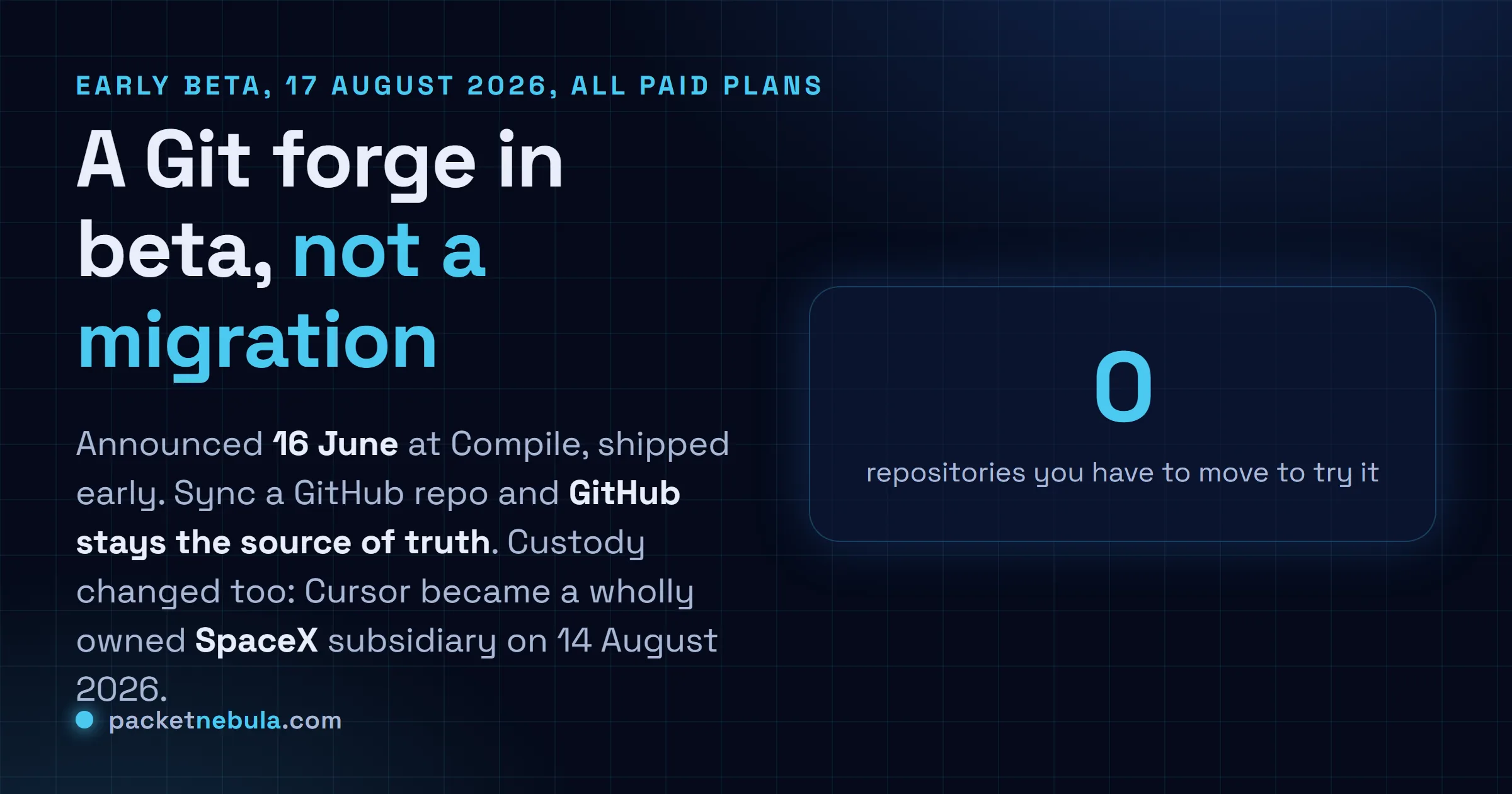
Answer card: Cursor Origin reached early beta on all paid plans on 17 August 2026, having been announced on 16 June 2026 at the Compile conference, with GitHub remaining the source of truth for any repository you sync, and Cursor becoming a wholly owned SpaceX subsidiary on 14 August 2026.
Three dates that got compressed into one headline this week.
Cursor's official Origin key art, showing the Origin cube mark and wordmark over a blurred hillside at dusk.

Image: Cursor, from its Origin product page.

What it is, without the framing

Cursor’s own page says nine words and then stops: a git forge for the agentic era, early beta now available on all paid plans. No pricing table, no feature grid. You get to it through a new tab in the desktop client, or through a command line tool, and hosted repositories live under cursor.com/codebase/ URLs.

Underneath, it is the Graphite technology re architected. Cursor bought Graphite in December 2025 and Graphite’s whole thing was stacked pull requests, so the lineage shows: stacking is in, along with a merge queue for agents landing changes at the same time and automatic conflict resolution across files. Pull requests come with the parts you would expect, meaning timelines, commits, checks and file change views. Code browsing on the web has full text search.

The genuinely different bit is that agent state is a first class output. Review status is readable through structured APIs and through MCP, which is the honest reason this exists. If you have a dozen agents opening pull requests overnight, a forge designed around a human clicking Approve is the bottleneck, and Cursor is betting that machine readable review is worth building a whole host for.

The numbers, read properly

Cursor put throughput on a slide at Compile, for a single repository: roughly 296,000 clones and about 81,000 pushes in an hour, and 22.6 commits in a second. Also global sync under 400 milliseconds, failover inside 10 milliseconds, S3 backed storage with replicas.

Then the coverage flattened it. You will see “296,000 clones a second” in more than one write up this week, which would be an absurd number and is not what was shown.
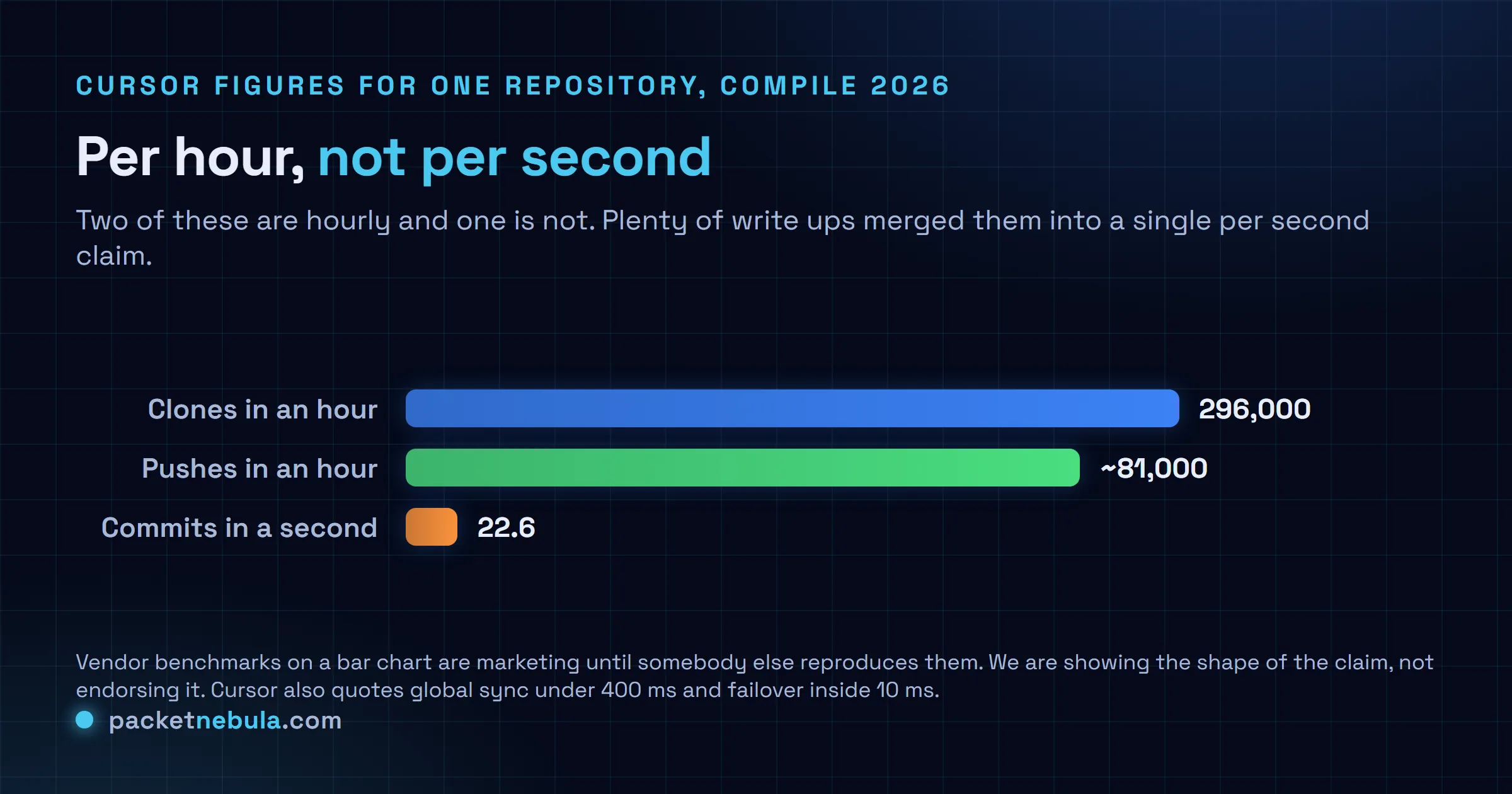
Comparison of Cursor's throughput figures for Origin on a single repository: roughly 296,000 clones and about 81,000 pushes in an hour, alongside 22.6 commits in a second, with a note that coverage restated the clone figure as per second.
Two hourly figures and one per second figure, which is how the confusion started.

Honestly, I do not think the raw ceiling matters much for most teams. Almost nobody is clone limited on their forge. What matters is whether a hundred parallel agent branches merge without a human refereeing, and no slide answers that.

The outage was luck, not strategy

Worth being precise, because the coincidence has been doing a lot of narrative work. GitHub’s incident on 17 August started around 9:40 ET on API requests and spread inside twenty minutes to Actions, Webhooks, Issues and pull requests. At 14:04 ET GitHub was reporting error rates near 20% on web and API, and up to about 50% on archive downloads and raw content. Service came back mid afternoon. Reports put the total between roughly six and a half and seven and a half hours, and GitHub attributed it to a problematic component without publishing a root cause.

It is not an isolated day. One reliability tracker counted 257 GitHub incidents between May 2025 and April 2026, 48 of them major, with Actions the worst affected at 57 and an average recovery time just over six hours. August 2026 had thirteen incidents across nine separate days before the 17th even arrived.

A Cursor employee posted that day that it would be a shame if a decent alternative launched, then linked the announcement. Cheeky. Also not a plan you can schedule.

What is not in the box
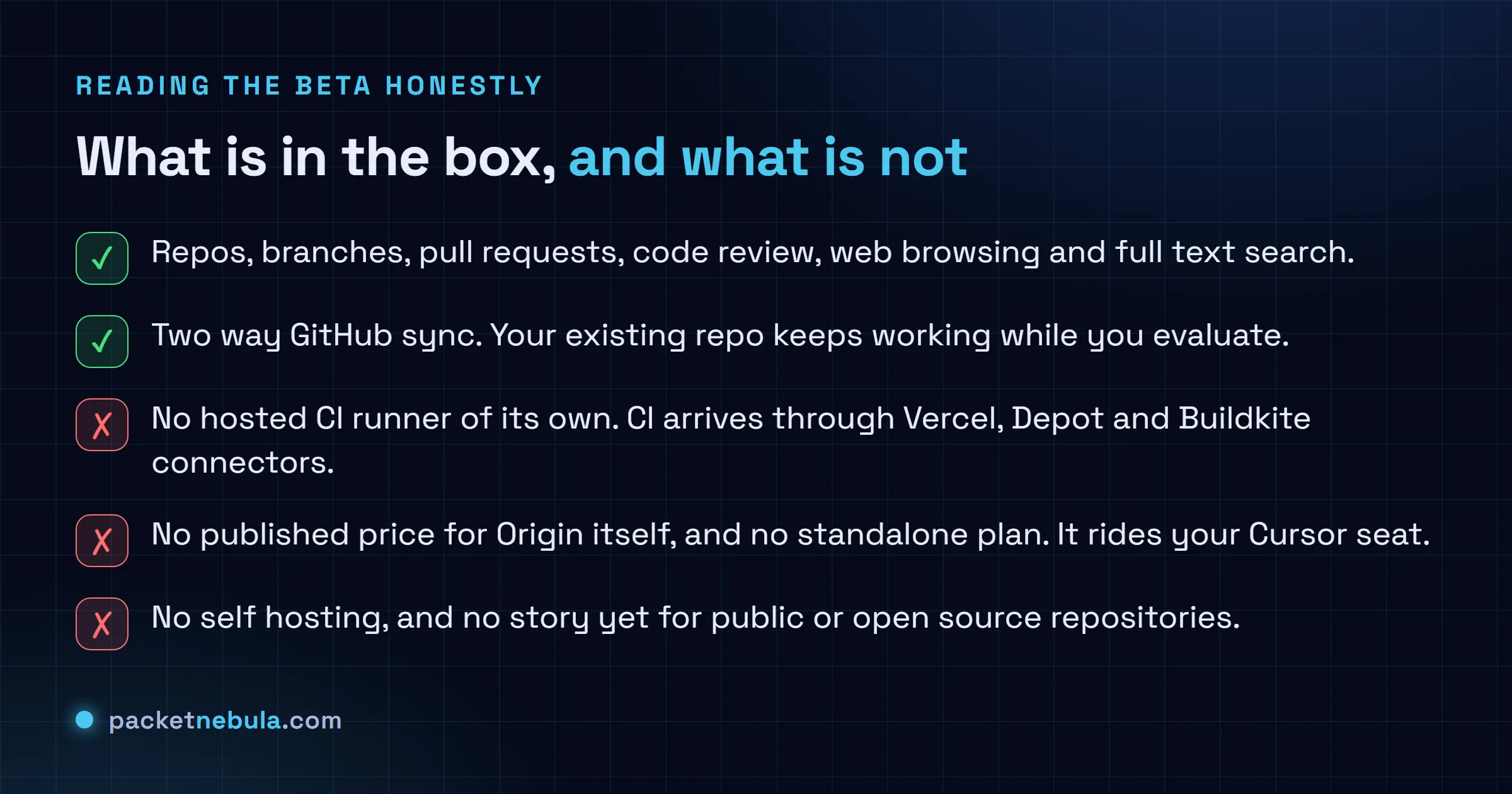
Checklist of what Cursor Origin ships in its August 2026 beta and what it does not: repositories, pull requests, review and search are present along with two way GitHub sync, while there is no hosted CI runner, no published Origin pricing, no self hosting and no story for public repositories.
The absences are the story. Four of these are things you would need before moving anything real.

Continuous integration does not come from Origin. It comes from connectors, and the ones live on day one are Vercel for preview environments, Depot, and Buildkite. That is a reasonable start and it is also the gap: if your build is a heap of Actions workflows, nothing published tells you how to bring them across.

There is no price for Origin as a product. It rides your existing paid Cursor seat during the beta, which is fine now and tells you nothing about later. No self hosting. Nothing announced for public or open source repositories, which for a forge is a fairly large hole, given that the reason GitHub counted around 180 million developers in October 2025 is largely that open source lives there.

The part that was not on a slide

On 14 August 2026, the all stock acquisition of Anysphere by SpaceX became effective, valuing the company at about $60 billion, with Cursor continuing as a wholly owned SpaceX subsidiary and folded into a SpaceXAI unit. TechCrunch put the close on the 15th. Three or four days later, the same company opened a code hosting service.

We are not making a claim about anyone’s intentions here. The observation is narrower and it is the one procurement will make for you: hosting your source with Cursor now means hosting it with a SpaceX subsidiary, and Origin has shipped without published data terms of its own covering retention, training use, export or deletion. That is normal for an early beta. It is also the thing to ask about before a repository that matters goes anywhere near it.

If you have been following how Cursor scaled agent fan out earlier this year, Origin is the obvious next piece. And the owner is the same one pouring money into its own silicon, which tells you the compute story is not slowing down.

What we would actually do

Sync one repository. Not the important one. Something with real branches and a real review habit, because the whole pitch is about what happens when several agents push at once, and a toy repo will not show you that.

Leave GitHub as the source of truth, which is the default anyway. Then watch two things over a few weeks. Does the merge queue behave when several agents push at once, and does the automatic conflict resolution produce diffs you would actually sign off on. Everything else is a demo. If Cursor publishes Origin pricing and data terms before your evaluation ends, that is the real signal that this is a product rather than a wedge.

I might be wrong about the urgency. Forge migrations are historically painful and rarely worth it for speed alone. But an early beta you can attach to an existing repository, at no extra cost, with a one click undo, is about as cheap as evaluating infrastructure ever gets.

Sources

Cursor, Origin product page, read 19 August 2026. TechCrunch, Cursor capitalizes on GitHub frustration, launches rival hosting platform, 18 August 2026. SiliconANGLE, Cursor launches Origin code hosting service to compete with GitHub, 17 August 2026. BigGo Finance, Cursor unveils Origin at Compile and Origin launches on the day of a major GitHub outage, June and August 2026. Yahoo Finance, SpaceX completes record $60 billion acquisition of AI coding platform Cursor, August 2026. Seeking Alpha, SpaceX completes $60B acquisition of Cursor, August 2026.

Frequently asked questions

What is Cursor Origin and who can use it?

Origin is a hosted git forge built by Cursor, described on its own product page as a git forge for the agentic era. It handles repositories, branches, pull requests, code review, web browsing of code and full text search. Cursor first showed it on 16 June 2026 at Compile, its inaugural conference in San Francisco, and said it was coming in the autumn. It arrived earlier than that: an early beta opened to all paid Cursor plans on 17 August 2026. You reach it from a tab in the Cursor desktop client or from a dedicated command line tool, and hosted repositories sit under cursor.com/codebase URLs.

Do I have to leave GitHub to try Origin?

No, and that is the design. Origin connects to a GitHub organisation, lets you pick which repositories to sync, and then keeps both sides current in both directions within seconds. GitHub remains the source of truth for anything you sync, so your existing pull request flow, permissions and downstream automation keep working while you evaluate. Treat it as adding a remote rather than swapping one out. That also means the failure mode is mild: if you stop using Origin, the repository you actually depend on has not moved.

Are the throughput numbers Cursor quotes per second or per hour?

Mixed, and a lot of the coverage merged them. The figures Cursor showed cover one repository: roughly 296,000 clones and about 81,000 pushes in an hour, plus 22.6 commits in a second. Several write ups restated the clone figure as 296,000 clones a second, which is not what was presented. Cursor also quotes global synchronisation under 400 milliseconds and automatic failover inside 10 milliseconds. None of it has been independently reproduced yet, so read all of it as a vendor benchmark rather than a measured result on your workload.

Does Origin replace GitHub Actions?

Not with anything of its own, at least not in this beta. Continuous integration arrives through connectors rather than a hosted runner, and the ones live at launch are Vercel for preview deployments, Depot, and Buildkite for pipelines. Cursor also exposes review state through structured APIs and MCP so agents and external systems can read it. If your build is a pile of Actions workflows, that is the part which does not port, and nobody has published a migration path for it.

Who holds my code now that SpaceX owns Cursor?

SpaceX, indirectly, for anything you host on Origin. The all stock acquisition of Anysphere, the company behind Cursor, was valued at about $60 billion and the merger became effective on 14 August 2026, with Cursor surviving as a wholly owned SpaceX subsidiary. TechCrunch dated the close a day later, on 15 August. Either way it landed days before the Origin beta. That does not make hosting there unsafe, but it does mean the question of who your code custodian is has a new answer, and Cursor has not published Origin specific data terms covering retention, training use, export or deletion. Until it does, we would not put a repository there that you could not comfortably hand to a third party.

Tags: aibig-techdevdeveloper-toolsgitnews
Share198Tweet124
stephane

stephane

  • Trending
  • Comments
  • Latest
Answer card: Proton Lumo 2.0 is private by policy, not by locality. Saved history is locked so even Proton cannot read it, but the prompt is decrypted on a Proton EU server to answer it, then forgotten.

Proton Lumo 2.0 review: how private is it, really?

3 September 2026
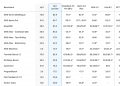
The Agentic Coding section of the official Hy4 preview benchmark appendix published by Tencent, a table comparing Hy3 and Hy4 preview against DeepSeek V4 Pro 0813, Qwen 3.8 Max, GLM 5.3, Kimi K3, GPT 5.6 Sol and Claude Opus 5 across SWE-bench Multilingual, SWE-bench Pro, DeepSWE, three SWE Atlas tasks, SWE-Marathon, Terminal-Bench 2.1, NL2Repo-Bench, CyberGym, ProgramBench, PostTrainBench and Harbor-Index.

Tencent’s 770B Hy4 tops one benchmark row in 46

3 September 2026
Answer card: Qwen 3.7 Max is API-only and cannot run locally yet; the open Qwen models (Qwen 3.6 27B, qwen3:8b to 32b) run offline via Ollama.

Qwen 3.7 local: what you can actually run offline

22 June 2026
Answer card: JWTs are not encrypted, anyone can read them; the signature proves who issued the token, not who may read it.

Are JWTs encrypted? No, and the difference will bite you

0
Answer card: a random 8 character password falls in under 2 hours offline, while 16 random characters hold for 1.4 trillion years at the same speed.

How long does it take to crack a password in 2026?

0
Answer card: three DNS records decide if your mail lands or bounces; SPF lists allowed senders, DKIM signs messages, DMARC sets the failure policy.

SPF, DKIM and DMARC explained: the records your email needs

0
Answer card stating that Qwen-Image-2.1, released on 20 September 2026, ships open weights with a 7 billion parameter diffusion transformer, a Qwen3-VL 8B text encoder and an RGBA VAE totalling about 33 gigabytes in BF16, under the Qwen Research License that limits use to research or evaluation and requires a separate commercial licence, unlike the Apache 2.0 licence of Qwen-Image 1.0.

Qwen-Image-2.1 brings the weights back, but not the Apache licence

21 September 2026
Answer card stating that Ternary Bonsai 2 27B, released by PrismML on 17 September 2026 under Apache 2.0, packs Qwen3.8 27B into 5.95 gigabytes at 1.72 bits per weight, keeps 98.2 percent of the 14-benchmark average, about 75 percent on SWE-bench Verified and Terminal-Bench 2.1, and needs PrismML's llama.cpp fork to run.

Does Bonsai 2 27B really keep 98% of Qwen3.8 in 5.95 GB?

20 September 2026
Answer card stating that Jev 1.13 from TypeSafe AI is a decision model in early access since 15 September 2026 that returns typed probabilities instead of text, priced at 42 dollars per billion input tokens with output tokens free, answering in 70 to 500 milliseconds, with a 64K token request budget, text input only, and a documented list of things it does badly, including counting and dates.

Jev 1.13 bills $42 a billion tokens, and it can’t count

19 September 2026
  • About
  • Contact
  • Privacy
  • Legal

Copyright © 2026 Stephane Cardon.

Welcome Back!

Login to your account below

Forgotten Password?

Retrieve your password

Please enter your username or email address to reset your password.

Log In
No Result
View All Result
  • Home
  • Articles
    • Security
    • Network
    • Dev
    • Sysadmin
    • SEO
    • Email & DNS
  • Tools
    • Network tools: free, fast, no signup
    • Security tools: free, fast, no signup
    • Developer tools: free, fast, no signup
    • Sysadmin tools: free, fast, no signup
    • SEO tools: free, fast, no signup
    • Email & DNS tools: free, fast, no signup
  • Download
  • About

Copyright © 2026 Stephane Cardon.