
• Latest
  • Trending
  • All
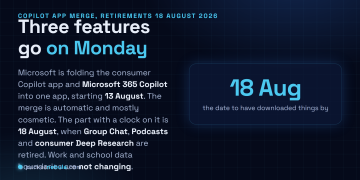
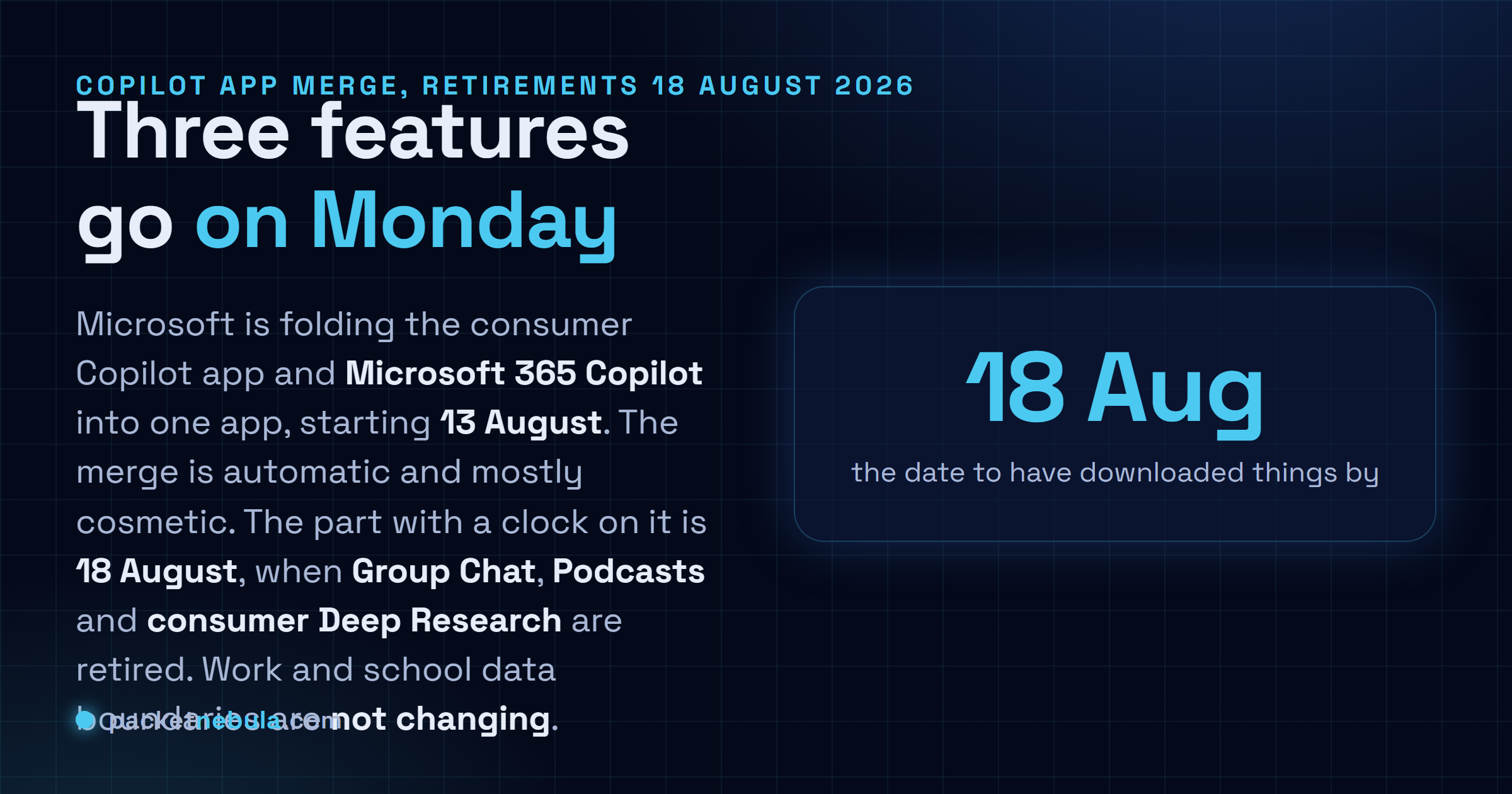
Answer card: Microsoft began merging the consumer Copilot app and Microsoft 365 Copilot into a single application on 13 August 2026, with mobile and web worldwide in mid August and Windows and Mac in mid September, and retires Copilot Group Chat, Podcasts and consumer Deep Research on 18 August 2026 while leaving work and school data boundaries unchanged.

Microsoft merged the Copilot apps, and three features retire

3 September 2026
Answer card stating that Qwen-Image-2.1, released on 20 September 2026, ships open weights with a 7 billion parameter diffusion transformer, a Qwen3-VL 8B text encoder and an RGBA VAE totalling about 33 gigabytes in BF16, under the Qwen Research License that limits use to research or evaluation and requires a separate commercial licence, unlike the Apache 2.0 licence of Qwen-Image 1.0.

Qwen-Image-2.1 brings the weights back, but not the Apache licence

21 September 2026
Answer card stating that Ternary Bonsai 2 27B, released by PrismML on 17 September 2026 under Apache 2.0, packs Qwen3.8 27B into 5.95 gigabytes at 1.72 bits per weight, keeps 98.2 percent of the 14-benchmark average, about 75 percent on SWE-bench Verified and Terminal-Bench 2.1, and needs PrismML's llama.cpp fork to run.

Does Bonsai 2 27B really keep 98% of Qwen3.8 in 5.95 GB?

20 September 2026
Answer card stating that Jev 1.13 from TypeSafe AI is a decision model in early access since 15 September 2026 that returns typed probabilities instead of text, priced at 42 dollars per billion input tokens with output tokens free, answering in 70 to 500 milliseconds, with a 64K token request budget, text input only, and a documented list of things it does badly, including counting and dates.

Jev 1.13 bills $42 a billion tokens, and it can’t count

19 September 2026
Answer card stating that Qwen3.8-Omni-Flash launched on 17 September 2026 as an API only model on Alibaba Cloud Model Studio, taking text, images, audio and video in a 1M token context and returning text only, priced at 0.15 dollars per million input tokens for every modality and 0.47 dollars per million output tokens in the international regions, with no open weights published and the Qwen-Live Harness GitHub repository returning 404.

Qwen3.8-Omni-Flash bills audio at $0.15 and ships no weights

18 September 2026
Answer card stating that on 15 September 2026 AWS said it is unable to restore access to resources and data hosted exclusively in the Middle East Bahrain region me-south-1 and in the mec1-az2 zone of the UAE region, because the damage spanned multiple Availability Zones and exceeded what multi-AZ services are designed to withstand.

AWS can’t restore me-south-1, six months after the drone strikes

17 September 2026
Answer card stating that Google released Gemini 3.8 Live and Gemini 3.8 Live Extended Thinking on 15 September 2026 at 3 dollars per million audio input tokens and 12 dollars out, that the thinking model requires asynchronous tools, and that Artificial Analysis scores it 82.6 on its Speech to Speech Quality Index.

Gemini 3.8 Live Extended Thinking rejects any tool that blocks

16 September 2026
Answer card summarising the Atria Dawn Preview release: 744B GLM-5.2 base, MIT licence, 1.5 TB BF16 and 756 GB FP8 checkpoints, 256K context, top on five of sixteen benchmark rows and trailing on SWE-bench Pro.

Atria Dawn Preview is 744B under MIT, and the BF16 weighs 1.5 TB

15 September 2026
Answer card stating that OpenAI released the Agents API in public beta on 10 September 2026 with no separate fee, billed through model tokens, tool calls and hosted sandbox time, with a choice of OpenAI hosted, self hosted or partner sandboxes, US only data residency and no Zero Data Retention support.

OpenAI’s Agents API has no fee, no ZDR and a one hour sandbox clock

14 September 2026
Answer card: Sakana Fugu Max at $2 and $6 per million tokens, Fugu Ultra v2 unchanged at $5 and $30, and Sakana saying Ultra v2 scores without Fable 5 or GPT-6 Astra in its pool.

Fugu Max costs $2 and $6 while Fugu Ultra v2 runs without Fable 5

13 September 2026
Answer card stating that DeepSeek released DeepSeek-V4.1-Flash on 10 September 2026 as a 552 billion parameter mixture of experts model with a new causal encoder decoder architecture that activates 8 billion parameters on input and 16 billion on output, with native vision, a one million token context and MIT licensed weights, that the API model name is now deepseek-flash at 0.15 dollars per million input tokens and 0.60 dollars per million output tokens off peak, and that DeepSeek announced V4 Pro would be routed to V4.1-Flash from 14 September and reversed that on 11 September.

DeepSeek V4.1-Flash arrived, and the V4 Pro retirement lasted a day

12 September 2026
Answer card stating that Cognition released SWE-2 on 10 September 2026, a coding model post-trained from Kimi K3, scoring 50.0 percent on FrontierCode 1.1 Main against 50.9 percent for Claude Fable 5.1 and 27.3 percent on Terminal-Bench 4 against 55.8 percent, available only inside Devin.

SWE-2 trails Fable 5.1 by one point, and by 28 on Terminal-Bench 4

11 September 2026
Answer card for Meta Muse, free to 100 million tokens a week then $20 a month, launched 8 September 2026 for United States adults only, running in a dedicated per user virtual machine.

Does Meta Muse do enough to earn your inbox and a card on file?

9 September 2026
  • About
  • Contact
  • Privacy
  • Legal
Monday, September 21, 2026
  • Login
Packet Nebula
  • Home
  • Articles
    • Security
    • Network
    • Dev
    • Sysadmin
    • SEO
    • Email & DNS
  • Tools
    • Network tools: free, fast, no signup
    • Security tools: free, fast, no signup
    • Developer tools: free, fast, no signup
    • Sysadmin tools: free, fast, no signup
    • SEO tools: free, fast, no signup
    • Email & DNS tools: free, fast, no signup
  • Download
  • About
No Result
View All Result
Packet Nebula
No Result
View All Result
Home Dev

Microsoft merged the Copilot apps, and three features retire

by stephane
3 September 2026
in Dev
0
Answer card: Microsoft began merging the consumer Copilot app and Microsoft 365 Copilot into a single application on 13 August 2026, with mobile and web worldwide in mid August and Windows and Mac in mid September, and retires Copilot Group Chat, Podcasts and consumer Deep Research on 18 August 2026 while leaving work and school data boundaries unchanged.
491
SHARES
1.4k
VIEWS
Share on FacebookShare on Twitter

The app icon changing is not the story. Microsoft started merging the consumer Copilot app into Microsoft 365 Copilot on 13 August, and on 18 August it retires three features inside it: Group Chat, Podcasts, and Deep Research for anyone not paying. Your chats come across on their own, so the merge itself asks nothing of you. The retirements do. Podcasts is the sharp one, because Microsoft says previously created podcasts will not be accessible afterwards and shared links stop working, and the coverage cannot agree on whether you can export them first. We went to the help page. Short version: try the download button today, because Monday is the whole window.

The short answer

Microsoft is folding its two Copilot apps into one, and that part needs nothing from you. Five days later it retires three features. Podcasts is the only one where content genuinely stops being reachable, and it is also the one the coverage got muddled about. Download first, argue later.
18 AugGroup Chat, Podcasts, consumer Deep Research
automaticthe app merge itself, chats included
unchangedtenant controls and data boundaries
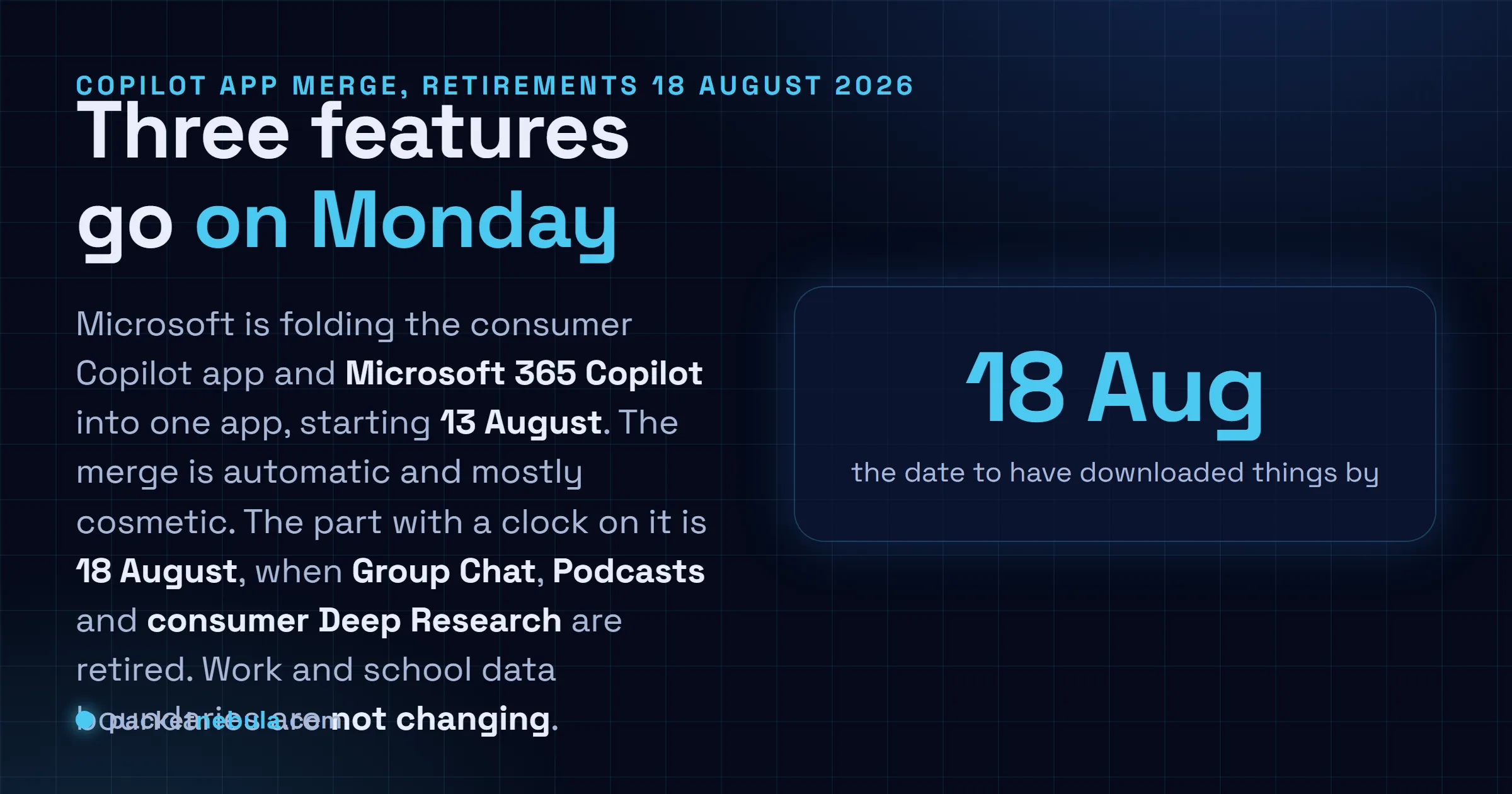
Answer card: Microsoft began merging the consumer Copilot app and Microsoft 365 Copilot into a single application on 13 August 2026, with worldwide mobile and web rollout in mid August and Windows and Mac apps in mid September, and is retiring Copilot Group Chat, Podcasts and consumer Deep Research on 18 August 2026.
One of these dates asks something of you. It is not the merge.

The merge, briefly

Two apps called Copilot have coexisted for a while now. The consumer one with the chat and the image generation, and Microsoft 365 Copilot with the work documents behind it. From 13 August they became one app, starting with Windows Insiders.

You sign in with a personal account, a work or school account, or both, and switch between them inside the same shell. Microsoft is explicit that the data stays apart: commercial data boundaries, tenant controls and compliance protections are not changing, and nothing entered in the work experience flows into the personal one. If you administer a tenant, that is the sentence you wanted and it is on the record.

The rollout runs in waves. Mobile and web worldwide through mid August, Windows and Mac apps in mid September.

Honestly, as reorganisations go this one is dull, and dull is fine. Microsoft has said a proper “super app” is coming later in the year, with coding and agents folded in. This is not that. This is the plumbing.
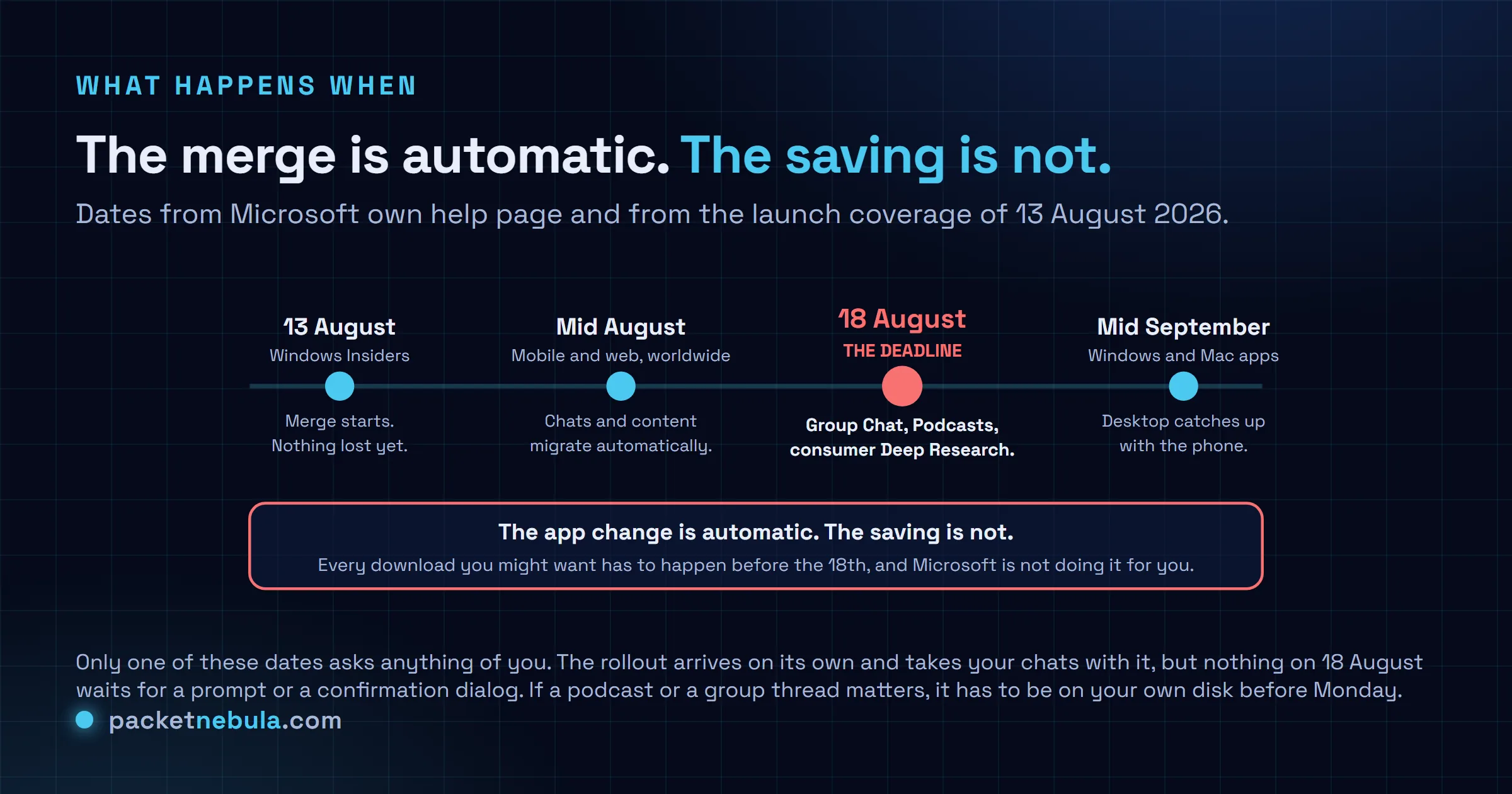
Timeline of the Copilot app merge: Windows Insiders from 13 August 2026, worldwide mobile and web rollout in mid August, retirement of Group Chat, Podcasts and consumer Deep Research on 18 August 2026, and Windows and Mac desktop apps following in mid September 2026.
The rollout arrives on its own. The 18th does not wait for you.

What actually goes on Monday

Three features, all consumer side.

Group Chat. Microsoft says group chats are migrated as individual chats, with existing messages and artifacts still accessible afterwards. So the threads are not being torched. What Microsoft asks you to do before the date is download any media shared by other participants that you want to keep, which is a fairly loud hint about which part does not survive. At least one outlet went further and reported that shared content and images in group conversations get deleted. We cannot reconcile those two accounts from published material, and I would not spend the weekend trying. Save the images.

Podcasts. This is the real deletion. Previously created podcasts will not be accessible after 18 August, and shared podcast links stop working.

Deep Research, for consumers. New reports stop, but Microsoft says existing research content stays available, with reporting describing an export to Word. Microsoft 365 Premium subscribers keep the Researcher agent, which does the same job against the web plus your work data with citations. So for paying users this is a rename and a move. For free users it is a feature that used to be there and now is not, which is worth naming plainly rather than dressing up as consolidation.

The podcast export mess

Here is where the reporting fell apart, and it matters because it is the only bit with a real clock on it.

A run of coverage this week said flatly that Copilot Podcasts ships with no export option, that the feature never included any way to download or save the generated audio outside Copilot, and that everything you made is simply gone on the 18th. Headlines to that effect are still up.

Microsoft own help page says something different. It tells you to download individual podcasts from your podcast library using the download option.

Those cannot both be true. We have not been able to test it, so we are not going to tell you which one is right. What we will tell you is the only sensible response: open the podcast library today and press whatever download control is there. If it works, you have your files and the reporting was stale. If it does not, you have lost four minutes and you knew before Monday instead of after.

That is generally the move with a retirement notice. The vendor page and the coverage disagree surprisingly often, and the tie is broken by trying it, not by reading more articles about it.
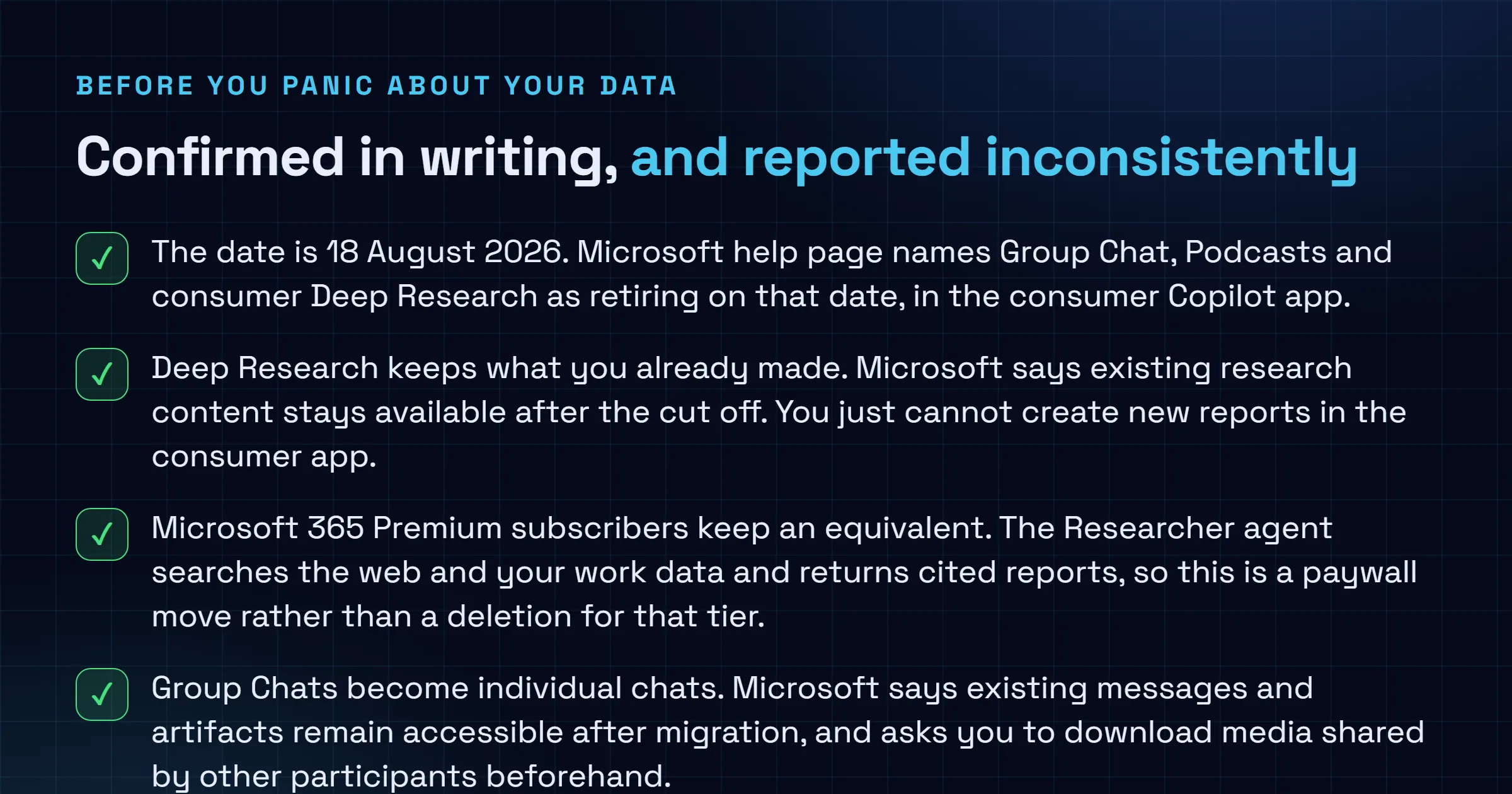
Checklist separating what Microsoft has confirmed in writing about the Copilot merge and the 18 August 2026 retirements from the points that the launch coverage reports inconsistently, including whether podcasts can be downloaded and what happens to group chat media.
Five things on the record, four worth checking yourself.

What we would actually do about it

If you never touched Podcasts or Group Chat, nothing. Genuinely nothing. The app updates itself, your history comes across, and Tuesday looks like Friday did.

If you did make podcasts, that is the one errand. Today or tomorrow, not Monday morning.

If you leaned on consumer Deep Research as a free research tool, the honest read is that it has moved behind Microsoft 365 Premium and you now have a choice to make. Plenty of people were using it precisely because it was the free one, and Researcher is not a consolation prize if you were never going to pay.

And if you run a tenant, the thing to watch is not this week at all. It is the September desktop wave, plus whatever the super app turns out to mean when it lands with agents attached. This merge changed the shell. The next one is supposed to change what the shell can do.

One small thing that still bugs me. All of this went out as an updated help page. No announcement post, no press release. A vendor is allowed to do that, and for a UI merge it is even reasonable. But three features with content behind them are being retired on a five day notice, and a help page revision is a thin way to tell people. If you had asked me to guess where users would learn about it, I would have said “when the feature is missing”, and for most of them that is exactly what will happen.

For what it is worth, we wrote up the Gemini 3.7 Flash pricing change on a similar note earlier this week: the announcement was the good news and the calendar entry was the part that cost you something. Same shape here.

Sources

Microsoft, Updates to Copilot and the Microsoft Copilot app, for the 18 August 2026 retirement date, the group chats migrating as individual chats, the instruction to download media shared by other participants, the podcast library download option, the statement that existing Deep Research content remains available, and the wording that commercial data boundaries, tenant controls and compliance protections are not changing. GeekWire, Microsoft starts merging its Copilot consumer and business apps, for the 13 August Windows Insider start, the mid August mobile and web wave, the mid September Windows and Mac wave, and the later super app plan. The Register, Microsoft dueling Copilot apps have combined into a single entity, for the report that shared content and images in group conversations are deleted and that shared podcast links stop working. Thurrott, Microsoft is retiring Copilot Deep Research and Podcasts, for the Researcher agent as the Microsoft 365 Premium equivalent, the export of saved research reports to Word, and the reporting that no podcast export option is available.

Frequently asked questions

What is Microsoft retiring in Copilot on 18 August 2026?

Three things, all in the consumer Copilot app: Group Chat, Podcasts, and Deep Research. Microsoft help page names the date directly. Work and school Copilot is not affected by the retirements, and Microsoft 365 Premium subscribers keep a comparable research feature called the Researcher agent.

Can I download my Copilot podcasts before they are deleted?

Microsoft help page says you can download individual podcasts from your podcast library using the download option, so try that first. Be aware that several outlets reported there is no export path at all. The accounts conflict, the deadline does not, so open the library and attempt the download rather than deciding which report is right.

Do my Copilot Deep Research reports disappear?

No. Microsoft says existing Deep Research content remains available after 18 August 2026, and reporting describes exporting saved reports to Word. What ends is the ability to create new ones in the consumer app. If you want new research reports after that date you need Microsoft 365 Premium and its Researcher agent.

What happens to Copilot group chats?

They are migrated as individual chats, and Microsoft says existing messages and artifacts stay accessible. The catch is media: Microsoft asks you to download anything shared by other participants before 18 August, and at least one outlet reported shared content and images in group conversations are deleted. Save what matters rather than trusting either version.

Does the Copilot merge change anything for work or school accounts?

Not on the compliance side. Microsoft states that commercial data boundaries, tenant controls and compliance protections are not changing, and that data entered in the work experience does not flow into the personal one or the reverse. What changes is the app: you sign into one application and switch between account types inside it.

When does the merged Copilot app reach Windows and Mac?

Mid September 2026, going by the rollout schedule reported at launch. Windows Insiders started receiving it the week of 13 August, and the worldwide mobile and web rollout runs through mid August. The desktop apps are the last wave.

Tags: aibig-techcopilotmicrosoftnewsproductivity
Share196Tweet123
stephane

stephane

  • Trending
  • Comments
  • Latest
Answer card: Proton Lumo 2.0 is private by policy, not by locality. Saved history is locked so even Proton cannot read it, but the prompt is decrypted on a Proton EU server to answer it, then forgotten.

Proton Lumo 2.0 review: how private is it, really?

3 September 2026
The Agentic Coding section of the official Hy4 preview benchmark appendix published by Tencent, a table comparing Hy3 and Hy4 preview against DeepSeek V4 Pro 0813, Qwen 3.8 Max, GLM 5.3, Kimi K3, GPT 5.6 Sol and Claude Opus 5 across SWE-bench Multilingual, SWE-bench Pro, DeepSWE, three SWE Atlas tasks, SWE-Marathon, Terminal-Bench 2.1, NL2Repo-Bench, CyberGym, ProgramBench, PostTrainBench and Harbor-Index.

Tencent’s 770B Hy4 tops one benchmark row in 46

3 September 2026
Answer card: Qwen 3.7 Max is API-only and cannot run locally yet; the open Qwen models (Qwen 3.6 27B, qwen3:8b to 32b) run offline via Ollama.

Qwen 3.7 local: what you can actually run offline

22 June 2026
Answer card: JWTs are not encrypted, anyone can read them; the signature proves who issued the token, not who may read it.

Are JWTs encrypted? No, and the difference will bite you

0
Answer card: a random 8 character password falls in under 2 hours offline, while 16 random characters hold for 1.4 trillion years at the same speed.

How long does it take to crack a password in 2026?

0
Answer card: three DNS records decide if your mail lands or bounces; SPF lists allowed senders, DKIM signs messages, DMARC sets the failure policy.

SPF, DKIM and DMARC explained: the records your email needs

0
Answer card stating that Qwen-Image-2.1, released on 20 September 2026, ships open weights with a 7 billion parameter diffusion transformer, a Qwen3-VL 8B text encoder and an RGBA VAE totalling about 33 gigabytes in BF16, under the Qwen Research License that limits use to research or evaluation and requires a separate commercial licence, unlike the Apache 2.0 licence of Qwen-Image 1.0.

Qwen-Image-2.1 brings the weights back, but not the Apache licence

21 September 2026
Answer card stating that Ternary Bonsai 2 27B, released by PrismML on 17 September 2026 under Apache 2.0, packs Qwen3.8 27B into 5.95 gigabytes at 1.72 bits per weight, keeps 98.2 percent of the 14-benchmark average, about 75 percent on SWE-bench Verified and Terminal-Bench 2.1, and needs PrismML's llama.cpp fork to run.

Does Bonsai 2 27B really keep 98% of Qwen3.8 in 5.95 GB?

20 September 2026
Answer card stating that Jev 1.13 from TypeSafe AI is a decision model in early access since 15 September 2026 that returns typed probabilities instead of text, priced at 42 dollars per billion input tokens with output tokens free, answering in 70 to 500 milliseconds, with a 64K token request budget, text input only, and a documented list of things it does badly, including counting and dates.

Jev 1.13 bills $42 a billion tokens, and it can’t count

19 September 2026
  • About
  • Contact
  • Privacy
  • Legal

Copyright © 2026 Stephane Cardon.

Welcome Back!

Login to your account below

Forgotten Password?

Retrieve your password

Please enter your username or email address to reset your password.

Log In
No Result
View All Result
  • Home
  • Articles
    • Security
    • Network
    • Dev
    • Sysadmin
    • SEO
    • Email & DNS
  • Tools
    • Network tools: free, fast, no signup
    • Security tools: free, fast, no signup
    • Developer tools: free, fast, no signup
    • Sysadmin tools: free, fast, no signup
    • SEO tools: free, fast, no signup
    • Email & DNS tools: free, fast, no signup
  • Download
  • About

Copyright © 2026 Stephane Cardon.