
• Latest
  • Trending
  • All
NVIDIA launch artwork for Nemotron 3.5 Lightning, the model name set over a dark green graphic with a stylised lightning motif, from the NVIDIA blog post announcing the release.

Nemotron 3.5 Lightning runs 30B on 3B active parameters

3 September 2026
Answer card for Claude Opus 5.5: 4 dollars in and 20 dollars out per million tokens, down from 5 and 25, with cache reads at 20 cents.

Claude Opus 5.5 drops to $4 and $20, and breaks four Opus 5 habits

23 September 2026
The official xAI announcement card for Grok 4.7, white type on a dark grey and navy gradient.

Grok 4.7 keeps $2 and $6, and its gains over 4.6 are xhigh versus high

22 September 2026
Answer card stating that Qwen-Image-2.1, released on 20 September 2026, ships open weights with a 7 billion parameter diffusion transformer, a Qwen3-VL 8B text encoder and an RGBA VAE totalling about 33 gigabytes in BF16, under the Qwen Research License that limits use to research or evaluation and requires a separate commercial licence, unlike the Apache 2.0 licence of Qwen-Image 1.0.

Qwen-Image-2.1 brings the weights back, but not the Apache licence

21 September 2026
Answer card stating that Ternary Bonsai 2 27B, released by PrismML on 17 September 2026 under Apache 2.0, packs Qwen3.8 27B into 5.95 gigabytes at 1.72 bits per weight, keeps 98.2 percent of the 14-benchmark average, about 75 percent on SWE-bench Verified and Terminal-Bench 2.1, and needs PrismML's llama.cpp fork to run.

Does Bonsai 2 27B really keep 98% of Qwen3.8 in 5.95 GB?

20 September 2026
Answer card stating that Jev 1.13 from TypeSafe AI is a decision model in early access since 15 September 2026 that returns typed probabilities instead of text, priced at 42 dollars per billion input tokens with output tokens free, answering in 70 to 500 milliseconds, with a 64K token request budget, text input only, and a documented list of things it does badly, including counting and dates.

Jev 1.13 bills $42 a billion tokens, and it can’t count

19 September 2026
Answer card stating that Qwen3.8-Omni-Flash launched on 17 September 2026 as an API only model on Alibaba Cloud Model Studio, taking text, images, audio and video in a 1M token context and returning text only, priced at 0.15 dollars per million input tokens for every modality and 0.47 dollars per million output tokens in the international regions, with no open weights published and the Qwen-Live Harness GitHub repository returning 404.

Qwen3.8-Omni-Flash bills audio at $0.15 and ships no weights

18 September 2026
Answer card stating that on 15 September 2026 AWS said it is unable to restore access to resources and data hosted exclusively in the Middle East Bahrain region me-south-1 and in the mec1-az2 zone of the UAE region, because the damage spanned multiple Availability Zones and exceeded what multi-AZ services are designed to withstand.

AWS can’t restore me-south-1, six months after the drone strikes

17 September 2026
Answer card stating that Google released Gemini 3.8 Live and Gemini 3.8 Live Extended Thinking on 15 September 2026 at 3 dollars per million audio input tokens and 12 dollars out, that the thinking model requires asynchronous tools, and that Artificial Analysis scores it 82.6 on its Speech to Speech Quality Index.

Gemini 3.8 Live Extended Thinking rejects any tool that blocks

16 September 2026
Answer card summarising the Atria Dawn Preview release: 744B GLM-5.2 base, MIT licence, 1.5 TB BF16 and 756 GB FP8 checkpoints, 256K context, top on five of sixteen benchmark rows and trailing on SWE-bench Pro.

Atria Dawn Preview is 744B under MIT, and the BF16 weighs 1.5 TB

15 September 2026
Answer card stating that OpenAI released the Agents API in public beta on 10 September 2026 with no separate fee, billed through model tokens, tool calls and hosted sandbox time, with a choice of OpenAI hosted, self hosted or partner sandboxes, US only data residency and no Zero Data Retention support.

OpenAI’s Agents API has no fee, no ZDR and a one hour sandbox clock

14 September 2026
Answer card: Sakana Fugu Max at $2 and $6 per million tokens, Fugu Ultra v2 unchanged at $5 and $30, and Sakana saying Ultra v2 scores without Fable 5 or GPT-6 Astra in its pool.

Fugu Max costs $2 and $6 while Fugu Ultra v2 runs without Fable 5

13 September 2026
Answer card stating that DeepSeek released DeepSeek-V4.1-Flash on 10 September 2026 as a 552 billion parameter mixture of experts model with a new causal encoder decoder architecture that activates 8 billion parameters on input and 16 billion on output, with native vision, a one million token context and MIT licensed weights, that the API model name is now deepseek-flash at 0.15 dollars per million input tokens and 0.60 dollars per million output tokens off peak, and that DeepSeek announced V4 Pro would be routed to V4.1-Flash from 14 September and reversed that on 11 September.

DeepSeek V4.1-Flash arrived, and the V4 Pro retirement lasted a day

12 September 2026
  • About
  • Contact
  • Privacy
  • Legal
Wednesday, September 23, 2026
  • Login
Packet Nebula
  • Home
  • Articles
    • Security
    • Network
    • Dev
    • Sysadmin
    • SEO
    • Email & DNS
  • Tools
    • Network tools: free, fast, no signup
    • Security tools: free, fast, no signup
    • Developer tools: free, fast, no signup
    • Sysadmin tools: free, fast, no signup
    • SEO tools: free, fast, no signup
    • Email & DNS tools: free, fast, no signup
  • Download
  • About
No Result
View All Result
Packet Nebula
No Result
View All Result
Home Dev

Nemotron 3.5 Lightning runs 30B on 3B active parameters

by stephane
3 September 2026
in Dev
0
NVIDIA launch artwork for Nemotron 3.5 Lightning, the model name set over a dark green graphic with a stylised lightning motif, from the NVIDIA blog post announcing the release.
497
SHARES
1.4k
VIEWS
Share on FacebookShare on Twitter

Thirty billion parameters, and only three billion of them wake up per token. That ratio is the whole pitch for what NVIDIA published on 11 August: Nemotron 3.5 Lightning, a mixture-of-experts model with open weights on Hugging Face under a plain OpenMDW 1.1 licence, aimed at agents that run all day instead of chatbots that answer once. The speed claim is the loud part, and unusually it survives an outside harness. Artificial Analysis clocked it at 350.9 output tokens per second against a median of 99.5 for models in its class. What doesn't survive is the context number, and one cost comparison NVIDIA really shouldn't have led with.

The short answer

NVIDIA published Nemotron 3.5 Lightning on 11 August 2026: a 30 billion parameter MoE with 3 billion active, on a hybrid Mamba-2 and attention stack, under the permissive OpenMDW 1.1 licence with NVFP4 and BF16 checkpoints. The agentic post-training dataset shipped with it. Independent measurement backs the speed claim. The advertised context and the served context don”t match, and the cost comparison NVIDIA leads with is its own benchmark.
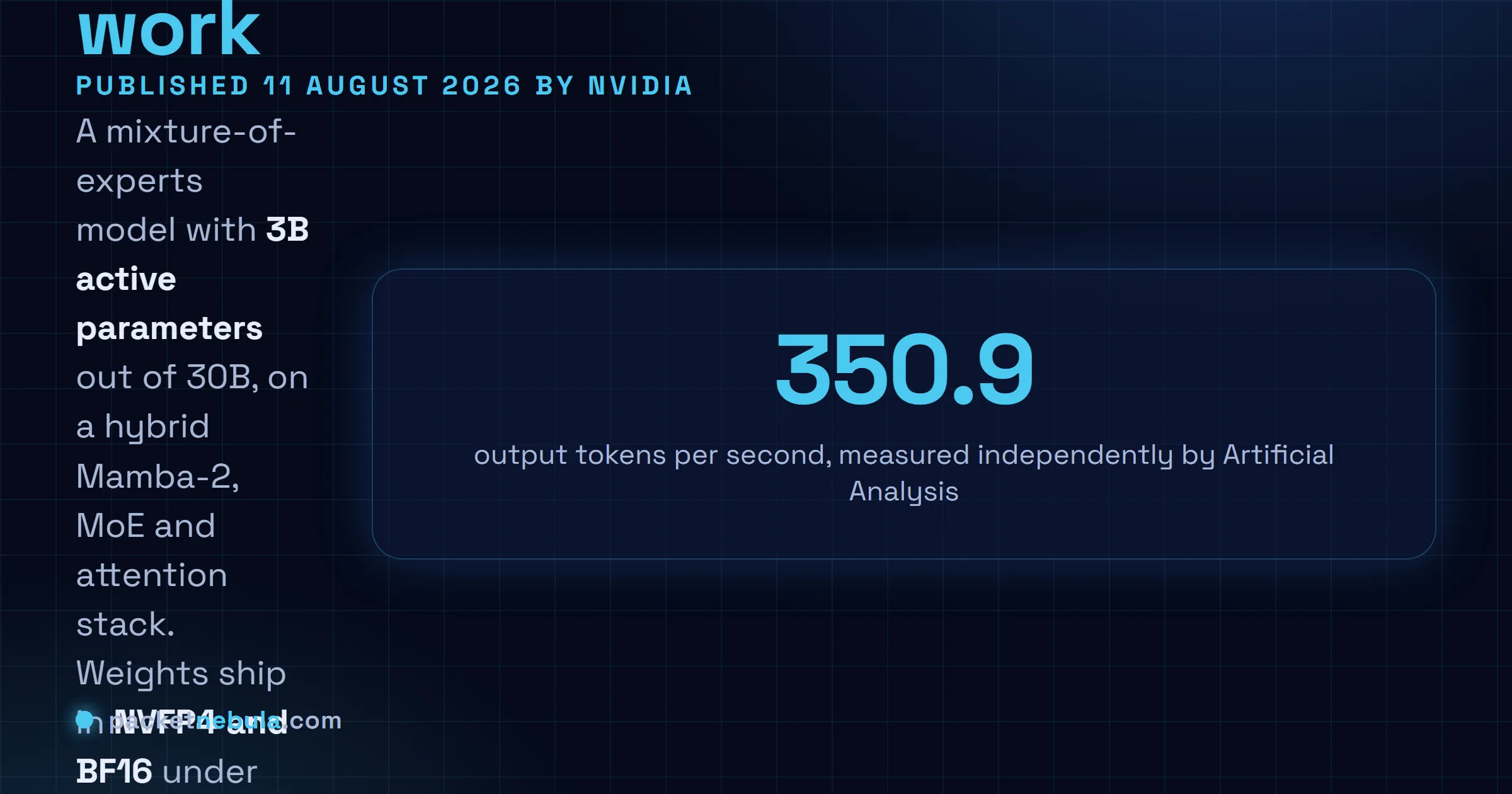
3Bactive parameters out of 30B, mixture of experts
350.9 t/soutput speed, measured by Artificial Analysis, not NVIDIA
262Kcontext actually served, against 1M on the model card
Answer card: NVIDIA released Nemotron 3.5 Lightning on 11 August 2026, a 30 billion parameter mixture of experts model with 3 billion active parameters on a hybrid Mamba-2, MoE and attention stack, published under the OpenMDW licence version 1.1 with NVFP4 and BF16 checkpoints on Hugging Face, measured independently at 350.9 output tokens per second.
The active parameter count is the number that decides your serving bill.

What the sparsity actually buys you

Ten to one. That’s the ratio between what the model weighs and what it computes, and it’s why this thing is fast rather than merely cheap to store.

A mixture-of-experts model keeps all 30 billion parameters resident but routes each token through a small slice of them. So memory scales with the full model while compute scales with the 3 billion. NVIDIA went further and built the backbone as a hybrid, mixing Mamba-2 state-space layers with attention and the MoE blocks, which is where the throughput comes from on long inputs. Attention costs grow with sequence length. Mamba layers don’t, or rather they grow far more politely.

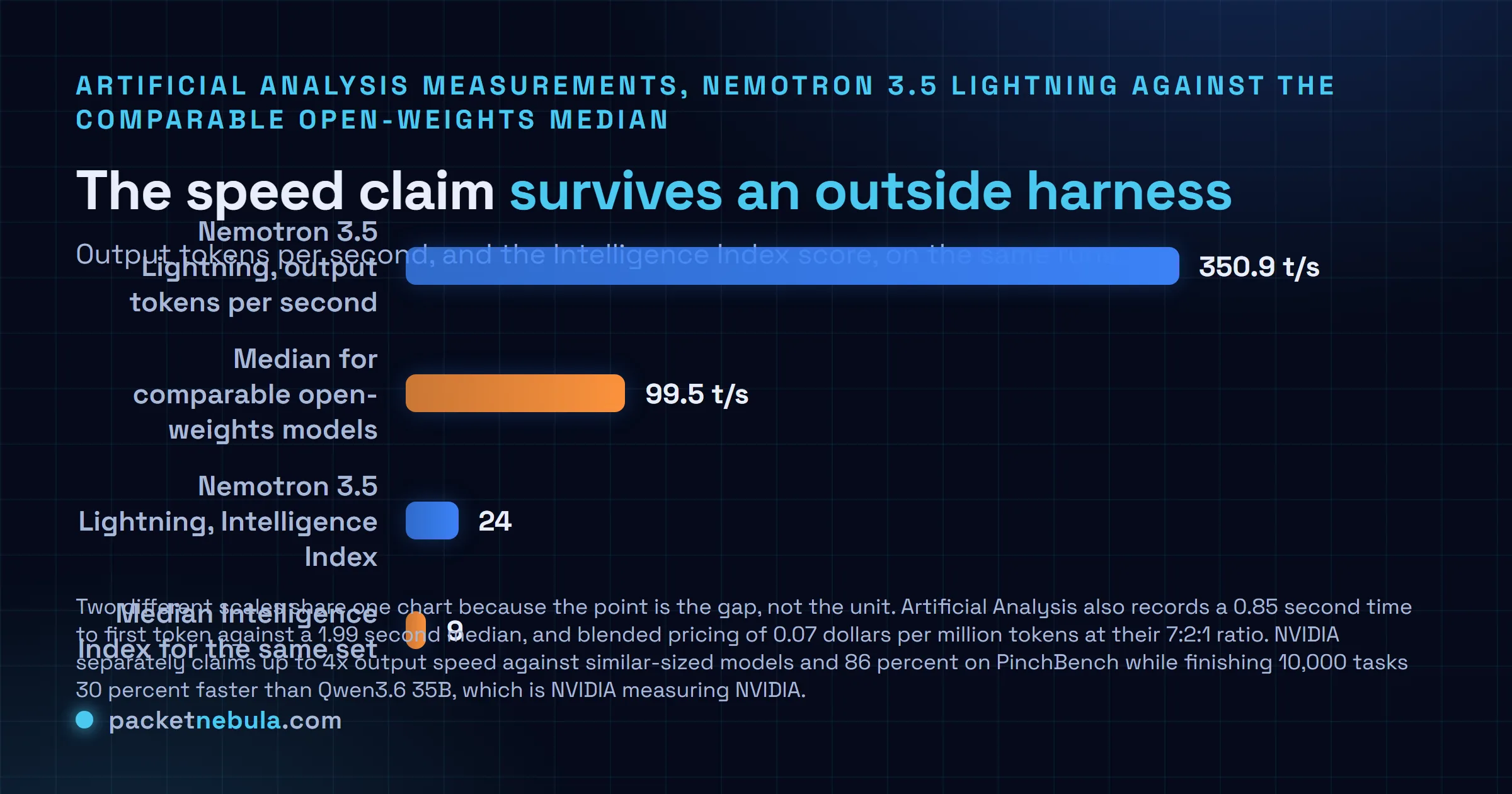
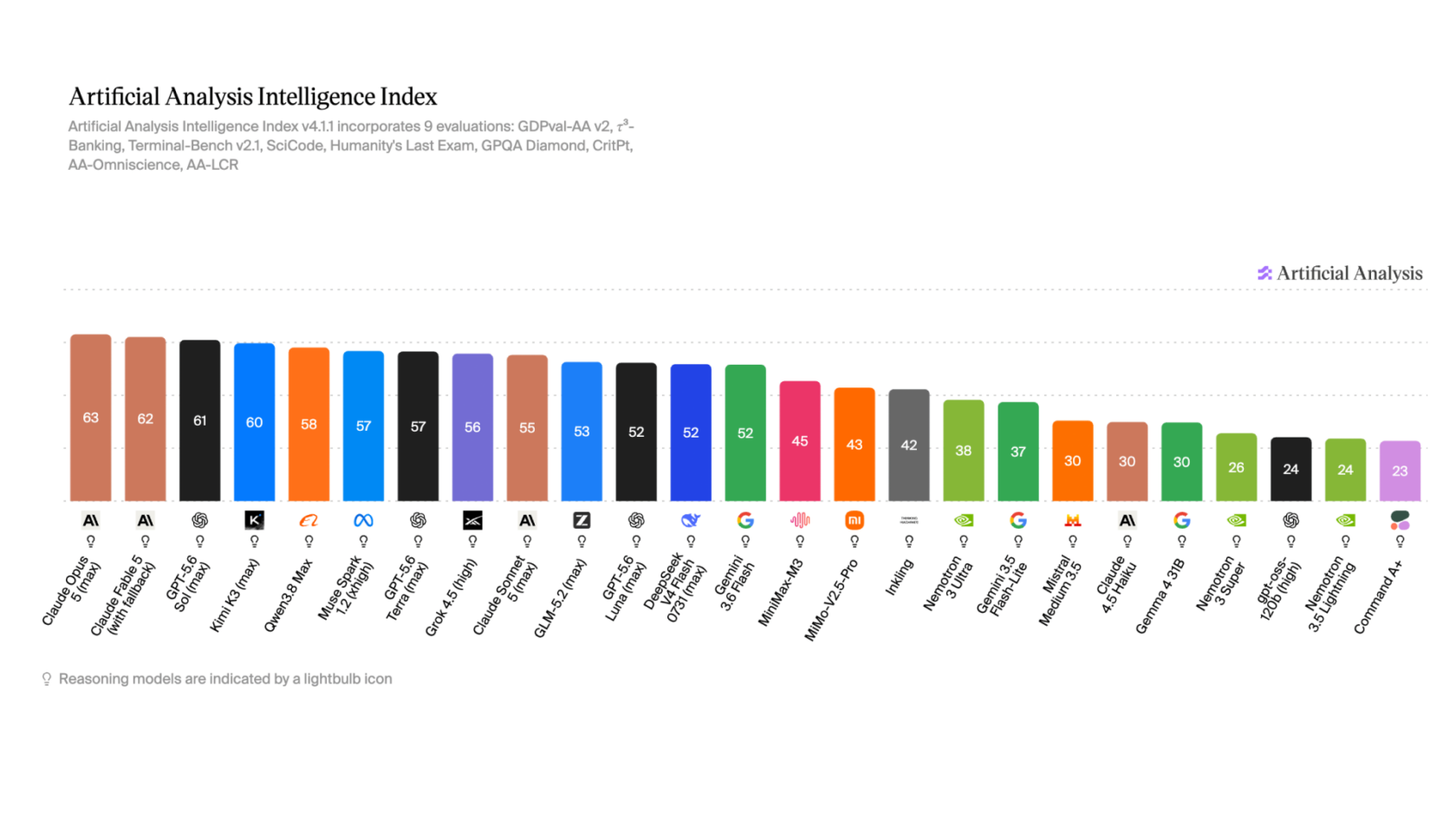
The result reads well on an outside harness. Artificial Analysis scores it 24 on their Intelligence Index against a median of 9 for comparable open-weights models, at 350.9 output tokens per second against a median of 99.5, with a 0.85 second time to first token where the median is 1.99.
NVIDIA launch artwork for Nemotron 3.5 Lightning, the model name over a dark green graphic with a lightning motif.

Image: NVIDIA

Chart of Artificial Analysis measurements for Nemotron 3.5 Lightning against the median for comparable open weights models: 350.9 output tokens per second versus 99.5, and an Intelligence Index score of 24 versus 9.
Vendor speed claims usually shrink under an outside harness. This one didn't.

I’ll admit I expected the independent numbers to deflate the launch post. They didn’t, and that’s rare enough to say plainly.

The part that shipped quietly

Weights under OpenMDW 1.1, fine. Plenty of that about lately.

The dataset is the interesting bit. NVIDIA released Nemotron-RL-Agentic-Terminal-Pivot, the agentic reinforcement learning set used to post-train the model for coding agent behaviour, which means the recipe for the specific capability being marketed is sitting there for anyone to run against their own base model. Weights without data are a product. Weights with the post-training data are closer to a method. That distinction matters more than the licence text, honestly, and it lands in the middle of a policy argument we wrote up when twenty-five signatories put their names to an open-weights letter.

Where the release stops being straight with you
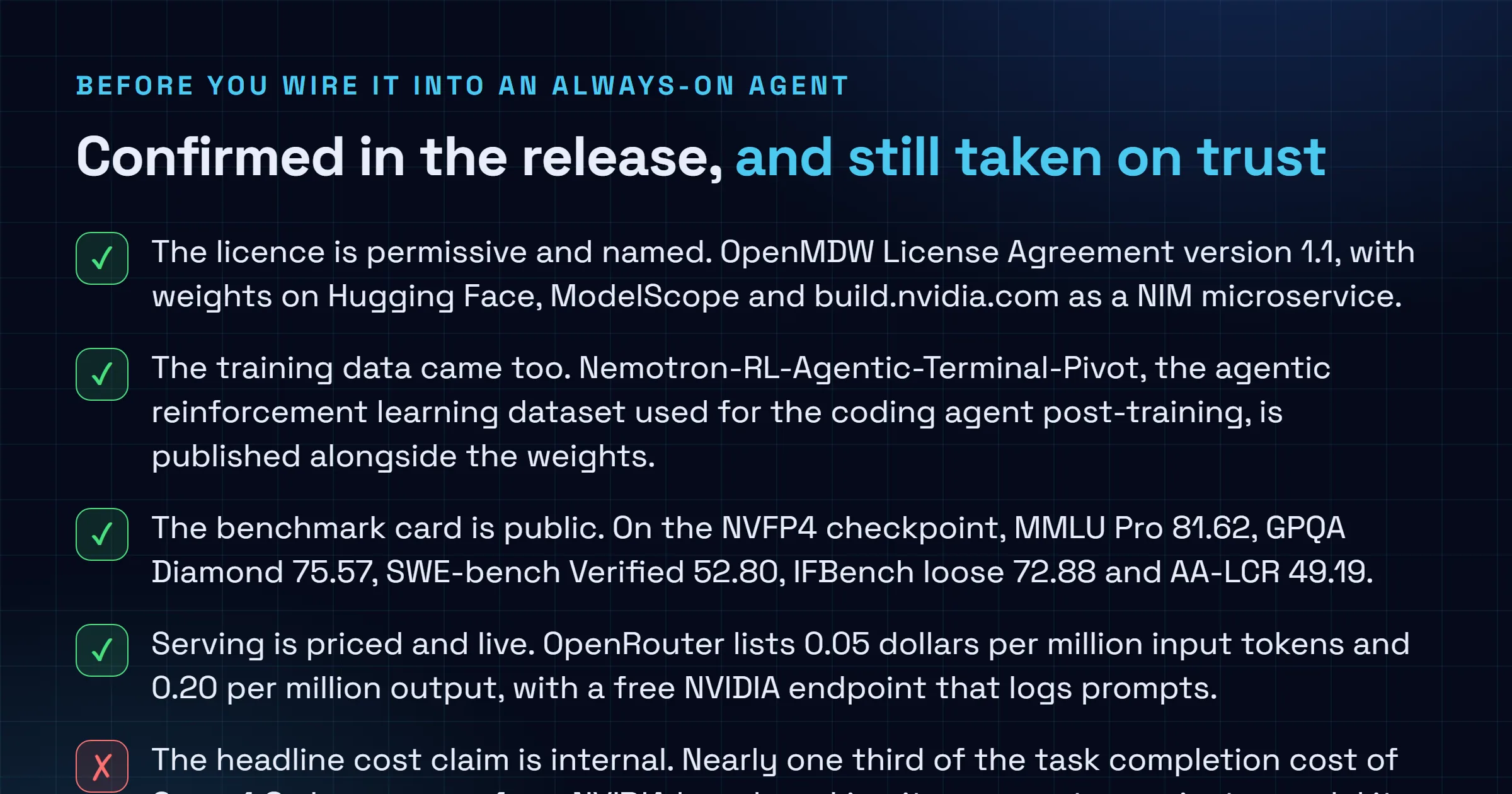
Checklist of what the Nemotron 3.5 Lightning release confirms, including the OpenMDW 1.1 licence, NVFP4 and BF16 checkpoints, the released post-training dataset, published benchmark scores and OpenRouter pricing, against what remains unverified, including the one third of Opus 4.8 routing claim, the gap between the 1M advertised context and the 262K served, and the absence of a published consumer VRAM floor.
Four things you can check. Four you're taking on trust.

Start with context. The model card says up to 1M tokens. OpenRouter serves 262K. Nobody reconciles those, and a factor of four is not a rounding difference. If you’re building around long documents, assume 262K until your own testing says otherwise.

Then the hardware framing. NVIDIA’s blog says RTX PCs, DGX Spark, DGX Station and Jetson. The model card, more carefully, names one H100 or one DGX Spark as the single-GPU deployment targets, and lists GeForce RTX 5090 among supported hardware without publishing a memory floor for it. Those aren’t contradictory, they’re just pitched at different audiences. A 5090 is a 32 GB card and a 30B model in NVFP4 should fit, but should isn’t a spec sheet. Compare that with the 24 GB floor Meta published for Muse Glimmer two days earlier, where at least the number was stated and you could plan against it.

And then Switchyard. The routing library itself is a genuinely useful piece of plumbing, an open-source layer that picks a model per request so you’re not paying frontier rates for tasks that don’t need them. The claim attached to it is where I’d push back: internal benchmarks showing task completion cost at nearly one third of Opus 4.8 alone. NVIDIA built the router, chose the workload, picked the comparison model, and ran the test. Any of us would produce a favourable number under those conditions. Nothing suggests it’s wrong. It’s just not evidence yet.

Who should pick this up

If you’re running high-volume agent loops where the same task shape repeats thousands of times, the economics here are hard to argue with. Half a dollar buys ten million output tokens, the latency is low enough for tool-calling chains that pause constantly, and SWE-bench Verified at 52.80 on the NVFP4 checkpoint says it can hold a coding task without being a frontier model about it.

If you want one strong model to think hard about a small number of problems, this isn’t it, and NVIDIA doesn’t claim it is. Lightning is explicitly the execution layer, the thing Switchyard routes the easy work to.

Two limits before you commit. Post-training data stops in May 2026 and pre-training in September 2025, so recency arrives through tools or not at all. And the language list is short: English plus code, Spanish, French, German, Italian, Japanese. If your users write in something else, test before you promise anything.

Sources

NVIDIA’s announcement is on the NVIDIA blog, with the technical write-up on the NVIDIA developer blog. Architecture, licence, hardware targets and the benchmark table come from the model card on Hugging Face. Independent speed and intelligence measurements are from Artificial Analysis, and serving prices with the 262K context figure from OpenRouter. Release framing cross-checked against CNBC.

Frequently asked questions

What hardware do I need to run Nemotron 3.5 Lightning?

NVIDIA lists Blackwell (DGX Spark and GB10, GB200, GeForce RTX 5090), Hopper (H100 and H200), and Ampere through the W4A16 path. The single-GPU deployment targets it actually names are one H100 or one DGX Spark, so the consumer story is thinner than the RTX PC framing suggests. No VRAM floor is published for the 5090, which is the number we would want before planning a desk deployment. Checkpoints come in NVFP4 and BF16.

Is it really open weights, and under what licence?

Yes, the OpenMDW License Agreement version 1.1, which is permissive and has no user-count threshold bolted on. What makes this release stand out is that the weights aren't the only thing published: NVIDIA also released Nemotron-RL-Agentic-Terminal-Pivot, the agentic reinforcement learning dataset used to post-train the model for coding agent work. Weights are on Hugging Face, ModelScope, and build.nvidia.com as a NIM microservice.

How much does it cost through an API?

OpenRouter lists 0.05 dollars per million input tokens and 0.20 dollars per million output tokens. Artificial Analysis puts the blended figure at 0.07 dollars per million using their 7:2:1 cache to input to output ratio. There's also a free NVIDIA endpoint, and the terms on that one say prompts get logged for security and service improvement, so keep confidential material off it.

Does it really have a 1M token context?

The model card says up to 1M tokens. OpenRouter serves 262K. Both statements are published and nothing on either page reconciles them, so treat 262K as what you get today through the easiest route and test the long end yourself before designing around it. Artificial Analysis measured 49.19 on AA-LCR for the NVFP4 checkpoint, which is a long-context reasoning benchmark and the only public signal we have on how the model behaves out there.

What is NeMo Switchyard?

An open-source routing library that sits in front of a mixed pool of models and sends each request to whichever one suits it, without you rewriting the application. The idea is sound and the code is on GitHub. The headline number attached to it is not independent: NVIDIA says internal benchmarks show it holds frontier-level accuracy while cutting task completion cost to nearly one third of Opus 4.8 alone, which is NVIDIA measuring its own router against a competitor's model.

Tags: agentsaillmnewsnvidiaopen-weights
Share199Tweet124
stephane

stephane

  • Trending
  • Comments
  • Latest
Answer card: Proton Lumo 2.0 is private by policy, not by locality. Saved history is locked so even Proton cannot read it, but the prompt is decrypted on a Proton EU server to answer it, then forgotten.

Proton Lumo 2.0 review: how private is it, really?

3 September 2026
The Agentic Coding section of the official Hy4 preview benchmark appendix published by Tencent, a table comparing Hy3 and Hy4 preview against DeepSeek V4 Pro 0813, Qwen 3.8 Max, GLM 5.3, Kimi K3, GPT 5.6 Sol and Claude Opus 5 across SWE-bench Multilingual, SWE-bench Pro, DeepSWE, three SWE Atlas tasks, SWE-Marathon, Terminal-Bench 2.1, NL2Repo-Bench, CyberGym, ProgramBench, PostTrainBench and Harbor-Index.

Tencent’s 770B Hy4 tops one benchmark row in 46

3 September 2026
Answer card: Qwen 3.7 Max is API-only and cannot run locally yet; the open Qwen models (Qwen 3.6 27B, qwen3:8b to 32b) run offline via Ollama.

Qwen 3.7 local: what you can actually run offline

22 June 2026
Answer card: JWTs are not encrypted, anyone can read them; the signature proves who issued the token, not who may read it.

Are JWTs encrypted? No, and the difference will bite you

0
Answer card: a random 8 character password falls in under 2 hours offline, while 16 random characters hold for 1.4 trillion years at the same speed.

How long does it take to crack a password in 2026?

0
Answer card: three DNS records decide if your mail lands or bounces; SPF lists allowed senders, DKIM signs messages, DMARC sets the failure policy.

SPF, DKIM and DMARC explained: the records your email needs

0
Answer card for Claude Opus 5.5: 4 dollars in and 20 dollars out per million tokens, down from 5 and 25, with cache reads at 20 cents.

Claude Opus 5.5 drops to $4 and $20, and breaks four Opus 5 habits

23 September 2026
The official xAI announcement card for Grok 4.7, white type on a dark grey and navy gradient.

Grok 4.7 keeps $2 and $6, and its gains over 4.6 are xhigh versus high

22 September 2026
Answer card stating that Qwen-Image-2.1, released on 20 September 2026, ships open weights with a 7 billion parameter diffusion transformer, a Qwen3-VL 8B text encoder and an RGBA VAE totalling about 33 gigabytes in BF16, under the Qwen Research License that limits use to research or evaluation and requires a separate commercial licence, unlike the Apache 2.0 licence of Qwen-Image 1.0.

Qwen-Image-2.1 brings the weights back, but not the Apache licence

21 September 2026
  • About
  • Contact
  • Privacy
  • Legal

Copyright © 2026 Stephane Cardon.

Welcome Back!

Login to your account below

Forgotten Password?

Retrieve your password

Please enter your username or email address to reset your password.

Log In
No Result
View All Result
  • Home
  • Articles
    • Security
    • Network
    • Dev
    • Sysadmin
    • SEO
    • Email & DNS
  • Tools
    • Network tools: free, fast, no signup
    • Security tools: free, fast, no signup
    • Developer tools: free, fast, no signup
    • Sysadmin tools: free, fast, no signup
    • SEO tools: free, fast, no signup
    • Email & DNS tools: free, fast, no signup
  • Download
  • About

Copyright © 2026 Stephane Cardon.