
• Latest
  • Trending
  • All
Official San Francisco AI Summit photograph dated 24 July 2026 showing eleven executives and officials applauding on stage in front of a blue backdrop.

SK and NVIDIA signed letters of intent, not a $500B deal

3 September 2026
Answer card stating that OpenAI released the Agents API in public beta on 10 September 2026 with no separate fee, billed through model tokens, tool calls and hosted sandbox time, with a choice of OpenAI hosted, self hosted or partner sandboxes, US only data residency and no Zero Data Retention support.

OpenAI’s Agents API has no fee, no ZDR and a one hour sandbox clock

14 September 2026
Answer card: Sakana Fugu Max at $2 and $6 per million tokens, Fugu Ultra v2 unchanged at $5 and $30, and Sakana saying Ultra v2 scores without Fable 5 or GPT-6 Astra in its pool.

Fugu Max costs $2 and $6 while Fugu Ultra v2 runs without Fable 5

13 September 2026
Answer card stating that DeepSeek released DeepSeek-V4.1-Flash on 10 September 2026 as a 552 billion parameter mixture of experts model with a new causal encoder decoder architecture that activates 8 billion parameters on input and 16 billion on output, with native vision, a one million token context and MIT licensed weights, that the API model name is now deepseek-flash at 0.15 dollars per million input tokens and 0.60 dollars per million output tokens off peak, and that DeepSeek announced V4 Pro would be routed to V4.1-Flash from 14 September and reversed that on 11 September.

DeepSeek V4.1-Flash arrived, and the V4 Pro retirement lasted a day

12 September 2026
Answer card stating that Cognition released SWE-2 on 10 September 2026, a coding model post-trained from Kimi K3, scoring 50.0 percent on FrontierCode 1.1 Main against 50.9 percent for Claude Fable 5.1 and 27.3 percent on Terminal-Bench 4 against 55.8 percent, available only inside Devin.

SWE-2 trails Fable 5.1 by one point, and by 28 on Terminal-Bench 4

11 September 2026
Answer card for Meta Muse, free to 100 million tokens a week then $20 a month, launched 8 September 2026 for United States adults only, running in a dedicated per user virtual machine.

Does Meta Muse do enough to earn your inbox and a card on file?

9 September 2026
Answer card stating that the public download pages for the VMware Virtual Disk Development Kit on developer.broadcom.com began returning 404 errors on 25 August 2026 with no announcement or deprecation notice, that Broadcom support tells customers the kit is no longer available for use or download, and that release lines 7.0.3.1, 8.x and 9.x are all affected.

Broadcom pulled VDDK 8.0 and 9.0, and the 404 is the only notice

8 September 2026
Answer card stating that OpenAI published its research acceleration measurements on 6 September 2026, that as of mid August 2026 its research organisation logged 3.1 agent workdays of coding agent runtime for every workday of human labour normalised to a standard eight hour day, and that OpenAI states this should not be read as a 3.1 times productivity gain because it measures runtime rather than delivered output.

OpenAI’s 3.1 agent-workdays per human day is not a 3.1x gain

7 September 2026
Answer card stating that Mullvad announced on 3 September 2026 that it is shutting down its public encrypted domain name system servers on 2 November 2026 and sponsoring the Quad9 Foundation instead, with 194.242.2.2 and its five sibling addresses all going away, and virtual private network customers unaffected.

Mullvad’s DNS servers go dark on 2 November, and Quad9 blocks no ads

5 September 2026
OpenAI announcement image for GPT-6 Astra, a spiral galaxy of white, blue and amber points of light curling around a bright core on a near black star field.

GPT-6 Astra lists at $10 and $50, 2.5x what GPT-5.6 Sol costs

6 September 2026
Google's official announcement image for the release, reading Introducing Gemini 3.8 Flash and 3.8 Flash Cyber in black type over a pale blue background with a blurred white chevron and the four colour Gemini spark below.

Gemini 3.8 Flash keeps the price and the 1 January cliff

3 September 2026
Answer card stating that Anthropic announced Enterprise Frontier Safeguards on 1 September 2026, that activity data used for misuse monitoring moves into cloud storage the customer controls under the customer own encryption keys, that Anthropic charges nothing for the feature while the cloud provider bills storage and egress, and that the phased rollout starts later in autumn 2026 with interim zero data retention on Fable 5 and Fable 5.1 for eligible customers.

Anthropic moves retention into your own cloud, for 30 days

3 September 2026
Official Google diagram of a client connection in three numbered steps: a DNS lookup with a query and an address, a TLS ClientHello and ServerHello, then a content exchange with a website. A callout on the DNS step reads 25% of global web traffic is now protected by encrypted DNS, and a callout beside an Android phone on the ClientHello step reads Android 17 supports ECH GREASE by default.

Android 17 hides the SNI, not your DNS or destination

3 September 2026
  • About
  • Contact
  • Privacy
  • Legal
Tuesday, September 15, 2026
  • Login
Packet Nebula
  • Home
  • Articles
    • Security
    • Network
    • Dev
    • Sysadmin
    • SEO
    • Email & DNS
  • Tools
    • Network tools: free, fast, no signup
    • Security tools: free, fast, no signup
    • Developer tools: free, fast, no signup
    • Sysadmin tools: free, fast, no signup
    • SEO tools: free, fast, no signup
    • Email & DNS tools: free, fast, no signup
  • Download
  • About
No Result
View All Result
Packet Nebula
No Result
View All Result
Home Dev

SK and NVIDIA signed letters of intent, not a $500B deal

by stephane
3 September 2026
in Dev
0
Official San Francisco AI Summit photograph dated 24 July 2026 showing eleven executives and officials applauding on stage in front of a blue backdrop.
491
SHARES
1.4k
VIEWS
Share on FacebookShare on Twitter

Three deals landed in one afternoon at a San Francisco hotel, and the biggest number came with the least paperwork. On July 24 SK Group and NVIDIA announced plans for a $500-billion-plus partnership, which reads like the largest thing anyone signed all year until you check the instrument: letters of intent. No breakdown, no period, no purchase order. What is actually named is a 2 gigawatt AI factory that SK Telecom will build on NVIDIA's DSX platform, running Vera Rubin compute on SK hynix HBM4 memory, planned online in 2027. The other half is a long-term memory partnership. That second half is the part that reaches your invoice, and almost nobody led with it.

The short answer

SK Group and NVIDIA announced a $500-billion-plus partnership on July 24 in San Francisco. The paperwork behind it is letters of intent, with no breakdown and no stated period. What is concrete: a 2 gigawatt SK Telecom AI factory on the DSX platform with Vera Rubin and SK hynix HBM4, planned for 2027, plus a long-term memory partnership. Compare that with the smallest deal announced the same day, which came with written closing conditions attached.
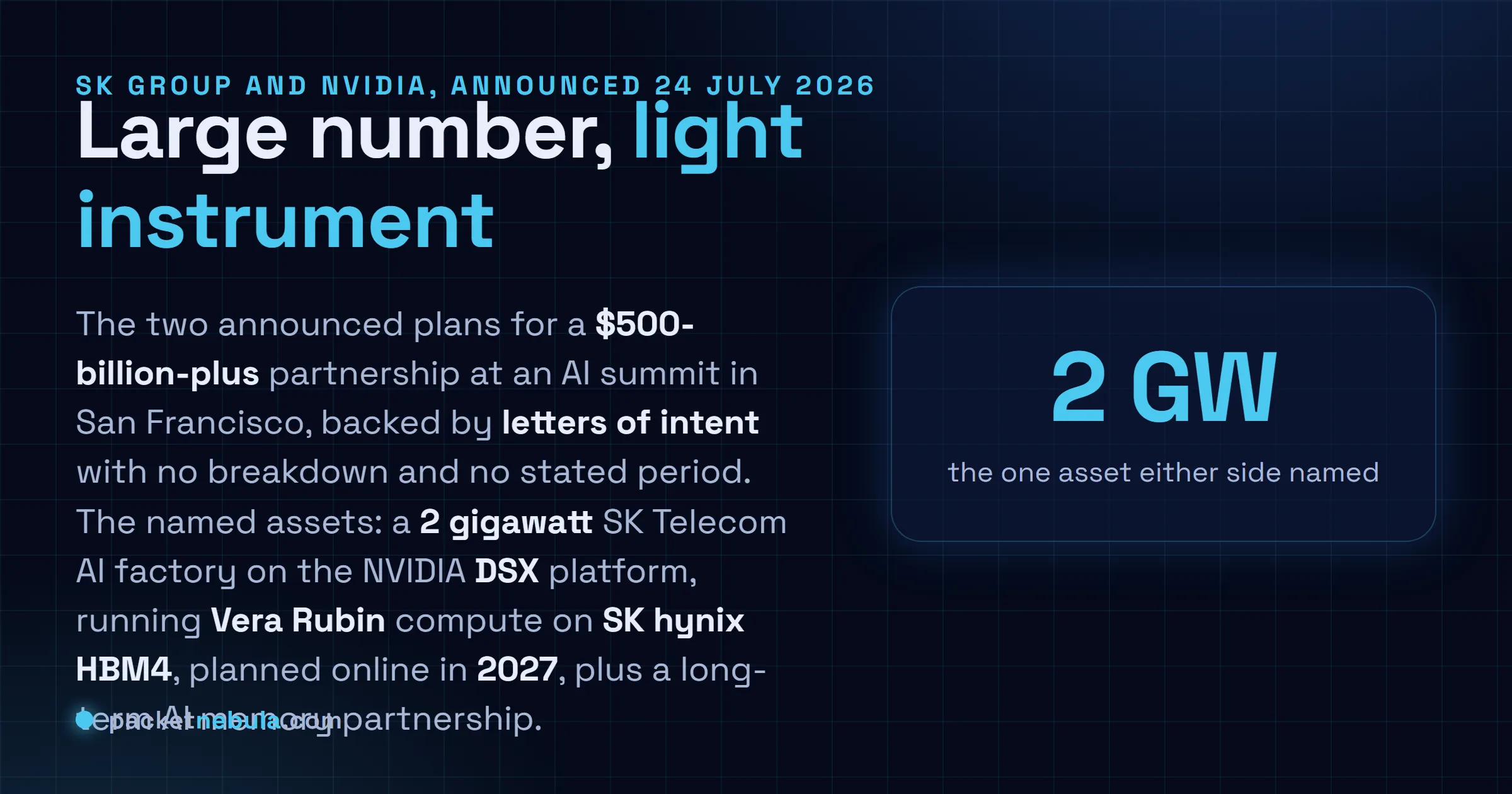
$500B+headline, letters of intent
2 GWthe one named asset
2027first factory, planned
Answer card explaining that SK Group and NVIDIA announced a 500 billion dollar plus partnership on July 24 2026 backed by letters of intent, with the only named assets being a 2 gigawatt SK Telecom AI factory on the NVIDIA DSX platform with Vera Rubin compute and SK hynix HBM4 memory planned online in 2027, plus a long-term AI memory partnership.
The one-card version. Large number, light instrument.

What was actually signed

Letters of intent. That is the phrase both companies used, and it is the whole story of how to read the rest.

NVIDIA’s release says the two announced “plans for a $500-billion-plus comprehensive partnership” and that letters of intent were signed covering AI factory construction through memory supply. SK hynix put out its own version the next day with the same language. Nothing in either document breaks the figure into parts, attaches it to a period, or names a payer. NVIDIA’s forward-looking statements disclaimer sits at the bottom doing its usual job.

Two things are genuinely named. SK Telecom will build a 2 gigawatt AI factory on NVIDIA’s DSX platform with Vera Rubin accelerated computing and SK hynix HBM4 memory, with the first facility planned online in 2027. And SK hynix enters a long-term AI memory partnership with NVIDIA to codevelop next-generation memory, described as covering everything from large language model training to agentic and physical AI.
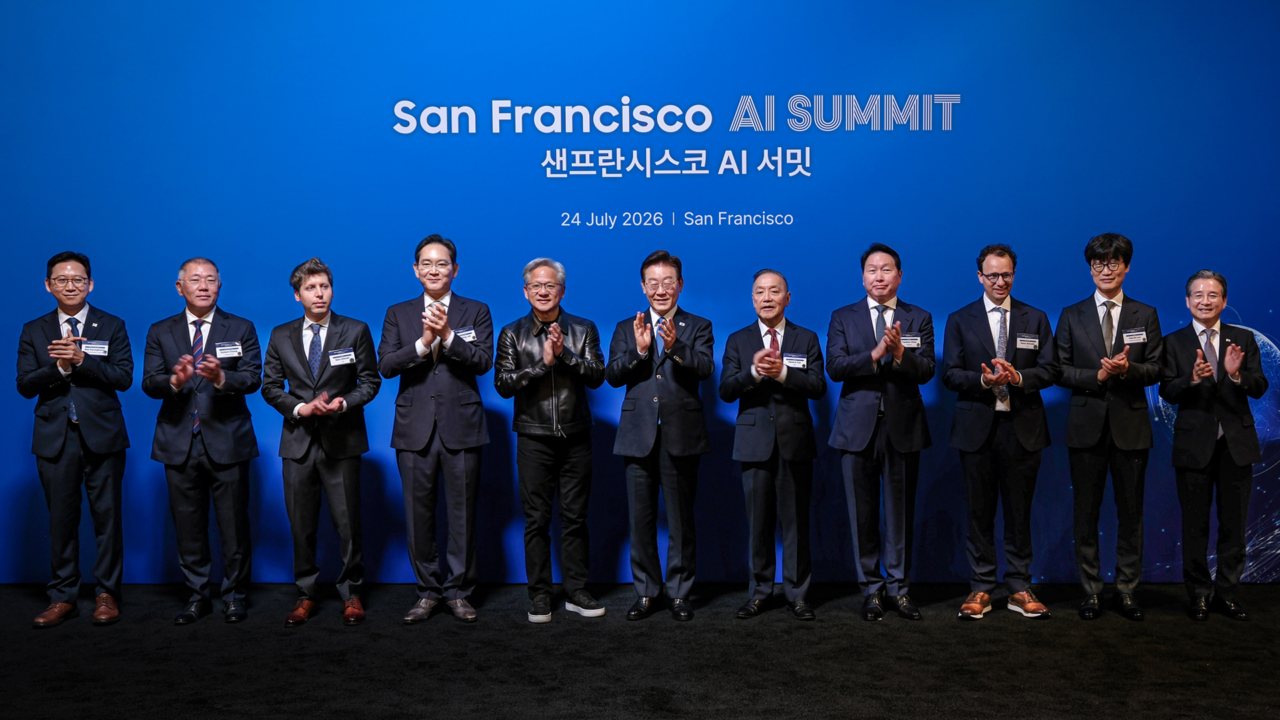
Group photograph from the San Francisco AI Summit on 24 July 2026, showing eleven executives and government officials applauding on stage against a blue backdrop that reads San Francisco AI Summit. Image: NVIDIA

That photo is the actual context. This was a summit hosted by South Korean president Lee Jae Myung, and SK was one signature among several. Samsung and Broadcom signed a memorandum of understanding reported at more than $200 billion across HBM4 supply, two-nanometre foundry and advanced packaging, running five years to 2030. NAVER, NVIDIA and Brookfield announced a $10 billion package. Coverage tallied roughly $950 billion of announcements across the day.

The smallest number is the only one with conditions

Here is where it gets interesting, and honestly it took reading all three releases side by side to notice.
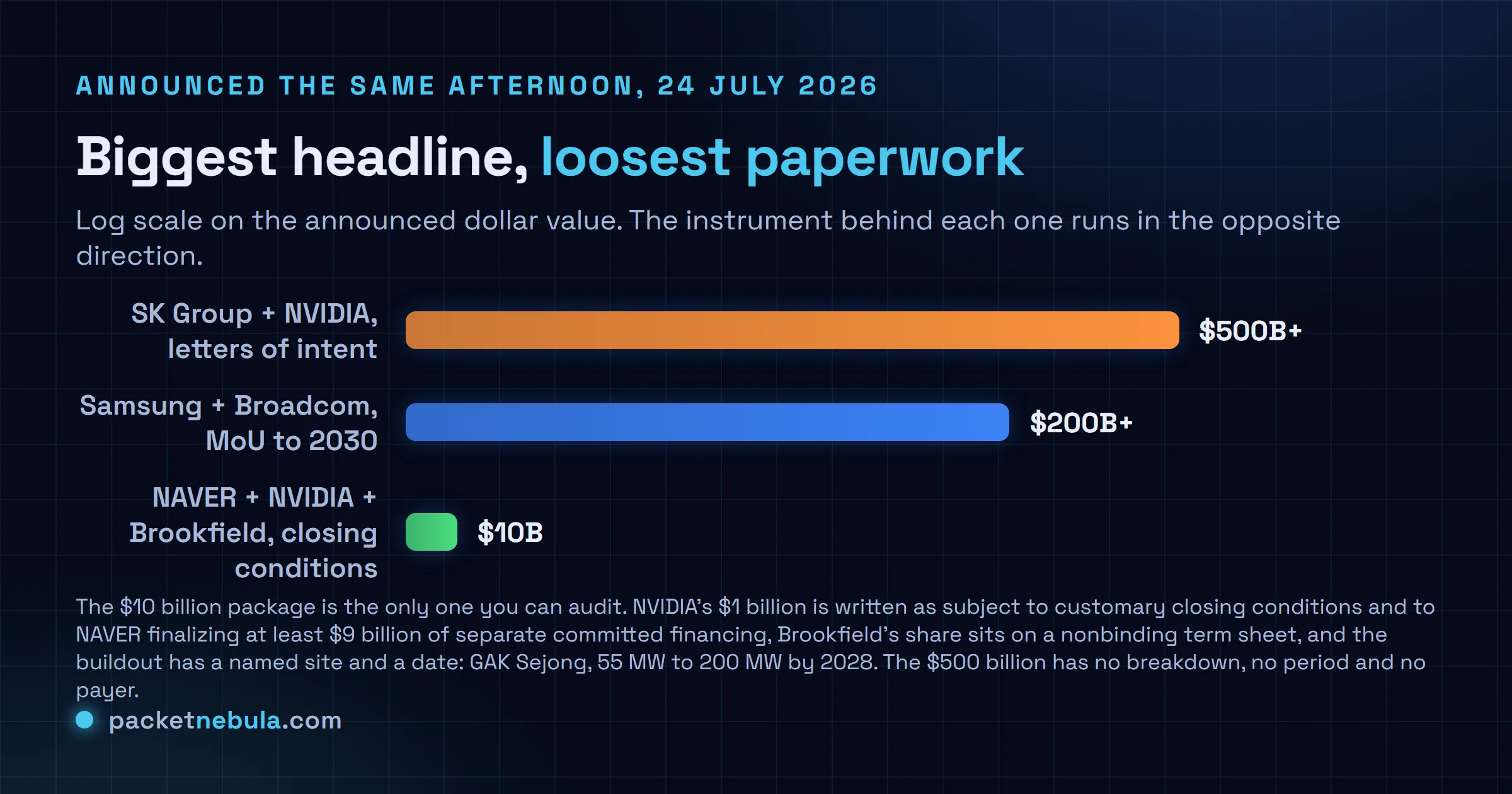
Log-scale comparison of three deals announced at the San Francisco AI Summit on 24 July 2026: SK Group and NVIDIA at over 500 billion dollars on letters of intent, Samsung and Broadcom at over 200 billion dollars on a memorandum of understanding, and NAVER with NVIDIA and Brookfield at 10 billion dollars with written closing conditions.
Headline size on the left axis. Legal weight runs the other way.

The NAVER deal is the small one, and it is the only one where you can see the machinery. NVIDIA is putting in $1 billion, explicitly “subject to customary closing conditions and NAVER finalizing at least $9 billion of committed financing for the project”. Brookfield’s share, up to $9 billion, sits on a nonbinding term sheet. The buildout is specific: the GAK Sejong data centre goes from the 55 megawatts announced in June to 200 megawatts by 2028, roughly 100,000 GPUs on Vera Rubin.

So the deal with the smallest headline is the one carrying a written financing condition, a named site and a date. The $500 billion has none of those.

Now, some arithmetic that nobody in either release does. NAVER discloses 200 MW against a $10 billion envelope, which is $50 million per megawatt. Run SK’s 2 GW at that same disclosed rate and you land near $100 billion. The headline is five times larger. Which tells you the $500 billion is not the factory. It is an umbrella over memory fabs, future capacity, service revenue and whatever else the two sides expect to transact over years they did not specify.

Maybe that is fair enough. SK is a conglomerate and memory fabs cost a fortune, so an umbrella number is not automatically a fiction. But a number you cannot decompose is a direction, not a commitment. I would rather have the $10 billion with the closing condition.

The half that reaches your invoice

Skip the gigawatts for a second. The memory partnership is the part with a shorter path to your budget.

SK hynix already told everyone how tight this is. At its Q3 2025 results, the head of DRAM marketing said flatly that the company had sold out its DRAM, NAND and HBM capacity for the following year. Customers had booked the slots. A long-term supply partnership with NVIDIA books more of that output further ahead, and Seoul Economic Daily reported on July 26 that SK is extending HBM4 supply to Microsoft as well. No contracted volumes or prices have been published by anyone, so treat the specifics as unknown.

The direction is not really in doubt though. Everyone shipping an accelerator is queueing at the same handful of suppliers. When AMD put 31 TB of HBM4 in a Helios rack it was drawing on the same constrained pool that NVIDIA is now locking up years in advance. That pressure has been leaking into ordinary DDR5 pricing for months.

Practical version: if you are specifying servers or workstations for the next 18 months, treat memory as a rising line item rather than a flat one. I might be wrong about the magnitude. About the direction, less so.

Two gigawatts, in units you can picture

NVIDIA gave us a usable ratio without meaning to. Its NAVER announcement pairs roughly 100,000 GPUs with a 200 megawatt buildout, so about 2 kW per accelerator once cooling and facility overhead are in. Apply that to SK’s 2 GW and you get something on the order of a million accelerators in one site. That extrapolation is ours, not NVIDIA’s, and the real ratio will drift with rack density and cooling design. Still, it puts the announcement in a bracket.

For power, the comparison that matters is regulatory. New York started gating new data centers above 50 MW, and this is forty of those in a single campus. Silicon has not been the binding constraint on these builds for a while. Grid interconnect and local politics are, which is exactly why the 2027 date deserves the same scepticism as the dollar figure.
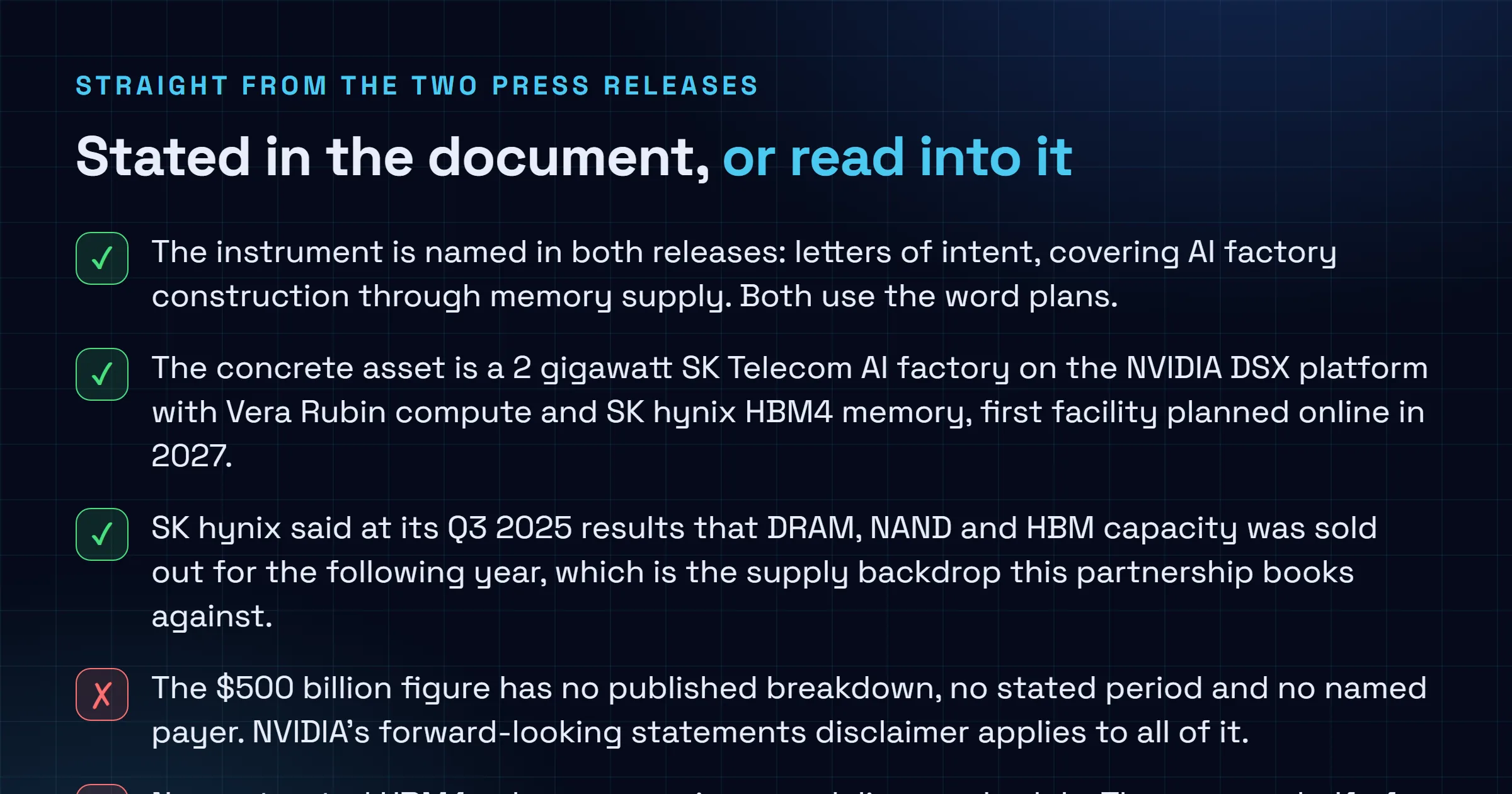
Checklist separating what is confirmed in the SK and NVIDIA announcement from what remains a stated intention, noting the letters of intent, the absence of any breakdown or period for the 500 billion dollar figure, the 2027 and 2028 timelines, and the sold-out HBM capacity.
Sorted by what the two press releases actually state.

What to watch instead of the number

The conversion. Letters of intent become contracts or they quietly do not, and that transition is the only signal worth setting an alert on. After that: a named construction site with a grid interconnect, and an HBM4 delivery schedule with volumes on it.

Meanwhile nothing about your 2026 procurement changed this week. First SK facility is 2027, NAVER’s 200 MW is 2028. Announcements at a summit do not add a single rack to the market this year, which is a boring thing to say about a $500 billion headline, and it happens to be the accurate one.

Sources: NVIDIA newsroom, July 24 2026, SK hynix newsroom, July 25 2026, the NAVER, NVIDIA and Brookfield release, NVIDIA’s summit blog post, CNBC on Samsung and Broadcom and Notebookcheck on SK hynix sold-out capacity. The letters of intent wording, the $500-billion-plus figure, the 2 GW SK Telecom factory and its 2027 date come from the NVIDIA and SK hynix releases. NVIDIA’s $1 billion, Brookfield’s up to $9 billion nonbinding term sheet, the $9 billion closing condition, the 55 to 200 megawatt expansion and the 2028 date are quoted from the NAVER release, and the roughly 100,000 GPU figure from NVIDIA’s summit blog. The Samsung and Broadcom terms and the roughly $950 billion daily tally are as reported in press coverage, not primary documents. The $50 million per megawatt rate and the 2 kW per GPU ratio are our own arithmetic on those published figures. The image is NVIDIA’s own summit photograph.

Frequently asked questions

What did SK Group and NVIDIA actually announce?

Plans for a partnership worth more than $500 billion, announced July 24, 2026 at an AI summit in San Francisco. The companies say they signed letters of intent. The named assets are a 2 gigawatt AI factory that SK Telecom will build using the NVIDIA DSX platform and Vera Rubin accelerated computing with SK hynix HBM4 memory, planned to come online in 2027, and a long-term AI memory partnership between SK hynix and NVIDIA.

Is the $500 billion a signed contract?

No. Both press releases describe letters of intent and use the word plans. Neither NVIDIA nor SK published a breakdown of the figure or the period it covers, and NVIDIA's release carries the usual forward-looking statements disclaimer. Treat it as a stated direction rather than money that has moved.

How big is 2 gigawatts in practical terms?

Very. New York now gates new data centers above 50 megawatts, so a single 2 GW site is about forty times that threshold. For accelerator counts, NVIDIA's own NAVER announcement pairs roughly 100,000 GPUs with a 200 MW buildout, which works out to about 2 kW per GPU once cooling and facility overhead are counted. Apply that same ratio and 2 GW lands on the order of a million accelerators. That extrapolation is ours, not NVIDIA's.

What does this change for HBM4 and memory prices?

It extends a squeeze that was already on. SK hynix said at its Q3 2025 results that it had sold out DRAM, NAND and HBM capacity for the following year, and a long-term supply partnership with NVIDIA books more of that output ahead. Nobody has published contracted volumes or prices, so the honest read is directional: if you are specifying servers or workstations over the next 18 months, budget memory as a rising line item.

When does any of this affect what I can buy?

Not in 2026. The first SK facility is planned for 2027 and NAVER's 200 MW expansion targets 2028. Nothing announced at this summit adds capacity to the market this year, and the letters of intent have to convert into contracts before construction schedules mean anything.

Tags: aidatacentergpuhardwarenewsnvidia
Share196Tweet123
stephane

stephane

  • Trending
  • Comments
  • Latest
Answer card: Proton Lumo 2.0 is private by policy, not by locality. Saved history is locked so even Proton cannot read it, but the prompt is decrypted on a Proton EU server to answer it, then forgotten.

Proton Lumo 2.0 review: how private is it, really?

3 September 2026
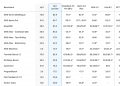
The Agentic Coding section of the official Hy4 preview benchmark appendix published by Tencent, a table comparing Hy3 and Hy4 preview against DeepSeek V4 Pro 0813, Qwen 3.8 Max, GLM 5.3, Kimi K3, GPT 5.6 Sol and Claude Opus 5 across SWE-bench Multilingual, SWE-bench Pro, DeepSWE, three SWE Atlas tasks, SWE-Marathon, Terminal-Bench 2.1, NL2Repo-Bench, CyberGym, ProgramBench, PostTrainBench and Harbor-Index.

Tencent’s 770B Hy4 tops one benchmark row in 46

3 September 2026
Answer card: Qwen 3.7 Max is API-only and cannot run locally yet; the open Qwen models (Qwen 3.6 27B, qwen3:8b to 32b) run offline via Ollama.

Qwen 3.7 local: what you can actually run offline

22 June 2026
Answer card: JWTs are not encrypted, anyone can read them; the signature proves who issued the token, not who may read it.

Are JWTs encrypted? No, and the difference will bite you

0
Answer card: a random 8 character password falls in under 2 hours offline, while 16 random characters hold for 1.4 trillion years at the same speed.

How long does it take to crack a password in 2026?

0
Answer card: three DNS records decide if your mail lands or bounces; SPF lists allowed senders, DKIM signs messages, DMARC sets the failure policy.

SPF, DKIM and DMARC explained: the records your email needs

0
Answer card stating that OpenAI released the Agents API in public beta on 10 September 2026 with no separate fee, billed through model tokens, tool calls and hosted sandbox time, with a choice of OpenAI hosted, self hosted or partner sandboxes, US only data residency and no Zero Data Retention support.

OpenAI’s Agents API has no fee, no ZDR and a one hour sandbox clock

14 September 2026
Answer card: Sakana Fugu Max at $2 and $6 per million tokens, Fugu Ultra v2 unchanged at $5 and $30, and Sakana saying Ultra v2 scores without Fable 5 or GPT-6 Astra in its pool.

Fugu Max costs $2 and $6 while Fugu Ultra v2 runs without Fable 5

13 September 2026
Answer card stating that DeepSeek released DeepSeek-V4.1-Flash on 10 September 2026 as a 552 billion parameter mixture of experts model with a new causal encoder decoder architecture that activates 8 billion parameters on input and 16 billion on output, with native vision, a one million token context and MIT licensed weights, that the API model name is now deepseek-flash at 0.15 dollars per million input tokens and 0.60 dollars per million output tokens off peak, and that DeepSeek announced V4 Pro would be routed to V4.1-Flash from 14 September and reversed that on 11 September.

DeepSeek V4.1-Flash arrived, and the V4 Pro retirement lasted a day

12 September 2026
  • About
  • Contact
  • Privacy
  • Legal

Copyright © 2026 Stephane Cardon.

Welcome Back!

Login to your account below

Forgotten Password?

Retrieve your password

Please enter your username or email address to reset your password.

Log In
No Result
View All Result
  • Home
  • Articles
    • Security
    • Network
    • Dev
    • Sysadmin
    • SEO
    • Email & DNS
  • Tools
    • Network tools: free, fast, no signup
    • Security tools: free, fast, no signup
    • Developer tools: free, fast, no signup
    • Sysadmin tools: free, fast, no signup
    • SEO tools: free, fast, no signup
    • Email & DNS tools: free, fast, no signup
  • Download
  • About

Copyright © 2026 Stephane Cardon.