
• Latest
  • Trending
  • All
Answer card: PsiQuantum signed a $125M performance-based agreement with DARPA on July 22 under the Quantum Benchmarking Initiative, funding verification and validation of its pathway to a utility-scale quantum computer, building on a $31.8M Stage C award from September 2025, with no qubit count or error rate disclosed.

PsiQuantum’s $125M DARPA deal buys verification, not a machine

3 September 2026
Answer card stating that OpenAI published its research acceleration measurements on 6 September 2026, that as of mid August 2026 its research organisation logged 3.1 agent workdays of coding agent runtime for every workday of human labour normalised to a standard eight hour day, and that OpenAI states this should not be read as a 3.1 times productivity gain because it measures runtime rather than delivered output.

OpenAI’s 3.1 agent-workdays per human day is not a 3.1x gain

7 September 2026
Answer card stating that Mullvad announced on 3 September 2026 that it is shutting down its public encrypted domain name system servers on 2 November 2026 and sponsoring the Quad9 Foundation instead, with 194.242.2.2 and its five sibling addresses all going away, and virtual private network customers unaffected.

Mullvad’s DNS servers go dark on 2 November, and Quad9 blocks no ads

5 September 2026
OpenAI announcement image for GPT-6 Astra, a spiral galaxy of white, blue and amber points of light curling around a bright core on a near black star field.

GPT-6 Astra lists at $10 and $50, 2.5x what GPT-5.6 Sol costs

6 September 2026
Google's official announcement image for the release, reading Introducing Gemini 3.8 Flash and 3.8 Flash Cyber in black type over a pale blue background with a blurred white chevron and the four colour Gemini spark below.

Gemini 3.8 Flash keeps the price and the 1 January cliff

3 September 2026
Answer card stating that Anthropic announced Enterprise Frontier Safeguards on 1 September 2026, that activity data used for misuse monitoring moves into cloud storage the customer controls under the customer own encryption keys, that Anthropic charges nothing for the feature while the cloud provider bills storage and egress, and that the phased rollout starts later in autumn 2026 with interim zero data retention on Fable 5 and Fable 5.1 for eligible customers.

Anthropic moves retention into your own cloud, for 30 days

3 September 2026
Official Google diagram of a client connection in three numbered steps: a DNS lookup with a query and an address, a TLS ClientHello and ServerHello, then a content exchange with a website. A callout on the DNS step reads 25% of global web traffic is now protected by encrypted DNS, and a callout beside an Android phone on the ClientHello step reads Android 17 supports ECH GREASE by default.

Android 17 hides the SNI, not your DNS or destination

3 September 2026
Still frame from the Claude Fable 5.1 launch video showing model-designed protein binders in orange docked against twelve grey target proteins, rendered as ESMFold2 structure predictions.

Claude Fable 5.1 breaks forced tool use, cuts cache 75%

1 September 2026
Answer card stating that on 31 August 2026 the European Commission designated ChatGPT a Very Large Online Search Engine under the Digital Services Act, the first conversational AI service classified that way, because it answers user prompts and queries including by searching the web, with OpenAI having declared roughly 159.1 million average monthly users in the European Union for ChatGPT search.

The EU now calls ChatGPT a very large search engine

3 September 2026
Answer card stating that on 31 August 2026 the Department of War added OpenAI ChatGPT Mil and Starshield AI Grok for Government to the GenAI.mil portal alongside Google Gemini, all three accredited at Impact Level 5 for Controlled Unclassified Information, with 1.7 million unique users onboarded out of roughly 3 million eligible personnel, and ChatGPT Mil currently serving GPT-5.4 Terra with GPT-5.6 Terra said to be rolling out.

ChatGPT Mil and Grok reached IL5 on GenAI.mil

3 September 2026
Answer card stating that Anthropic opened a research preview of the Model Hardware Standard on 27 August 2026, standardising the driver layer between an operating system and a laboratory instrument with read and write primitives plus discovery and safety limits, reachable through MCP as well as a command line and code files, with no public specification published.

Anthropic’s Model Hardware Standard is gated, and sits under MCP

3 September 2026
Official Cohere key art for the Parse 5 launch: the Cohere mark and the wordmark Parse with a superscript 5 in white, centred on a soft out of focus gradient of deep blue, violet and amber curves.

Cohere Parse 5 is $1.50 per 1,000 pages, on three of five dimensions

3 September 2026
Title card from the OpenAI announcement video: a man sits on a blue sofa in a loft with tall windows and potted plants, a laptop open on the coffee table in front of him, with the words WebMCP in ChatGPT in large white type across the lower left.

WebMCP in ChatGPT needs GPT-5.6 Sol or Terra

3 September 2026
  • About
  • Contact
  • Privacy
  • Legal
Tuesday, September 8, 2026
  • Login
Packet Nebula
  • Home
  • Articles
    • Security
    • Network
    • Dev
    • Sysadmin
    • SEO
    • Email & DNS
  • Tools
    • Network tools: free, fast, no signup
    • Security tools: free, fast, no signup
    • Developer tools: free, fast, no signup
    • Sysadmin tools: free, fast, no signup
    • SEO tools: free, fast, no signup
    • Email & DNS tools: free, fast, no signup
  • Download
  • About
No Result
View All Result
Packet Nebula
No Result
View All Result
Home Dev

PsiQuantum’s $125M DARPA deal buys verification, not a machine

by stephane
3 September 2026
in Dev
0
Answer card: PsiQuantum signed a $125M performance-based agreement with DARPA on July 22 under the Quantum Benchmarking Initiative, funding verification and validation of its pathway to a utility-scale quantum computer, building on a $31.8M Stage C award from September 2025, with no qubit count or error rate disclosed.
492
SHARES
1.4k
VIEWS
Share on FacebookShare on Twitter

DARPA just wrote PsiQuantum a check for $125 million, and the headlines already read like the encryption-breaking quantum computer is around the corner. Slow down. What PsiQuantum signed on July 22 is a validation contract, money for DARPA's own auditors to climb into the company's manufacturing lines and stress-test whether the plan actually holds. That's a real milestone. It's the largest US government award PsiQuantum has landed, and it keeps them in the final two of DARPA's benchmarking program. But we read the announcement twice, and there isn't a qubit count in it. Not one error rate. This is the government paying to check the homework, not to grade a finished machine.

The short answer

PsiQuantum signed a $125 million expanded, performance-based agreement with DARPA under the Quantum Benchmarking Initiative on July 22. The money funds verification and validation of its route to a utility-scale, fault-tolerant quantum computer, building on a $31.8M Stage C award from September 2025. It’s the company’s biggest US government contract, and it keeps them in the final two of the program. What it isn’t: a working machine. The announcement carries no qubit count, no error rate, no benchmark. DARPA is paying to check the plan.
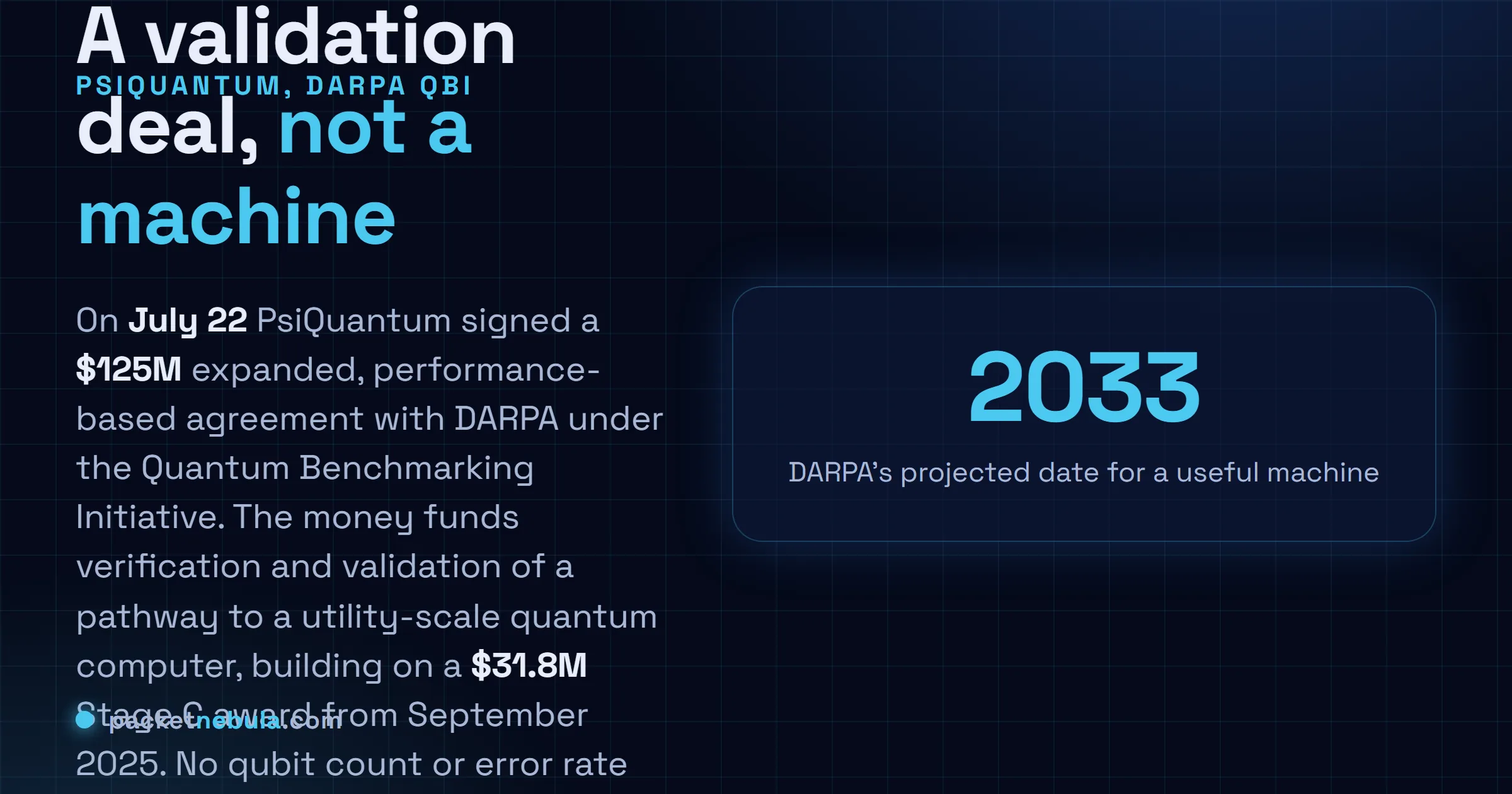
$125Mthe DARPA agreement, signed July 22
V&Vwhat it funds: verification, not qubits
1 of 2firms left in Stage C
Answer card: PsiQuantum signed a $125M performance-based agreement with DARPA on July 22 under the Quantum Benchmarking Initiative, funding verification and validation of its pathway to a utility-scale quantum computer, building on a $31.8M Stage C award from September 2025, with no qubit count or error rate disclosed.
The one-card version. A big validation contract, and a machine that still doesn't exist.

What PsiQuantum actually signed

Strip the word “quantum” off it for a second and you’ve got a government agency expanding a testing contract with a supplier. That’s the honest shape of this. DARPA is paying $125 million for verification and validation work, and PsiQuantum is the thing being verified.

The specifics, from PsiQuantum’s own release and the trade coverage: a performance-based tasking under the Quantum Benchmarking Initiative, PsiQuantum’s most valuable US government award so far. It funds four areas of hands-on evaluation. Inspection of the barium titanate thin-film modulators at the PsiFactory line in Milpitas, California. Photonic edge coupling and assembly testing. System-level cryogenic validation of the cooling stack. And algorithmic resource benchmarking through the company’s Construct software.

Notice what all four have in common. They’re checks. DARPA audit teams get direct access to the design pipelines and the manufacturing lines, and they go looking for whether the numbers on the roadmap survive contact with a real fab. This is adversarial in the good sense. PsiQuantum’s own CSO, Pete Shadbolt, put it plainly: the scrutiny “put us to the test and significantly strengthened our plans.” That’s a co-founder telling you the value here is being audited, not being funded.
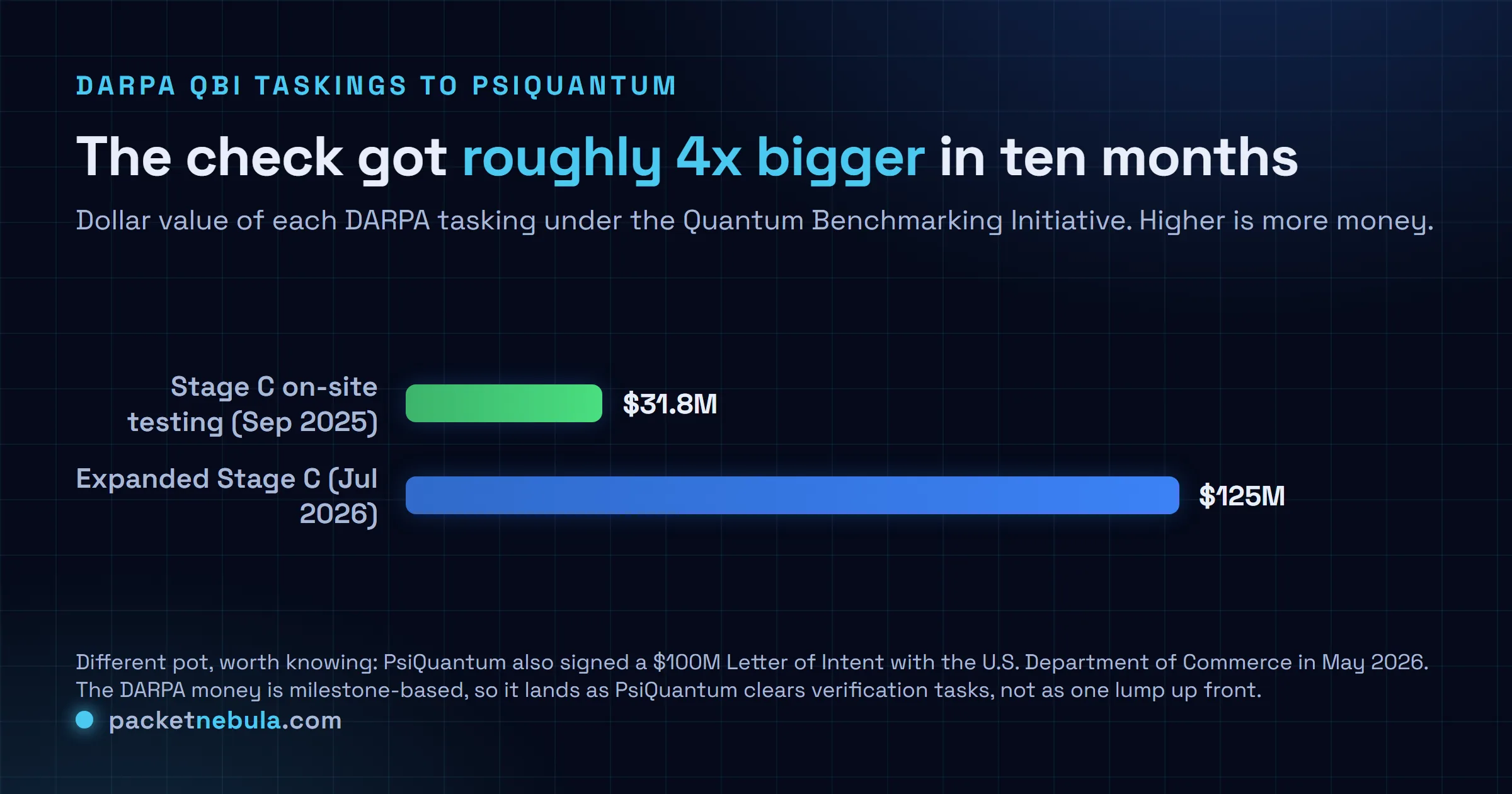
Comparison bars: DARPA's Stage C on-site testing award to PsiQuantum was $31.8M in September 2025, and the expanded Stage C agreement in July 2026 is $125M, roughly four times larger.
Ten months, and the tasking grew from $31.8M to $125M. The direction of travel is the signal.

Why the escalation is the real news

The number that matters isn’t $125 million on its own. It’s $125 million against the $31.8 million DARPA committed in September 2025 for Stage C on-site testing. That’s roughly a fourfold jump in ten months, from the same evaluator, aimed at the same pathway.

DARPA doesn’t quadruple a benchmarking budget on a hunch. QBI exists specifically to be pathway-agnostic and hard to fool, so a bigger tranche reads as “the earlier checks came back clean enough to fund deeper ones.” PsiQuantum entered the program’s earliest phase back in early 2023, moved to Stage C in February 2025, and Stage C is the last and most invasive stage. They say they’re one of only two companies still standing in it.

Honestly, that survival is the strongest single fact in the whole announcement. Not the dollar figure. Being one of two left, in the program built to weed out the pretty roadmaps, after DARPA has been inside your fab. That’s harder to fake than a press release.

What the announcement does not say

Here’s the part the hype skips. Read the release for a technical result and you’ll come up empty.

No qubit count. No logical qubit count. No physical error rate, no logical error rate, no fidelity number, no benchmark against a target algorithm. For a company built on photonic quantum chips, whose whole pitch is manufacturability, an announcement this size mentioning zero performance figures tells you what it is. A funding-and-validation event, not a capability reveal.

That’s not a knock. Validation contracts genuinely aren’t supposed to ship benchmarks. But it’s exactly the gap the headlines paper over when they turn “DARPA expands testing agreement” into “quantum breakthrough.” We don’t have a breakthrough here. We have a well-scrutinized plan getting more money to keep proving itself.

And the timeline everyone quotes needs the same care. DARPA’s Micah Stoutimore said it “now seems likely that someone will build a utility-scale quantum computer by 2033.” Read that slowly. Likely, someone, by 2033. That’s a program manager’s projection about the field, not a ship date, and PsiQuantum’s own “before 2033” target is a goal the QBI process is literally there to interrogate. The point of the program is that these dates are unproven. Quoting them as fixed misses the entire exercise.
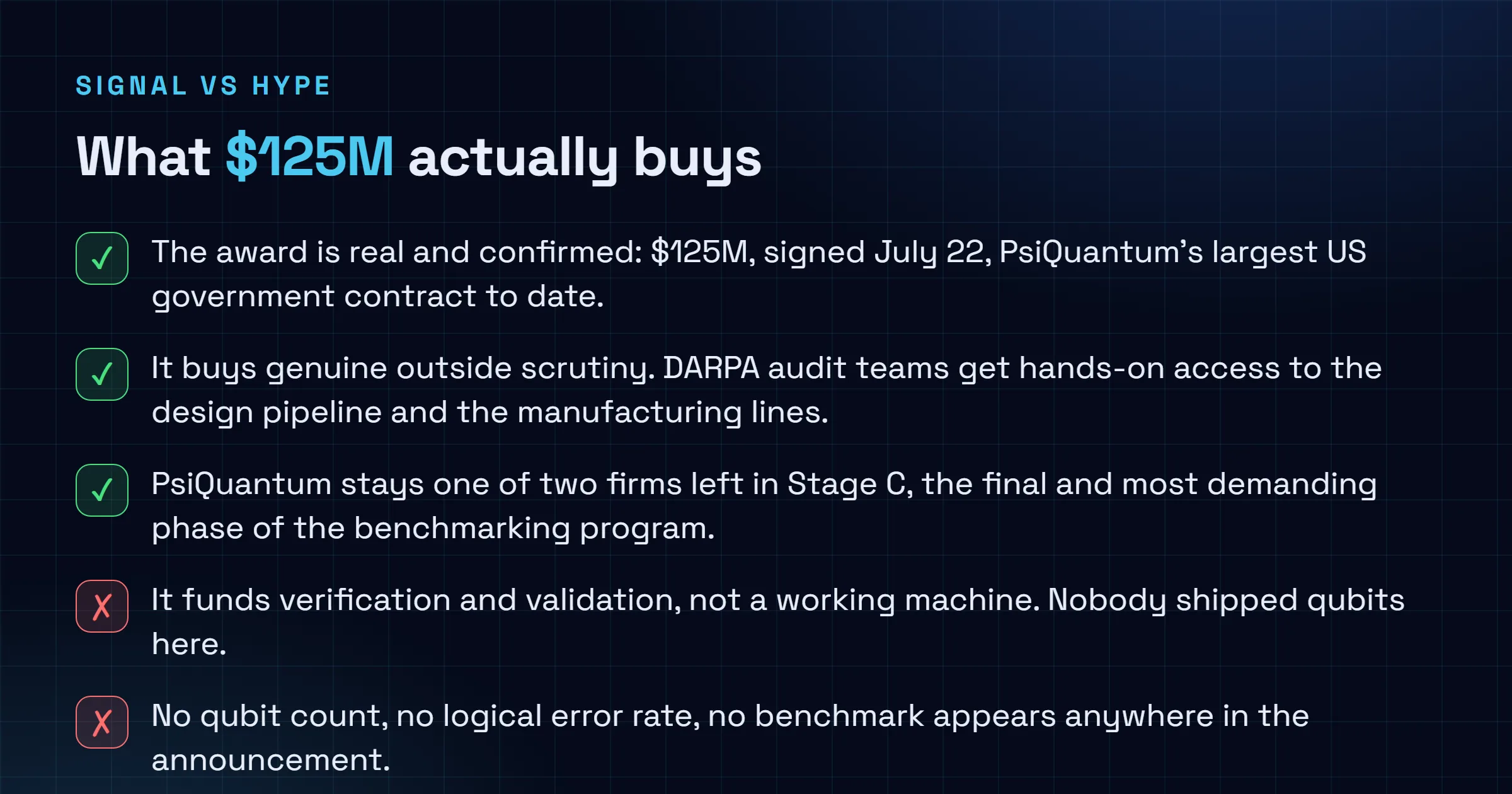
Checklist: the PsiQuantum DARPA award is confirmed at $125M signed July 22 and is the company's largest US government contract, it buys genuine outside scrutiny with hands-on DARPA access, and PsiQuantum is one of two firms left in Stage C; but it funds verification not a working machine, discloses no qubit count or error rate or benchmark, and the 2033 date is a projection not a commitment.
What survives a careful read of the announcement, and what needs the footnote.

So what should you actually do with this

If you build quantum hardware or write decoders, this is worth your full attention. DARPA doubling down on photonic V&V shifts where the credible bets are, and PsiQuantum’s manufacturing-first thesis just got a bigger stamp from the toughest evaluator in the room.

For everyone else running real systems, the honest answer is: nothing changes today. A validation deal doesn’t move up the morning your RSA keys become breakable. What actually moves that date is the slow, boring migration to post-quantum crypto, and that’s happening now on its own schedule, independent of any single vendor’s roadmap.

If you want a concrete step instead of a headline, this is the one that has a calendar and a migration path: post-quantum TLS and why ML-DSA is the signature to ship. And if you’re curious how deep the standards work already runs, Classic McEliece just became the first ISO post-quantum standard. Those are the parts of the quantum story with something you can act on. A DARPA testing contract, however large, isn’t one of them yet.

Sources

  • PsiQuantum newsroom, on its DARPA QBI partnership.
  • The Quantum Insider, “PsiQuantum Signs $125 Million Agreement with DARPA”, July 22, 2026, for the stage timeline, the “one of two companies” detail and the executive quotes.
  • Quantum Computing Report, for the four verification areas, the $31.8M September 2025 award and the $100M Commerce Letter of Intent.
  • Business Wire via Morningstar, for the official announcement text.

Frequently asked questions

What did PsiQuantum actually sign with DARPA?

A $125 million expanded, performance-based tasking agreement, announced July 22, 2026, under DARPA's Quantum Benchmarking Initiative (QBI). It funds verification and validation of PsiQuantum's hardware architecture, its photonic manufacturing processes and its cryogenic infrastructure. It builds on a $31.8 million Stage C award from September 2025, and PsiQuantum calls it its most valuable US government contract to date.

Does this mean PsiQuantum built a quantum computer?

No. The money pays for DARPA to test and validate the pathway, not for a finished machine. The announcement discloses no qubit count, no logical error rate and no benchmark result. Performance-based means PsiQuantum gets paid as it clears verification milestones. It is a strong vote of confidence in the plan, not proof of a working system.

What is DARPA's Quantum Benchmarking Initiative?

QBI is DARPA's program to independently, rigorously and pathway-agnostically evaluate whether any company's route to a utility-scale quantum computer is credible. It runs in stages. PsiQuantum entered the earliest phase in early 2023, advanced to Stage C in February 2025, and Stage C is the final and most hands-on phase, where DARPA audit teams get direct access to internal design pipelines and manufacturing lines. PsiQuantum says it is one of two companies left in Stage C.

When will there be a useful quantum computer?

DARPA's Micah Stoutimore said it now seems likely someone builds a utility-scale quantum computer by 2033. PsiQuantum targets a commercially useful, fault-tolerant machine before 2033. Treat both as projections, not delivery dates. The whole point of QBI is that these timelines are the thing being tested, not something anyone has proven yet.

Should I change anything about my security today?

Not because of this. A validation contract does not move up the day a quantum computer can break RSA or ECC. The move that actually matters for you is post-quantum cryptography, and that migration is happening now regardless of PsiQuantum's timeline. If you want a concrete next step, look at post-quantum TLS and which signature to ship, not at DARPA press releases.

Tags: darpafault-tolerancefundingnewspsiquantumquantum
Share197Tweet123
stephane

stephane

  • Trending
  • Comments
  • Latest
The Agentic Coding section of the official Hy4 preview benchmark appendix published by Tencent, a table comparing Hy3 and Hy4 preview against DeepSeek V4 Pro 0813, Qwen 3.8 Max, GLM 5.3, Kimi K3, GPT 5.6 Sol and Claude Opus 5 across SWE-bench Multilingual, SWE-bench Pro, DeepSWE, three SWE Atlas tasks, SWE-Marathon, Terminal-Bench 2.1, NL2Repo-Bench, CyberGym, ProgramBench, PostTrainBench and Harbor-Index.

Tencent’s 770B Hy4 tops one benchmark row in 46

3 September 2026
Answer card: Proton Lumo 2.0 is private by policy, not by locality. Saved history is locked so even Proton cannot read it, but the prompt is decrypted on a Proton EU server to answer it, then forgotten.

Proton Lumo 2.0 review: how private is it, really?

3 September 2026
Answer card: Apple released iOS 26.6 and iPadOS 26.6 on 27 July 2026 with a release note covering bug fixes, security updates and an optimized Spotlight index to prepare for iOS 27, the index the rebuilt Siri reads for personal context.

iOS 26.6 is out: the Spotlight index it quietly builds

27 July 2026
Answer card: JWTs are not encrypted, anyone can read them; the signature proves who issued the token, not who may read it.

Are JWTs encrypted? No, and the difference will bite you

0
Answer card: a random 8 character password falls in under 2 hours offline, while 16 random characters hold for 1.4 trillion years at the same speed.

How long does it take to crack a password in 2026?

0
Answer card: three DNS records decide if your mail lands or bounces; SPF lists allowed senders, DKIM signs messages, DMARC sets the failure policy.

SPF, DKIM and DMARC explained: the records your email needs

0
Answer card stating that OpenAI published its research acceleration measurements on 6 September 2026, that as of mid August 2026 its research organisation logged 3.1 agent workdays of coding agent runtime for every workday of human labour normalised to a standard eight hour day, and that OpenAI states this should not be read as a 3.1 times productivity gain because it measures runtime rather than delivered output.

OpenAI’s 3.1 agent-workdays per human day is not a 3.1x gain

7 September 2026
Answer card stating that Mullvad announced on 3 September 2026 that it is shutting down its public encrypted domain name system servers on 2 November 2026 and sponsoring the Quad9 Foundation instead, with 194.242.2.2 and its five sibling addresses all going away, and virtual private network customers unaffected.

Mullvad’s DNS servers go dark on 2 November, and Quad9 blocks no ads

5 September 2026
OpenAI announcement image for GPT-6 Astra, a spiral galaxy of white, blue and amber points of light curling around a bright core on a near black star field.

GPT-6 Astra lists at $10 and $50, 2.5x what GPT-5.6 Sol costs

6 September 2026
  • About
  • Contact
  • Privacy
  • Legal

Copyright © 2026 Stephane Cardon.

Welcome Back!

Login to your account below

Forgotten Password?

Retrieve your password

Please enter your username or email address to reset your password.

Log In
No Result
View All Result
  • Home
  • Articles
    • Security
    • Network
    • Dev
    • Sysadmin
    • SEO
    • Email & DNS
  • Tools
    • Network tools: free, fast, no signup
    • Security tools: free, fast, no signup
    • Developer tools: free, fast, no signup
    • Sysadmin tools: free, fast, no signup
    • SEO tools: free, fast, no signup
    • Email & DNS tools: free, fast, no signup
  • Download
  • About

Copyright © 2026 Stephane Cardon.