
• Latest
  • Trending
  • All
Answer card: DNS TTL is the expiry date on a DNS answer, the seconds a resolver may cache it; propagation is mostly waiting for old TTLs to run out.

What is DNS TTL? Cache, propagation and the values to use

12 June 2026
Answer card stating that OpenAI released the Agents API in public beta on 10 September 2026 with no separate fee, billed through model tokens, tool calls and hosted sandbox time, with a choice of OpenAI hosted, self hosted or partner sandboxes, US only data residency and no Zero Data Retention support.

OpenAI’s Agents API has no fee, no ZDR and a one hour sandbox clock

14 September 2026
Answer card: Sakana Fugu Max at $2 and $6 per million tokens, Fugu Ultra v2 unchanged at $5 and $30, and Sakana saying Ultra v2 scores without Fable 5 or GPT-6 Astra in its pool.

Fugu Max costs $2 and $6 while Fugu Ultra v2 runs without Fable 5

13 September 2026
Answer card stating that DeepSeek released DeepSeek-V4.1-Flash on 10 September 2026 as a 552 billion parameter mixture of experts model with a new causal encoder decoder architecture that activates 8 billion parameters on input and 16 billion on output, with native vision, a one million token context and MIT licensed weights, that the API model name is now deepseek-flash at 0.15 dollars per million input tokens and 0.60 dollars per million output tokens off peak, and that DeepSeek announced V4 Pro would be routed to V4.1-Flash from 14 September and reversed that on 11 September.

DeepSeek V4.1-Flash arrived, and the V4 Pro retirement lasted a day

12 September 2026
Answer card stating that Cognition released SWE-2 on 10 September 2026, a coding model post-trained from Kimi K3, scoring 50.0 percent on FrontierCode 1.1 Main against 50.9 percent for Claude Fable 5.1 and 27.3 percent on Terminal-Bench 4 against 55.8 percent, available only inside Devin.

SWE-2 trails Fable 5.1 by one point, and by 28 on Terminal-Bench 4

11 September 2026
Answer card for Meta Muse, free to 100 million tokens a week then $20 a month, launched 8 September 2026 for United States adults only, running in a dedicated per user virtual machine.

Does Meta Muse do enough to earn your inbox and a card on file?

9 September 2026
Answer card stating that the public download pages for the VMware Virtual Disk Development Kit on developer.broadcom.com began returning 404 errors on 25 August 2026 with no announcement or deprecation notice, that Broadcom support tells customers the kit is no longer available for use or download, and that release lines 7.0.3.1, 8.x and 9.x are all affected.

Broadcom pulled VDDK 8.0 and 9.0, and the 404 is the only notice

8 September 2026
Answer card stating that OpenAI published its research acceleration measurements on 6 September 2026, that as of mid August 2026 its research organisation logged 3.1 agent workdays of coding agent runtime for every workday of human labour normalised to a standard eight hour day, and that OpenAI states this should not be read as a 3.1 times productivity gain because it measures runtime rather than delivered output.

OpenAI’s 3.1 agent-workdays per human day is not a 3.1x gain

7 September 2026
Answer card stating that Mullvad announced on 3 September 2026 that it is shutting down its public encrypted domain name system servers on 2 November 2026 and sponsoring the Quad9 Foundation instead, with 194.242.2.2 and its five sibling addresses all going away, and virtual private network customers unaffected.

Mullvad’s DNS servers go dark on 2 November, and Quad9 blocks no ads

5 September 2026
OpenAI announcement image for GPT-6 Astra, a spiral galaxy of white, blue and amber points of light curling around a bright core on a near black star field.

GPT-6 Astra lists at $10 and $50, 2.5x what GPT-5.6 Sol costs

6 September 2026
Google's official announcement image for the release, reading Introducing Gemini 3.8 Flash and 3.8 Flash Cyber in black type over a pale blue background with a blurred white chevron and the four colour Gemini spark below.

Gemini 3.8 Flash keeps the price and the 1 January cliff

3 September 2026
Answer card stating that Anthropic announced Enterprise Frontier Safeguards on 1 September 2026, that activity data used for misuse monitoring moves into cloud storage the customer controls under the customer own encryption keys, that Anthropic charges nothing for the feature while the cloud provider bills storage and egress, and that the phased rollout starts later in autumn 2026 with interim zero data retention on Fable 5 and Fable 5.1 for eligible customers.

Anthropic moves retention into your own cloud, for 30 days

3 September 2026
Official Google diagram of a client connection in three numbered steps: a DNS lookup with a query and an address, a TLS ClientHello and ServerHello, then a content exchange with a website. A callout on the DNS step reads 25% of global web traffic is now protected by encrypted DNS, and a callout beside an Android phone on the ClientHello step reads Android 17 supports ECH GREASE by default.

Android 17 hides the SNI, not your DNS or destination

3 September 2026
  • About
  • Contact
  • Privacy
  • Legal
Tuesday, September 15, 2026
  • Login
Packet Nebula
  • Home
  • Articles
    • Security
    • Network
    • Dev
    • Sysadmin
    • SEO
    • Email & DNS
  • Tools
    • Network tools: free, fast, no signup
    • Security tools: free, fast, no signup
    • Developer tools: free, fast, no signup
    • Sysadmin tools: free, fast, no signup
    • SEO tools: free, fast, no signup
    • Email & DNS tools: free, fast, no signup
  • Download
  • About
No Result
View All Result
Packet Nebula
No Result
View All Result
Home Network

What is DNS TTL? Cache, propagation and the values to use

by stephane
12 June 2026
in Network
0
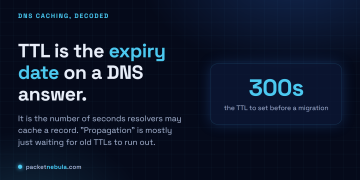
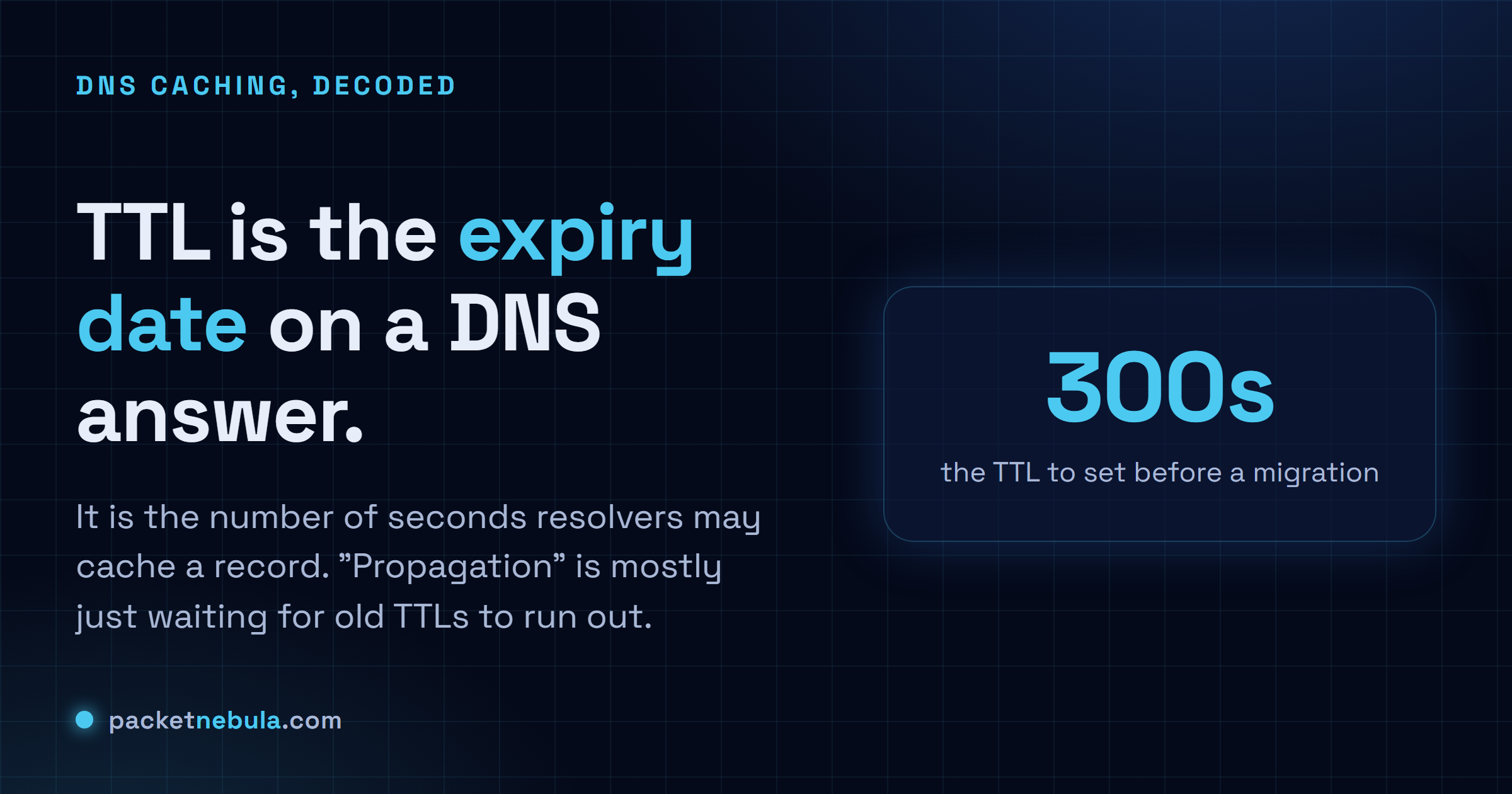
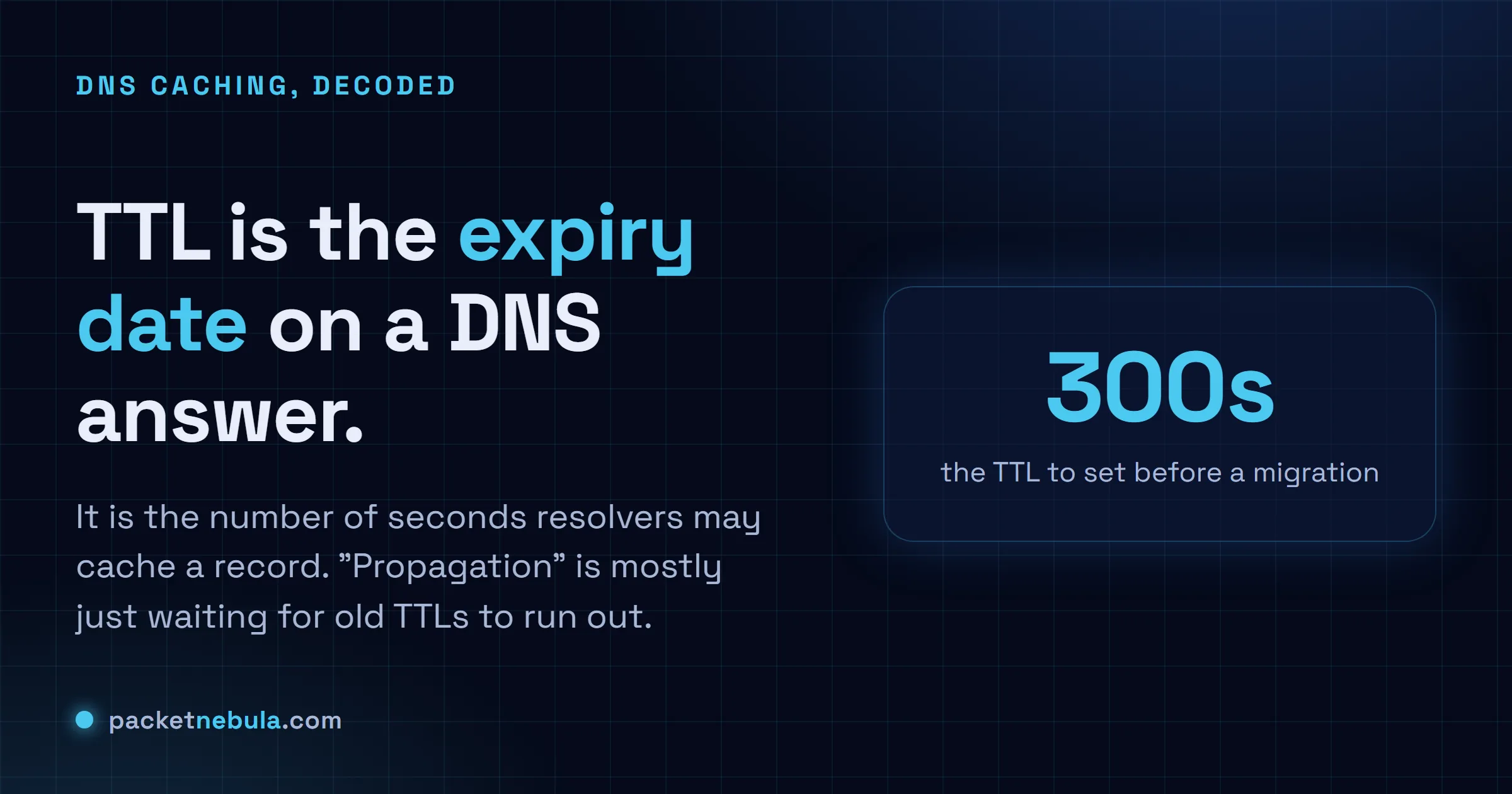
Answer card: DNS TTL is the expiry date on a DNS answer, the seconds a resolver may cache it; propagation is mostly waiting for old TTLs to run out.
492
SHARES
1.4k
VIEWS
Share on FacebookShare on Twitter

You changed the record an hour ago, and half the office still lands on the old server. That's DNS TTL: the number of seconds a resolver may cache a DNS answer before asking again, an expiry date stamped on every record. Nothing actually 'propagates'. After a change, thousands of independent caches keep serving the old value until their countdowns hit zero, and they all started at different moments. Once that clicks, DNS stops being mysterious. We'll cover how caching really works, which TTL fits which situation (a permanent 60 seconds is usually waste), and how to plan a migration around the math instead of hoping.

The short answer

TTL (time to live) is the number of seconds a resolver may cache a DNS answer before asking again. It’s set per record, and it’s why “propagation” exists: after a change, the world keeps serving the old answer until the old TTL runs out. Lower it before changes. The rest of the time, park it around an hour.
300 sTTL before a planned change
3600 ssane everyday default
old TTLyour real propagation time
Answer card explaining DNS TTL as the expiry date on a DNS answer: the seconds resolvers may cache it, with propagation being the wait for old TTLs to expire.
TTL in one card: an expiry date on every DNS answer.

The mechanism in thirty seconds

Every DNS record carries a TTL, assigned by whoever runs the zone. When a recursive resolver (your ISP’s, say, or Google’s 8.8.8.8) fetches www.example.com A 93.184.215.14 TTL 3600, it stores the answer and serves it from memory for up to an hour, counting down as it goes. Run a DNS lookup twice in a row and you’ll see it: the second answer often returns faster, with a lower TTL. You’re reading someone’s cache mid-countdown.

That’s the entire trick that lets a protocol from 1983 serve today’s internet. Authoritative servers for a popular domain answer a tiny fraction of the world’s queries; caches absorb the rest. The TTL is the dial that trades freshness against load. Shorter, and changes apply faster. Longer, and resolvers ask less often.

The semantics live in RFC 1035 and its clarifications, and the key word is maximum, not contract. Caches may drop records early under memory pressure, and a handful of resolvers clamp very low TTLs upward. Negative answers (the domain doesn’t exist) get cached too, governed by the SOA record’s minimum field. Classic gotcha when you query a name before creating it.

”Propagation” is not what the word suggests

Nothing propagates. There’s no wave rolling across the internet. Publish a change and your authoritative servers answer with the new value; every resolver that asks fresh gets it instantly. Every resolver holding a cached copy keeps serving the old value until its countdown hits zero. Those countdowns started at different moments, on thousands of independent caches.

So the worst case for full convergence is the TTL that sat on the record before you changed it. Change a record carrying 86400 and some users can see stale data for a day; nothing you do afterward shortens it. It’s also why the gradient happens: your phone on 5G already sees the new site while your colleague’s office resolver serves the old one for forty more minutes. Both are behaving correctly.

Which inverts how most people schedule changes. The important TTL work happens before the change. Drop the TTL to 300 at least one full old-TTL period in advance, so every cache has picked up the short value. Make the change, verify, raise it back. That five-minute window is the difference between a cutover and a vigil.

Recommended TTL by situation (log scale)

Emergency rollback 60 s
Planned migration 300 s
Everyday A/AAAA 1 hour
MX / TXT records 1 hour
Stable A records 4 hours
NS records 24 hours

Lower the TTL one full old-TTL period before any change, raise it back after.

TTL by situation. The mistake is using one number for all of them.

Picking values like an operator

For everyday A and AAAA records on stable services, 3600 (one hour) is the boring, correct answer. Changes apply within a coffee break and nobody notices anything. Genuinely static infrastructure can run 4 hours or more without regret.

Failover records are the exception. If a load balancer or a DNS-based failover service is supposed to move traffic in minutes, its TTL has to stay short, 60 to 300, permanently. That’s the cost of the feature. Just be honest about which records those are. A 60 second TTL on a record nobody has changed since 2023 is pure waste: every minute, every resolver on earth re-asks the same question and gets the same answer. Honestly, most low TTLs we run into are that second kind.

Slow-moving plumbing goes the other way. NS records and glue change rarely and break loudly, so a day is normal. MX records sit comfortably at an hour or more, since sending servers retry on failure anyway; mail forgives brief DNS staleness. TXT records used for verification (SPF, DKIM, DMARC, the topic of our email authentication guide) live fine at an hour, though we drop ours to 300 while iterating on a new SPF record. Saves a lot of waiting between attempts.

A migration checklist that respects the math

Say the old record is www A 203.0.113.10 TTL 14400 and you’re moving to a new host. Day one: lower the TTL to 300, change nothing else. Wait at least four hours (the old TTL) so every cache holds the short-TTL copy. Then cut over: switch the A record to the new address and verify immediately with a fresh lookup against your authoritative servers plus a couple of public resolvers. Keep the old origin serving (or redirecting) for stragglers. Within five minutes the world has converged. A day later, raise the TTL back to its cruising value and decommission the old origin.

The whole thing is ten minutes of actual work wrapped around two waiting periods, and the waiting isn’t optional. It’s the TTL doing exactly what it says. Internalize that and DNS changes stop being scary. It’s a cache with a countdown, and you own the clock.

Frequently asked questions

What does TTL 3600 mean on a DNS record?

Resolvers may reuse that answer for up to 3600 seconds (one hour) without asking your nameservers again. A user whose resolver cached the record at minute zero can see the old value until minute sixty after you change it. It's a maximum, not a promise: caches may evict earlier, and a few misbehave and hold on longer.

How long does DNS propagation really take?

Your authoritative servers answer with the new value seconds after you publish. Everyone else catches up as their cached copy expires, so the realistic worst case is the OLD TTL that was in effect before the change, plus a little slack for resolver quirks. If the old TTL was a day, plan for a day. Nothing you do after the change speeds it up.

Is a very low TTL like 30 or 60 seconds bad?

As a permanent setting, usually yes. Every cache expiry forces a fresh lookup, so a 60 second TTL multiplies query load on your DNS provider and adds resolution latency for users, in exchange for agility you rarely use. Keep low TTLs for planned changes and failover records. Park everything else at an hour or more.

Why did my change show up for some people and not others?

Different resolvers cached the old record at different moments, so their copies expire at different moments. Some resolvers pre-fetch popular names. Mobile carriers run aggressive caches. A few resolvers flat out ignore low TTLs. Put that together and a rollout always lands as a gradient, not a step. Checking against several resolvers shows it directly.

Does TTL affect my SEO?

Not directly, TTL isn't a ranking signal. Where it bites is migrations: a botched cutover with a day-long TTL can leave crawlers hitting a dead origin for hours. Lower the TTL before moving, confirm the new target, then raise it again. Googlebot follows DNS like any other client.

Tags: articlednsmigrationnetworkingttl
Share197Tweet123
stephane

stephane

  • Trending
  • Comments
  • Latest
Answer card: Proton Lumo 2.0 is private by policy, not by locality. Saved history is locked so even Proton cannot read it, but the prompt is decrypted on a Proton EU server to answer it, then forgotten.

Proton Lumo 2.0 review: how private is it, really?

3 September 2026
The Agentic Coding section of the official Hy4 preview benchmark appendix published by Tencent, a table comparing Hy3 and Hy4 preview against DeepSeek V4 Pro 0813, Qwen 3.8 Max, GLM 5.3, Kimi K3, GPT 5.6 Sol and Claude Opus 5 across SWE-bench Multilingual, SWE-bench Pro, DeepSWE, three SWE Atlas tasks, SWE-Marathon, Terminal-Bench 2.1, NL2Repo-Bench, CyberGym, ProgramBench, PostTrainBench and Harbor-Index.

Tencent’s 770B Hy4 tops one benchmark row in 46

3 September 2026
Answer card: Qwen 3.7 Max is API-only and cannot run locally yet; the open Qwen models (Qwen 3.6 27B, qwen3:8b to 32b) run offline via Ollama.

Qwen 3.7 local: what you can actually run offline

22 June 2026
Answer card: JWTs are not encrypted, anyone can read them; the signature proves who issued the token, not who may read it.

Are JWTs encrypted? No, and the difference will bite you

0
Answer card: a random 8 character password falls in under 2 hours offline, while 16 random characters hold for 1.4 trillion years at the same speed.

How long does it take to crack a password in 2026?

0
Answer card: three DNS records decide if your mail lands or bounces; SPF lists allowed senders, DKIM signs messages, DMARC sets the failure policy.

SPF, DKIM and DMARC explained: the records your email needs

0
Answer card stating that OpenAI released the Agents API in public beta on 10 September 2026 with no separate fee, billed through model tokens, tool calls and hosted sandbox time, with a choice of OpenAI hosted, self hosted or partner sandboxes, US only data residency and no Zero Data Retention support.

OpenAI’s Agents API has no fee, no ZDR and a one hour sandbox clock

14 September 2026
Answer card: Sakana Fugu Max at $2 and $6 per million tokens, Fugu Ultra v2 unchanged at $5 and $30, and Sakana saying Ultra v2 scores without Fable 5 or GPT-6 Astra in its pool.

Fugu Max costs $2 and $6 while Fugu Ultra v2 runs without Fable 5

13 September 2026
Answer card stating that DeepSeek released DeepSeek-V4.1-Flash on 10 September 2026 as a 552 billion parameter mixture of experts model with a new causal encoder decoder architecture that activates 8 billion parameters on input and 16 billion on output, with native vision, a one million token context and MIT licensed weights, that the API model name is now deepseek-flash at 0.15 dollars per million input tokens and 0.60 dollars per million output tokens off peak, and that DeepSeek announced V4 Pro would be routed to V4.1-Flash from 14 September and reversed that on 11 September.

DeepSeek V4.1-Flash arrived, and the V4 Pro retirement lasted a day

12 September 2026
  • About
  • Contact
  • Privacy
  • Legal

Copyright © 2026 Stephane Cardon.

Welcome Back!

Login to your account below

Forgotten Password?

Retrieve your password

Please enter your username or email address to reset your password.

Log In
No Result
View All Result
  • Home
  • Articles
    • Security
    • Network
    • Dev
    • Sysadmin
    • SEO
    • Email & DNS
  • Tools
    • Network tools: free, fast, no signup
    • Security tools: free, fast, no signup
    • Developer tools: free, fast, no signup
    • Sysadmin tools: free, fast, no signup
    • SEO tools: free, fast, no signup
    • Email & DNS tools: free, fast, no signup
  • Download
  • About

Copyright © 2026 Stephane Cardon.