
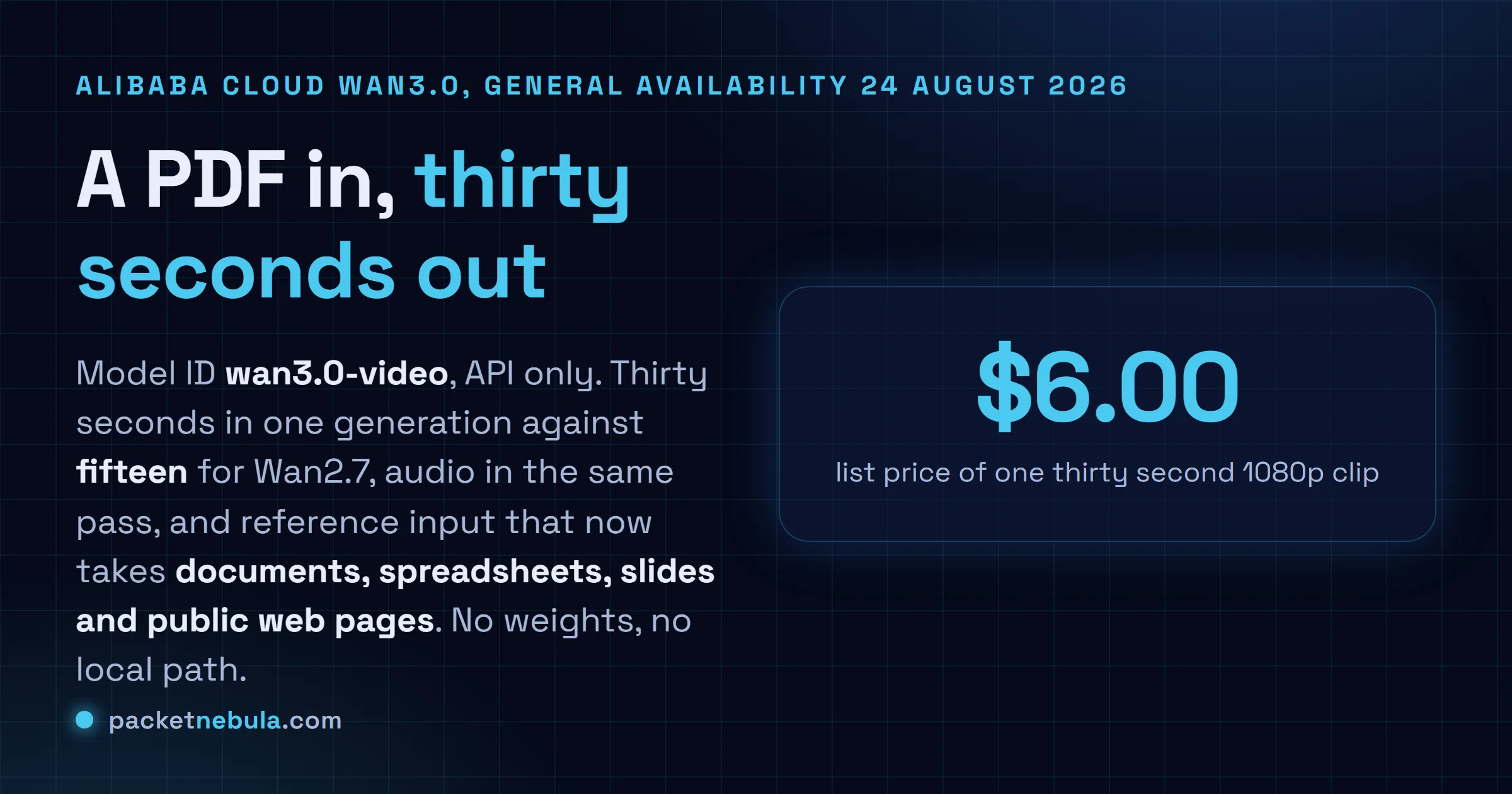
Hand it a PDF and it makes the video. That is the actual headline in Alibaba's Wan3.0 rollout on 24 August, more than the length bump everyone led with. The model takes thirty seconds of output in a single generation now, double what Wan2.7 managed, with audio rendered in the same pass instead of bolted on after. It also accepts a deck, a spreadsheet or a public URL as reference material, so nobody has to sit there translating a slide into a prompt. What it does not do is run on your machine. There are no weights, the price list stops at 1080p, and a thirty second clip there costs six dollars at list.
The short answer
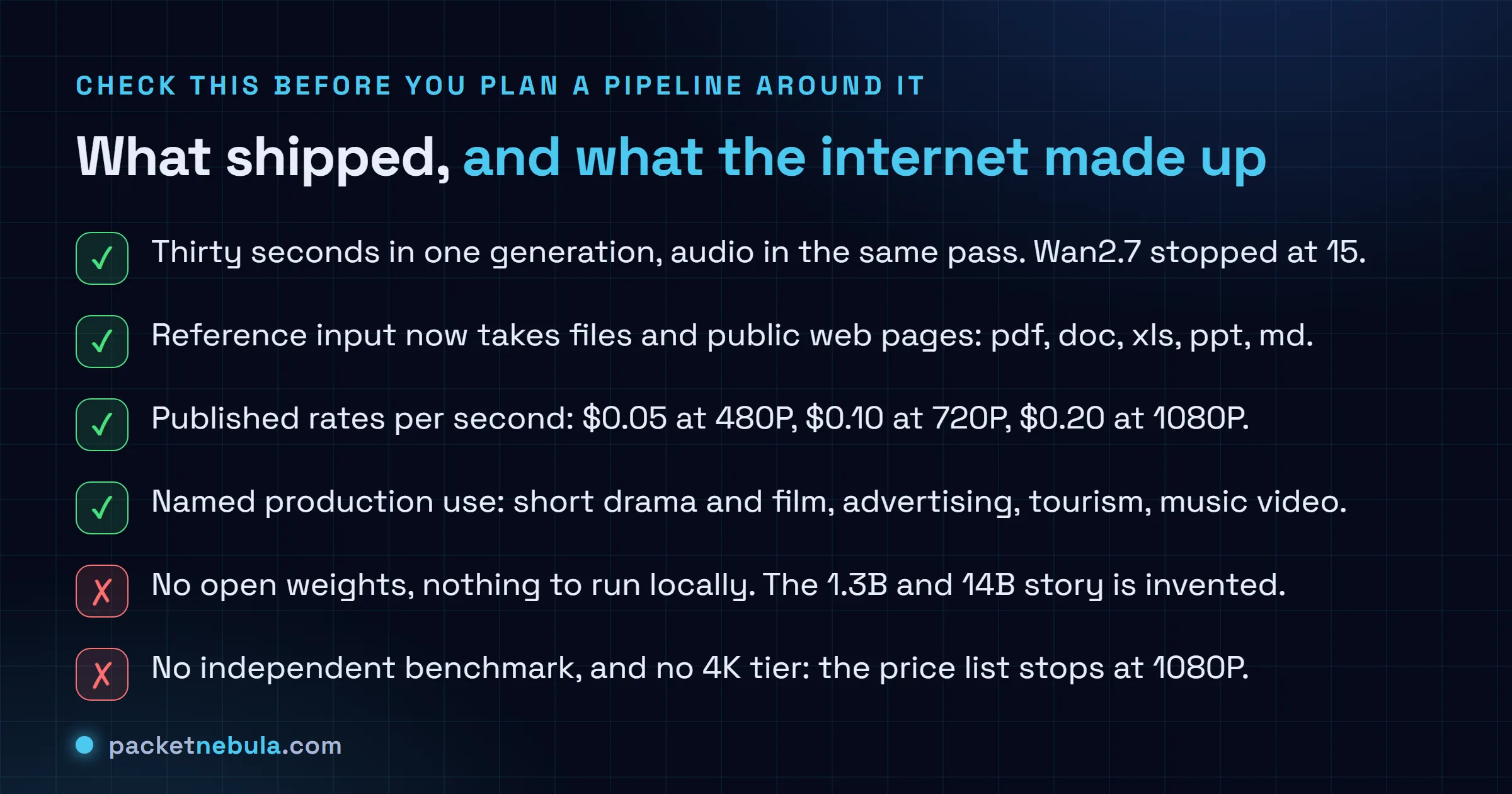
Alibaba Cloud rolled Wan3.0 out on 24 August 2026, after a public beta that opened on 6 August. Model ID wan3.0-video, API only. Thirty seconds of video in one pass against fifteen for Wan2.7, audio rendered alongside it, and reference input that now takes documents, spreadsheets, slides and public web pages. List price is $0.05, $0.10 and $0.20 per generated second at 480P, 720P and 1080P, so about $6 for a thirty second 1080p clip. No open weights, no local path, and no independent benchmark yet.
The file is the prompt now
Every video model in the last two years has taken text, and most take an image for the first frame. Wan3.0 adds a lane nobody else has shipped this plainly: attach the source document and let the model read it.
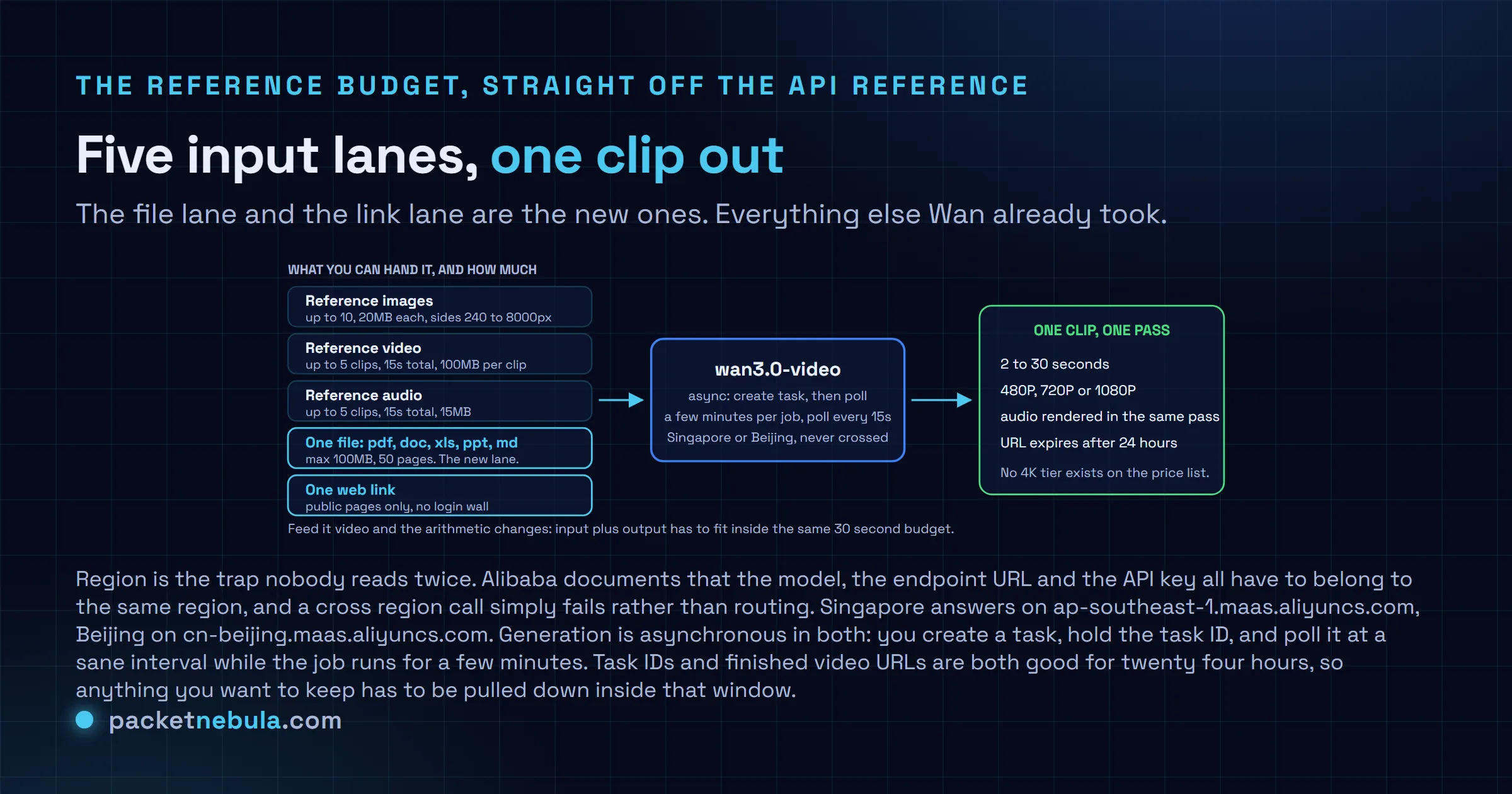
One file per request. Up to 100MB, up to 50 pages, across pdf, doc, xls, ppt, txt, md, plus the Apple formats. Or one public web link, as long as there is no login wall in front of it. Alibaba calls the whole reference system Omni-Reference, which is marketing, but the file lane underneath it is a real workflow change.
Think about what that removes. Today, turning a product one-pager into a thirty second promo means a human reads the one-pager, decides what matters, and writes a prompt that describes a video about it. That translation step is where most of the fidelity leaks out, and it’s the step you repeat forty times when the client changes a number on slide four. Hand the deck over instead and the source of truth stays the source of truth.
I’m not going to pretend we know how well it holds up. Nobody outside Alibaba has published a comparison of prompt-written versus document-fed output. But the shape of the feature is right, and it’s the first one in a while that seems designed by somebody who has watched an agency work.
Thirty seconds matters more than it sounds
Fifteen seconds to thirty is not a spec bump you’d normally write about. Here it is, because of where the failures live.
Anyone who has assembled a longer piece out of short generations knows the drill: clip one has your character, clip two has a cousin of your character, and by clip four the jacket has changed colour. Stitching is where consistency dies. So a model that renders the whole thirty seconds in one pass is not giving you twice the video, it’s giving you a shot that doesn’t need reconciling with itself.
Audio in the same pass belongs to the same argument. Generate video and then align sound to it and you are doing sync work. Generate them together and you are not.
The fine print is worth reading before you plan around it. Without video input you can ask for two to thirty seconds. With video input, the input and the output have to fit inside the same thirty second budget together, so feeding it eight seconds of reference leaves you twenty two. Pass duration: -1 and it picks a length itself.
Do the arithmetic before you commit
$0.20 per generated second at 1080p. That’s $6 for a thirty second clip, $12 a minute, and it’s list price on Model Studio. Beijing quotes 0.30, 0.60 and 1.20 yuan per second for the three tiers, and regional rates drift a bit.
Run that against a real week. Iterating on one thirty second spot, ten takes deep, is $60 in generation before anyone has approved anything. Not ruinous. Not free either, and it’s the kind of number that changes how a team works: you stop re-rolling casually and start drafting at 480P, where the same take costs $1.50, then finishing the chosen one at 1080p. That’s how we’d run it regardless of price. The cheap tier exists for exactly this.
One operational detail that will bite somebody. Alibaba documents that the model, the endpoint URL and the API key all have to belong to the same region, and a cross-region call fails rather than routing. Singapore answers on ap-southeast-1.maas.aliyuncs.com, Beijing on cn-beijing.maas.aliyuncs.com. Generation is asynchronous in both: create a task, hold the task ID, poll it while the job runs for a few minutes. Alibaba suggests a fifteen second polling interval. Task IDs and finished video URLs are good for twenty four hours, so anything worth keeping has to be pulled down inside that window rather than linked to.
The open weights story is not true
This is the part worth being blunt about, because it’s spreading.
There is a claim doing the rounds that Wan 3.0 shipped under Apache 2.0 in two sizes, a 1.3B consumer model that fits in 8GB of VRAM and a 14B professional one that wants 24GB or more. People are planning local pipelines on it. It appears in no Alibaba announcement.
We checked directly rather than trusting the summaries. The Wan-AI organisation on Hugging Face, read on 24 August 2026, has the Wan2.2 family at the top: Wan2.2-Animate-2-14B last modified on 13 August 2026, Wan2.2-Animate-2-14B-Diffusers the day before, and the T2V, I2V and TI2V checkpoints from 2025 below them. No Wan 2.7. No Wan 3.0. The last openly weighted video release from this team is Wan 2.2, and the 1.3B and 14B pairing in the rumour matches the Wan 2.1 lineup rather than anything new.
So if your plan involved running this on a workstation, there is nothing to run. Wan3.0 is a closed model behind an API, and the only question worth asking is whether the API is worth the money.
The 4K claim is the same shape and easier to dismiss. Three price tiers exist, ending at 1080P. A vendor that had 4K would be charging for 4K.
What we’d actually watch for
Two things, and neither is a demo reel.
First, a real benchmark. Wan3.0 hasn’t been independently scored, and any head-to-head published this week is comparing vendor samples against vendor samples. That will change within a few weeks and it’s the only number that would move us. Until then, per-second price is the one honest axis of comparison, and $12 a minute at 1080p is not the cheap end of the market.
Second, whether the document lane survives contact with messy real files. A clean 12-slide deck is not a 50-page PDF with three tables and a scanned appendix, and the page limit suggests Alibaba knows where the edges are.
Worth noting where this landed in the calendar, because it’s not a coincidence. Alibaba priced a HK$80 billion share placement, 710 million new shares at HK$112.70, the day before the rollout, and said the whole net proceeds go into AI. That came a week after quarterly earnings fell 75% year on year on AI capital expenditure. A launch on that particular Monday is a company showing what the money bought.
Alibaba names the production work it’s already being used for: short drama and film, advertising and marketing, tourism promotion, music video creation. Short-form Chinese drama is a genuinely enormous market, and a thirty second single-pass shot is exactly what it eats. That’s a better signal than a benchmark chart, though it isn’t a substitute for one.
If you’re building anything that calls this from a service, check what your outbound endpoint actually resolves to before you debug a region mismatch by hand. Cross-region failures here look like auth failures, and that wastes an afternoon.
Sources
The rollout date, the share placement and the earnings context come from Reuters, published 24 August 2026 as Alibaba launches Wan3.0 AI video model after $10 billion share sale. Model ID, duration rules, resolution and aspect ratio options, the per-input reference limits, the region and endpoint requirement and the polling guidance are read from Alibaba Cloud’s own Wan3.0 Video Generation API Reference on Model Studio. Per-second pricing across the three tiers, the beta date of 6 August and the absence of a 4K tier are from the Wan 3.0 model page at Morphic and the analysis at Kingy AI, which also traces the open weights claim back to its absence from any Alibaba source. The Hugging Face check is ours, run against the Wan-AI organisation on 24 August 2026.
Update, 7 October 2026. Alibaba Cloud labels the $0.05, $0.10 and $0.20 per second figures as list prices with a limited-time 30 percent discount and no end date. Source: Model Studio pricing.
Frequently asked questions
What is Wan 3.0?
Wan3.0 is Alibaba Cloud's video generation model, in public beta since 6 August 2026 and rolled out more widely on 24 August. The API model ID is wan3.0-video. It generates up to thirty seconds of video in a single pass at 480P, 720P or 1080P, renders audio in the same pass, and accepts text, images, video, audio, documents and public web pages as reference input.
How much does Wan 3.0 cost?
Alibaba prices it per generated second rather than per clip: about $0.05 a second at 480P, $0.10 at 720P and $0.20 at 1080P, with the Beijing region quoted in yuan at 0.30, 0.60 and 1.20. That works out at roughly $6 for a full thirty second clip at 1080p, or $12 a minute. Rates vary a little by region and by reseller, so check the console before you budget a batch.
Are the Wan 3.0 weights open source?
No. Wan3.0 is API only, on Alibaba Cloud Model Studio and Qwen Cloud. The claim circulating about an Apache 2.0 release with a 1.3B consumer model and a 14B professional model does not appear in any Alibaba announcement, and no such weights are published. We checked the Wan-AI organisation on Hugging Face on 24 August 2026: the newest published checkpoints there are the Wan2.2 family, with Wan2.2-Animate-2-14B last modified on 13 August 2026.
What does document-to-video actually mean in Wan 3.0?
You attach a file instead of writing a description of it. Alibaba's API reference allows one file per request, up to 100MB and 50 pages, across pdf, doc, xls, ppt, txt, md and the Apple formats, plus one public web link with no login wall. The model parses that material and uses it as reference for the generation, so a product deck or a spec sheet becomes the brief rather than something you have to summarise into a prompt first.
How does Wan 3.0 compare to Wan 2.7?
The clearest difference is length: thirty seconds in a single generation against fifteen for Wan2.7. Document and webpage reference input is new, and Alibaba describes character and layout consistency as holding across the longer runtime. What is missing is measurement. No independent benchmark has scored Wan3.0 yet, so any quality comparison between the two right now rests on vendor demos rather than results.


