Your model bill went up again and nobody on the team can say which feature did it. That's the itch Ramp is scratching. On 19 August it opened Router, the gateway it had been running on its own traffic for three years, to anyone in the US: one OpenAI-compatible endpoint in front of OpenAI, Anthropic, xAI and a pile of open weights, with routing that picks the cheapest model clearing whatever bar you set. Free through the end of 2026, twenty six dollars of model credit thrown in, and a claimed 40 percent off inference. Good deal. It also ships with a default we'd change before sending a single production request, because Router keeps your inputs, outputs and tool calls for a year unless you go and switch that off.
The short answer
Ramp made its internal model gateway public on 19 August. One OpenAI compatible endpoint in front of OpenAI, Anthropic, xAI and a set of open weights, with automatic fallback and four routing strategies. Integration is a base URL change. Free until January, then an unpublished price. The dashboard is the part we’d actually keep. The retention default is the part we’d change first.

One endpoint, one line of config
Router sits in front of the providers and speaks their API back to you. Point an existing SDK at https://api.router.com/v1, leave the rest of the code alone, and Router decides which model actually serves the call. Ramp describes the integration as a base URL change. Reading the docs, that looks honest for anything already talking to a Responses style endpoint.
At launch you get OpenAI, Anthropic and xAI. The press release writes that last one as SpaceXAI, which tells you how fresh the ownership paperwork is. Gemini is listed as coming soon. Open weights cover Kimi, DeepSeek, GLM, Qwen and Nvidia’s, served through Fireworks AI, Google, AWS, Together AI, Baseten and Crusoe.
Four routing strategies ship with it. Flex tier drops you onto a provider’s discounted queue when the measured latency matches the standard one. Shadow models mirror a sample of production requests to a candidate model without changing what your users get back. Benchmark routing lets you name up to three benchmarks, weight them, and have Router rank models against that. Then there’s escalation, which Ramp calls Switchyard after the Nvidia component: cheap models handle the routine steps, hard ones get promoted.
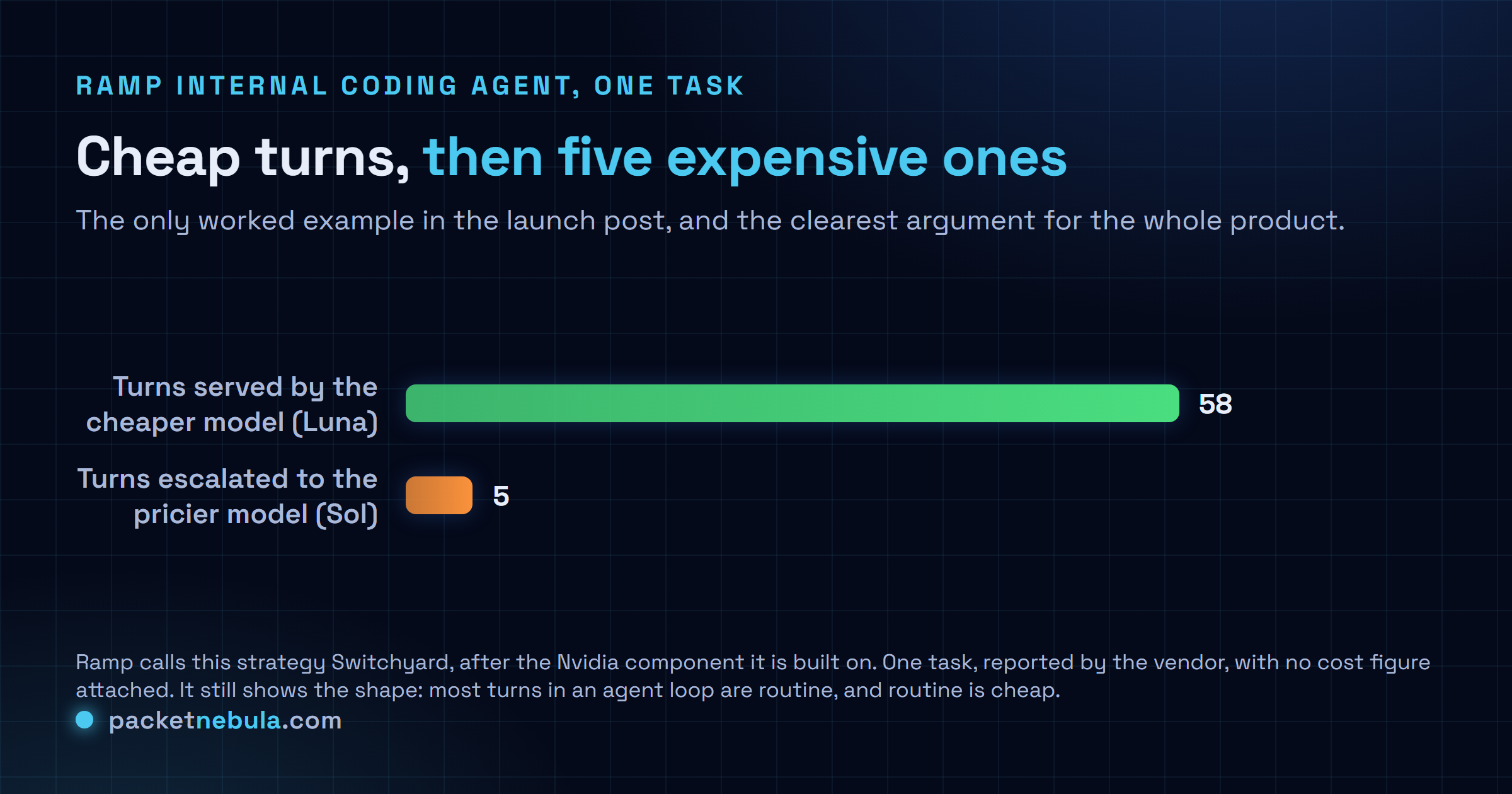
That last strategy carries the only concrete example in the launch post, and it happens to be the useful one. An internal Ramp coding agent ran 58 turns on Luna and escalated only the final 5 to Sol. If your agent loop looks remotely like that, you can see exactly where the money is going. We covered Luna’s 80 percent price cut when it landed, and this is the workload shape that cut was built for.
Image: Ramp

The numbers are all Ramp’s
A 40 percent average saving for customers already on it. Roughly 30 percent off Ramp’s own inference bill for the same output. Better than 99.9 percent reliability across production traffic. More than 100 optimizations spanning model selection, caching, compression, request timing and retry handling. Continuous evaluation against an internal thing called Ramp SWE-Bench.
Every one of those is company reported. No methodology, no dataset, no published eval results. That isn’t an accusation, it’s just an accurate description of the evidence available today. Nobody outside Ramp has reproduced the 40 percent.
Honestly, I don’t think the headline figure matters that much. Sending an agent’s easy turns to a cheap model saves real money whether it comes out at 20 percent or 45. What I’d actually want from day one is the per request view: model, provider, service tier, token counts, latency, cost, fallback attempts. Measure first. The savings argument is downstream of the measurement, and most teams we talk to have neither.
Ramp’s own spending index puts AI as the fastest growing line item across its customer base, up 20.7 times since June 2025. That’s the market being sold into here, and it’s also why a corporate card company built a model router in the first place.
The default we’d change first
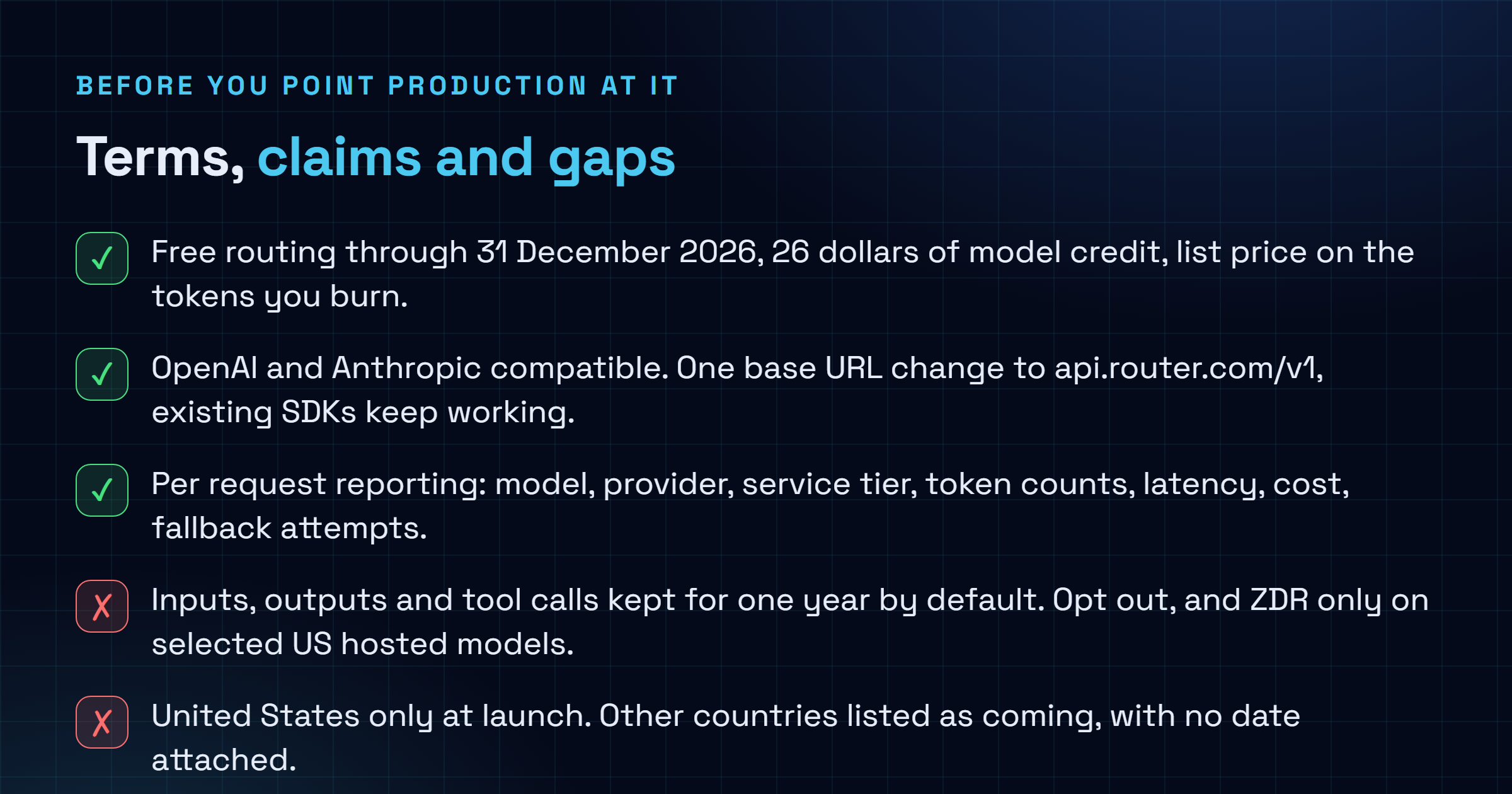
Router records your model inputs, outputs and tool calls for one year. That’s the shipping default. It’s opt out, there’s a zero data retention option on selected US hosted models, and Ramp says it strips personally identifiable information before that content improves the product.
Fine. It’s still a gateway carrying every request you make, and gateways see everything by construction. That’s the same property that makes them useful.
We were writing about retention defaults yesterday from the other direction, and the lesson is identical whichever vendor you’re reading: open the setting, don’t inherit it. Five minutes in the console before the first production call, not after somebody in legal asks.
US only for now, on US infrastructure, with other countries listed as coming.
Free until it isn’t
Free through 2026 means free for a little over four months. What routing costs in January hasn’t been published, and there’s no statement about how existing accounts get treated when the window shuts. Normal launch mechanics. Also a calendar entry.
The timing around it isn’t subtle. Stripe confirmed its roughly 7.5 billion dollar acquisition of OpenRouter on 19 August, and Ramp opened its own router to the public the same week, for nothing. Two payments companies deciding, more or less simultaneously, that the toll booth on token spend is worth owning. Router had been in closed beta since 20 July, so this is a schedule that landed well rather than a reaction.

Would we move production traffic onto it this month? Not in one go. We’d wire it up in shadow mode, let it mirror a slice of real requests for a fortnight, then hold its dashboard against the provider invoices we already trust. If the two agree, switching is a base URL. If they don’t, an afternoon is all you spent finding out.
Sources
Ramp press release, “Ramp Launches Router.com to Cut Companies’ Rising AI Bills” (19 August 2026, official: the 40 percent and 30 percent figures, the 99.9 percent reliability claim, the provider list, the Ramp AI Index number, and the quotes from CTO Rahul Sengottuvelu and Anthropic’s Katelyn Lesse). Ramp’s own launch post (the four routing strategies, the 58 turns on Luna and 5 on Sol escalation example, the free routing window and the 26 dollar credit). router.com and the Router docs (the api.router.com/v1 base URL, OpenAI and Anthropic compatibility, US availability and the zero data retention option). TechCrunch on the launch (independent reporting, and the source for the one year opt out retention default on inputs, outputs and tool calls).
Frequently asked questions
What is Ramp Router?
It is an LLM gateway Ramp opened to the public on 19 August 2026 at router.com, after roughly three years of running it on its own production traffic and a closed beta that started on 20 July. You point an existing OpenAI or Anthropic compatible SDK at https://api.router.com/v1 and Router decides which model actually serves each request, based on cost, latency and whatever quality bar you configure. It also falls back automatically when a provider rate limits you or goes down, and it reports model, provider, service tier, token counts, latency, cost and fallback attempts per request.
How much does Ramp Router cost?
Routing is free through the end of 2026 and new accounts get 26 dollars of model credit. You still pay list price for the tokens you actually consume, billed through Router rather than to each provider. Pricing after 2026 has not been published, and Ramp has not said what the routing fee becomes once the free window closes. Worth a calendar entry if you build on it, because four months is not long.
Which models and providers does Router support?
OpenAI, Anthropic and xAI at launch, with Google Gemini listed as coming soon. Open weight models include Kimi, DeepSeek, GLM, Qwen and Nvidia's. Serving runs through Fireworks AI, Google, AWS, Together AI, Baseten and Crusoe, with more providers promised. Ramp does not train its own models, which is the argument it makes for why the routing is neutral.
Does Ramp Router keep my prompts?
By default, yes. Router records model inputs, outputs and tool calls for one year and uses that content to improve the service, with personally identifiable information stripped first. It is opt out, so you can disable it in the account settings, and a zero data retention option is available on selected US hosted models. The provider's own retention policy still applies underneath whichever model you land on. We would set this before the first production call rather than after.
Are the 40 percent savings independently verified?
No. The 40 percent average customer saving, the roughly 30 percent cut in Ramp's own inference bill, the better than 99.9 percent reliability figure and the internal Ramp SWE-Bench evaluations are all company reported. No methodology, dataset or evaluation results have been published. That does not make them wrong, it just means the only way to know what routing does to your bill is to shadow a slice of your own traffic and compare against the invoices you already have.