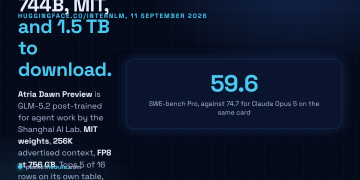





No launch post. No pricing page. On 11 September 2026 a repo called internlm/Atria-Dawn-Preview appeared on Hugging Face, an FP8 twin followed the next morning, and a 185-author paper caught up on arXiv on the 14th. It's the Shanghai Artificial Intelligence Laboratory's agent model, it sits on the 744B GLM-5.2 base, and it's MIT licensed. We've read the card, summed the file list and gone through the benchmark table row by row, because the lab leads with the rows it wins and the rows it loses are the ones you'd actually care about.
The short answer
Atria Dawn Preview is GLM-5.2 post-trained for long agent runs by the Shanghai AI Lab. Weights are MIT, in BF16 (about 1.5 TB) and FP8 (756 GB). The card advertises a 256K context and text input only. On the lab's own 16-row table it takes the top score on five rows, AutomationBench and BrowseComp among them, and lands near the bottom on SWE-bench Pro (59.6 against 74.7 for Claude Opus 5) and Terminal-Bench 2.1 (78.3 against 90.2). There's a hosted API with OpenAI and Anthropic-compatible endpoints, and no published price on its docs page.
What landed on Hugging Face, and what it's built on
The repo was created at 08:27 UTC on 11 September. The FP8 variant, Atria-Dawn-Preview-FP8, went up at 04:01 UTC on the 12th. Both are mirrored on ModelScope. The card describes the model as "a preview version of a new-generation agentic model" built on "the 744B-parameter MoE GLM-5.2 foundation model", aimed at work that needs "continuous environmental understanding, tool use, and multi-step task completion". The four buckets the lab lists are discovery (research and evidence gathering), creation (software and data work), delivery (turning inputs into reports and decks) and security analysis in authorised environments. Chinese and English are the declared languages.
The config file agrees with the "same base" claim. Architecture GlmMoeDsaForCausalLM, 78 layers, 256 routed experts plus one shared, 8 experts active per token, a 6,144 hidden size and a 154,880-token vocabulary. That's GLM-5.2's shape. Honestly, the parameter count is one place we'd hedge: the card says 744B, and when we covered GLM-5.3 and its predecessor we'd seen 753B quoted for the same base. Same model, two roundings, we think. The active count isn't stated anywhere on the card.
Context is the other number to read carefully. The card and the API docs both say 256K. The config's max_position_embeddings says 1,048,576. Those aren't in conflict, exactly. The positional table goes to 1M because GLM-5.2's does, and the lab is advertising the window it tested at. If you self-host and push past 256K, you're on your own.
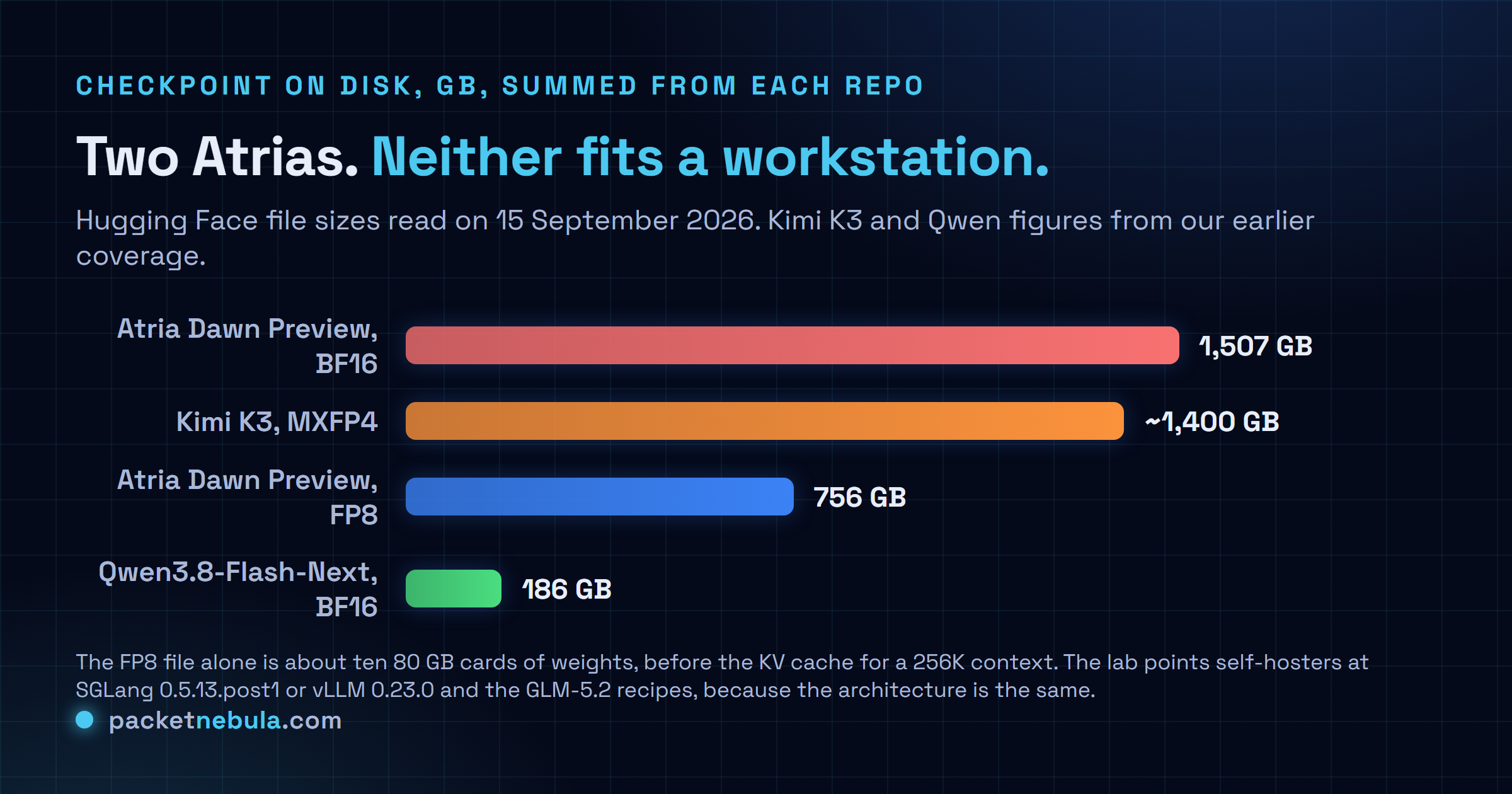
On disk, the BF16 repo is 364 files totalling 1,507 GB. The FP8 repo is 756 GB. For scale, that puts the full-precision build a hair above the 1.4 TB Kimi K3 drop we wrote about in July, and the FP8 build at roughly ten 80 GB accelerators of weights before a single token of KV cache. MIT is the licence for both code and weights, no territory carve-outs, no usage tiers, which after this summer's run of open-weight releases with conditions attached is worth stating plainly.
Reading the benchmark table from both ends
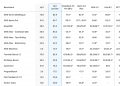
The card compares Atria Dawn Preview against six models: DeepSeek V4 Pro 0813, Kimi K3, Qwen 3.8 Max, GLM 5.3, GPT 5.6 sol and Claude Opus 5. Sixteen rows. The paper's abstract says "the highest reported score on five of them", and we count the same five on the card: AutomationBench (53.8 against 49.7 for Qwen 3.8 Max and 49.4 for Opus 5), BFCL v4 (77.0 against 74.1 for GLM 5.3), CyberGym (86.5 against 84.5), DeepSearchQA (96.0 against 95.9 for Kimi K3) and BrowseComp (92.5 against 92.2 for GPT 5.6 sol). Two of those margins are a tenth of a point. Workspace-Bench-Lite and SkillsBench have it within a point or two of the top without leading.
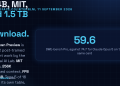
Then the other end. SWE-bench Pro at 59.6, above only DeepSeek V4 Pro's 58.3 in that column and fifteen points behind Opus 5's 74.7. Terminal-Bench 2.1 at 78.3, where Qwen 3.8 Max posts 89.3 and Opus 5 90.2. JobBench 50.3 against 68.0. GDPval 1583 against 1768. The τ³-Bench Banking row is 41.2, bottom of the seven. So the shape is clear enough: strong on browsing and on tool-calling protocol, middling on the coding benches everyone actually quotes. That's not a criticism of the lab's framing, they built it for research loops and office deliverables and the rows say so. It's a warning against reading "top on five" as "frontier coding model".
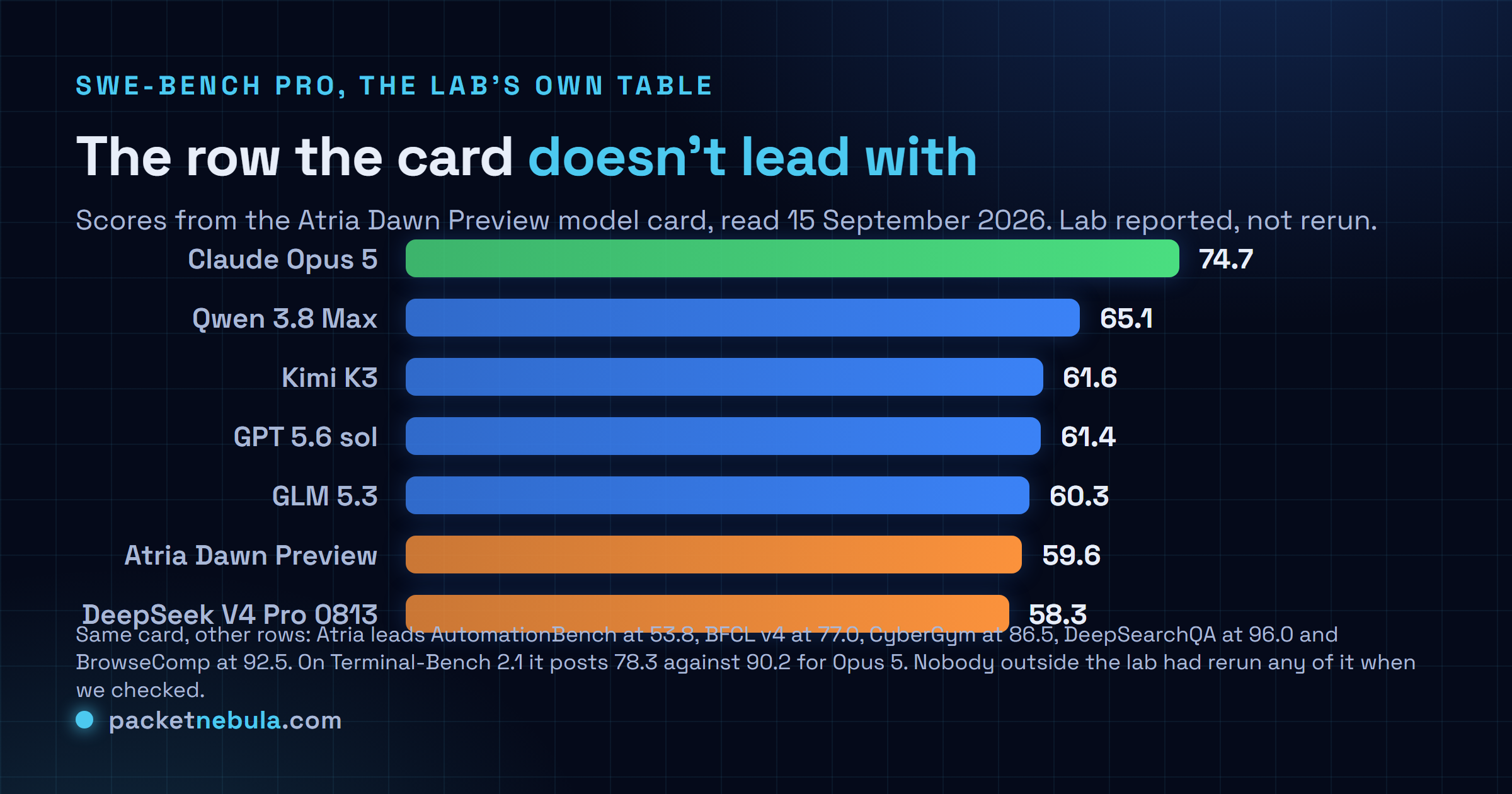
Every figure above is lab-reported. The arXiv paper (2609.15818, submitted 14 September, 185 authors) describes a "Verifiable Experience Pipeline" tying tool interactions to executable environments and externally checked outcomes, and a human study of 769 task records from 56 participants where about a third of AI-assisted tasks were rated infeasible without the model. Interesting, and not the same as an independent rerun. When we looked on 15 September there was no third-party evaluation entry we'd trust. Give it a week or two.
Running it, or calling it
Self-hosting goes through the GLM-5.2 path, because the architecture is the GLM-5.2 architecture. The card names SGLang v0.5.13.post1 or later and vLLM v0.23.0 or later, and points at the existing GLM-5.2 cookbook and recipes rather than anything Atria-specific. Pull the FP8 build unless you have a very good reason not to:
huggingface-cli download internlm/Atria-Dawn-Preview-FP8 --local-dir atria-dawn-fp8
That's 756 GB, so budget the disk and the afternoon. The hosted route is api.atria-asi.ai for international users and a separate China endpoint. The docs list three interfaces on one key: /v1/chat/completions, an Anthropic-style /v1/messages, and an OpenAI-style /v1/responses. Model name Atria-Dawn-Preview, 256K context, output capped at 65,536 tokens. What the docs don't list is a price. There's a console for "cost observation", and no rate card we could find on 15 September. One aggregator was listing the model at $0 in and $0 out through a third-party provider, labelled as a free preview. We wouldn't plan a budget around that lasting.
Two integration notes matter if you're going to drop it into an agent harness. It's text only. The endpoint rejects images with a 400 that reads Atria-Dawn-Preview is not a multimodal model, so the card ships a Codex CLI catalog file (Codex 0.154.0 or later) that declares input_modalities as text and strips attachments client-side, and a Python PreToolUse hook for Claude Code that blocks the Read tool on PDFs and images. Both are workarounds for the same gap. If your workflow leans on screenshots, this isn't your model yet, and I'd guess the non-preview release is where that changes.
Sources
Shanghai Artificial Intelligence Laboratory, Atria-Dawn-Preview model card, Hugging Face, created 11 September 2026 (the GLM-5.2 base and 744B figure, the 256K context, the MIT licence, the full benchmark table, the SGLang and vLLM versions, the Codex and Claude Code integration notes, the text-only 400 message). Hugging Face API, repo metadata and the config.json, read 15 September 2026 (creation timestamps, the 364-file 1,507 GB and 756 GB sums, the 78 layers, 256 experts, 8 active and 1,048,576 positions). Guo, Gui, Chen et al., Atria Dawn: The Dawn of Agentic Superintelligence, arXiv, 14 September 2026 (the 16 benchmarks and five top scores, the Verifiable Experience Pipeline, the 769-record human study). Atria, API documentation, read 15 September 2026 (the three interfaces, the 65,536 output cap, the absence of a rate card). ZenMux, atria-dawn-preview listing, read 15 September 2026 (the $0 preview pricing through a third-party provider). The Kimi K3 and GLM-5.2 figures are from our own July and August coverage.
Frequently asked questions
What is Atria Dawn Preview?
An agent-oriented language model from the Shanghai Artificial Intelligence Laboratory, published on Hugging Face on 11 September 2026 under the InternLM organisation. It's a post-training of the 744B mixture-of-experts GLM-5.2 base, tuned for long tool-using runs: research, code, report generation and similar multi-step work. It's labelled a preview, and the lab hasn't said when a final version follows.
Is Atria Dawn Preview open source, and what's the licence?
The weights and code are released under the MIT licence, with no regional exclusions or usage tiers on the card. Two checkpoints exist: BF16 at about 1.5 TB across 364 files, and FP8 at about 756 GB. Both are on Hugging Face and ModelScope. Training data and the training pipeline itself aren't published, so "open weights" is the accurate phrase.
How much does the Atria API cost?
As of 15 September 2026 the official docs at api.atria-asi.ai list the endpoints and limits but no per-token price. The docs mention a console for cost observation. One aggregator was relaying the model at $0 per million tokens in both directions through a third-party provider, described as a free preview. Treat any price you see as provisional until the lab publishes one.
How does Atria Dawn Preview compare with Claude Opus 5 or GPT 5.6?
On the lab's own table it beats both on AutomationBench, BrowseComp and BFCL v4, and trails both by a wide margin on SWE-bench Pro (59.6 against 74.7 for Opus 5 and 61.4 for GPT 5.6 sol) and Terminal-Bench 2.1 (78.3 against 90.2 and 85.1). All numbers are reported by the lab and had not been independently rerun when we checked.
Can Atria Dawn Preview take images or PDFs?
No. The model is text only, and the hosted endpoint returns a 400 error for image input. The model card provides a Codex CLI catalog file that declares text-only input modalities and a Claude Code PreToolUse hook that blocks reads of image and PDF files, so that agent harnesses don't send attachments the model can't use.