




On Wednesday DeepSeek told its API users that V4 Pro had four days left. On Thursday it didn't. In between, on 10 September 2026, the company shipped DeepSeek-V4.1-Flash, a 552B mixture of experts with a new encoder-decoder layout, native image input and MIT weights, and renamed the endpoint to deepseek-flash. We've spent two days reading the pricing page and the change log against the model card, because they don't quite agree, and the disagreements are the useful part.
The short answer
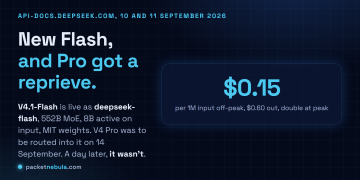
DeepSeek-V4.1-Flash is live as deepseek-flash at $0.15 per million input tokens and $0.60 output off-peak, double that at peak, with cache hits at $0.003. The old deepseek-v4-flash and deepseek-v4-flash-vision-exp names are retired and temporarily route to it. On 10 September DeepSeek said every deepseek-v4-pro call would be routed to V4.1-Flash from 14 September at Flash rates. On 11 September the pricing page and change log gained a footnote saying V4 Pro stays on the API after 14 September with billing unchanged, in response to user demand. The launch post still carries the original sentence.
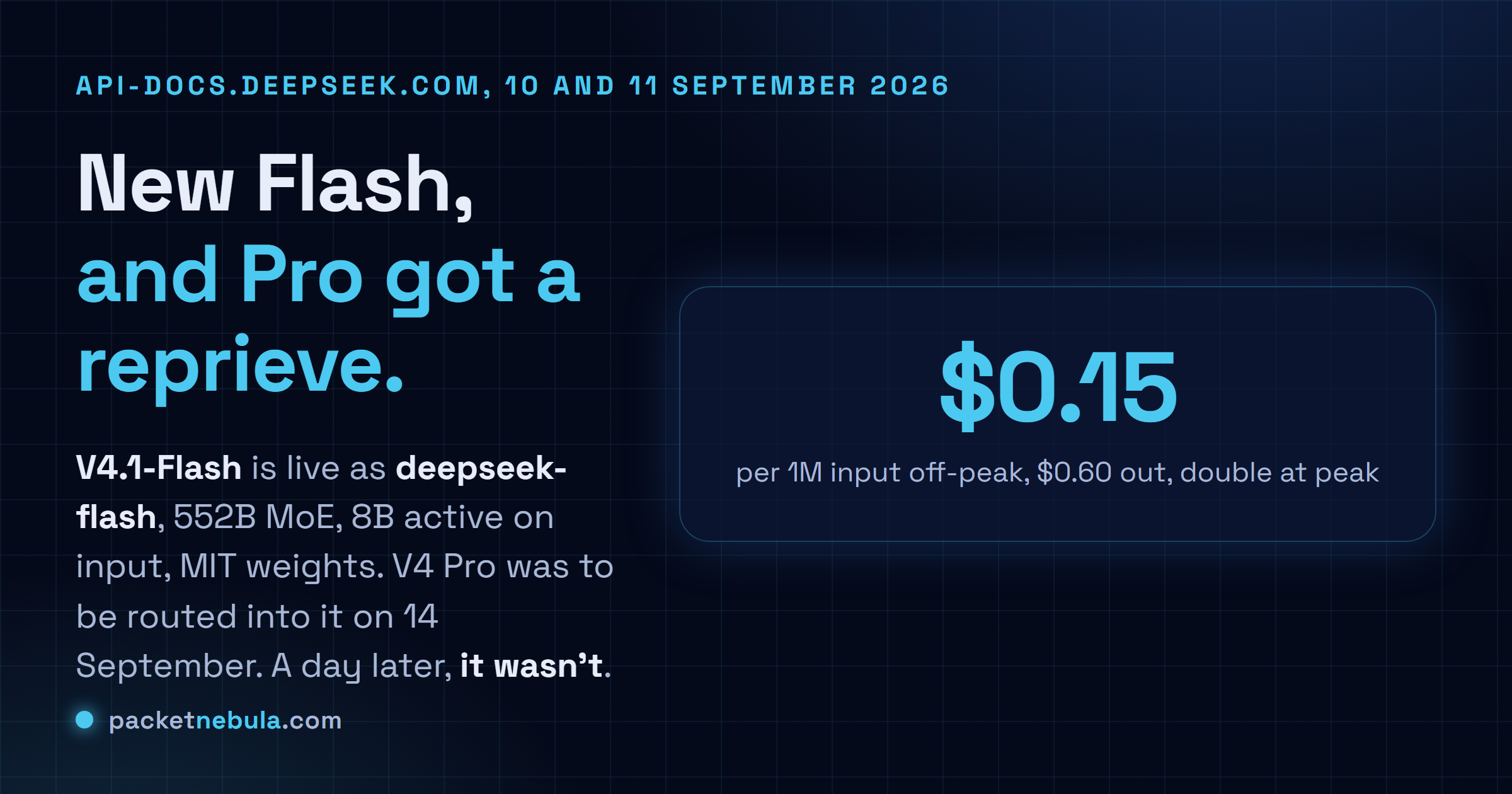
What shipped, and what your model name does now
The architecture is the actual news, and it's a real change rather than another re-post-training. V4.1-Flash is a 40 layer Transformer split into a 20 layer causal encoder and a 20 layer decoder. The decoder's global KV cache is projected from the encoder's final hidden states instead of being built layer by layer, which is how DeepSeek gets to 8B active parameters per token on prefill and 16B on decode, out of a 552B backbone. There's a 196B Engram conditional memory on top of that, plus a vision encoder trained from scratch, so the Hugging Face checkpoint reports 763B parameters in total and weighs about 510 GB across 88 files, most of it already in 8 bit. The card lists 384 routed experts per layer with 6 active, 45T training tokens, a 1M context, and a reasoning effort setting the card describes as an integer from 1 to 100, where the V4 API offered low, high and max. Weights are MIT, ungated, with vLLM and SGLang recipes.
On the API side, the name changed. Set model to deepseek-flash. The two previous names still work, but the models behind them are gone, and DeepSeek's own word for the routing is "temporarily". If you were on the vision experimental model from the Flash line we tracked through July, you're now on a different model with a different price and you didn't opt in, which has happened on this API more than once this year already. A minimal call looks like this:
curl https://api.deepseek.com/chat/completions -H "Authorization: Bearer $DEEPSEEK_API_KEY" -H "Content-Type: application/json" -d '{"model":"deepseek-flash","messages":[{"role":"user","content":"Which model are you?"}]}'
Vision is native on deepseek-flash and not supported on deepseek-v4-pro, per the pricing page's feature matrix. Both keep the 1M context and the 384K output ceiling. Concurrency caps are unchanged: 2,500 for Flash, 500 for Pro.
A price cut, unless you remember July
DeepSeek's launch post says the new architecture lets it serve more users for less and that it's passing the savings on. That's true against last week. Off-peak, V4.1-Flash costs $0.003 per million tokens on a cache hit, $0.15 on a miss and $0.60 on output. V4 Flash, since the peak and off-peak split arrived on 16 August, cost $0.007, $0.22 and $0.66 in the same slots. So input dropped by about a third and output by 9%. Peak hours, which are 01:00 to 04:00 and 06:00 to 10:00 UTC on weekdays, cost exactly double: $0.006, $0.30 and $1.20.
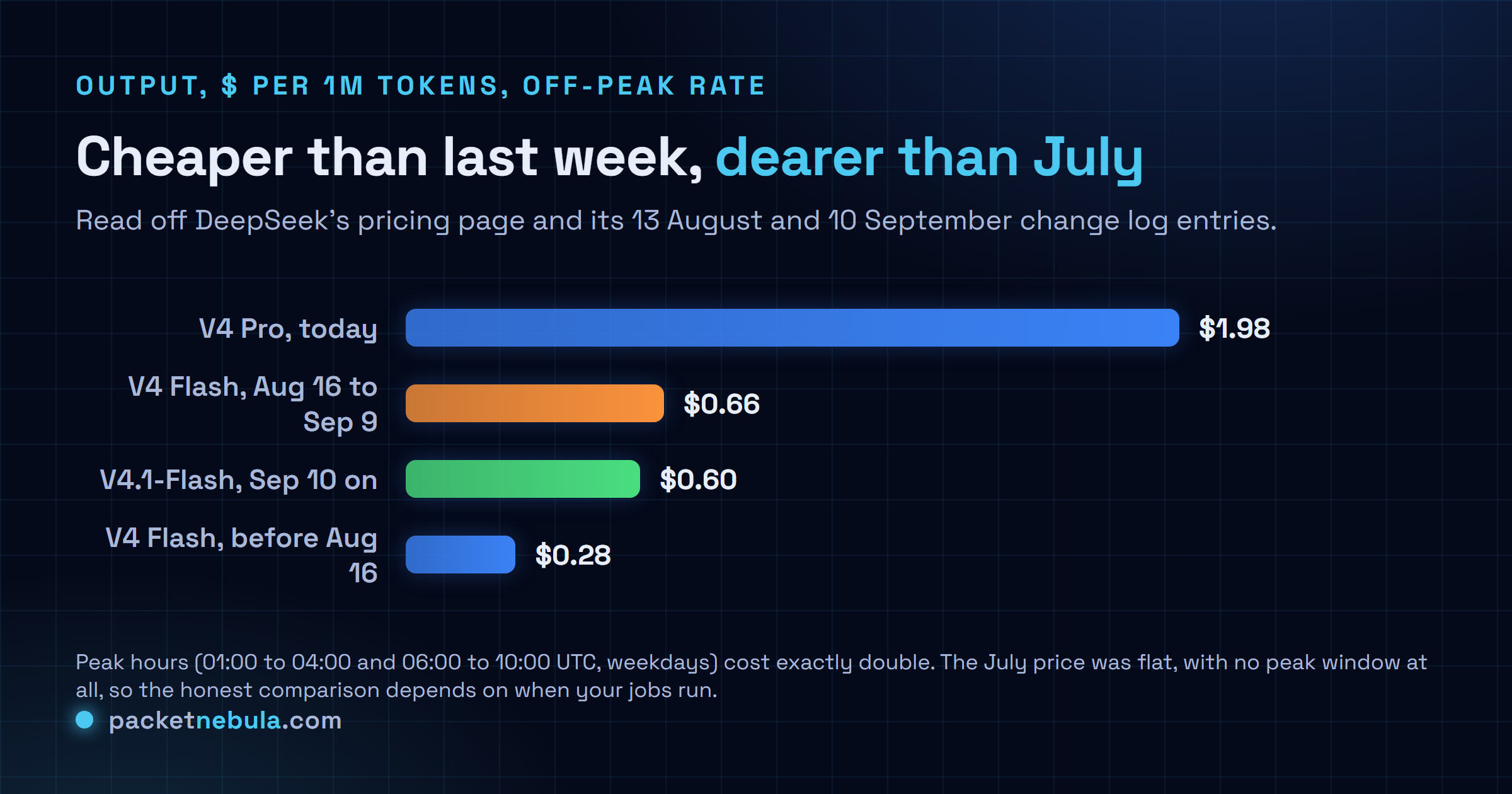
Now go back one more step. Until 16 August, V4 Flash was a flat $0.0028, $0.14 and $0.28, no peak window at all. Against that, the shiny new model is dearer on every line, and more than double on output even at the discounted hours. Put it on the workload we used in July, an agent loop pushing 10 million input and 2 million output tokens a day with 90% of the input hitting cache. On the July rates that was about $0.73 a day. On V4.1-Flash off-peak it's $0.15 for the misses, roughly $0.03 for the hits and $1.20 for output, so $1.38. Run it at peak and you're at $2.75. That's our arithmetic on published rates, not a DeepSeek figure, and it's the number I'd want in front of anyone who reads "lower API prices" in the announcement.
The part that may actually save you money isn't on the price list. The global KV cache is down to 890 bytes per token, about a quarter of V4 Flash, and the persistent cache footprint on disk is about an eighth. DeepSeek says cache hit charges are often a large share of agent costs and that compressing the cache is what let it cut them. If you self-host, that's a straight HBM saving. If you use the API, it's the reason the cache hit price is $0.003 rather than $0.007, and it only pays off if your prefix is stable enough to hit. Check your hit rate before you check anything else.
Pro was retired on Wednesday and un-retired on Thursday
The launch post is blunt. Tests by multiple parties, it says, put V4.1-Flash ahead of V4 Pro on performance, cost, speed and total runtime, so "we're phasing out V4-Pro", and from 04:00 UTC on 14 September every deepseek-v4-pro request would be routed to V4.1-Flash at Flash rates until a V4.1-Pro launches. Trade press ran it as the flagship being killed. Then, on 11 September, footnote two on the pricing page and a new paragraph in the change log said that in response to user demand DeepSeek will keep serving V4 Pro after 14 September with billing unchanged, and will give notice of any future change. As we write this, the news page still shows the routing sentence. Nobody has edited it.
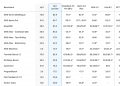
Why the demand? Look at the rows where Flash doesn't win. On DeepSeek's own table V4.1-Flash beats V4 Pro 0813 across the agentic block: 90.6 against 87.9 on Terminal-Bench 2.1, 74.2 against 62.7 on DeepSWE v1.1, 31.2 against 12.4 on Terminal-Bench 4.0. But Pro still leads on GPQA Diamond, 92.4 to 90.9, and on the text-only slice of HLE, 42.7 to 39.1. A 16B-active decoder is a brilliant coding agent and a slightly worse encyclopaedia, which is roughly what you'd predict. Someone with a knowledge-heavy workload asked to keep paying $1.98 a million for the bigger brain, and DeepSeek said fine.
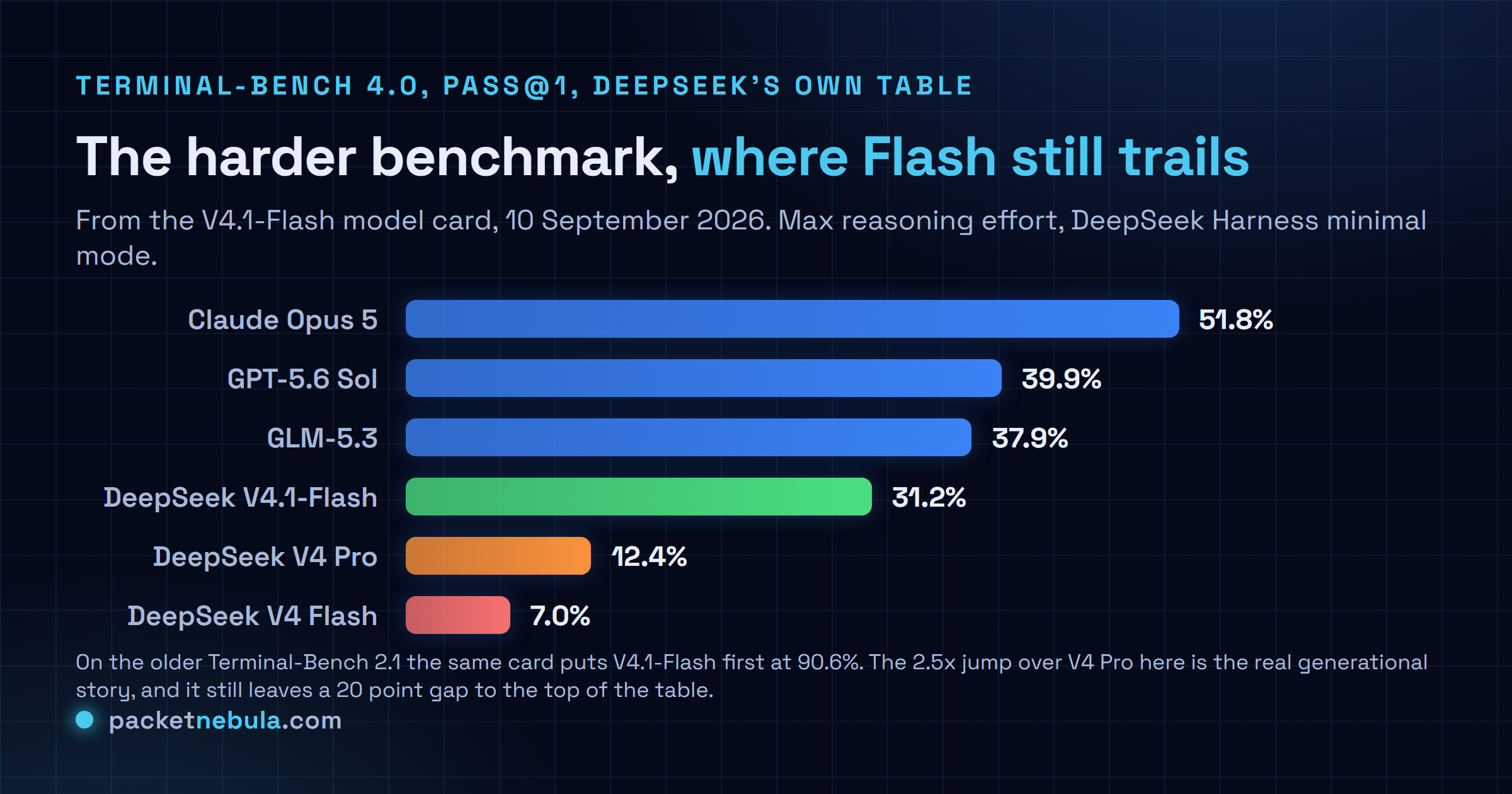
Two cautions on those scores, both printed by DeepSeek itself. Everything was run at the maximum effort setting, and the code agent rows use DeepSeek Harness in minimal mode, which the card says produced 90.6 on Terminal-Bench 2.1 where Claude Code got 88.0 and Codex 84.1 with the same model. Your harness picks your number. And the table that puts Flash at 74.2 on DeepSWE, a hair over Claude Opus 5 at 74.0, also puts it at 31.2 on Terminal-Bench 4.0 against 51.8. Both rows are honest. Only one of them will be quoted.
What we'd do this week: if you're on Pro for coding agents, try deepseek-flash on the calls that hurt, because the table says it's better there at a third of the output price. If you're on Pro for anything that leans on world knowledge, stay, and put a calendar note on the wording "we will provide further notice". Honestly, I read the one-day reversal as a good sign, a vendor that listens, but I might be wrong about how long it holds. A company that planned to route its flagship into a cheaper model on four days' notice can plan it again, and the notice period is the thing to watch, not the model.
Sources
DeepSeek, DeepSeek-V4.1-Flash: Smarter, Faster, More Efficient, 10 September 2026 (architecture summary, the deepseek-flash name, the KV cache ratios, the 14 September routing statement, the pricing effective date). DeepSeek, Models & Pricing, read 12 September 2026 (the full peak and off-peak table, the feature matrix, concurrency limits, and footnote two on V4 Pro continuing after 14 September). DeepSeek, API change log, entries of 13 August, 21 August and 10 September 2026 (the 16 August peak and off-peak switch, the vision experimental model, the reversal paragraph). DeepSeek, DeepSeek-V4.1-Flash model card on Hugging Face, 10 September 2026 (the benchmark table, the harness comparison, the MIT licence, the parameter counts, and the 510 GB repository size from its file listing). PANews, DeepSeek V4 Pro API Call Service Will Not Be Discontinued, 11 September 2026 (independent timing of the reversal). VentureBeat, DeepSeek-V4.1-Flash debuts with $0.003/1M off-peak cached-input rate, 10 September 2026 (independent confirmation of the pricing and the original Pro routing plan). The pre-16 August prices are from our own July and August coverage of the pricing page. The daily cost figures are our arithmetic on the published rates.
Frequently asked questions
What is DeepSeek-V4.1-Flash?
DeepSeek's first model on a new architecture, released on 10 September 2026. It's a 552B parameter mixture of experts built as a 20 layer causal encoder followed by a 20 layer decoder, which lets it activate 8B parameters per token on input and 16B on output. It takes images natively, has a 1M token context, and the weights are on Hugging Face under the MIT licence. DeepSeek calls it the smallest model in the new family, which implies larger ones are coming.
How much does DeepSeek V4.1-Flash cost?
Per million tokens, off-peak: $0.003 on a cache hit, $0.15 on a cache miss and $0.60 for output. Peak hours, 01:00 to 04:00 and 06:00 to 10:00 UTC on weekdays, cost exactly double. That's lower than the V4 Flash rate in force since 16 August ($0.22 in, $0.66 out off-peak) and higher than the flat $0.14 and $0.28 V4 Flash cost before that date.
Is DeepSeek V4 Pro being discontinued?
Not any more. The 10 September launch post said all deepseek-v4-pro requests would be routed to V4.1-Flash at Flash rates from 04:00 UTC on 14 September until a V4.1-Pro launched. On 11 September DeepSeek added a note to its pricing page and change log saying it will continue to serve V4 Pro after 14 September with billing unchanged, in response to user demand, and will give further notice of any change. The launch post hasn't been updated to match.
Do I need to change my code for deepseek-flash?
Eventually, yes. The new model name is deepseek-flash. The old names deepseek-v4-flash and deepseek-v4-flash-vision-exp still resolve, but DeepSeek describes that routing as temporary and the models behind them are retired, so anything still using them is already talking to V4.1-Flash at V4.1-Flash prices. Change the string now and re-run your evals, because the model behind it changed on 10 September whether you did or not.
Can I run DeepSeek-V4.1-Flash locally?
The weights are MIT licensed and ungated, and the model card ships vLLM and SGLang commands. The repository is about 510 GB across 88 files, mostly stored in 8 bit, and the card recommends a 1M context with at least 256K output tokens, so this is a multi-GPU server job rather than a workstation one. The 890 byte per token KV cache is the part that makes long contexts tractable at all.