
• Latest
  • Trending
  • All
Answer card stating that Anthropic opened a research preview of the Model Hardware Standard on 27 August 2026, standardising the driver layer between an operating system and a laboratory instrument with read and write primitives plus discovery and safety limits, reachable through MCP as well as a command line and code files, with no public specification published.

Anthropic’s Model Hardware Standard is gated, and sits under MCP

3 September 2026
Answer card stating that Ternary Bonsai 2 27B, released by PrismML on 17 September 2026 under Apache 2.0, packs Qwen3.8 27B into 5.95 gigabytes at 1.72 bits per weight, keeps 98.2 percent of the 14-benchmark average, about 75 percent on SWE-bench Verified and Terminal-Bench 2.1, and needs PrismML's llama.cpp fork to run.

Does Bonsai 2 27B really keep 98% of Qwen3.8 in 5.95 GB?

20 September 2026
Answer card stating that Jev 1.13 from TypeSafe AI is a decision model in early access since 15 September 2026 that returns typed probabilities instead of text, priced at 42 dollars per billion input tokens with output tokens free, answering in 70 to 500 milliseconds, with a 64K token request budget, text input only, and a documented list of things it does badly, including counting and dates.

Jev 1.13 bills $42 a billion tokens, and it can’t count

19 September 2026
Answer card stating that Qwen3.8-Omni-Flash launched on 17 September 2026 as an API only model on Alibaba Cloud Model Studio, taking text, images, audio and video in a 1M token context and returning text only, priced at 0.15 dollars per million input tokens for every modality and 0.47 dollars per million output tokens in the international regions, with no open weights published and the Qwen-Live Harness GitHub repository returning 404.

Qwen3.8-Omni-Flash bills audio at $0.15 and ships no weights

18 September 2026
Answer card stating that on 15 September 2026 AWS said it is unable to restore access to resources and data hosted exclusively in the Middle East Bahrain region me-south-1 and in the mec1-az2 zone of the UAE region, because the damage spanned multiple Availability Zones and exceeded what multi-AZ services are designed to withstand.

AWS can’t restore me-south-1, six months after the drone strikes

17 September 2026
Answer card stating that Google released Gemini 3.8 Live and Gemini 3.8 Live Extended Thinking on 15 September 2026 at 3 dollars per million audio input tokens and 12 dollars out, that the thinking model requires asynchronous tools, and that Artificial Analysis scores it 82.6 on its Speech to Speech Quality Index.

Gemini 3.8 Live Extended Thinking rejects any tool that blocks

16 September 2026
Answer card summarising the Atria Dawn Preview release: 744B GLM-5.2 base, MIT licence, 1.5 TB BF16 and 756 GB FP8 checkpoints, 256K context, top on five of sixteen benchmark rows and trailing on SWE-bench Pro.

Atria Dawn Preview is 744B under MIT, and the BF16 weighs 1.5 TB

15 September 2026
Answer card stating that OpenAI released the Agents API in public beta on 10 September 2026 with no separate fee, billed through model tokens, tool calls and hosted sandbox time, with a choice of OpenAI hosted, self hosted or partner sandboxes, US only data residency and no Zero Data Retention support.

OpenAI’s Agents API has no fee, no ZDR and a one hour sandbox clock

14 September 2026
Answer card: Sakana Fugu Max at $2 and $6 per million tokens, Fugu Ultra v2 unchanged at $5 and $30, and Sakana saying Ultra v2 scores without Fable 5 or GPT-6 Astra in its pool.

Fugu Max costs $2 and $6 while Fugu Ultra v2 runs without Fable 5

13 September 2026
Answer card stating that DeepSeek released DeepSeek-V4.1-Flash on 10 September 2026 as a 552 billion parameter mixture of experts model with a new causal encoder decoder architecture that activates 8 billion parameters on input and 16 billion on output, with native vision, a one million token context and MIT licensed weights, that the API model name is now deepseek-flash at 0.15 dollars per million input tokens and 0.60 dollars per million output tokens off peak, and that DeepSeek announced V4 Pro would be routed to V4.1-Flash from 14 September and reversed that on 11 September.

DeepSeek V4.1-Flash arrived, and the V4 Pro retirement lasted a day

12 September 2026
Answer card stating that Cognition released SWE-2 on 10 September 2026, a coding model post-trained from Kimi K3, scoring 50.0 percent on FrontierCode 1.1 Main against 50.9 percent for Claude Fable 5.1 and 27.3 percent on Terminal-Bench 4 against 55.8 percent, available only inside Devin.

SWE-2 trails Fable 5.1 by one point, and by 28 on Terminal-Bench 4

11 September 2026
Answer card for Meta Muse, free to 100 million tokens a week then $20 a month, launched 8 September 2026 for United States adults only, running in a dedicated per user virtual machine.

Does Meta Muse do enough to earn your inbox and a card on file?

9 September 2026
Answer card stating that the public download pages for the VMware Virtual Disk Development Kit on developer.broadcom.com began returning 404 errors on 25 August 2026 with no announcement or deprecation notice, that Broadcom support tells customers the kit is no longer available for use or download, and that release lines 7.0.3.1, 8.x and 9.x are all affected.

Broadcom pulled VDDK 8.0 and 9.0, and the 404 is the only notice

8 September 2026
  • About
  • Contact
  • Privacy
  • Legal
Sunday, September 20, 2026
  • Login
Packet Nebula
  • Home
  • Articles
    • Security
    • Network
    • Dev
    • Sysadmin
    • SEO
    • Email & DNS
  • Tools
    • Network tools: free, fast, no signup
    • Security tools: free, fast, no signup
    • Developer tools: free, fast, no signup
    • Sysadmin tools: free, fast, no signup
    • SEO tools: free, fast, no signup
    • Email & DNS tools: free, fast, no signup
  • Download
  • About
No Result
View All Result
Packet Nebula
No Result
View All Result
Home Dev

Anthropic’s Model Hardware Standard is gated, and sits under MCP

by stephane
3 September 2026
in Dev
0
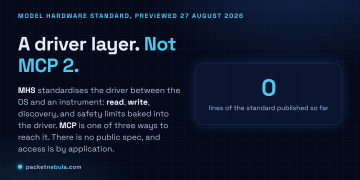
Answer card stating that Anthropic opened a research preview of the Model Hardware Standard on 27 August 2026, standardising the driver layer between an operating system and a laboratory instrument with read and write primitives plus discovery and safety limits, reachable through MCP as well as a command line and code files, with no public specification published.
500
SHARES
1.4k
VIEWS
Share on FacebookShare on Twitter

Every lab we have ever worked near keeps the same drawer of vendor software. Seven programs, seven serial protocols, nothing that talks to anything else. Anthropic opened a research preview of the Model Hardware Standard on 27 August 2026, and MHS is the swing at making that drawer go away: one driver format per device, exposing read and write plus network discovery, so an agent can find a microscope or a liquid handler and drive it. Two things the headlines got wrong. It is not a rival to MCP. It sits underneath, and MCP is one of three ways to reach it. And you cannot have it yet. No spec, no repo, no reference driver. There is an application form.

The short answer

Anthropic wants one driver format for microscopes and robot arms, with safety limits living in the driver instead of a prompt. The idea is good and the partner numbers are striking. You still cannot build against it, because nothing has been published.
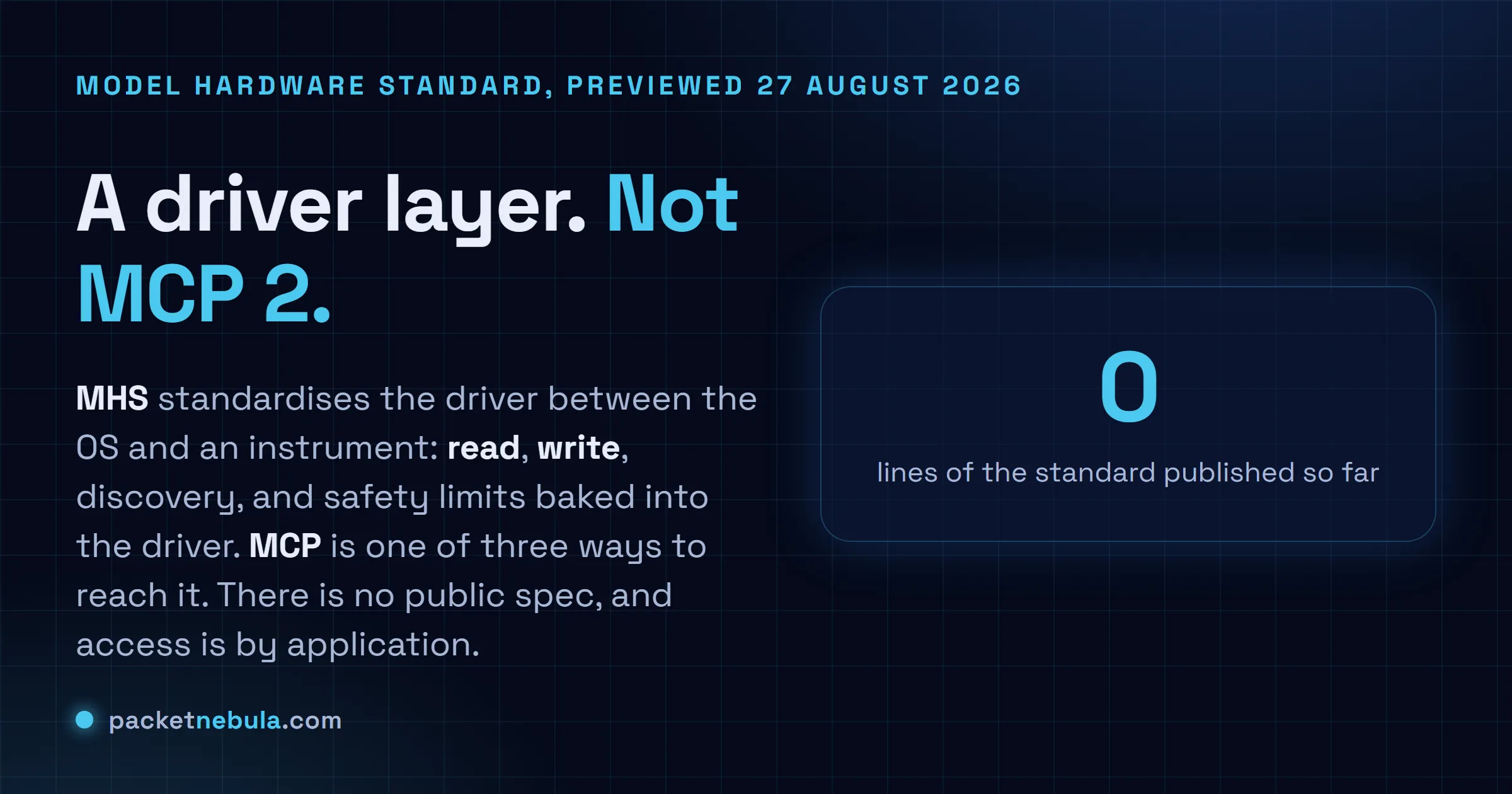
27 AugMHS research preview opened
read/writethe whole primitive set, plus discovery
gatedapplication form, no spec published
Answer card stating that Anthropic opened a research preview of the Model Hardware Standard on 27 August 2026, standardising the driver layer between an operating system and a laboratory instrument with read and write primitives plus network discovery and a generated reference file carrying safety limits, reachable through the Model Context Protocol as well as a command line and code files, model agnostic, gated behind an application form with no public specification and no date for open sourcing.
What was announced, and the bit the headlines skipped.

What MHS actually standardises

A driver. That is the whole trick, and it is smaller than the announcement makes it sound.

Today a robotic arm speaks whatever its manufacturer decided in 2014, a microscope ships a Windows program with a scripting tab, and gluing them into one experiment means somebody writes serial glue for a fortnight. MHS says: give each device a driver that exposes the same tiny surface. Read, as in get temperature. Write, as in set temperature. Plus discovery, so devices and agents can find each other across a network in a standard format.

Then the interesting bit. The driver carries natural-language tags, which compile into a reference file the agent reads before it touches anything. That file says what the device can measure, what is adjustable, and where the safety limits are. Physical facts too, like how much a given arm weighs.

Which means the guardrail is in the driver, not the system prompt. Honestly, that is the design decision I would defend if I only got to keep one. Prompt-level safety is per-agent and evaporates the moment somebody swaps harnesses. A limit compiled into the driver applies to every caller, including the one you did not anticipate.
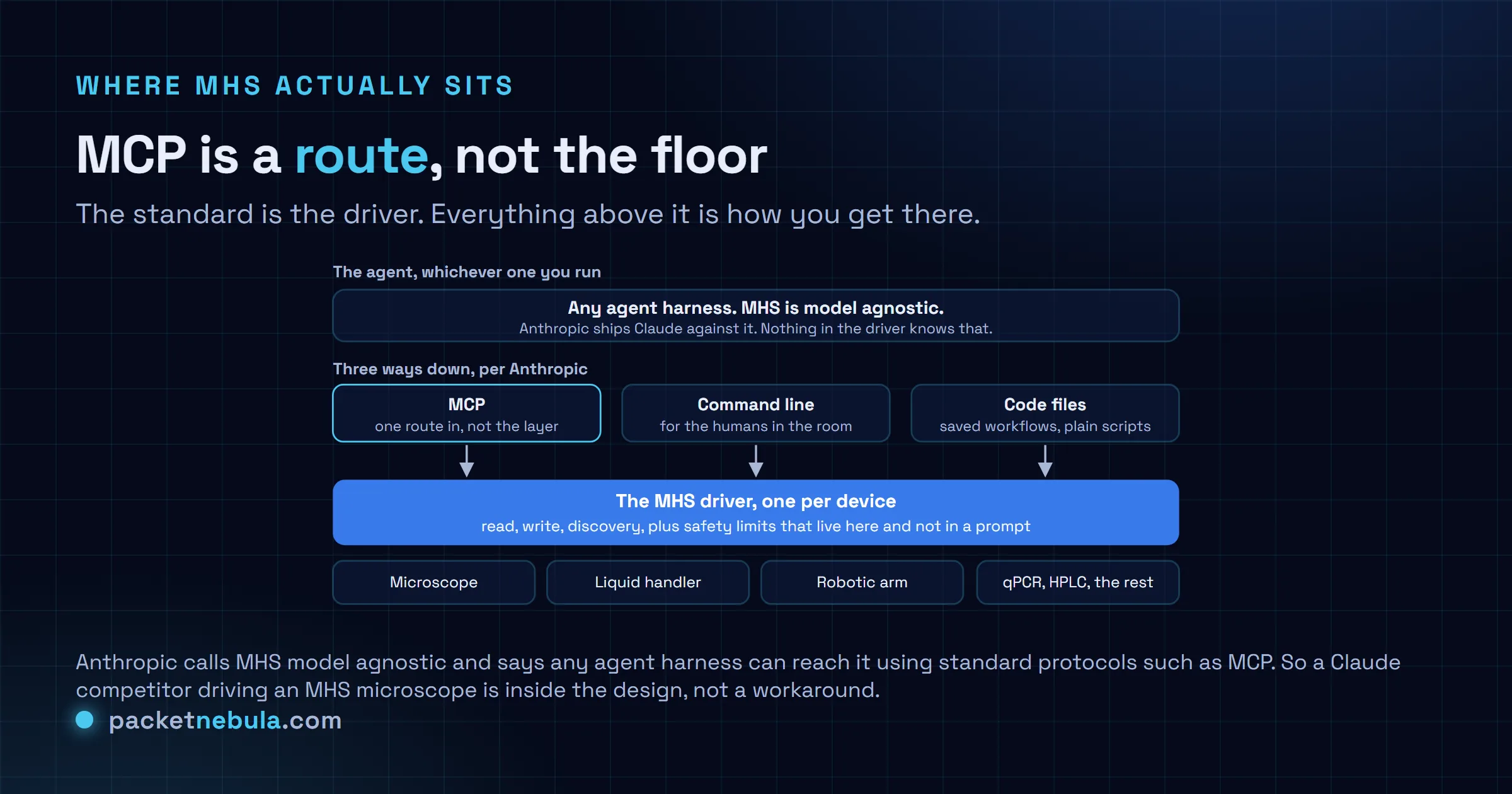
Layer diagram showing an agent harness at the top, then the three routes Anthropic names for reaching a device, MCP and a command line and code files, all pointing down into a single MHS driver per device exposing read, write, discovery and enforced safety limits, with a row of instruments beneath: microscope, liquid handler, robotic arm, and the qPCR and HPLC machines named by the University of Washington team.
MHS is the driver layer. MCP is one way in, which is not how most of the coverage put it.

The MCP comparison is doing damage

Plenty of write-ups framed this as Anthropic doing for hardware what it did for software. Fair enough as a slogan. It is wrong as architecture.

MCP is a protocol between an agent and a tool server. MHS is a device driver contract underneath that. Anthropic’s own text names three ways to orchestrate a device: MCP, a command line, and code files. If you already run an MCP server or two, MHS does not replace them. It gives them something consistent to sit on top of, roughly the way WebMCP gave ChatGPT’s Site tools a defined surface inside a browser instead of a pile of button-guessing.

So the honest one-liner is duller than the headline. MHS standardises the boring layer nobody wants to own.

The numbers, and who counted them

QuEra Computing gives the loudest one. A laser relock routine on its neutral-atom hardware, previously handled by a bespoke script that worked 58 percent of the time and burned 150 seconds an attempt, hit a 99.3 percent success rate across 700 trials under MHS, recovering in under six seconds for easy disturbances and 10 to 14 seconds for hard ones.

Carnegie Mellon reports going from raw equipment to a finished dose-response protocol in eight hours, against the several weeks a vendor integration usually eats, and running the experiments about three times faster. A University of Washington group connected six instruments in under a week. Janelia collapsed a microscopy workflow from seven separate vendor programs into one dashboard click.

Every one of those came from a preview partner, and none of them ship a methodology. I would not put any of it in a business case yet.

The number I trust most is the failure. At Genentech, Claude tuned an automated protein assay to roughly 140 microlitres a second for water and 10 for a protein solution, then bubbles formed and it could not tell a physical problem from a software bug. Anthropic says this out loud: Claude learns the physical world through text and images, so its spatial reasoning has limits that still need expert oversight. Good. A standard that pretends otherwise would be worse than no standard.

What you can do with this today

Nothing, and I want to be blunt about it because the coverage was not.

There is no specification document. No reference driver, no repository, no schema for the reference file. modelhardwarestandard.com is a landing page with an application form for organisations in science, robotics and manufacturing. Anthropic says it will open source the standard once preview partners have helped build safety evaluations, and it has published no date for that.
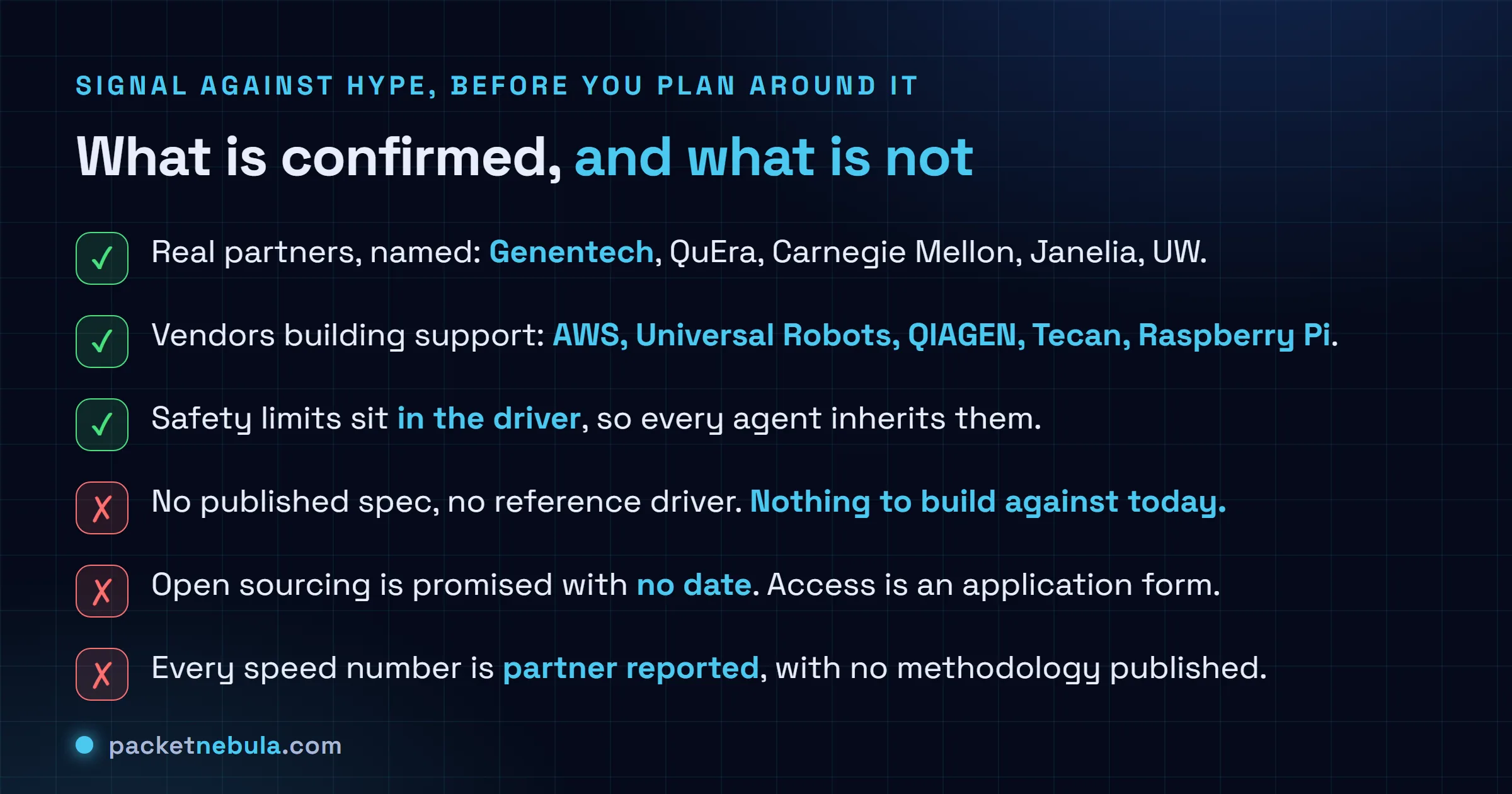
Checklist separating what the Model Hardware Standard research preview confirms, including named partners such as Genentech and QuEra and Carnegie Mellon, vendors building support including AWS and Universal Robots and Raspberry Pi, and safety limits encoded in the driver, from what it withholds, including any published specification or reference driver, an open-sourcing date, and methodology behind the partner-reported performance numbers.
Worth tracking. Not worth planning a quarter around.

If you run anything with a programmable control surface, the vendor list is the signal to watch. Universal Robots and Doosan on arms, QIAGEN and Tecan on lab kit, AWS on the agent side, and Raspberry Pi sitting there for whoever wants to prototype a driver on a 60 dollar board once the spec exists. A standard nobody implements is a blog post. That list is the closest thing to evidence that this one might not be.

We will pick it up again when there is a file to read. Until then it is a good idea with a waiting list.

Sources

The announcement and the partner results are from Anthropic’s Previewing the Model Hardware Standard post of 27 August 2026, plus the application page at modelhardwarestandard.com. Independent coverage and the driver-level detail were cross-checked against The Decoder and MarkTechPost. For the protocol layer above it, see our notes on the MCP roadmap after the 2026-07-28 spec.

Frequently asked questions

What is the Model Hardware Standard?

MHS is a shared specification, previewed by Anthropic on 27 August 2026, for letting AI agents discover and operate physical equipment. Each device gets an MHS driver that translates between the operating system and the hardware using a small primitive set: read (get temperature), write (set temperature) and discovery across a network. The driver also carries natural-language tags that compile into a reference file describing what a device measures, what can be adjusted, and which safety limits get enforced.

Does MHS replace the Model Context Protocol?

No, and this is the part most coverage flattened. Anthropic lists three ways to drive an MHS device: MCP, a command line, and code files. MCP is one route into the layer, not the layer itself. MHS is also described as model agnostic, so any agent harness can reach it through standard protocols. Think of MHS as the driver and MCP as one of the doors, rather than as MCP version two for robots.

Can I download the spec or a driver today?

Not as of 31 August 2026. There is no published specification, no reference implementation and no repository. modelhardwarestandard.com is an application form for a gated research preview, open to organisations in science, robotics and manufacturing. Anthropic says it intends to open source the standard after building safety evaluations with preview partners, but it has attached no date to that.

Who is already building on it?

Anthropic names research partners including Genentech, QuEra Computing, Carnegie Mellon, HHMI Janelia Research Campus, Tetsuwan Scientific and two University of Washington labs. On the vendor side it lists Amazon Web Services with Strands Robots, Automata, Danaher, Doosan Robotics, MBF Bioscience, QIAGEN, Tecan, Universal Robots, Hugging Face and Raspberry Pi. The Raspberry Pi entry is the one worth watching if you want to prototype cheaply once the spec lands.

How good are the performance numbers Anthropic published?

They are partner-reported, with no methodology paper behind them. QuEra says a laser relock task went from a bespoke script succeeding 58 percent of the time at 150 seconds per attempt to a 99.3 percent success rate over 700 trials. Carnegie Mellon reports eight hours of driver work against several weeks for a vendor setup. Treat those as vendor case studies until somebody outside the preview reproduces them.

Tags: agentsaianthropicmcpnewsrobotics
Share200Tweet125
stephane

stephane

  • Trending
  • Comments
  • Latest
Answer card: Proton Lumo 2.0 is private by policy, not by locality. Saved history is locked so even Proton cannot read it, but the prompt is decrypted on a Proton EU server to answer it, then forgotten.

Proton Lumo 2.0 review: how private is it, really?

3 September 2026
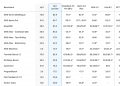
The Agentic Coding section of the official Hy4 preview benchmark appendix published by Tencent, a table comparing Hy3 and Hy4 preview against DeepSeek V4 Pro 0813, Qwen 3.8 Max, GLM 5.3, Kimi K3, GPT 5.6 Sol and Claude Opus 5 across SWE-bench Multilingual, SWE-bench Pro, DeepSWE, three SWE Atlas tasks, SWE-Marathon, Terminal-Bench 2.1, NL2Repo-Bench, CyberGym, ProgramBench, PostTrainBench and Harbor-Index.

Tencent’s 770B Hy4 tops one benchmark row in 46

3 September 2026
Answer card: Qwen 3.7 Max is API-only and cannot run locally yet; the open Qwen models (Qwen 3.6 27B, qwen3:8b to 32b) run offline via Ollama.

Qwen 3.7 local: what you can actually run offline

22 June 2026
Answer card: JWTs are not encrypted, anyone can read them; the signature proves who issued the token, not who may read it.

Are JWTs encrypted? No, and the difference will bite you

0
Answer card: a random 8 character password falls in under 2 hours offline, while 16 random characters hold for 1.4 trillion years at the same speed.

How long does it take to crack a password in 2026?

0
Answer card: three DNS records decide if your mail lands or bounces; SPF lists allowed senders, DKIM signs messages, DMARC sets the failure policy.

SPF, DKIM and DMARC explained: the records your email needs

0
Answer card stating that Ternary Bonsai 2 27B, released by PrismML on 17 September 2026 under Apache 2.0, packs Qwen3.8 27B into 5.95 gigabytes at 1.72 bits per weight, keeps 98.2 percent of the 14-benchmark average, about 75 percent on SWE-bench Verified and Terminal-Bench 2.1, and needs PrismML's llama.cpp fork to run.

Does Bonsai 2 27B really keep 98% of Qwen3.8 in 5.95 GB?

20 September 2026
Answer card stating that Jev 1.13 from TypeSafe AI is a decision model in early access since 15 September 2026 that returns typed probabilities instead of text, priced at 42 dollars per billion input tokens with output tokens free, answering in 70 to 500 milliseconds, with a 64K token request budget, text input only, and a documented list of things it does badly, including counting and dates.

Jev 1.13 bills $42 a billion tokens, and it can’t count

19 September 2026
Answer card stating that Qwen3.8-Omni-Flash launched on 17 September 2026 as an API only model on Alibaba Cloud Model Studio, taking text, images, audio and video in a 1M token context and returning text only, priced at 0.15 dollars per million input tokens for every modality and 0.47 dollars per million output tokens in the international regions, with no open weights published and the Qwen-Live Harness GitHub repository returning 404.

Qwen3.8-Omni-Flash bills audio at $0.15 and ships no weights

18 September 2026
  • About
  • Contact
  • Privacy
  • Legal

Copyright © 2026 Stephane Cardon.

Welcome Back!

Login to your account below

Forgotten Password?

Retrieve your password

Please enter your username or email address to reset your password.

Log In
No Result
View All Result
  • Home
  • Articles
    • Security
    • Network
    • Dev
    • Sysadmin
    • SEO
    • Email & DNS
  • Tools
    • Network tools: free, fast, no signup
    • Security tools: free, fast, no signup
    • Developer tools: free, fast, no signup
    • Sysadmin tools: free, fast, no signup
    • SEO tools: free, fast, no signup
    • Email & DNS tools: free, fast, no signup
  • Download
  • About

Copyright © 2026 Stephane Cardon.